Can West Ham United bounce back from Relegation?

Past history has shown that we always come back very quickly. But will it be the same this time?

West Ham have a long history of bouncing back from relegation. I have followed the club since 1958 and I have witnessed us drop out of the top flight six times. Since dropping down in 1978, 1989, 1992, 2003, 2011 and now 2026, the club has generally responded well to the challenge of life in the second tier. In fact, with the exception of the period following the 1978 relegation, we have never spent more than two seasons outside the top division before earning promotion again, and in 1978 we only spent three seasons away, and those were three of the most exciting seasons that I remember.

The first major test came after relegation in 1978. The Hammers started life in the Second Division impressively, a whirlwind start opening the season with a 5-2 victory over Notts County and we followed this up with a smart 3-0 away win at Newcastle United to top the league. Joy turned to gloom, however, with two home defeats in four days and we never again topped the league that season. The first two games suggested an immediate return was possible, and we remained in promotion contention in the top five for much of the campaign. However, a poor run towards the end of the season, four wins in the last sixteen and just one win in the final seven games saw us finish fifth and miss out on promotion.

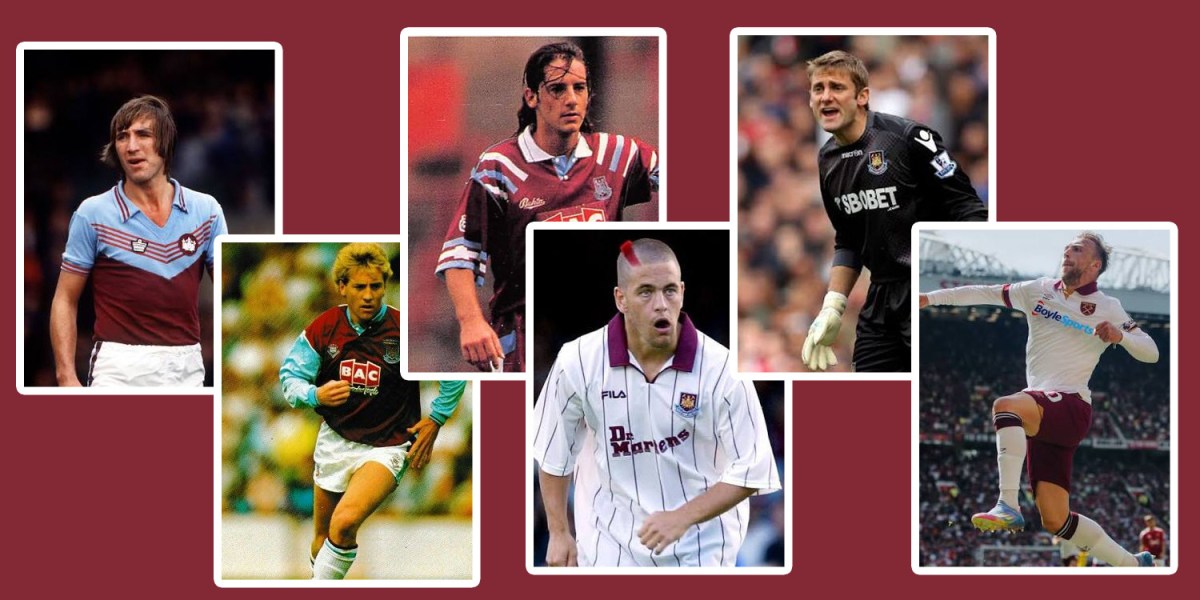
The following season brought one of the most memorable achievements in the club’s history, as we won the FA Cup despite still being outside the top-flight. However, league form was inconsistent and incredibly we only finished seventh. How was this possible with players of the calibre of Parkes, Stewart, Lampard, Martin, Bonds, Brooking, Devonshire, Holland, Neighbour, Cross and Pearson?

After a narrow 1-0 defeat against Liverpool in the Charity Shield at the start of the 1980-81 season we disappointingly lost the opening league game at home to Luton Town. From there we went on an amazing unbeaten run winning fourteen and drawing three games before a defeat in mid-November to Luton Town again! By then we were at the top and never relinquished the top spot finally securing promotion in the record-breaking season which saw us win 28 and draw 10 of our 42 games. 66 points (just 2 points for a win then) would have been 94 points in the modern three points for a win times. It meant that it took the club three seasons to regain top-flight status.

When we were relegated again in 1989, the response was less convincing initially. The club experienced managerial upheaval and were mid-table for much of the season under Lou Macari. We eventually finished only seventh in our first season back in the Second Division. However, under Billy Bonds we produced a much stronger campaign in 1990-91. The team went unbeaten in the opening 21 league matches and built our promotion challenge on a strong defensive record. Early results in the first four games included draws against Middlesbrough and Portsmouth before wins over Watford and Leicester City. That consistency helped us win 24 and draw 15 of our 46 fixtures amassing 87 points to finish second (behind champions Oldham!) and secure promotion back to the top after two seasons away.

The 1992 relegation produced a much faster recovery. We won our opening match at Barnsley but then suffered defeats against Charlton Athletic and Newcastle United. Rather than derailing their campaign, those setbacks appeared to galvanise the side. Billy Bonds’ team quickly found momentum and produced several emphatic victories, including a 5-1 win at Bristol City and a 6-0 home victory over Sunderland. By the end of the season, we had finished runners-up with 26 wins and 10 draws and returned to the top flight which was now the FA Premiership at the first attempt with 88 points in second place behind Newcastle. We needed to beat Cambridge in the final game of the season to ensure automatic promotion and achieved this with second half goals from David Speedie and Clive Allen.

Perhaps the most frustrating recovery attempt came after the club’s relegation in 2003. Despite possessing considerable talent and expectations of an immediate return, West Ham were unable to secure promotion straight away. The season began positively with a victory over Preston North End, but inconsistency soon followed. Manager Glenn Roeder departed early in the campaign and the club eventually reached the play-off final, where we were beaten by Crystal Palace. Promotion finally arrived in 2005 under Alan Pardew, meaning West Ham spent two seasons outside the Premier League.

The 2011 relegation is perhaps the most relevant comparison to the current situation. With Sam Allardyce appointed as manager and a squad that retained significant Premier League quality, West Ham entered the Championship as one of the favourites for promotion. However, the campaign did not begin perfectly. The Hammers lost their opening game 1-0 at home to Cardiff City before responding strongly with victories over Doncaster Rovers, Watford and Nottingham Forest. Although we narrowly missed automatic promotion, we eventually secured a return to the Premier League by winning the play-offs and defeating Blackpool at Wembley.

The 2026-27 Championship campaign presents a fresh challenge. We remain one of the largest clubs in the division with massive support, the biggest stadium, and continue to possess players with top-flight experience. But are we good enough? These are the players who took us down. We’ve lost two talented players but received top dollar for them. We could do without the boardroom turmoil which doesn’t help. We could do with an injection of some talented new players. The evidence of pre-season games doesn’t fill me with great enthusiasm for our prospects for an immediate return. But I accept pre-season games can be deceptive.

The Championship is notoriously unpredictable over a 46-game season. We are clear favourites with the bookmakers to win the league and earn promotion but relegated Premier League clubs often dominate the early betting because of parachute payments and assumed squad strength. However, the league’s competitiveness regularly produces surprises, and I certainly would not risk my money on a swift return.

Looking across the past five completed relegation cycles, a clear pattern emerges. West Ham have usually responded positively to relegation, earning promotion within one or two seasons on four occasions. Only the aftermath of the 1978 relegation resulted in a longer stay outside the top-flight, but that was just three seasons and what seasons they were once we got accustomed to the level. That record provides grounds for optimism that the latest setback will prove temporary, even if history also shows that promotion is rarely as straightforward as we supporters hope that it will be.

It’s A West Ham Scorcher: Seven Minute Sunny Spell Triggers Soaring Expectations

As West Ham progress through to the second round of the Carabao cup, there is a danger of being seduced by an emphatic scoreline that was not as flattering as it looks.

A wise man once proclaimed, “the truth of the battle is whatever the victor deems it to be.’ I’m not sure who it was, but probably some Chinese fella such as Master Po from the 1970’s Kung Fu TV series. In this spirit, significant swaths of the West Ham commentariat have deemed to interpret Saturday’s ‘comfortable’ 3 – 1 win against Portsmouth as an omen of a glorious Championship season to come. I fear this might be somewhat premature.

The reality of the performance was quite different. Although a pre-season friendly feel still hung in the air, the familiar fragile foibles of last season continued to haunt the London Stadium. A slow start, giving away possession, an inability to play through the lines, stilted movement, and a general lack of adventure. A repeat showing next weekend will result in a very unhappy return trip from East Lancashire.

Let’s remember that Portsmouth are a very average Championship side. They finished 18th last season and will most likely be in and around the lower reaches once more this time around. They looked tidy in possession but with (fortunately) little cutting edge. How and why were they able to dominate so completely for the first 40 minutes of the game is perplexing. Before the Hammers grabbed the equaliser, I believe they were trending at 65% possession.

In his post-match comments, Nuno praised the movement and combinations on show for each of the West Ham goals. But where had those attributes been hiding prior to the seven-minute goal blitz. A period where the best on offer were spells of pointless passing across the back – followed by hopeful punts up field once other options had been exhausted.

When Nuno is interviewed after games, he will frequently suggest that the way we play week in, week out is not what he wants. He is delighted by those brief moments where the team discovers its swaggers, where passing and movement spring to life, and confidence on the ball spreads through the team. Why then, do the players find it so difficult to deliver what he says he wants – and what, we must assume, he prepares them for? Do they not understand the instructions, are they scared to take any risks, is there no leadership on the pitch? How can the same plan fail in the same way with such monotonous regularity?

And what caused the sudden change of heart for those seven glorious minutes? The shock of going a goal behind? Or had someone spiked the hydration break water bottles with shots of concentrated Carabao Raspberry energy burst?

The idea of West Ham as runaway league leaders of the Championship built upon limited possession, scoring on the break, and lengthy periods of defensive game management seems highly implausible. A speculative long shot even though my knowledge of the breadth and depth of quality in the Championship is largely unknown. I just don’t see a quick return to the top level in prospect without a significant boost to the squad’s resources over the remaining days of the transfer window.

It is never ideal to leave most of your transfer business until after the season has started but it is a habit that has proven hard to break. The players yet to leave may be just as important as the new recruits as the club endeavours to manage its shaky finance, comply with the new squad ratio rules and buy a new drive belt for the broken fax machine. As a minimum, I expect we are hoping to offload the attitudes and costs of all three of Todibo, AWB and Fullkrug before the end of the month. Incomings must then address the most pressing gaps in what remains a dangerously sketchy squad.

My simple view when assessing players is that they must primarily be competent in fulfilling the basic purpose of their role. It’s no use being the greatest keeper with the ball at your feet if your handling is weak and you cannot dominate the area. Futile being a ball playing centre half or marauding full back if you don’t have the bravery or positional nous to the fundamental defensive duties. Pointless running around all day, huffing and puffing as a forward if you’re not scoring goals or providing assists. Sadly, we fall down in so many positions. Astute prioritisation and a process of make do and mend will be of over-riding importance.

If it was my decision, creative midfield and wide left would top the list followed by striker and centre back reinforcements. Hopefully, each of these can be satisfied even if it means some are loans from Premier League clubs.

We should forget to mention that there were some decent performances on Saturday. Taty and Jarrod Bowen showed they are sure to score goals at this level – and plenty of them given the right service. KWP did well and we saw flashes (but not the whole of the moon) from Lewis Orford and Mo Kante. I’d hope to see more of the latter pair but doubt they can yet be relied upon to carry the midfield through a gruelling 46 match season.

Listening to Nuno speak, I often detect an air of Master Po’s eastern mysticism in his persona. It would be entertaining and just as informative if he injected a hint of far-eastern philosophical nonsense into his press conferences. Reporter: “Jacob Waffle, Stratford Examiner, will you continue with the same ultra-cautious approach to games in the Championship that we saw last year in the Premier League?” Nuno: “Seek not to know the answers, but to understand the questions, Grasshopper”.

It’s worth a try and would make about as much sense as the usual answers. COYI!

Crisis? What Crisis? The Summer of Discontent Heats Up At The London Stadium

West Ham’s approach to new season has the level of preparedness usually associated with someone mistaking blind optimism for a successful strategy. What could possibly go wrong?

West Ham fans of any vintage are well used to the topsy-turvy nature of most football seasons. More turvy than topsy if the truth be told. But at least we used to have the summer break to forget all about it and watch the cricket instead. Nowadays, the close season is filled with almost as much drama, swinging from despair to hope and back again with each news cycle.

Intermittent relegation is a cross we’ve come to bear in east London. We may kid ourselves it shouldn’t happen, that it can never happen again, that we are too big and too rich a club to get things so wrong. But then here we are. Forever cursed with incompetent owners?

Emotions had understandably reached their lowest ebb when relegation was finally confirmed on 24 May. Here was a club with huge debt, expensive credit, plunging revenues, supporting a lopsided squad of overpaid misfits. Turmoil, fire sales, games played in a half empty London stadium, and visions of becoming a second Leicester City were reasonable predictions for the year ahead.

Then a few things happened to slowly lift the gloom. The much-despised David Sullivan resigned to spend more time with his lawyers and following his sidekick Baroness Brady of Knightsbridge out of the door. A joint statement from Daniel Kretinski and Vanessa Gold promised a share transfer deal and a newfound spirit of cooperation that would see the Czech become the club’s largest shareholder. At long last, a specialist director of recruitment had been appointed, and the club had played hard ball in extracting top of the range fees for the sales of Fernandes and Summerville. And loans to Barclay Bank had been paid off, although the more extortionate payday credit from Rights and Media Funding remained in place.

Perhaps things weren’t as bad as we feared after all. The situation was still light on detail. Had West Ham complied with the final year Premier League PSR rules, how would they meet Championship Squad Cost Ratio rules in a world of falling revenues, would the transfer funds received be used to pay off debt or improve the squad?

Regardless, a ray of optimism saw fit to raise its ugly head. And whenever that happens, it’s a sure sign that things are about to come crashing down. And so, it came to pass – and predictably it was a backwards pass! We discovered the boardroom pact was not as harmonious as presented, the pre-season games were a reminder of how one dimensional the football is under the current manager, and despite the gaping holes in the squad, the only new addition has been the permanent signing of Keiber Lamadrid.

Could there be a worse time to be caught in ownership limbo? It is difficult to see it not having knock-on implications in the day to day running of the club. The impasse in the original plan, it seems, were the conflicting desires of Kretinsky and Gold. For reasons unknown (but widely speculated upon), Kretinsky hadn’t wanted to increase his ownership above 50%, and the Gold Family Trust didn’t want to be left holding a small percentage of shares.

It has been suggested that the plan was for Kretinsky to find a separate buyer for the remainder of Gold’s shares but with the passing of time nothing came to fruition. Into this void enter Amanda Staveley and her consortium with an offer for the whole of the Golds shareholding which they saw as too good to refuse. Did Kretinsky fail to follow through or did the Golds renege on the deal. Both claim to be acting in the best interests of West Ham. What to make of it? The malign tentacles of Gold and Sullivan are far from history.

The latest move clearly upset Kretinsky and his desire for stability in the run up to the new season. There must now be a two-month two-round process before anything can be resolved. In round 1, existing shareholders have the right to buy the Gold shares in proportion to their existing holding – Sullivan and Kretinsky could buy 50.8% and 36% of the shares on offer respectively. Other minority shareholders have the same option. In round 2, any unsold shares can be purchased by those buying in round 1.

The general online consensus is that Sullivan is unlikely to be interested in increasing his stake – and he has remained uncharacteristically quiet about his position on the matter. So, everything depends on Kretinsky showing his colours. It will need to be an all or nothing play from him – either doing nothing or buying all the Gold shares to block Staveley’s bid – for now. Until she returns with an eye on Sullivan’s holding.

It has never been obvious what Kretinsky wants. He has been a mostly passive investor with West Ham, just one small part of his immense asset portfolio. The Sullivan situation may have forced his hand to act but possibly only to protect his original investment. Does he have any true appetite to become a majority owner? All we can do now is wait and hope the club does not enter a state of paralysis as the boardroom struggle plays out.

If things in the boardroom are a mess, then the omens on the pitch look no better. It came as a surprise to many when the club decided to persevere with Nuno Espirito Santo after last season’s events. Continuity is fine if what you want is more of the same. True, he was mostly lumbered with the squad he inherited, there was an upturn in form towards the end of the campaign, and he has a previous Championship promotion under his belt. But he wasn’t a late relegation battle arrival. He was appointed in September with plenty of opportunity to make his mark. Is his brand of cautious, counter attacking football really the route to success in the long, hard slog of a Championship season. I see no rationale why West Ham should be among the favourites for the title or automatic promotion.

As yet, nothing has been done to address the squad’s perennial on-field weaknesses: reliable goal-scoring front man; creativity in midfield; energetic defensive midfielder; and fearless central defender – virtually the whole spine of the team. I made the mistake of shelling out a fiver to watch Saturday’s friendly and how toothless was that performance against a side who just about managed to avoid the drop from Bundesliga 2 last season. OK, it was only a friendly, but you would expect to see signs of a team able to take control a game. Instead, it was a reprise of the plodding, unadventurous style that failed to impress in the Premier League.

Listening to players interviewed after games and I get the impression they have no belief either. Platitudes such as “we’re heading in the right direction”, “we need to keep growing as a team” and “we must keep pushing for what we want to achieve” had me checking whether David Brent had been appointed Director of Communications.

I do understand some of the original delay in recruitment while Nils Koppen got his feet under the table but to have done nothing on the eve of the new season is disastrous. Other clubs have shown it is possible to recover from a slow start, but it’s a dangerous game. And far more difficult when you add in an uber cautious coach.

Unfortunately, I’m not on the same page as those who see youth team players stepping up to fill the missing pieces. I love it when a youth team breaks through and am loathe to write any off any individual too quickly. But for a self-styled ‘academy of football’ West Ham have a wretched record of youth development in recent years. Sadly, I’ve yet to be convinced by any of the current crop but will be more than happy to be proved wrong.

The academy might like to think of itself as a production line of talent, but it is turning out identikit graduates where discipline has been drilled in at the expense of flair and risk taking. Players whose first instinct is control, half turn, and short pass. Nothing more. It’s like the way plant breeders eliminated taste from fruit by prioritising appearance. We were perhaps lucky that the only notable academy graduate of the past 15 years got his early footballing education at a completely different club.

What we are left with is players who look elegant but fall short on the other attributes required to make it as a top-level footballer – strength, determination, resilience, stamina, positional sense, awareness, vision, and decision-making. Whether that is peculiar to West Ham or is a wider problem of the rarified academy environment, I don’t know. Are these the skills which were once honed during 20-a-side matches in the street or over the park?

Apart from all that, preparations for the new season look perfect. What could possibly go wrong? COYI!