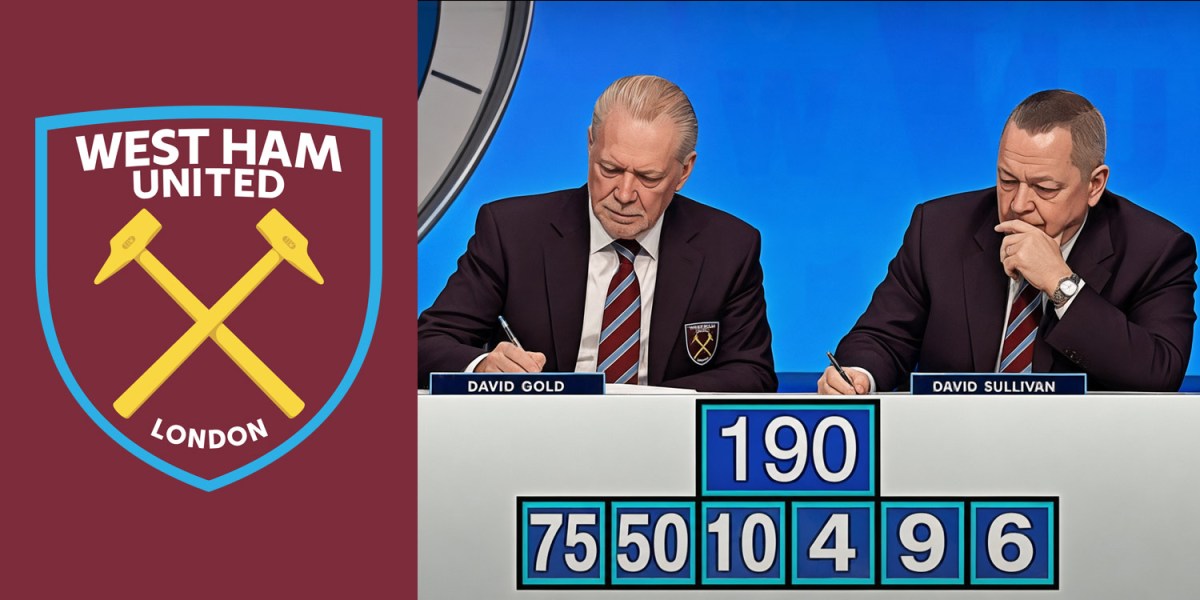
The Gold and Sullivan Years in Numbers: An Era of Stagnation and Squandered Opportunity

We hope it’s all over. Running the numbers on an unenterprising, wasteful, self-aggrandising and shameful period in the history of West Ham United

It all started with low expectations, went mostly downhill, and ended in a slurry of sleaze and shady behaviour. With the Gold and Sullivan era hopefully gone forever, we look back on the numbers which define this wasteful and distasteful period of West Ham history.

16 – the number of seasons ‘competing’ in the topflight. The first match on 26 January 2010, a 1-1 draw away at Portsmouth leaving West Ham in 16th position. The last, a 3-0 home win on 24 May 2026 confirming the Hammer’s relegation with an 18th place finish.

2 – the number of Premier League relegations. One a consequence of their first disastrous managerial appointment in 2011. The other, the culmination of shocking mismanagement in the aftermath of the European Conference success and the transfer of Declan Rice.

6 – the number of top ten finishes (excluding the Championship year) out of 16 attempts. The highest was 6th place in 2020/21, a season which also set West Ham Premier League records for number of wins (19) and points gained (65).

633 – total number of league games played, of which 214 were won (33.8%) and 258 lost (40.7%). In the Premier League only, the 190 victories from 587 games (32.3%) were overshadowed by 250 defeats (42.6%). West Ham stand proud as holders of the record for all-time number of Premier League defeats.

13th – the average league finishing position throughout the Gold and Sullivan years. This is reflected in an average Premier League points tally of 45. As a club featuring regularly among the world’s top twenty richest – and one of the top 8 richest in England – these are far from impressive statistics.

3 – the number of topflight seasons when West Ham won more league games than they lost. And unsurprisingly, these are also the only seasons that ended with a positive goal difference. The seasons in question: 2015/16, 2020/21 and 2021/22.

9 – number of managers employed – technically, it is 10 if you count David Moyes twice. The entire rogue’s gallery comprises Gianfranco Zola, Avram Grant, Sam Allardyce, Slaven Bilic, David Moyes, Manuel Pellegrini, Julen Lopetegui, Graham Potter, and Nuno Espirito Santo. The strongest link in terms of Premier League win percentage is David Moyes (36.87%). The weakest was Avram Grant (18.92%). Anywhere between 45% and 55% is usually considered to be a strong managerial performance.

2.9 billion – the cumulative amount in pounds received in revenues over 17 seasons from broadcast, matchday and commercial sources. A club record of £270 million was posted in the 2024 accounts. It is estimated that relegation will cost the club at least £100 million in income next season.

1.34 billion – the amount paid in euros (sorry, all Transfermkt data is in euros) for player transfer fees. At today’s exchange rate that is £1.15 billion. In addition to the 92 players signed for a fee, there were 36 free transfers and 41 loans – a total of 169 players in all. The record signing was Sebastien Haller at €50 million with another 17 players costing €25 million or more. 

650 million– the amount received (€) for player transfers. West Ham sold 67 players and allowed 55 to leave on a free. The record sale was Declan Rice (€116 m) with only five other players sold for €25 million or more. The sale of Rio Ferdinand in 2000 continues to hold sixth place in the ranking of highest transfer fees received.

1.1 billion– the cumulative amount (£) paid in wages to achieve very little. The wage bill as well as transfer spend has increased significantly in recent years. All to assemble a squad fit for relegation.

16,711,118 – the number shuffling through the turnstiles at West Ham home matches, both at Upton Park and the London Stadium.

47,475 – the average home attendance (excluding COVID restricted games) across 352 matches – they keep turning up regardless. The average for games played at Upton Park was 32,836. At the London Stadium, 58,219. Attendance numbers have now become theoretical rather than actual body counts with the highest recorded attendances of 35,005 at Upton Park and 62,477 at the London Stadium.

214 – total number of players fielded by West Ham during first team games in all competitions. 81 of whom made fewer than 10 starts for the club.

426 – the highest number of appearances made by an individual player during the GSB era – Mark Noble. Next best is Aaron Cresswell at 369 with the following each breaking the 200 barrier: Michail Antonio (323), Tomas Soucek (284), Jarrod Bowen (280), Angelo Ogbonna (249), Declan Rice (245), Manuel Lanzini (226), Winston Reid (222), James Tomkins (205) and Pablo Fornals (203).

85 – the most goals scored by an individual player in all competitions – the ever-reliable Bowen. Antonio is next with 83 and he remains the club’s all-time leading Premier League goalscorer (68 to Bowen’s 65.) Just 5 other players managed 20 or more Premier League goals to their name. These are Soucek (41), Noble (37), Andy Carroll (33), Lanzini (27), and Marko Arnautovic (21). The frequently injured Carroll is the only player brought in as an out and out striker to feature on the list.

16 – most league goals scored in a season by an individual player – Bowen in 2023/24. Second place with 14 goes to Carlton Cole in the 2011/12 Championship season. West Ham players have reached double figures on just eight other occasions in the Premier League: Bowen (13) in 2024/25, Bowen (12) in 2021/22, Arnautovic (11) in 2017/18, Antonio (10) in 2019/20, Antonio & Soucek (10) in 2020/21, Diafra Sakho (10) in 2014/15 and Kevin Nolan (10) in 2012/13.

1069– the total number of goals scored by West Ham (1.39 per game) in all competitions. Goals conceded totalled 1083 (1.41 per game). For league games only, the numbers are 849 for (1.34 per game) and 952 against (1.50 per game).

8 – the most goals scored by West Ham in a single game – the 8-0 win against Macclesfield in the 2018/19 League Cup. The biggest league win was 6-0 in the Championship against Brighton (2011/12). Although West Ham scored 5 on 4 occasions in cup competitions, they were unable to repeat that feat in the Premier League. Ironically, the last 5 goal haul came just before the takeover – a 5-3 win over Burnley in November 2009. The Hammers bagged 4 on 30 separateoccasions, 20 times in topflight games.

6 – most goals conceded in a single match – once in a 6-0 league cup semi, first leg defeat by Manchester City in 2014, and again in the league versus Arsenal in 2024.  The West Ham rearguard conceded 5 goals on 12 occasions and 4 goals 33 times.

8 – highest aggregate score in a West Ham game – the 8-0 win against Macclesfield. There were 7 games featuring 7 goals – 4-3 wins against Huddersfield and Portsmouth, 2-5 losses to Liverpool and Arsenal, and 3-4 defeats to Bournemouth, Palace and Newcastle.

139 – the number of West Ham clean sheets earned in Premier League games (23.6% of games played)

161 – the number of Premier League games in which the Hammers failed to score (27.4%)

35 – the total number of goalless games featuring West Ham (5.9%). Goalless draws peaked during the Sam Allardyce years, accounting for 40% of the total.

13 – the number of players to win the Hammer of The Year Award. Declan Rice has three wins, Scott Parker and Mark Noble two, Winston Reid, Aaron Cresswell, Dimitri Payet, Michail Antonio, Marko Arnautovic, Lukasz Fabianski, Tomas Soucek, Jarrod Bowen, Aaron Wan-Bissaka, and Konstantinos Mavropanos one each.

1 – the number of trophies won. That night in Prague and victory over Fiorentina in the Europa Conference League. A victory that the owners hoped to dine on for eternity. West Ham competed in five European campaigns. Two under Slaven Bilic where they were eliminated in the qualifying rounds and three under David Moyes. As well as the Conference win, the Moyes campaigns saw one semi-final and one quarter-final Europa League appearance, losing both to German opposition.

0 – the number of domestic trophies won or finals reached. In the FA Cup, the best efforts were quarter-final exits in 2011, 2016 and 2026. In the League Cup, the Hammers were losing semi-finalists in 2011 and 2014 and were knocked out in the quarter finals four times. Ironically, the best performing cup year was the Avram Grant relegation season.

0 – the number of people disappointed at seeing the back of David Sullivan
Czech Mate: Knight Takes Porn To Capture Control Of West Ham Board

Optimism reigns as Daniel Kretinsky rides to the rescue at the London Stadium. Should we be excited and what is needed to recover from the shortcomings of the last 16 years?

Never in the field of humiliating relegations has despair turned to optimism quite as quickly as it has at West Ham in recent days. First the welcome and overdue resignation of Chairman David Sullivan ahead of the Panorama revelations. And then the news that Daniel Kretinsky is to purchase a chunk of the Gold family shares to make himself the Hammer’s largest stakeholder. Cue an old-fashioned east-end knees up!

Since then, the rumour mill has gone into overdrive with a deluge of plans and proposals (both real and imaginery) that would make West Ham great again. New investment to clear debts, dampening down the fire sale, sorting out the unlovable stadium and developing a fit-for-purpose training facility are just a few of them. Turns out our saviour was hiding in plain sight all along. Just waiting for the asset to get distressed enough to ride to the rescue in his trademark style.

It is a reasonable question to ask what Kretinsky has been doing these past five years. Had he been thwarted in attempts to modernise the club by the intransigent Sullivan/ Gold alliance? Or was it always his intention to take a watching brief from afar and await the collapse? After all, in the most recent accounts he was not even listed as a director. Still, he has been making all the right noises in the media, and we owe him the benefit of the doubt until proven otherwise. Time will tell whether he can follow through on the promises or whether the good intentions end up as another piece of nostalgic memorabilia alongside the Gold and Sullivan 10-point pledge?

As I had written previously, if the plan had been to use funds from player sales to pay off the transfer debt to other clubs and to clear the expensive loans that had been taken out, then West Ham were in deep trouble. In that sense, the message that additional investment would be forthcoming (however that is achieved) is as crucial as it is welcome.

Player sales are still be inevitable to comply with the 85% squad cost ratio rules in light of the estimated £100 million hit on revenues that relegation brings. But the impact needn’t be so great if the club’s cash flow problems are ameliorated. It also strengthens the club’s negotiating position for the transfer of those unwilling to spend at least one season in the lower tier. I would be mightily surprised if any of Fernandes, Summerville, Todibo, Diouf, Wan-Bissaka, Areola, Alvarez, and Fullkrug were still around in August. There may also be others who want to leave, or the club would prefer to have off the payroll.

The objective will be to shift the bigger names for as high a price (and as high a profit) as possible. Play hard ball and the more competition for signatures the better. The bigger the player trading profit, the more that can be reinvested in rebuilding.

The flipside of the expected exodus is the size of the rebuild. The challenge to assemble a squad not only capable of battling their way to promotion but also forming the backbone on the return to the Premier League. West Ham have been notoriously poor at player trading for as long as I can remember – would you believe that the sale of Rio Ferdinand 26 years ago is still seventh in the list of the club’s record transfers out – and requires immediate attention. The rumoured appointment of Steve Nickson (from Newcastle) as Director of Football/ Technical Director sounds like a very positive move. His up-to-date knowledge and expertise would allow him to hit the ground the running in the current transfer window. The turnaround in personnel will be huge and I’m nowhere near as bullish as some on the value our youth players can offer.

The thorny issue (for anyone taking up the DoF role) will be Nuno and his historically over-cosy relationship with friend and super-agent Jorge Mendes. The impression I have of the manager is that he is churlish enough to refuse to play a signing simply because he was not involved in the recruitment process. The DoF/ manager relationship is critical to a successful window and a quick return to the top tier.

One area where Kretinsky’s business empire could come in handy is getting in on the associated party action when securing lucrative sponsorship deals. If it’s good enough for Manchester City!  I’m visualising Royal Mail as our shirt sponsor. First Class Mail for the faster players. Second Class for the rest!  

No doubt, Kretinsky’s immediate priorities will be to sort out the finances and oversee the extensive transfer business over the coming months. Improving the stadium and training facilities are both much longer term projects. The stadium is saddled with so many vested interests and reputations that it is difficult to see a clear way forward for now. That the current arrangement really doesn’t suit anyone should, however, be motivation enough to act.

As for the training ground, could the writing be on the wall for the Rush Green Portakabin village and its satellites? A consolidated location has long been needed to bring the facilities up to contemporary standards and to foster continuity from youth to senior football. It will probably mean a move out of Greater London into the estuarine hinterlands of Essex but so be it. In the Czech tradition, maybe land is available at Bataville in east Tilbury. And the ‘Academy of Football’ really deserves a campus, not just a training ground!

The mention of churlishness earlier, reminds us that David Sullivan is not entirely out of the picture as yet. His days of calling the shots on operational matters may be well and truly over but until he sells up, he remains a significant shareholder. And the support of all large shareholders is required for any major restructuring decisions the club may need. How will he react to the impotency of his behind-the-scenes exile? Will he go gently into the night, tail between his legs? Or linger stubbornly like that bad smell when a mate has been sick in the backseat of your Cortina.

The last thing Kretinsky needs is Sullivan as an obstacle as he plots his next moves. One night in Stratford makes a hard man humble, not much between despair and ecstasy. COYI!

Sundry Sport Exclusive: Former West Ham Chairman Probed By Aliens

In a parallel universe.

The scene is a tacky Essex mansion at the start of a new season. Karen Brady reclines on a four-poster waterbed reading the latest Jackie Collins novel as David Sullivan emerges from the bathroom wearing only a Cossack shower cap.

All seems well with the world. The pain, anguish and humiliation of the previous season had never happened. There had been no relegation, no impending fire sale, no executive resignations, and no TV exposés. Graham Potter had tippy-tappyed his team to surprise European qualification, Niclas Fullkrug was up for the golden boot – and Bobby Ewing was still alive. It had all been a bad dream, just like in Dallas.

Back to life, back to reality!

The sudden resignation of David Sullivan from his executive positions at West Ham last Saturday was met with spontaneous, universal and unbridled joy across the West Hammersphere. Prayers had finally been answered; the despised Chairman was no more. As one astute commentator put it: “they’ll be dancing in the streets of the Queen Elizabeth Olympic Park tonight.”

The Panorama documentary was probably not as revealing as many had hoped. Not helped by its short length, early evening slot, parts played by actors, and that we were already familiar with much of the sleaze involved. Reading the accounts of the accusers in The Times were far more harrowing. The damage for Sullivan is more that it may prompt others to come forward with further allegations from his sordid past.

At least there was enough in the broadcast to close the door on any idea Sullivan may have had about a return to the boardroom. We are well rid of him.

But like everything at West Ham, as one door opens another slams rudely in your face. Sullivan may have stepped away from executive involvement and the day to day running of the club but, for now, remains the largest single shareholder. Not surprisingly, speculation is rife as to what might happen next. Will Sullivan choose to sell? Will he be forced out by the football regulator? Will Kretinski want to assume greater control? Is someone else waiting in the wings in the hope of picking up what has become a distressed asset?

It will be a pivotal summer for West Ham’s future as they scramble to sort out finances, cash flows, compliance with squad cost ratios (from vastly reduced revenues) – and to assemble a squad capable of returning to the Premier League at first time of asking. Not the best time for the club’s ownership to be in limbo.

The previously proposed sale of Gold Family holdings giving Sullivan and Kretinski equal stakes at 40% was never finalised in the light of relegation. Had it happened, the changes to individuals with significant control would have required notification to Companies House – and would be available to see.

So, as things stand, we are left with the original fragmented ownership structure of Sullivan (38.8%), Kretinski (27%), Gold Family (25.1%), Tripp Smith (8%) and Others (1.1%).  Sullivan, like anyone else with a 25% plus stake, is able to veto any resolutions which impact the club’s constitution, share capital, mergers and acquisitions etc. At worst, he can continue to mess things up behind the scenes. At best, he needs to support whatever way forward is proposed.

Further, Sullivan’s appointees (currently his two sons) sit on the board and are able to contribute to decisions on operational matters on his behalf.

In theory, the Independent Football Regulator could order Sullivan to sell his holding, but this is likely to be used as a last resort. As odious an individual as he is, does he really stand out from the crowd when it comes to fit and proper ownership in modern football?

Far better that the ownership is resolved internally. Indeed, a clean sweep purging all Golds and Sullivans from the club would be the ideal scenario. It is difficult to believe that either of Sullivan’s sons would want to spend too much time in the media spotlight given a likely ongoing investigation, and with a mother who is best known as director of ‘Horny Housewives on the Job.’ And the Gold family are only in there by default.

Kretinski has been making all the right noises so far, but it is not known what appetite he has for greater investment. It is understood the put-and-call option negotiated in 2021 is still on the table, but the originally agreed price may no longer be attractive to him.

A third party – Amanda Staveley, Daniel Levy, predatory US venture capital, a Tony Cottee consortium – buying up all the Gold & Sullivan shares would give them majority control although Kretinski would need to approve any such a move.

While all this is going on, a question mark remains over who is at the wheel to oversee the summer clear out and rebuild. Someone needs to drag West Ham’s operational structure, finances, recruitment and coaching into the 21st century. And a cool head is needed to turn to the so-called ‘Fire Sale’ into an effective rebuilding fund – refusing to blink when the big clubs come knocking. And to recruit not only for the Championship but with an eye to the future beyond?

It’s going to be a cold, lonely summer. COYI!