5 Observations from West Ham v Burnley

Welcome points from a largely forgettable encounter against Burnley.

5 Things WHUA Win is Just a Win

At the end of the day it is 3 points earned.   When we look back on the ‘lost’ 2016/17 season in years to come it will be recorded as a match won during a period where we rose from relegation possibles to mid-table obscurity.  Just as the Noble strike will be recorded as a goal scored rather than a penalty missed, the manner of the victory in a forgettable game will be erased from the memory of even those who attended.  There was no mass booing and ear-cupping this time around to trigger future memories and indifferent refereeing and an aggrieved losing manager are far too common to resonate past the next few matches.  Four points in the last two games has given Slaven Bilic a welcome boost in the quest for 20 points by the end of the year and a chance of continued employment.

Closing Out Matches in a Game of Two Halves

Apparently West Ham have lost 12 points from winning positions this season  which, had we not, would have had us riding high in 6th place in the Premier League table.  In the post-match interviews Bilic was bemoaning the ability of the team to close out games and, for me, this raises the question of what his own role and influence in these circumstances?   One wonders what his instructions were at half time and to what degree the players failed to execute them.  There were a few home games last season where we looked on fire in the first half but turned into a damp squib in the second.  When you have been comfortably on top (but only have a slender lead to show for it) it is rarely a good plan to surrender the initiative and invite the opposition to attack.  There is far too much caution shown in these types of home fixtures for my liking.

Keeping Possession

West Ham are very bad at keeping possession of the ball.  This is not the same topic as whether there is any relationship between amount of possession and winning a game.  It is well known that when Leicester won the Premier League last season they recorded less overall possession than the opposition in many games.  But when they got the ball they moved it quickly and incisively.  When they didn’t have the ball they defended as a team and were prepared to let their opponents play around in harmless areas.  West Ham’s problem is that once in possession they so frequently give the ball away cheaply.  There are two key elements that result in effective passing; good pass execution (speed and accuracy) and range of options available for the player with the ball.  As a rule we are slow to exploit and create space and when there are no options the ball goes backwards to keeper or defender who lumps it forward in desperation.  In almost all the games I have seen this season we have been second best at passing and moving over the course of a game.

You’re Shaking My Confidence Daily

Much is made of confidence in football so I guess it must be a big deal.  A run of defeats or playing in a new stadium can dent a team’s confidence; a point at Liverpool can boost it but failure to hold on to a lead can damage it again.  We hear that such a player is a confidence player and just needs a goal to fire him in to action.  I have to disclose a touch of scepticism here although I will be delighted if an ‘ugly’ win over Burnley can help to ‘kick-start’ the season, as they say.  These are highly paid players who are meant to represent the very top of their profession; are they really so collectively fragile?  Could you explain away your own lack of performance at work as a lack of confidence?  To admit to lower motivation and fitness levels, compared to most opponents, would be more honest and believable.  If confidence really is an issue then it is something for the coaching staff to address; not some an unmanageable external factor in the hands of the footballing gods.

Big Man Andy Carroll

I am pleased to see Andy Carroll back to fitness (crosses fingers, buys lucky heather, finds rabbits foot, avoids ladders and path crossing black cats).  When Zaza has set the bar so low then anything is an improvement as far as our striking problem is concerned but Carroll is a massive upgrade.  Bilic says he is a big fan of Carroll and considers that he is great in the air and on the ground.  Difficult to argue with the first part of the assessment but the second is something of a stretch or, at least, unproven.  He does provide a physical presence and will always be a danger at crosses and set pieces but he is unlikely to contribute much in slick passing breakaways or intricate penalty box interplay.  The danger is that his strength in the air becomes our one and only tactic (other than trying to win a free kick) and although he can be effective in the right setup I don’t believe that is as a lone striker.  To be effective he needs someone alongside to feed off the knock-downs.  Unfortunately our midfield is too weak to release someone to play as a second striker.

Who is to blame for our poor start to the season?

Who is in the firing line as disappointed fans look for someone to blame for the current shortcomings.

Board, manager, playersThe move to a new stadium often results in some people being unhappy. Most clubs when they move take a little while to settle. It’s the same as moving house. It takes a while to get used to your new surroundings. A trawl through social media reveals how when results are going against us, or when we are not playing well (to put it mildly), then individuals want to blame someone, or a group of people, or an inanimate object as to the reason for it. Sometimes it’s the players, or the manager, or the board, or the stadium. Sometimes it is all of them added together.

I can understand the disenchantment with players, especially when sometimes they don’t appear to be giving their all. I can understand that the buck stops with the manager when he is responsible for picking the team, devising tactics etc. If he is unhappy with the effort being put in by players at training, then it is his responsibility to do something about it. When things are not going well then the board will inevitably come in for criticism from some fans too. Certainly the summer transfer dealings which resulted in some very average recruitment, the proposed payments to Tevez, and anticipation of a “marquee” signing, would have been better kept in-house rather than discussed with media outlets. But the vitriolic personal attacks by some on social media are totally unnecessary, although I guess are just a consequence of the computer age, and happen in other spheres of life, too.

The one that really gets me is the criticism of the stadium. It’s just a football pitch surrounded by stands. I understand all the talk about it not being a football stadium, further from the pitch etc., so how comes we turned in the performance we did against Chelsea in the League Cup? Did we play it somewhere else when I wasn’t looking? The atmosphere at that game was at least equal to anything ever produced at Upton Park. The decibel levels when Antonio nodded in the late winner against Bournemouth, or when Payet scored his wonder individual goal to equalise against Middlesbrough went off the scale. And if you study the statistics, Upton Park was rarely a “fortress”.

I’m not one of the new breed of plastic supporters that I see written about. I spent 58 years going to Upton Park. I loved it in the old days when we stood on the terraces and were close to the pitch. Yes, sometimes a crowd of 20,000 would generate a fantastic atmosphere, but only at times when we were lifted by the players on the pitch. When we weren’t playing well you could almost hear a pin drop at times. And with the redevelopment of Upton Park into an all-seater stadium following the Taylor report, we weren’t that close to the pitch either. I am more than happy with the new stadium, as are most of the people I’ve discussed it with who sit nearby. But everyone is entitled to their opinion, and I always respect other opinions.

But I personally don’t understand why fans keep going on about it. There is no going back I’m afraid. There is no point in posting pictures of the Boleyn Ground in various states of demolition. I’ve even read pleas to wealthy West Ham fans to come forward, and put together a new team, a bit like what has happened in Manchester, and even try to buy the Boleyn Ground from the developers and build a brand new purpose built football stadium there. Quite a project to undertake.

Perhaps the reason for our poor start is a mixture of players, injuries, the manager and coaching staff, the training facilities, the board, and the stadium. I believe that with a good run of results, much of the negativity will disappear. Everyone has to pull together to turn things around. But if we are still hovering around the relegation zone at the turn of the year, then I am afraid that the current discontent will continue. Let’s hope that everyone involved does their bit to ensure a big improvement in the remainder of the season.

Transfer Rumours: No Fellaini Please

Maybe it’s only a rumour but bringing in Fellaini would be a massive backward step.

Transfer WindowAt the risk of falling into that internet trap where a transfer rumour has been made up only to spawns a torrent of outraged responses I would just like to say how disappointed it would be if West Ham really were interested in bringing Marouane Fellaini to the east London.
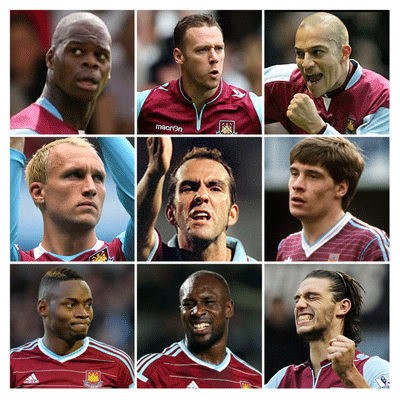
As in any transfer window there will be a glut rumours linking the Hammers with all sorts of players and only a few of them will have legs (the rumours that is not the players – although given recent dealings it may not be that obvious).

Noises coming out of the boardroom on Twitter are suggesting that we are mainly in the market for loan players and given the rather precarious position towards the bottom of the table it will give free rein to speculation on all manner of cast-offs from other teams. Experience unfortunately suggests that seeking reinforcements for a struggling team in the January window is rarely productive and often leads to panic signings. Fellaini is very much on the fringe at Old Trafford and after his cameo contribution at he weekend is likely to be even further away from any serious action. What to do with such an expensive flop? Why, send him to West Ham.

I would like to think that the club would have a good chuckle about the speculations and that would be the end of it. That Fellaini would be seen as the type of player that Fat Sam may have coveted but is one that is at odds with the modern style of Premier League football where pace, mobility, agility and finesse are the defining qualities.

When Slaven Bilic came into the club I thought, at last, we were getting a progressive manager. One who was in tune with current methods of fitness, organisation, tactics and formation; and for much of last season that is how it looked. Now I am not so sure and bringing in a player like Fellaini would be a further worying sign (after the summer transfer debacle) that Bilic is not really offering anything new.

There may be an argument that we need grit as well as skill to get out of the hole we have made for ourselves but that needn’t mean that all footballing principles should be abandoned.

5 Observations from Arsenal Humiliation

An abject performance against Arsenal sets alarm bells ringing and requires questions to be asked.

5 Things WHUCrisis, Dilemma, Emergency, Disaster, Mess

That’s 21 games played in all competitions this season with just one good performance (Chelsea in the EFP Cup) and one decent performance (away to Palace).  Even for the most optimistic supporter the alarm bells must be ringing loud and clear.  Sure Arsenal are, on their day, an excellent side but it was the manner of defeat rather than defeat itself that is the most worrying.  Watching the TV pictures of the players in the tunnel before the game and they looked petrified, like a deer caught in headlights, and when the game started it looked no different.  From the off you sensed it was only a matter of time before Arsenal scored and then having steadied the ship a little we gifted them another very soft goal; the rest is history.  This is not a team that is simply going through a bad patch or a loss of form and confidence.  It is shades of Roeder, Grant and Pardew’s last season all rolled into one. A desperate situation in the club that needs desperate measures in response before it is too late.  Hoping that is will all sort itself out is the height of foolishness.

Under Pressure

It is astonishing to think that following a buoyant first season that we are four months into a new season and manager, Slaven Bilic, looks broken, lost and devoid of ideas.  We may have had a bad transfer window but the core of the squad is the same as the one that performed so admirably last season.  They have not all suddenly become bad players but now look unmotivated, unfit, disorganised and careless.  It is almost impossible to articulate what our style of play is supposed to be; there is no plan and no structure in our play.  While managers such as Klopp, Pochettino, Conte and even Eddie Howe have built momentum based on intensity, pace, movement and pressing, West Ham fumble and stumble around haphazardly hoping that they might eventually get a free kick close enough to goal.  These problems lie squarely at the door of the manager and the coaching staff.  To bemoan a lack of intensity in training is a ridiculous comment when you are the one with the responsibility to make sure it happens.  A thin squad in terms of quality (caused in part by poor recruitment by Bilic) and an unwillingness to risk young players means there is largely no competition for places and this breeds complacency, as it has done in the past.  In a situation where a club doesn’t look to be heading in any particular direction it is the guy asleep at the wheel who needs to be changed.  Bilic says he will not walk away but that is a financial stance more than anything.

Case for the Defence

For starters, I’m not sure you could fault Randolph with any of the goals and he made a few decent saves to keep the score in single figures.  With the athletic Kouyate missing it was disappointing that we stuck with the suspect 3 at the back against a team like Arsenal who are typically so strong down the flanks.   In some respects I was quite pleased when Ginge went off and was replaced by Arbeloa (rather than Nordtveit) as it suggested a change to 4 at the back.  The problem was that Arbeloa and Fernandes both seemed unsure as to what formation we were now playing and decided to compete for the right wing back spot.  Mainly through Arsenal’s profligacy we settled a little after the early storm only to self-destruct by gifting them what was a deserved lead.  The main culprit was Ogbonna who during one of his daydreaming moments gave the ball away sloppilyin a dangerous position.     Reid was one of few players to earn his wages and gave another committed display and it is time he was given the captain’s armband full-time.  Masuaku had some good moments going forward but was later exposed by the excellent Sanchez.  Masuaku is OK as cover for Cresswell but not much more.  Arbeloa is a stop gap and we really do need a proper right back.  It is perplexing that West Ham is the only club that doesn’t seem to believe that having specialist full-backs is important.

Stuck in the Middle

Payet and Noble were shocking.  Payet wasn’t even interested enough to audition for Arsene Wenger who, according to that morning’s newspapers, was interested in his signature.  Regardless he still seems wasted marooned on the left wing.  Noble looked completely lost; apart from going back to exchange passes with his own defenders the game mostly passed him by.  He was like a little kid playing piggy-in-the-middle with his much bigger brothers.  Obiang put in another good performance and Lanzini was one of a few West Ham players playing with energy and at least trying to make things happen.  What was a disorderly midfield setup was turned into farce when Carroll and Ayew replaced Noble and Fernandes leaving a massive gap between defence and the attack minded players.  This led directly to the 3 goals in the last 10 minutes which even if it didn’t affect the result will have a further detrimental effect on confidence.  I would take your calculator to Anfield next week.

Looking Forward

Ashley Fletcher tried hard as the lone striker.  Better than Zaza but not as effective as Sakho in creating space and closing down defenders.  He can potentially become a good player.  Carroll came on, scored a consolation and didn’t get injured; what more could you ask.  Ayew didn’t look anything like a £20 million player.  After looking sharp in his brief cameo at Old Trafford he was back to languid and ineffectual.

Tottenham 3 v 2 West Ham

Too good to go down? Haven’t we heard that somewhere before?

Embed from Getty Images

So we have an experienced Premier League manager in charge. He has kept us in the top flight when many thought we might struggle. Many are happy that he has done his job, but some believe that a change is needed. So at the end of the season the experienced manager departs, and the board bring in someone who has not managed at the top level in English football. Some think it is a risk. He probably wasn’t the first choice of the board but he gets the job. All new managers have a honeymoon period where the fans will allow some dodgy early results. And we do have some unexpected defeats at the beginning of the season.

But the performance of the club improves, and as the season progresses we have some great results. We do much better than most would have expected.

On October 24th we beat Chelsea 2-1 at Upton Park. We have some unexpected victories away from home. A seventh placed finish at the end of the season exceeds West Ham’s usual position in the Premier League.

So hopes are high for the season to follow. We have a talented squad, and a star player idolised by the supporters. But the season doesn’t quite go to plan. Early on we are playing a game at home and hold a two goal lead, but we don’t hold on to it, and fail to win the game. How the season might have been different if we had we won that game.

The early season results continue to fail to meet the high expectations held by the fans, and everyone associated with the club is disappointed with the start we have made. We visit White Hart Lane to play our arch enemies from North London. It’s a typically competitive derby and we lose the game 3-2 to a last minute goal. And one of our centre backs is sent off.

We are in the month of November, and after twelve games of the season have been played we have just eleven points. Not in the bottom three, but only just outside of it. That is less than a point a game. Relegation form many believe. Many will argue differently. Our team is a good one. Too good to go down. It will all come good soon.

Now most of you will think that I am writing about our current predicament. But I am not. Going back to the start of this article, the experienced manager is Harry Redknapp. The new manager is Glenn Roeder. In Roeder’s first season in charge in 2001-2002 we did beat Chelsea 2-1 on 24th October. We did have some unexpected victories away from home. We did finish seventh in the Premier League. Hopes were high for the season to come. In 2002-2003 we did have a talented squad. Di Canio was our star player and was idolised by the fans. We were leading Arsenal 2-0 but failed to win the game. How the season might have been different if we had held on to that lead and picked up three points. We did lose 3-2 at Tottenham to a last minute goal, and Ian Pearce was sent off. After twelve games we had eleven points. But most weren’t worried. Most believed we were too good to go down.

For Harry Redknapp read Sam Allardyce. For Glenn Roeder read Slaven Bilic. In Bilic’s first season we did have some unexpected defeats at the start (Leicester, Bournemouth) and we did beat Chelsea 2-1 at Upton Park on 24th October. We did have some unexpected victories away from home. We did finish in seventh place in the Premier League. We went in to the new season (this one) with high hopes. We did hold a two goal lead in an early game (Watford) but failed to win the game. How might this season have been different if we had picked up three points then? We did just lose 3-2 to a last minute goal at Tottenham, and for centre back Ian Pearce being sent off, read Winston Reid. And we have got just eleven points after twelve games of the season. And we are not in the bottom three, but just above it.

The parallels when comparing 2001-2, and 2002-3, are uncannily like 2015-16 and 2016-17. But of course 2016-17 isn’t over yet. We are just twelve games in. But for those who believe that history might continue to repeat itself, shall we look back to what happened at the end of 2002-3?

We finished in eighteenth place and were relegated despite some improved performances towards the end of the season. But how could it have happened? We were too good to go down they said. After those first twelve games in 2002-3 we then didn’t win a single game in our next nine league matches. It won’t happen this time will it? We are too good to go down. Aren’t we?

The Third International Break

Another enforced interlude provides the opportunity to review the season to date

Embed from Getty Images

On 9 November one year ago I was writing my first book, Goodbye Upton Park, Hello Stratford, which chronicled West Ham’s final season at the Boleyn Ground.  On that exact date I wrote a chapter reviewing the Premier League season as we went into the third international break. Twelve months ago we were just twelve games into the season when it was interrupted for the third time to allow international matches to take place. This time we have played one fewer.

On 9 November 2015, Aston Villa occupied the bottom slot, Sunderland were just above them, and Bournemouth made up the trio of teams occupying the relegation places. Of course, only one of them went down, as the Mackems and the Cherries climbed to 17th and 16th respectively by the end of the season. The other two relegated teams, Norwich and Newcastle sat in 15th and 17th place on this day. Is this a warning to Middlesbrough and West Ham?

A year ago we were sixth in the table, just one point below Tottenham. Our North London neighbours had only lost once, but drawing half of their games kept them down in fifth place. This season Spurs are unbeaten so far, but drawing six of their eleven games has once again kept them down in fifth. Ironically the first game after this break in 2015 was a visit to White Hart Lane where we were “Kaned” 4-1. History repeats itself fixture-wise this season, but I am hoping that we don’t get a repeat of the score from last time.

What a difference a year makes for Liverpool. This time last year they sat in mid-table and were lucky to be that high thanks to some dubious refereeing decisions going their way. They had just lost at home to Palace and after that flop, some way off the top, Klopp had a strop, caught everyone on the hop, and had a pop at the Kop (not so easy to say) for deserting the ground before the final whistle. A year on they do now sit at the top after a breathtaking demolition of Watford last weekend, a performance matched by Chelsea in their exhilarating 5-0 victory over high flying Everton. Manchester City and Arsenal follow closely on their heels (they occupied the top two positions a year ago) so it looks like the title will be won by one of the top four.

After their unexpected success last season Leicester have reverted to where you would expect them to be and only have one more point than ourselves. The league is very close if you ignore the top seven and bottom two, with just five points separating Watford in eighth and Hull in eighteenth.

We are seventeenth, in part due to a shocking goal difference of minus 9; only the bottom three clubs have a worse figure, Hull (-14), Swansea (-11), and Sunderland (-12). Last season 38 points (or exactly one point a game) was the figure needed to keep your place in the Premier League. This time around a similar pattern is emerging with just the bottom three not averaging a point a game. But we are only just on that level, and with the tough (on paper) run of fixtures to come against teams occupying 5th, 6th, 4th and 1st, we could easily find ourselves in the relegation mix (usually termed a dogfight) early in December. We really need to raise our level of performance in those games and take something from them.

After that run we have easier games (on paper, again) at home to Burnley and Hull, before visiting Swansea and Leicester to finish off 2016, and to reach exactly the half-way point in the season. But we haven’t shown that we can easily beat “relatively weaker” sides either this season (or indeed last). Our two home victories (out of six home games) were very late 1-0 wins over Bournemouth and Sunderland, we managed 1-1 draws with Middlesbrough and Stoke, and lost to Watford (2-4) and Southampton (0-3). We have managed just six goals in our six home Premier League games, a very poor figure, especially given the fixtures. This is matched by our five goals in five away games. So, eleven games played, eleven goals scored, and eleven points on the board. Not what we were expecting after last season, perhaps!

So now I’ll put my prediction hat on, and say that in the next eight games, taking us up to the midpoint of the season, we will amass a further eleven points taking us up to 22, which would be seven short of where we were in the middle of last season. Anything much less than this and we will still be in potential relegation trouble. The bookmakers think we’ll be OK. We are joint sixth favourites (with Crystal Palace) to be relegated, after Sunderland, Hull, Swansea, Burnley, and Middlesbrough.

How many of our players can look at themselves in the mirror and be pleased with their performances to date this season? Antonio, perhaps, early on for his goalscoring which earned him an England squad place, although the goals have dried up recently. Obiang, who has been man of the match for me in most of the games he has played, and who surely has cemented his place in the starting line-up. Fernandes and Fletcher have shown a lot of promise from limited opportunities, too. As for everyone else, I don’t think any of them have reached the level they played at last season. I am pleased for Aaron Cresswell getting his chance finally in the England squad, though he has hardly played since returning from injury; the call up is based more on his consistency last season, and a new manager prepared to recognise it.

A Tale of Two Stadiums

It is the best of times, it is the worst of times. Wisdom or foolishness, belief or incredulity?

Stadiums

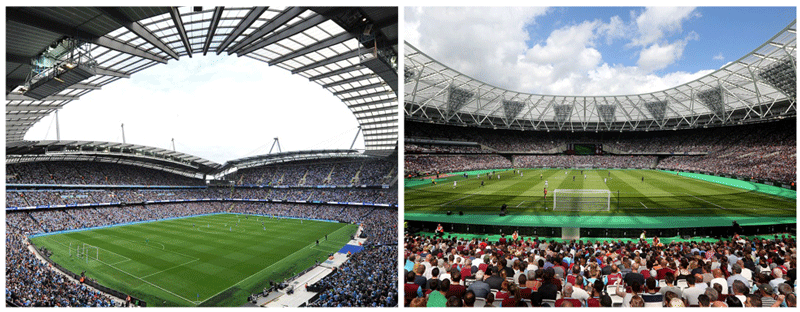
Imagine there was a football team with a traditional working class support that gave up the cherished memories of its full of character home ground, which it owned, and moved away to rent a taxpayer funded converted athletics stadium. The first season at the new stadium witnessed an early European exit to an obscure eastern European outfit and then patchy form resulted in them slipping to 16th place in the league. This week that team has just defeated Barcelona and were reported to be top earners from last season’s Champions League with revenues of £76 million (equivalent to about 60% of West Ham’s annual revenue from all sources). The team is, of course, Manchester City.

Despite the obvious parallels there are also important differences. Critics of the London Stadium will point out that the conversion of the City of Manchester stadium was to a dedicated football stadium rather than a multi-purpose arena; and I’m sure there is some justification in that as far as the matchday experience is concerned. In addition, although City pay more in rent than West Ham do, and are responsible for all operating overheads, they are able to benefit more from the associated (and now significant) naming rights and matchday income.

In the first 6 years in their new home City finished 18th, 8th, 15th, 14th, 9th and 10th respectively. Despite what we may believe a shiny, new high capacity stadium doesn’t guarantee success. It wasn’t until the injection of Thai (briefly) and Abu Dhabi money that City’s new successful era began. It is arguable whether that investment would have been forthcoming if they had still played at Maine Road.

I know a few Manchester City fans and all are delighted with their new found status. They are now the second most profitable English league club, after their near neighbours, and with massive financial backing are well placed to continue the upward momentum. I don’t recall too many rumblings related to the move but, if there was a lot of moaning in Royle family style sittings rooms across the City at the time, it is long forgotten now.

Famous victories under the lights against Barca may seem a long way away to the average Hammer’s fan at the moment. The optimism of the new stadium (where it existed) has been overtaken by events and with the negativity fuelled and amplified by the media. With few exceptions the media is rather patronising towards West Ham regarding them as a wayward cousin to the ‘real’ glamour London clubs or Arsenal, Chelsea and Tottenham. A rare moment in the sun is tolerated but other than that the club and its supporters are seen as a caricature that belongs in an Eastender’s plot. The nature and generosity of the deal for the London stadium has made the club a perfect target for journalists and online media sites to exaggerate and repeat half truths. It has not been helped by the actions of some supporters while similar flash-points at other grounds, with Manchester City fans smashing up the toilets at Old Trafford or Liverpool fans throwing flairs on to the pitch at Selhurst Park, barely get a mention. The stories about a return to the hooliganism of the 70’s or 80’s and the stadium being unsuitable for football are clearly risible.

I have mentioned before that in the past West Ham have relied heavily on TV money for revenues; far more so than our closest rivals in financial terms do. Staying at the Boleyn Ground (as it was) did not provide any opportunity for the club to develop or even to maintain the status quo with our peers. Whether it was viable to developing Upton Park into a stadium that could generate more revenue is another question but a moot one now. The point being that West Ham’s future depended on being able to increase Matchday and, more importantly, Commercial income. The alternative was to slip further away from any aspiration to join the leading London clubs and join the also-rans of Palace, QPR and Fulham instead. It is possible that some fans would be quite happy with this situation if it meant that traditions were maintained but, as a business decision, passing up the opportunity of the London stadium move would have been foolish; particularly with Tottenham hovering in the wings.

The gulf in earnings between West Ham and the (financially) big clubs is so huge now that even if the teething problems with the new stadium are fully resolved it can only take us a few rungs up the ladder. It is difficult to imagine a scenario where we are able to grow organically into becoming a regular Champion’s League participant. Major outside investment is the only route to such a promised land and that is something that would change the club out of all recognition.

The London Stadium and its location is ideal to attract the attention of investors (likely to be overseas) but the unanswered question is what type of club do we want?

The Fixtures Computer

Can we blame the fixtures computer for the fact that we sit seventeenth in the Premier League table after a quarter of the season?

Season Fixtures

In modern times in the Premier League era, fixtures divide very neatly into two halves of the season. What I mean by this is that we play games against each of the other nineteen teams in the league in the first half of the season, which concludes very neatly on 31 December, and then play them all again between January and May. As there are twenty teams, we play nineteen matches in each half.

From August to December our nineteen games comprise nine at home and ten away. The situation is reversed in the second half with ten at home and nine away. All very logical you might think, but this has not always been the case.

My support of West Ham goes back almost sixty years, and in the first season that I remember (1958-59), our second league game of the season on 25 August was at home to the previous season’s champions, Wolves. Then our fourth game was a visit to Wolves on September 3. So, just four games into the season and we had played our quota of games against the best side in the country. Incidentally we won at home and drew away. In 1964-65 a similar situation arose when we played Manchester United at home and away on August 24 and September 2.

So, in those days there was no real balance to the season, and the league table could therefore be potentially misleading if you fulfilled all your fixtures against the top clubs early on. I’m not sure when exactly this was rectified, but the current situation of playing all nineteen teams once, before playing them all again would seem to be fairer.

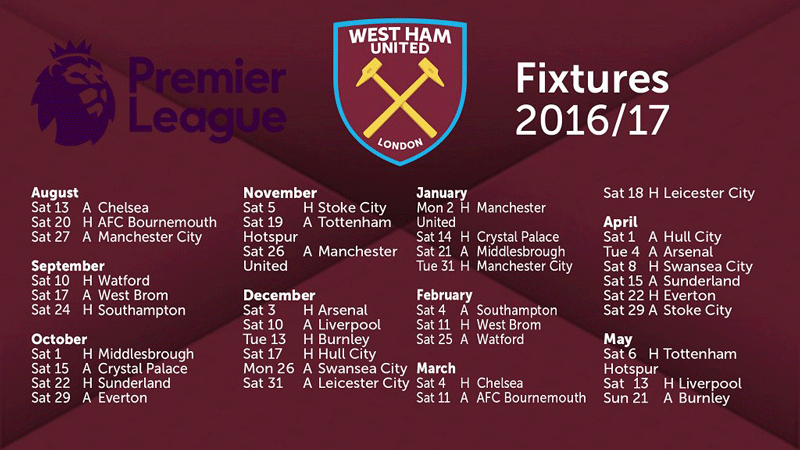
If we look at this season in detail then our nine home games in 2016 are against Bournemouth (16), Watford (13), Southampton (6), Middlesbrough (P), Sunderland (17), Stoke (9), Arsenal (2), Burnley (P) and Hull (P). The figures in brackets denote last season’s league position, plus “P” for the promoted clubs. That is just three teams who finished in the top half, three in the bottom half, and all three promoted teams. On paper you would have to conclude that our home games in the first half of the season should yield a substantial points total.

Conversely the ten away games in 2016 are against Chelsea (10), Man City (4), WBA (14), Palace (15), Everton (11), Tottenham (3), Man United (5), Liverpool (8), Swansea (12), and Leicester (1). Eight of the ten games are against teams that finished in the top twelve in the league. On paper, the conclusion we can draw from this, is that it is a very tough set of away fixtures in the first half of the season.

Of course, the situation is reversed in 2017, so that in the second half of the season we have easier away games and tougher home fixtures (on paper). I’m not sure how randomly the fixtures computer allocates fixtures, but there is certainly an imbalance in the apparent strength of our opponents in our home and away fixtures in the two halves of the season. For that reason perhaps we should not take too much notice of the league table until we are a long way into the season.

Surely it wouldn’t take too much computer programming skill to ensure a much more balanced fixture list. The fixtures computer should come up with an end result such that in each half of the season we play roughly half of our home games against teams that finished in the top half in the previous season, and half against teams from the bottom half. The same should be true of the spread of away fixtures.

This would be fairer to all teams, both top and bottom, and would ensure that the league table is more representative of the strength of clubs throughout the season, and give an indication of finishing positions much sooner. As it stands, teams with tough early fixtures could find themselves in a relegation dogfight early on in the season, which then inhibits the way that they play for the remainder.

So does this explain why we sit in seventeenth place after ten games of the season? No. It may be a partial factor, but we are there because of poor defending, plus the fact that we are as weak as I can remember at scoring goals. We have only found the net ten times in ten games, and conceded nineteen at the other end. Only Sunderland and Hull have conceded more goals than we have, and have poorer goal difference statistics.

Over a whole season an average of one goal a game would give us just 38 goals. In the last twenty-five years we’ve only managed such a poor scoring record twice. In one of those seasons we were relegated, and in the other we escaped relegation on the last day of the season. And conceding 19 goals in ten games or 1.9 goals a game would equate to 72 in 38 games. When did we last concede that many goals or more in a season? Fifty years ago in 1966-67. But in that year we scored eighty!

Where Have All The Strikers Gone?

Missing in Action: The 20 Goals Per Season Striker.

StrikersAfter the encouraging victory on Saturday the emotional swingometer has turned completely on its axis shifting from doom and despair to euphoric optimism. While the positivity is welcome after such a disappointing start to the season a sense of perspective needs to be maintained as we come to the end of our run of ‘easier’ games. The formation and attitude worked well at Palace and now we need to see if that can be followed through at home to Sunderland.

I cannot yet jump on the new found enthusiasm for Simone Zaza bandwagon. I don’t see that after one hard working performance we have a solution to our long running striker dilemma. He may have ‘put in a shift’ but was he really ‘different class’? Slaven Bilic said that we wouldn’t have won without him and I can only go along with that if he meant the alternative was playing with 10 men. Now Slav’s comments may have been designed to give Zaza a boost but I would like to see a greater end product (i.e. goals) rather than good stats on aerial duels won before I become a believer.

Now this is not meant to be a Zaza bashing article but rather to consider why it is that we have failed to secure an even half prolific goal scorer for such a long period of time. If the 20 goals a season striker is elusive at most clubs then he has completely disappeared during West Ham’s Premier League tenure. A regular goalscorer has been a problem for many years.  In our 20 Premier League seasons the best return that we have had was Di Canio’s 16 goals in 1999/2000. In only 7 of those 20 seasons has any West Ham player scored more than 10 league goals. In our last 10 Premier League seasons only Harewood (14 in 2005/6) and Zamora (11 in 2006/7) have exceeded the 10 goal mark. Quite a sorry return I would say.  Sure it is great to get goals from all around the pitch but every successful team tends to have at least one consistent scorer.

Paolo is also our all time Premier League scorer with 47 goals in 118 appearances (an average of 2 goals every 5 games) followed by Carlton Cole with 41 goals in 216 appearances (1 in 5). Only 10 players in total have scored more than 20 Premier League goals for West Ham and these include penalty takers Mark Noble and Julian Dicks. Tony Cottee is the only player to have scored a Premier League goal for West Ham to appear in the list of our Top 10 all-time goalscorers; 23 of his 115 goals coming in the Premier League era.

In the modern game a striker needs to contribute more than just goals but a striker who doesn’t score is not really doing his job. It seems strange that we have not been able to unearth and keep a decent goalscorer in recent history. There have been those that didn’t stick around for long for various reasons (Defoe, Tevez, Bellamy, even Ba) plus the unfortunate Dean Ashton but otherwise there has just been a procession of misfiring lumps; often the result of emergency January transfer window loan deals.

A top striker was stated as the priority in the most recent transfer window and the names of potential targets were appearing in the media almost daily. It is difficult to know how many of these were genuine or realistic but the many players mentioned didn’t fit a profile for a particular style or type of player. In the end it seemed that most were either not interested or not available and we ended up in a last minute panic taking whatever was convenient. It reminded me a little of going shoe shopping with a woman who has nothing to match the dress she will be wearing that evening.

I would be quite happy for Zaza to prove me wrong but neither his goal scoring record nor his performances have raised expectations that he will suddenly start firing them in from all angles . As things stand I don’t see any short term end to our striker famine unless we are able to pin all our hopes on Toni Martinez.

Palace Review – Shocking Decision

The Match of The Day pundit has a very different view of the sending off to the commentator.

acress-off

Having just watched a re-run of yesterday’s Match of the Day, and still angry over the performance of the officials, I was equally appalled by the match commentary from Jonathan Pearce. In my opinion he had a very poor grasp of the “mad minute”.

Firstly he reckoned that Cresswell was barely touched and went down too easily. Wrong I reckon. Next he was virtually suggesting that you could tell how easily he went down by Cabaye’s reaction. Surely with all his years of commentating he might have realised that the clever players react in this way to try to get away with it when they know they have done wrong. And then if he was of the opinion that Cresswell went down too easily, how comes he believed that the slight brush on Zaha was worthy of a second booking.

 I like to think I can remain unbiased when watching football. Yes I am a West Ham fan and that must influence me, but I can clearly recall instances where I have been disappointed by poor officiating when opposing players have been sent off in the past too.

At least Alan Shearer, an excellent pundit in my view with a good understanding of the game, got it spot on. It was a penalty and the second booking wasn’t even a foul. But I was very unimpressed with Mr. Pearce.