Indiana Santo and The Villa of Doom: Roof Collapses on West Ham Escape Plan

Defeat might have been expected in Sunday’s Villa Park encounter but it was the disappointing nature of the performance which raises serious questions about the Hammer’s survival credentials.

A pivotal moment in the genre of action-adventure movies – the Indiana Jones franchise popular in the 1980s and 90s, for example – is when the protagonists must navigate a series of perilous traps, rotating blades, and concealed pressure plates to avoid an ancient booby trap that would seal an inevitable fate.

The West Ham escape plan seems very much like that. Either by accident or design, Nuno had hit upon a balance of personnel, formation and style of play which, with a good following wind, might just get them out of trouble. The problem is that there is zero margin for error. Take away a single component, attempt anything in the wrong order then an ancient curse is activated and the ground beneath our feet crumbles to dust.

The bad news had already been received a few days previously. Crysencio Summerville, the talisman of West Ham’s current revival, had yet to recover from the injury picked up in the FA Cup tie against Brentford. Will we come to regret this half-time substitution? But there was even worse news to come.

When the teams were announced it was no surprise that Nuno had opted to start with the eleven who had wrestled a precious point from Manchester City a week earlier. The subliminal message was clear. Another point here would do very nicely. Let’s face it, away at Villa Park wasn’t high on anyone’s the list of winnable games. The only grain of optimism being the hosts poor recent run of form in the absence of several influential midfielder players.

Whatever the game plan was going to be, it was thrown into disarray when Jean-Clair Todibo was injured in the warmup. Assuming they had trained all week with a three centre-back formation in mind, the obvious solution would have been a like-for-like swap. But nothing says a lack of trust in your £40 million, £100 per week backup better than deciding to disrupt the entire plan instead. If he can’t be called upon for this type of emergency, why is he on the bench in the first place?

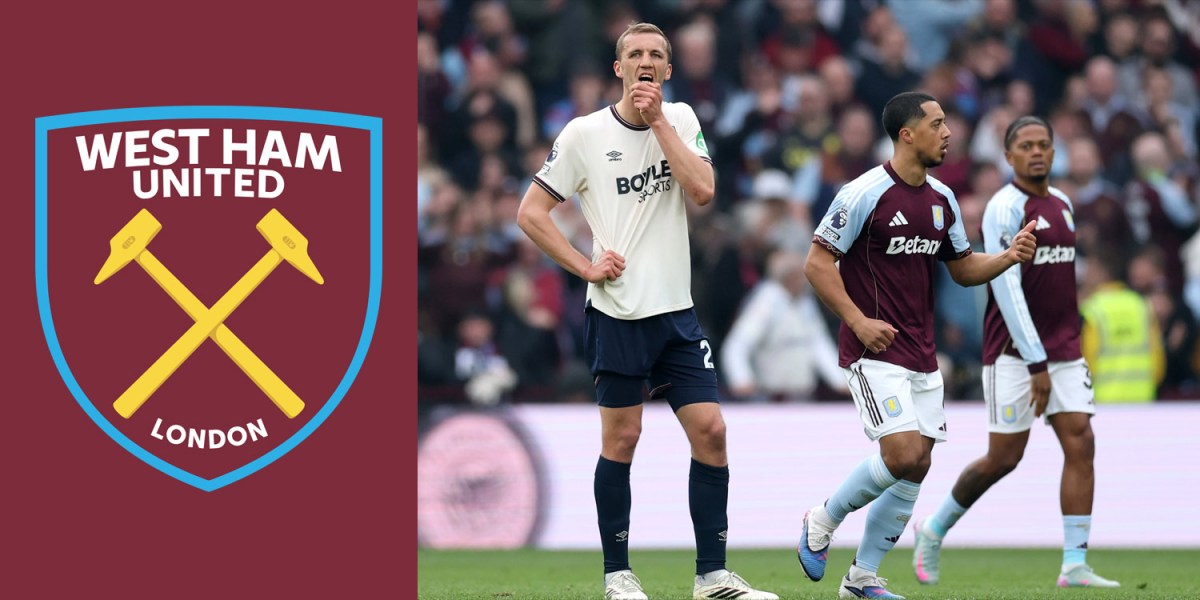
What actually happened was a repeat of one of those genius Nuno moments from earlier in the season. A plan which, in his mind, was imagined as a complex game of four-dimensional snakes and ladders. Aaron Wan-Bissaka man-marking Morgan Rogers, Jarrod Bowen filling in as emergency right back, and Pablo Felipe deployed in wide left midfield. With Pablo and Tomas Soucek about as mobile in midfield as a pair of clowns on stilts, the game was lost before it had begun. No structure, no cohesion and no goal threat. The trap had been triggered. Darts flew, tunnels collapsed, and a giant rolling boulder thundered towards the West Ham goal as Villa awoke from their slumbers awoke to rediscover Champions League bound form.

To think that a few years ago the two clubs occupied a similar position as hopeful pretenders to the rich six throne. Oh, what a sprinkling of boardroom competence and ambition can bring you in the right hands. In contrast, all we have learned (to our cost) from West Ham’s board is that incompetence not only makes them bad at running the club but also prevents them from recognising how bad they are.

West Ham’s resistance lasted barely 15 minutes. Villa had been looking to target Mads Hermansen’s obvious weakness and uncertainty in the air at set pieces. But it was an alternative and well worked passing routine from a corner that drew first blood. The ball ending up with McGinn on the edge of area whose curled shot evaded the desperate dive of the Hammer’s keeper – who should have done better in my opinion.

The closest West Ham came to a leveller was in the immediate aftermath. Taty failing/ not trying hard enough to get firm contact onto a Bowen cross. After that it was one-way traffic with only the heroics of Konstantinos Mavropanos keeping the score respectable. Quite how referee Paul Tierney saw the excellent tackle on Watkins as a penalty is indicative of the ever-declining refereeing standards. For once, VAR did its job – clearly and obviously.

Watkins would get the last laugh, however, scrambling home in the 68th minute to finally kill the game off. It was a textbook catalogue of West Ham errors. Bowen giving the ball away cheaply in the final third. Tomas Soucek so slow in tracking Roger’s run that even VAR had announced check complete before he caught up. And finally, Hermansen spilling Rogers’ tame shot into the delighted Watkins’ path. Game over!

There was just enough time remaining for a masterclass from substitute Adama Traore, showcasing his full repertoire of comical misdirected and overhit crosses.

In truth, it was a game that few expected to win. But nevertheless, it was a worryingly disappointing and passive performance from Nuno’s men. Yet, in the bigger picture; in the realm of take one game at a time management, nothing has been decided. The games that we might hope to win are still to come – home to Wolves, Everton and Leeds, away at Brentford and Palace. There are points still to win.

If something good can come out from the dreaded international break, it is the opportunity to get Summerville fit for the run-in. The future may depend on his recovery rate improving considerably on his previous seven-month absence.

Elsewhere, Nottingham Forest were the big winners from the weekend. Picking up three points from an unexpectedly comfortable romp at the Tottenham Hotspur stadium. It turns out that reports of the north Londoner’s corner turning had been wildly exaggerated. They will no doubt now be looking for yet another replacement caretaker manager. What’s Ryan Mason doing now? Leeds will regard it as two points dropped against Brentford on Friday night.

Time to regroup then Hammers. The most recent battle was lost but the war is not yet over. As one well known presidential politician put it in a late night post:

West Ham United, very underrated team, by the way. People don’t talk about them enough, but I do. I know football, maybe better than anyone, and I’m hearing VERY STRONG things about their survival chances. Very strong.

The so-called “experts” are saying relegation. WRONG! Total losers. They said the same thing about my many great successes and look how that turned out. West Ham has tremendous fans, really incredible people, and a beautiful stadium. London Stadium, fantastic place, I’ve heard.

They just need a little confidence, maybe a few better decisions from management (won’t name names!), and they will STAY UP. I guarantee it. People are coming up to me, big fans, tough guys, saying: “Sir, West Ham has plenty of bubbles left to blow.” And you know what? They’re right.

MAKE THE IRONS GREAT AGAIN!

The Fall and Rise of Nuno’s West Ham: A Path to Safety Or Too Little Too Late

The last two months has seen an amazing turn around in spirit and fortunes at West Ham. Will that momentum be enough to keep their heads above the relegation line?

Do you remember the coin pusher machines that were a common feature in seaside amusement arcades? Where no matter how many pennies you fed in, the moving tray refused to push the huge pile of cash over the edge and into the collection trough. Well, this season’s relegation battle is starting to take on a similar appearance.

This time last year, it was all over bar the shouting. Ipswich and Leicester were 12 points from safety and Southampton a further eight points behind them. In the final table, 26 points would have been sufficient to survive. This season, the pieces are far more reluctant to fall.

The weekend’s results were as inconclusive as it was possible to get. Leeds, Tottenham, Nottingham Forest and ourselves each picking up a single point. Forest will be the most disappointed having dropped valuable points at home to Fulham. A point apiece for West Ham and Tottenham, however, probably exceeded expectations. But then, predicting the outcome of games as the season draws to a close and attention is focused elsewhere always becomes increasingly troublesome.

For the briefest of overnight moment, the Hammers managed to climb out of the bottom three for the first time since 30 November. While there’s no doubt the situation remains on a knife edge, it is West Ham who are the side with moment. Another great escape feels possible but, as they say, “there’s many a slip ‘twixt cup and lip”

When West Ham lost at home to Nottingham Forest on 6 January, it was their tenth consecutive game without a win. The Guardian match report opened as follows:

“West Ham are drifting towards the most gutless of relegations. The London Stadium was half empty on another dismal night, encapsulating the apathy gripping this miserable club, and it is hard to see a way out for Nuno Espirito Santo’s accident prone side after a combination of misfortune and dismal defending left them seven points below Nottingham Forest in 17th place.”

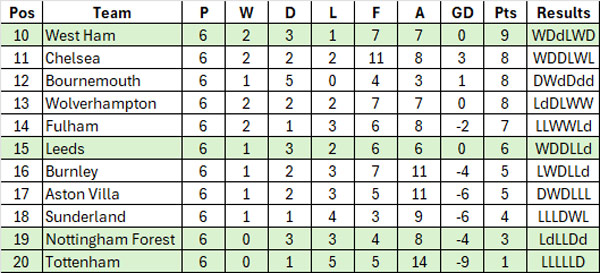
As well as being seven points behind Forest, they were eight behind Leeds and 13 behind Tottenham. Those gaps are now zero, three and one point respectively. The last six games table illustrates West Ham’s current momentum advantage. It is a period where the three rivals have won just one game between them – ironically Leeds victory over Nottingham Forest.

After the Forest defeat, many of us had already resigned themselves to relegation even if we didn’t say it out loud. Now, making the drop from the current resurgent position would be doubly disappointing. So, what has changed?  How did we progress from gutless performances and dismal defending to the fighting spirit and dogged resilience that was on show against Manchester City?

The answer lies in a combination of factors. The arrival of Paco Jemez, an adventurous foil to Nuno’s caution. The signings of Taty and Pablo allowing higher pressing and creating space for Jarrod Bowen and Crysencio Summerville to operate in. The introduction of Alex Disasi, a formidable presence in the centre of defence that has brought the best out of Dinos Mavropanos and Jean-Clair Todibo. Indeed, a defence that was once Keystone Cops and is now operating with all the competence and precision of a Formula 1 pit crew is one of the biggest turnarounds in my personal football memory.

The clincher, though, has been the ability to take the field without Lucas Paqueta and Max Kilman in the side. For different reasons each was detrimental to the cohesion, unity and team spirit we now see on the pitch.

The bottom line is a system that suits the players. One that is aligned with capabilities, that the players can understand, and which has bred belief and confidence. The antithesis of Potter’s ‘here’s how I want to play regardless of whether you can do it’.

Looking back, it is unfortunate that it took so long to get here. The slow recovery under Nuno could still be our undoing if we cannot outrun our opponents as the season draws to a close. In that sense, the improvement mirrors the Great Escape season of 2006/7 where Alan Curbishley only managed six points from his opening 12 games in charge – including a first day victory.

I am already starting to experience pre-match tension at the thought of having to win on the final day to preserve our Premier League status. I’m really hoping it doesn’t come to that.

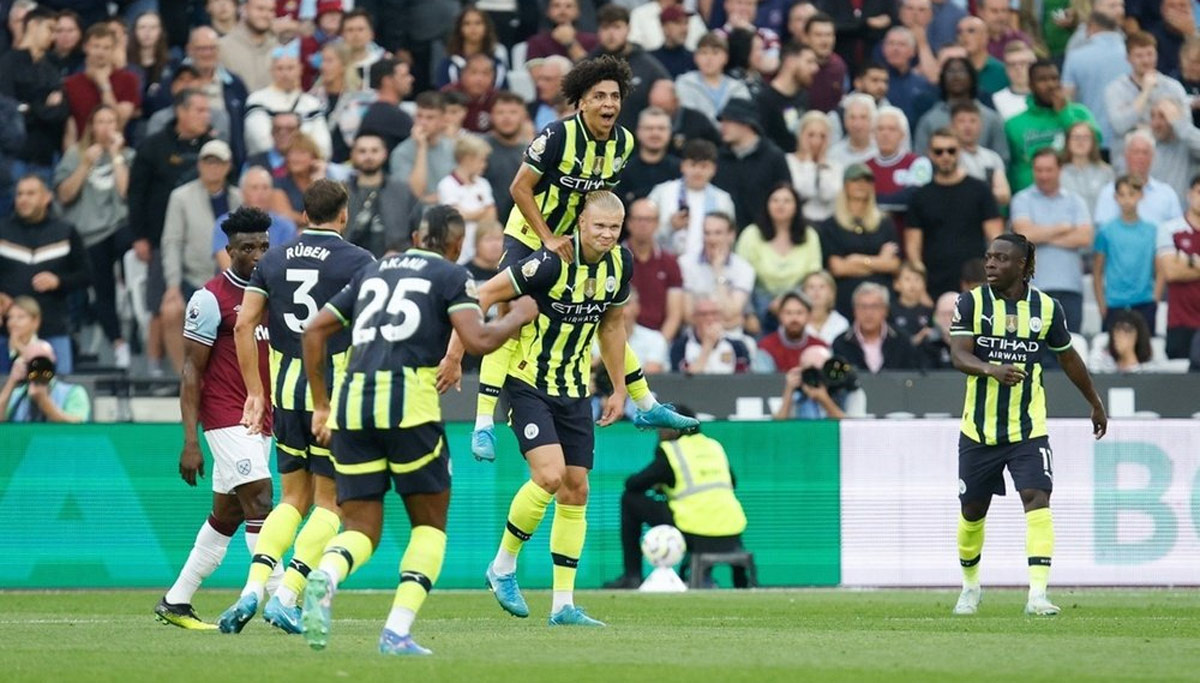
As Richard pointed out in his latest Supercomputer article, the Manchester City fixture was something of a free hit in the run-in. They are the one team we rarely get anything from even in the best of times. So, to come away with a point was exceptional despite the ‘needs must’ pragmatic approach to the game. A 100% goals to shots ratio is a rare occurrence indeed.

It was a tremendous effort from the Hammers and further endorsement of the spirit that now exists within the team. I find it intensely irritating when the click bait sites feel obliged to hand out a 3/10 rating to whoever they claim ‘stank the place out’ this weekend just to justify a headline. These are not fan sites!

As much as it was a team performance, Mavropanos and Todibo were both superb at the back with excellent support from Disasi, Diouf and Hermansen in goal. It is a solid foundation for the remaining eight games and the FA Cup adventure to come.

As far as Manchester City are concerned, they are well below the standards they have set for themselves in previous seasons. They are not yet out of the title race – with a game in hand and a home fixture with Arsenal to come – but the current side lacks the charisma it once had in the shape of Kompany, Toure, De Bruyne, (David) Silva and Aguero.

It’s possible that we are seeing the end of days for Pep Guardiola as City manager. I would love to see him prove his chops outside a big two club in any league. Just to see how good he really is without boundless funds to support him.

Next stop for West Ham is Villa Park next Sunday. The Villains have experienced a massive injury inspired slump over recent weeks and have a midweek Europa League tie in midweek to overcome. It might not be as formidable a test as it once appeared. If Summerville makes a return from injury, I could even be quietly confident. COYI!

The Under The Hammers Supercomputer has been rebooted to re-run West Ham’s survival equation

With nine games to go the supercomputer has updated the maths behind West Ham’s chances of staying up. Survival that once looked desperate is now doable. We are not safe or comfortable but it’s closer than it looked a few weeks ago.

Since the Under The Hammers Supercomputer, Deep Block, last ran its projections (prior to the Bournemouth game) three of the twelve remaining fixtures have now been completed, replacing twelve hypothetical outcomes with more hard data to assess our survival chances.

Results from those games:

  • West Ham 0-0 Bournemouth (H) – Draw (predicted draw)
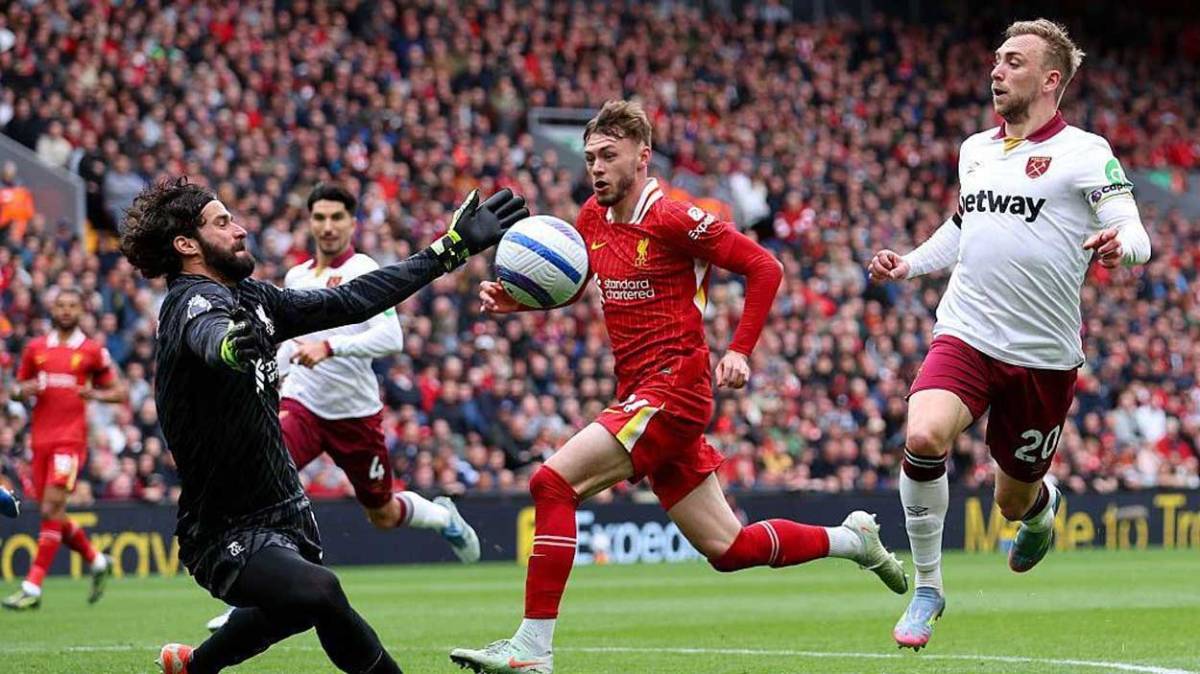
  • Liverpool 5-2 West Ham (A) – Loss (predicted loss)
  • Fulham 0-1 West Ham (A) – Win (predicted draw)

These results delivered 4 points from a possible 9, outperforming the original projection of two draws and a loss from these fixtures by two points. In particular, the away win at Fulham is a significant upgrade on the supercomputer’s expectations and materially improves the survival equation.

After 29 matches, West Ham now sit 18th in the Premier League with 28 points, level on points with Nottingham Forest in 17th but behind on goal difference. The teams in the relegation dogfight (the bottom six) currently read:

• 15th: Leeds – 31 points
• 16th: Tottenham – 29 points
• 17th: Nottingham Forest – 28 points
• 18th: West Ham United – 28 points
• 19th: Burnley – 19 points
• 20th: Wolves – 16 points

Crucially, the safety line is currently 29 points based on the season to date (exactly a point a game), meaning West Ham are now just one point behind that current safety level, with momentum firmly shifting in our favour.

With 9 games remaining, the survival target can now be recalibrated:

• Likely safety threshold at current performance levels: 38 points
• Points currently held: 28
• Points required: 10 from the final 9 matches

That equates to 1.11 points per match, which is lower than the rate required in the original model and less than West Ham’s recent form (1.33 per match in last six games).

Of course, results elsewhere can change the safety threshold and 38 might not be enough. But based on current figures Deep Block believes that a spread of 38-40 will be the level needed.

The upcoming schedule still presents major challenges, but the pressure has eased slightly thanks to the win at Fulham:

  • Manchester City (H) – Free hit
  • Aston Villa (A) – Low probability, but a point possible
  • Wolves (H) – Must‑win
  • Crystal Palace (A) – Likely draw but winnable
  • Everton (H) – Crucial and winnable
  • Brentford (A) – Likely draw
  • Arsenal (H) – Low probability
  • Newcastle (A) – Low probability
  • Leeds (H) – Potential season‑definer, perhaps must win?

The original identification of Wolves, Everton and Leeds at home as decisive fixtures to win remains valid. The difference now is that the margin for error has widened slightly.

What has changed since the original projection? The Fulham win is pivotal; it reduces the required points tally and shifts psychological pressure onto our rivals. Forest and Tottenham have failed to pull away allowing West ham to close the gap. Burnley and Wolves are effectively gone, leaving only one realistic relegation place still in play.

Deep Block originally projected a 37‑point finish and 18th place. Based on real results to date, that projection now reads closer to 39 points. Our survival chances have improved materially over the past three games. While relegation remains a genuine risk, the path to safety is now clearer and more achievable than when the original model was run.

If West Ham can beat Wolves, Everton and Leeds, and add two draws elsewhere (the games at Palace and Brentford are the most likely) as per the original forecasts then Deep Block predicts that Premier League survival is more likely than not. But the margins remain tight and depend upon results elsewhere. Failure to achieve the predicted eleven points from these games will likely need points gained elsewhere in the more challenging fixtures.

Assuming that Burnley and Wolves are as good as down (albeit not yet mathematically) the current form (last six games) of the four teams likely facing the final relegation place is as follows:

West Ham: 8 points
Leeds: 5 points
Forest: 3 points
Tottenham: 1 point

If that form continues into the final nine fixtures then we would be home and dry. But the games towards the end of the season tend to be unpredictable. Three games ago Deep Block predicted that we would probably just fall short. It now predicts that we might just be safe. It may yet come down to the final day. And if it does, well this is West Ham. We wouldn’t have it any other way.

West Ham – The Fight For Survival – Eleven Games. No More Margin for Error

With 11 games left and 25 points on the board, West Ham United’s season has reached the point where every kick, every decision, every missed chance feels heavier than the last. The maths is simple. The reality is anything but.

Most signs point to 38 points being the absolute minimum number this season. That means we need at least 13 more points between now and May. Not impossible. But there’s no room left for wasted opportunities.

Last weekend’s 0–0 draw with Bournemouth felt like one of those moments we may look back on. It wasn’t a bad result. It wasn’t a disaster. But it felt like two points dropped. When rivals are slipping and the door is ajar, you have to force your way through.

Because doors don’t stay open for long in relegation battles.

A Fixture List That Pulls No Punches

There’s no hiding from it: the run‑in is brutal.

Trips to Liverpool, Aston Villa and Newcastle. Home games against Manchester City and Arsenal. On paper, those are fixtures you circle and hope for a miracle. Anything from them is a bonus.

So where is this season really going to be decided?

At the London Stadium.
Against teams we have to beat.

  • Wolves (H)
  • Everton (H)
  • Leeds (H)

Those matches aren’t just important. They’re season‑defining. Lose any of them and the pressure multiplies instantly.

Away from home, trips to Fulham, Crystal Palace and Brentford carry just as much weight. Get something from those games and suddenly the table looks kinder. Come away empty-handed and the fear creeps in.

A realistic return across the run‑in might look like:

  • 3 wins
  • 3 draws
  • 5 defeats

That gets us to 37 points.

And that’s the terrifying part.

Thirty‑seven might not be enough. Thirty-eight might not be enough either. We might need forty, or perhaps forty-two? From the realistic return above can we turn two of the draws into wins? That gets us to forty-one. I’ve a feeling that would do it.

Which means an extra goal in two games. A late winner perhaps? Holding onto a lead instead of dropping more points from a winning position. A moment or two of courage or quality could be the difference between survival and heartbreak.

Why Hope Still Lives

For all the nerves, this team has given us reason to believe.

Eleven points from the last six games tells its own story. Performances have improved. There’s fight again. There’s structure. There’s belief. This side looks far more like a team that expects to compete than one simply hoping to survive.

Keep that level up, and averaging just over a point a game from here isn’t unrealistic. It still might not be enough. Do we need 37, 38, 40, 42? Who knows? It’s not in our hands now.  

But the warning is clear: the games we have to win must be won. There’s no safety net left. Lose those, and we’re relying on favours that rarely arrive.

The Bigger Picture

At the bottom, things are tightening.

Wolves and Burnley are almost gone. One relegation place remains, and it’s a scrap between several nervous clubs. Forest, Tottenham and Leeds all have reasons to worry. None are safe. Neither are we.

West Ham aren’t doomed. But we’re not comfortable either.

We’re on the tightrope now – every step deliberate, every wobble dangerous.

What This Comes Down To

Forget the spreadsheets. Forget the projections.

This is about:

  • Winning the games that matter
  • Turning home advantage into points
  • Finding something – anything in the toughest moments

It’s about players standing up when it hurts.
About the crowd dragging the team forward when legs feel heavy.
About refusing to let the season slip quietly away.

Eleven games.
Eleven chances to fight.
Eleven chances to prove this club belongs here.

Do enough – and we survive.
Fall short – and we’ll spend the summer replaying the moments where it slipped through our fingers.

The season isn’t over yet.
But from here on, every game is a final.

Anatomy Of A Relegation: Why West Ham Are In Trouble And Is There Any Way Out?

As West Ham show late season signs of life is there any chance that the battle for survival can outrun the culture of neglect surrounding the London Stadium club.

I recently came across an online comment that it was “players who win games, not formations.” It’s an interesting opinion and not one that I agree with, but it does sit at the heart of West Ham’s battle to avoid relegation over the coming weeks.

Ultimately, the recipe for sustained success is a squad with depth in every position. There is no getting away from the strong correlation that exists between revenues, the money invested in players and success on the pitch. But it is not the full story. If it were, the role of the coach would be largely redundant, other than ensuring appropriate levels of fitness are maintained.

The core competence of the effective coach/ manager is to unlock the full potential of his squad through the tactical arrangement of players on the field. Attempting to achieve the optimum balance between defensive stability, midfield control and attacking strategies relative to the strengths and weaknesses of the players available. Tactics and formations must support those goals, but more importantly must be understood and achievable by those expected to exeute them. We must cut our coat according to our cloth.

While the club’s degenerating and chronic ill-heath has been years in the making – a poor diet of short-termism, cheap alternatives and superficial ostentation by an egotistical board – it is the disastrous managerial appointments in the wake of Moyes’ departure which would take prominence in the final autopsy report.

Lopetegui was puzzling. An apparently successful coach who was locked in a permanent state of confusion. No discernible style of play and a laboured tactical approach which was completely incompatible with the Premier League’s unswerving direction of travel towards pace, energy and athleticism.

If that wasn’t bad enough, what folowed with Potter was even worse. He was the perfect example of a man with a one size fits all plan who was determined to stick to it regardless of whether it would ever work again, or whether those involved were suited to playing it. No lessons had been taken on board from his calamitous spell at Chelsea. The operation had been a success even if the patient had died.

The we come to Nuno. At the end of the year, it had looked like a pattern repeating itself. A ten-game winless streak and countless points thrown away from winning positions had left the club teetering on the precipice. But then two things happened. Two strikers were signed in the transfer window and Paco Jemez was appointed as sNuno’s assistant. The resulting change of approach – whether by accident or design – suddenly produced a positive change of fortunes. Where only 14 points had been accumulated from the opening 21 matches, the last six have yielded an additional 11. A repeat of the great escape continues to be a long shot but at least it’s not impossible to imagine. All that’s needed is for multiple planets to align.

The challenge for Nuno is the weakness of the squad in depth and its reliance on key players for specific roles. We have already seen this following the injury to Pablo Felipe. Let’s be honest, Pablo is a wholehearted workhorse, not a thoroughbred, yet there is apparently no-one available to cover his absence. No-one to offer a physical presence, run around a lot, close down, and make a nuisance of themselves. Instead, it has required a re-shuffle. Abandoning the 4-4-2 that has underpinned recent improvements and reverting to the 4-2-3-1 which had proven so ineffective in the past. If an injury to Pablo can be this disruptive, what might happen in the long term absence of Bowen, Summerville or Fernandes? If there is a bright spot to the season, it is that we have been very lucky with injuries. Touch wood!

A midfield of Fernandes, Soucek, and Magassa (or Potts) simply doesn’t have the variety to worry opponents or unlock defences. Against Bournemouth, Fernandes had his least influential game for some time when playing the deepest of the three. While there was no-one from midfield to push forward regularly or get in the box to support attacks. With fewer threats to deal with, the visitor’s defence were able to double up on Bowen and limit his usual influence on the game.

Having said that, the Hammers created enough chances to win the game comfortably. This included an uncharacteristic four shots in the opening five minutes and a flurry of late attempts following the introduction of Callum Wilson. If only Wilson were five or six years younger!

I didn’t think the challenge on Bowen at the death was a penalty, even though Keith Hacket felt differently. Anyway, I’ve always been convinced VAR have started packing away that late in the day and will only get involved in their favourite pastime of disallowing goals. Refereeing decisions are increasingly a lucky dip that are impossible to second guess and too easily influenced by external factors. I’m looking forward to the time when AI (Artificial Inconsistency) can be introduced into the equation.

In a parallel universe, West Ham might well have won both their last two league games. What a difference an additional two to four points would make to the optics of the relegation fight. As it is, the Hammers remain marooned in 18th place for the 12th consecutive week. Saturday’s visit to Anfield is an unlikely springboard for escaping this current plight.

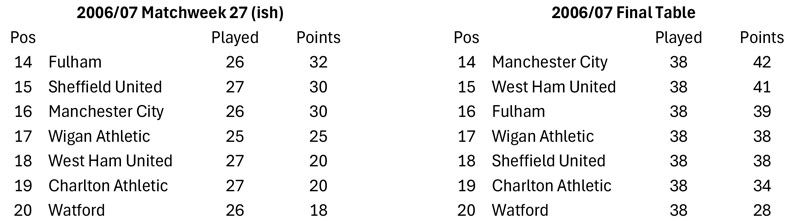
We can take a crumb of comfort from history where West Ham got out of a far worse position in the great escape season of 2006/7. The respective tables after 27 and 38 games are shown below. The Hammers earning 21 points from their final 11 games while Fulham took only seven points from their final 12. Had they not been presented with a get out of jail card by a very understrength Liverpool, they may well have been destined for the drop instead of our friends from Sheffield.

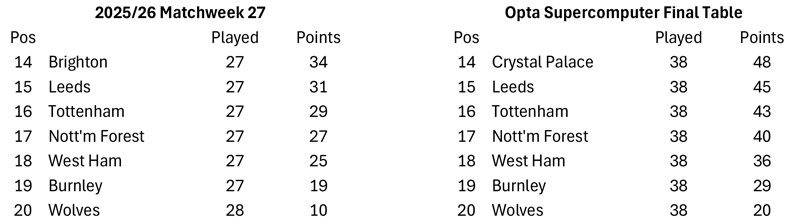
Few observers anticipate a repeat of such a feat this time around, but let’s not yet abandoned all hope. Richard’s analysis before the Bournemouth game estimated a 38-point finish for West Ham while this week’s Opta Supercomputer suggests the Hammers will be relegated with a meagre 36 points (see below). For perspective, the Opta Supercomputer managed to predict just three of last weekend’s ten Premier League games correctly. The computing equivalent of sticking a pin in.

If you are of a more optimistic nature, a repeat of the form from the last six matches would see West Ham surge to safety with 45 points. Wishful thinking, no doubt, but what else is there to look forward to. COYI!

West Ham’s Chances of Survival – The Under the Hammers Supercomputer Predicts

The Under The Hammers Supercomputer, Deep Block, has been called into action to predict what might be necessary in the run-in for West Ham to retain their Premier League status. Geoff’s latest article confirmed that Deep Block has been analysing the thousands of possible permutations and scenarios for the remaining league games. It concluded that the answer to the ultimate question of life, the universe and points needed to guarantee Premier League survival is 42. 

I asked Deep Block to consider the situation again and it ran thousands more permutations and it once again confirmed the belief that 42 points is needed to guarantee survival. It did however concede the Douglas Adams influence on the total needed and when asked if there was any leeway it confirmed that 38 points might be enough and now prefers to give a range of 38-42 points given the unpredictable nature of football. I asked it to consider West Ham’s chances of reaching the lower end of the range and this is what it came up with:

West Ham’s Remaining Premier League Fixtures (2025/26)

West Ham have 10 points from our last 6 games. Here are our final 12 league matches, with a prediction for each based on current form, opponent quality, and recent trends. Of course the current form of our opponents may be different at the time we come to play them:

DateOpponentVenuePrediction & Rationale
21 FebBournemouthHomeDraw – Bournemouth are in good form, 9th in the table and no team in the league can better their 14 points from their last 6 games, but West Ham’s home advantage could earn a point. This is one of the games where the difference between a loss, a draw and a win could be massive in the final analysis.
28 FebLiverpoolAwayLoss – Last season’s champions Liverpool are having a poor season by their standards, 6th in table, but are strong at Anfield; historically a tough fixture for West Ham. They have 8 points from their last 6 games. A point in this game is unlikely but if achieved it would be an added bonus in the fight for survival.
4 MarFulhamAwayDraw – Fulham are inconsistent, 12th in table, with just 2 wins and 4 defeats in their last 6 games; West Ham could grind out a point, but this is one of the six away games where we have the best chances for a win.
14 MarManchester CityHomeLoss – City are title contenders, second in the table and closing on Arsenal; they have 11 points in their last 6 games; West Ham will be big underdogs. We always lose this game and this season’s fixture is likely to have the same result. An unlikely point would be brilliant – Arsenal will be cheering us on.
22 MarAston VillaAwayLoss – Villa are flying high, currently third this season but only 8 points from last 6 games; a difficult away trip, but a point might just be possible although statistically unlikely.
11 AprWolvesHomeWin – Wolves are struggling, bottom of the league 17 points from safety with no chance of avoiding the drop; a must-win for West Ham and a realistic three points, despite the adverse result and display in the away fixture.
18 AprCrystal PalaceAwayDraw – Palace are unpredictable, 13th in the league with just 5 points from their last six games; a point is possible, but like the away game at Fulham this is one of the six away games where we have to hope for a win.
25 AprEvertonHomeWin – Everton are in good form, 8th in the table with 2 wins and 3 draws in their last 6 games; West Ham’s home form could be decisive. It won’t be easy but at this stage three points will be critical if all goes to plan.
2 MayBrentfordAwayDraw – Brentford are solid, an unexpected 7th in the current table and good form with 10 points in the last 6 games, but West Ham can take a point if we defend well. We meet in the fifth round of the FA Cup at the London Stadium before this game is played.
9 MayArsenalHomeLoss – Arsenal, top of the league, but faltering a little with 9 points from their last 6 games; they are likely to still be in the close title race; it will be tough for West Ham. This is an unlikely game to pick up anything unless Arsenal’s nerves are shredded at this point; they have been known to falter and panic as the season approaches a climax.
17 MayNewcastle UnitedAwayLoss – Newcastle are inconsistent but generally strong at home; but just 7 points from their last 6 games. West Ham will be underdogs, but at this stage anything from the game could be vital.
24 MayLeeds UnitedHomeWin – We will know what we need to do at this point if we are still able to survive. Leeds may still be involved but may well be safe by then; West Ham could take advantage if that is the case.
Summary of Points Projection
  • Predicted Results: 3 wins, 4 draws, 5 losses
  • Estimated Points: 13 points from the final 12 matches

As West Ham currently have 24 points, this projection would see them finish on 37 points—right on the bottom edge of the predicted survival threshold of 38-42 points.

Key Insights
  • Crucial Matches: Home games against Wolves, Everton, and Leeds (and possibly Bournemouth despite their current form) are the ‘must-wins’. Points gained in other games will likely decide West Ham’s fate.
  • Tough Run-in: Fixtures against 8 teams currently in the top 10 are challenging, and 5 games against top 7 sides Liverpool, Manchester City, Arsenal, Brentford and Villa especially so. Points from these five are very unlikely, but an odd one or two could be crucial.

Margin for Error: Slim—any slip-ups in crucial games could be fatal. Deep Block highlights the seven most crucial games are those against Bournemouth, Fulham, Wolves, Palace, Everton, Brentford and Leeds. At least 14 points from those will probably be the minimum required unless some unexpected points can be gained from away trips to Liverpool, Newcastle and Villa, and home games against the top two, Arsenal and Manchester City

  • Current Record: West Ham have played 26 matches, earning 24 points, which is an average of 0.92 points per match.
  • Recent Form: In their last 6 league matches, West Ham have picked up 10 points (3 wins, 1 draw, 2 defeats), which is an improved rate of 1.67 points per match.
  • Other Supercomputer Projections: Multiple models predict West Ham will finish with 36 points and in 18th place, which would mean relegation.
  • Required Rate for Survival: To reach the likely minimum safety threshold of 38 points, West Ham need at least 14 points from their final 12 matches—1.17 points per match. To hit the higher estimate of 42 points, we’d need 18 points or 1.5 points per match.
Fixture Analysis
  • West Ham’s remaining 12 fixtures include 8 matches against teams currently in the top half (top 10) of the table, with just 4 fixtures against teams in the bottom 10 (Fulham, Palace, Leeds and Wolves)
  • Our recent “upswing” (back-to-back wins before a narrow loss to Chelsea, and then a win against Burnley and draw against Manchester United) suggests we could maintain a realistic chance of survival if form continues. How important could the 20 points dropped from winning positions turn out to be?
Comparison with Other Relegation Teams

Burnley

  • Current Points: 18 from 26 matches (0.69 points per match).
  • Required Rate: Needs 20 points from 12 matches (1.67 points per match) to reach 38 points—an unlikely jump given their form.
  • Projection: Burnley will finish with 28–32 points and be relegated.

Wolverhampton Wanderers

  • Current Points: 10 from 27 matches (0.37 points per match).
  • Required Rate: Needs 28 points from 11 matches (2.55 points per match) for 38 points—virtually impossible but still mathematically possible.
  • Projection: Overwhelming favourites for relegation, predicted to finish bottom.

Nottingham Forest

  • Current Points: 27 from 26 matches (1.04 points per match).
  • Required Rate: Needs 11 points from 12 matches (0.92 points per match) for 38 points—achievable just if current form (9 points from 6 games) holds.
  • Projection: Slightly better survival odds than West Ham, but still at risk.

Tottenham

  • Current Points: 29 from 26 matches (1.12 points per match).
  • Required Rate: Needs 9 points from 12 matches (0.75 points per match) for 38 points—a very real risk of relegation unless recent slide in form (2 points from 6 games) and instability improves.
  • Projection: Slightly better survival odds than West Ham, but still at risk.

Leeds United

  • Current Points: 30 from 26 matches (1.15 points per match).
  • Required Rate: Needs 8 points from 12 matches (0.67 points per match) for 38 points—favourable position.
  • Projection: Most models predict survival, with Leeds finishing just above the drop zone.
Survival Chances: Odds and Supercomputer Predictions
  • Relegation Odds: Wolves and Burnley are overwhelming favourites for relegation. West Ham are the next most likely, with odds reflecting their precarious position but also their recent improvement. Tottenham and Forest are the next most likely with the bookmakers.
  • Our Supercomputer, Deep Block, Forecasts: West Ham are predicted to finish 18th with 37 points, just below the safety line. Burnley and Wolves are expected to go down, with Nottingham Forest, Tottenham and Leeds narrowly surviving.
Conclusion
  • Our survival chances are better than Burnley and Wolves, but slightly worse than Nottingham Forest, Tottenham and Leeds. But taking into account the unpredictability of results it is too close to call at the moment.
  • West Ham’s realistic points per match is 1.0–1.2 if recent form continues, but we need to maintain or improve this to survive. Key matches will be decisive. If West Ham can win those, survival is possible, but the margin for error is slim. West Ham will likely need at least 38 points to guarantee Premier League survival this season, but a safer target would be 40–42 points given the competitiveness of the relegation battle. This means we must secure 14–18 points from our final 12 matches. Anything less could leave our fate dependent on other teams’ results.

Bubbles, Bubbles, Toils and Troubles – West Ham’s Spooky Season -A poem for Halloween – ‘The Curse of the Claret and Blue’

As told by the ghost of Bobby Moore, forever watching over West Ham

My name is Bobby Moore, Sir Bobby to the fans
Although my boots are long hung up, my spirit haunts the stands.
I drift through empty terraces, unseen but ever near
A claret and blue ex-captain, I’ll whisper in your ear.
I watched them train on Halloween, ‘neath Friday’s haunted moon
Nuno’s boys looked weary, has all hope gone this soon?

At Sunderland the curse began, with three goals, no reply
Then Chelsea came to London, all we did was sigh.
Paqueta’s early magic, then five goals rained in fast,
A London Stadium nightmare, the spell was truly cast.
Brentford, Palace, Tottenham, another haunted three
But sadly all the London teams have danced in victory.

And then the new boss Nuno, his clipboard in his hand,
Making team selections no mortal could understand.
His full backs on the wrong side, and no striker in sight
Callum Wilson on the bench, that really couldn’t be right.
Paqueta as a false nine, and Soucek in the middle
Irving in there too, no pace or power, a riddle.

And what about the centre backs, when corners bring us dread,
Nine goals conceded from set pieces, their boots are filled with lead.
I spoke to the squad, my voice echoing through the mist
I’ve got some questions Nuno, a very lengthy list.
Your choices leave us baffled, I know that you’re the boss
Please get it right this time, we can’t take another loss.

The fans still sing my anthem, their scarves held to the sky
But shadows creep along the pitch, and hope is running dry.
The echoes of old triumphs, the roar of distant cheers
Are drowned by restless spirits and mounting modern fears.
The ghosts of Upton Park still wander through the night
They rattle in the rafters, they shiver in the light.

We long for days of glory, for heroes brave and true
But now we’re left with curses and dreams that won’t come through.
The pies are cold and costly, the beer’s a ghostly brew
The players heads are spinning, possessed by something new.
The substitutes are shivering, the bench is freezing cold
They really should be starting that’s if the truth be told.

The spirits of old legends, they gather in the mist
Sir Trev is juggling pumpkins, Di Canio shakes his fist.
Billy Bonds is howling, defend that haunted post
Sir Trev is floating gently, a most polite old ghost

Now here comes Sir Geoff, people on the pitch, how?
They think that it’s all over, it certainly is now.
The shot that hit the bar, ghosts gather and they groan
But even in the afterlife the answer’s still not known.

Martin Peters drifts by, with a pumpkin on his head,
He’s nutmegging the phantoms, his shirt 16 and red.
Arriving late as ever, that’s how he gets his kicks
And that is why he’s known as the ghost of 66.

Alan Devonshire’s dancing, his hair a haunted mop,
He glides through spectral midfielders, they trip until they drop.
He conjures up a cross, it swerves and disappears—
The keeper’s left bewildered, the crowd erupts in cheers!

Julian Dicks arrives, he’s come straight from a rave
He scares off all the wingers, none of them are brave.
A sweet left-footed penalty, he shoots with all his might
But if he played with Nuno he’d be moved to the right.

So heed this haunted warning to every claret and blue heart
The curse can yet be broken, but all must play their part.
Believe in West ham’s spirit, let courage see us through
And maybe then we’ll lift, the curse of the claret and blue.

And through the misty darkness the bubbles start to rise
They shimmer in the moonlight, heading to the skies.
They fly so high as they nearly reach up to the sky
But just like our dreams they begin to fade and die.
Our fortunes forever hiding as we look around in despair
Just keep on blowing bubbles, pretty bubbles in the air.

Now the midnight bells start chiming and the fog rolls off the Thames
The legends fade to shadows but the dream it never ends.
Raise your scarves to the heavens as the voices haunt the night
For every ghost in claret and blue still yearns to see us fight.
With fortunes always hiding, pretty bubbles shining through
One day we’ll break the curse and make our dreams come true.

Reasons to Be Cheerful (Part 1) – West Ham in 2025-26  

After inheriting a fractured squad mid-season in 2024-25, Graham Potter has now had the chance to begin to shape the team in his image. There have been lots of positives about the spirit, attitude, morale and togetherness of the squad in pre-season. But can the manager’s tactical acumen and calm leadership finally bring cohesion to the club? 

Promising pre-season form doesn’t mean a lot really but in the games I’ve seen then perhaps attacking fluidity is returning, although still there’s plenty of work to be done. These pre-season matches have helped reintegrate key players and build morale which are a crucial foundation for a strong start. 

It’s still early days in the transfer window by West Ham standards as we wait for the end of window bargains! Kyle Walker-Peters arrival on a free offers versatility and Premier League experience. El Hadji Malick Diouf from Slavia Prague adds youthful energy to midfield and could perhaps turn out to be one of our better buys in recent years. He could provide a new level to our attacking on the left in a similar way to Wan Bissaka does on the right. If the manager wants to play with wing backs (as seems likely) then we might just have an excellent pair. 

Potter’s reputation for nurturing young players could perhaps see a few breakthrough stars this season? Potts has looked the outstanding one in pre-season. Are there more on the horizon? There have definitely been some very encouraging performances from academy products during the pre-season games. Potts, Marshall, Orford, Scales, Fearon, Earthy – they are all prospects. And Guilherme always looks like he could become quite an asset but we haven’t seen enough of him yet. Perhaps Cummings from Celtic or Kante, who has spent a season on loan in France, will be good enough for integration into the first team squad? 

Another positive is that Paqueta’s potential lifetime ban has finally disappeared. (But why did it take so long?). Perhaps we can now see some performances from him that we were all hoping for when he arrived. 

It’s a Mads World but we seem to have acquired a good young goalkeeper who is highly thought of. I don’t know how many we were seriously chasing (so many names were put forward) but we seem to have the one that the goalkeeper coach wanted. Let’s hope he is a successful acquisition. 

It’s not about finishing in the top six — it’s about rediscovering identity and playing with purpose, entertaining the fans and giving it a real go in every game and in every competition. If Potter can mould the squad into a coherent unit we might just surprise a few doubters. But then again we might not! 

Reasons to Worry about West Ham in 2025–26 (Part 2) 

Graham Potter made an unconvincing start; his first season ended in 14th place, with just 43 points, a tally flattered by the poor quality of relegated sides. His tactical tinkering and lack of a settled XI left fans frustrated. If he doesn’t find consistency early, pressure will mount fast. 

Mohammed Kudus, arguably West Ham’s most dynamic attacker (although he was poor last season wasn’t he?), was sold to Spurs. No direct replacement has arrived. Crysencio Summerville is returning from long-term injury, but will he be the one who can fill Kudus’ boots? The obvious midfield gaps that we can all see in lack of pace, mobility and power and a much needed box to box player, preferably two, have not been addressed. At the very least one central midfielder to match the criteria is an absolute must surely! We appear to be after Fernandes from Southampton. If true he would be the best of all the ones I’ve seen mentioned, but will it happen? 

Only four senior additions so far in the transfer window: Diouf, Walker-Peters, Hermansen and Wilson. Only two needed a transfer fee payment and on the face of it they are likely to be good value for the money. Also, Walker-Peters is a decent versatile acquisition, and I know why Wilson has arrived although he is not really one for the future!  

The squad still lacks a reliable striker, with last season’s goal output among the lowest in the league. Fullkrug and Wilson may have proven goalscoring records but they have proven injury records too. A younger, more prolific striker to assist the ageing duo is another must! Perhaps Marshall can step up, it would be great if he can (I do hope so) but it is a big ask. 

Wing-backs (which Potter seems to favour) are pushed forward aggressively. Wan Bissaka and Diouf will be key in creating width and overloads. But this leaves space behind though which is a tactical risk if transitions aren’t managed well. Early days but there was evidence in the pre-season games in America that this could be an issue that needs to be addressed. Everton and Bournemouth could both have made more of this. Better teams might!  

Opta’s supercomputer predicts West Ham to finish 16th, with a 22% chance of relegation, reflecting the squad’s stagnation in recent times compared to improving rivals. In short, we feel like a club in transition, a work in progress but perhaps without the urgency or clarity to make the transition successful. I hope we can step forward but if Potter can’t galvanise the squad quickly, we could find ourselves in the type of scrap that we thought we’d left behind a few years ago. A poor start could set the tone for another season of struggle. 

Thoughts and Prayers: Ten West Ham Predictions For 2025/26

It’s the most wonderful time of the year. A new Premier League football season is finally upon us. But my West Ham glass has never been more half empty!

Cautionary Tales: Is Competitive a Synonym for Dull?

Nothing seen in pre-season suggests that a change of style for Graham Potter’s West Ham in 2025/26 is on the cards. In fact, we should expect an even more extreme version as he sweeps away the final vestiges of Lopetegui’s chaos to bed down his custom brand of cautious possession football. It’s unlikely to be exciting, rip-roaring stuff!

Although Potter’s style is very different from that of David Moyes, their underlying philosophy to minimise any risk is common ground. Neither embraces adventure or seeks to produce a team capable of taking a game by the scruff of the neck and pressing home their dominance.

Where Moyes prioritised deep defence and counterattacks to frustrate opponents, Potter does the same by maintaining possession in safe areas of the pitch, reluctant to enter the attacking third or committing bodies into the box. His rationale – repeated endlessly in last season’s press conferences – was to remain competitive in each game, even though so many were ultimately lost.

For those of a nostalgic disposition, remaining competitive might be seen as the antithesis of the elusive West Ham way, an approach best summed up by getting mullered 8-2 at home by Blackburn Rovers on Boxing Day 1963 only to win the return fixture 3-1 two days later.

A Goal Famine at Both Ends

The respective records of Lopetegui and Potter last season were roughly equivalent when it came to points per game (1.15 to 1.11) and goals scored (1.21 to 1.22). The significant difference was a reduction in goals conceded under Potter from 1.63 to 1.28 per game. Benchmarking these against the averages for Potter’s three seasons at Brighton and we see 1.16 points per game, 1.06 goals scored, and 1.26 goals conceded. Largely consistent except that the goal scoring exploits at West Ham look extravagent in comparison.                   

In his 18 Premier League at West Ham, there were five draws while nine of the other games were settled by a single goal (two wins, seven defeats).  In the four games with a two-goal winning margin, the Hammers won three and lost one. It can certainly be argued that close games maintain interest until the end, but it is always goals which create the greatest excitement and interest for fans.

My prediction for the season is 47 goals scored and 52 conceded.  

The Perils of Playing Out from the Back

I’m no fan of playing out from the back as the go-to tactic for every occasion. Apart from the very best drilled teams who have skilful players in every position with great movement and superior powers of recovery, it is a suicidal play. For the majority of teams there are far more drawbacks than advantages.

No doubt Mads Hermansen will perform better than Alphonse Areola who looks like a rabbit caught in the headlights with the ball at his feet. But please use it when appropriate, not by prescription. Even if the keeper manages not to mess up, can we trust our defenders and leaden footed midfielders to succeed in breaking through an opposition press? The more likely outcome is a sequence of sideways and backward passes before the ball is played back to the keeper again.

I predict at least four or five opposition goals arising directly from attempts at this flawed manoeuvre.

You Win Some, You Lose Some

There is no danger of anyone repeating last summer’s claim that West Ham had won the transfer window. The recruitment of Hermansen and El Hadji Malick Diouf are certainly positive – plus there was the contractual obligation to buy Jean-Clair Todibo – but otherwise it has been the largely underwhelming collection of squad fillers to replace the squad fillers that were let go.

At time of writing, the number one priority of many supporters to inject pace, power, youth, and creativity into the midfield has been stubbornly ignored. The straw to clutch at is that the window remains open for two more weeks. Still time for a wantaway star or a player issuing a come-and-get-me plea to make his way to the London Stadium.

If the midfield can be sorted out, I would have far greater optimism for the season. Unfortunately, past performance suggests the club will ultimately fail to act decisively. The remaining time will be wasted flitting from target to target like a butterfly; deals will prove impossible to conclude beyond the haggling stage; and a couple of free transfers will be recruited without fixing the original problem.  

In such a scenario, I see us losing more games than we win with a smattering of draws thrown in. My prediction: Win 12; Draw 10; Lose 16.

Where Will We Finish?

The most positive thing I can say about the upcoming season is that I don’t believe West Ham will be relegated. There will be times when we are too close for comfort but there will be three or more (even) worse teams destined to fight it out for the drop. A total of 46 points or so would be enough to finish between 13th and 15th. It is difficult to see better than that.

In fact, I would say that the current Potter style of play places a relatively low ceiling on what can be achieved. A cautious 3-5-2 formation with a preference to keep everything tight and condensed in midfield is textbook mid-table football.

Ironically, if done well, the low block/ rapid counterattack football preferred by Moyes is more exciting and provides greater possibilities – as witnessed by West Ham’s purple path in 2020/21 and Nottingham Forest for much of last season. But as we know, done badly it is as tedious as hell.

The AFCON Conundrum

The uncertainty in any season is losing players for extended periods due to injury. West Ham are exposed to this in key areas, especially in attack where keeping Jarrod Bowen and Niclas Fulkrug fit is paramount.

Other absences are known and must be planned for such as the 2025 African Cup of Nations (AFCON) which will is scheduled over the Christmas/ New Year period. West Ham will likely be without Aaron Wan-Bissaka, Diouf, Nayef Aguerd (and Max Cornet) for all or part of the tournament. Games affected will be home to Fulham, Brighton and Forest, and away to Man City, Wolves and Tottenham. Plus, the FA Cup Third Round.

Many other Premier League sides will similarly be impacted by AFCON. West Ham should have the cover to muddle through provided the tournament does not coincide with an injury crisis.

Anyone For a Cup Run

A cup run is an opportunity to boost team and supporter morale when things are otherwise floundering in the league. West Ham’s recent experience is to notch up a few decent victories before being drawn away for a routine defeat at Liverpool or Manchester City.

Cup draws are rarely kind to the Hammers and last nights for the second round of the Carabao Cup was no exception. There were many more favourable outcomes than an away trip to Wolverhampton.

Once again, I don’t see Potterball as suited to cup football success. A look at his Brighton record shows exits as follows: 3rd Round – twice; 4th Round – three times; 5th Round – once.

Predicted exits for West Ham this season: League Cup – 2nd Round; FA Cup – 5th Round

HOTY

This is an easy one. Diouf to win Hammer of the Year. A standout season for the left wing back especially once his colleagues realise that playing the ball into the space in front of him is the way to go. Whether there will be anyone in the box to get on the end of his tantalizing crosses is another matter. The end of the season will no doubt raise questions of buy-out clauses and moves to bigger clubs. Expect to enjoy him for two seasons maximum.

Top Scorer

Little to chose from here with no player entering the conversation for the Golden Boot. A 13 goal haul for Bowen would allow him to eclipse Michail Antonio’s record as the clubs leading Premier League goal scorer. Fulkrug weighing in with ten and Callum Wilson one.   

Young Players

Many of the more energetic moments in the Premier League summer series came when the academy players were introduced as late substitutes. Their improvised exuberance likely giving the coach palpitations.

Freddie Potts was given the most minutes and will be a candidate for a start on Saturday. He looks to be a tidy player, but I wonder if there is enough to his game in terms of passing range and movement. I would love to see more of Luis Guilherme, but wingers are superfluous in the coach’s preferred system.

Others in with a shout to ipress are George Earthy, Callum Marshall, Ollie Scales, Lewis Orford, Preston Fearon and the mysterious Mohammadou Kanté. Fearon and Orford in particular showed a sense of purpose and adventure during their US cameos that is rarely seen from the club’s senior midfield players.

Of the group, Potts, Scarles, Guilherme and Earthy will be matchday regulars – but mainly from the bench as the coach persists with JWP and Tomas Soucek.   

What Can West Ham Expect This Season From The Four Ps Of Potterball

The promised squad overhaul has yet to materialise as the new season gets ever closer. Potter’s preference for patience, possession, passing and probing has looked more cohesive in pre-season but has yet to be put to the test.

Pre-season preparations have changed significantly over the years. What were once low-key trips down the road to Oxford or Southend have been repurposed into fully fledged televised tournament extravaganzas. Hosted in any far-flung corner of the planet prepared to stump up enough cash for Premier League clubs to play exhibition games.

The idea of a Premier League Summer Series seemed to have all the appeal of the low budget seaside specials – starring Vince Hill, Mike and Bernie Winters and the dancers of the Young Generation – that dominated holiday TV schedules many years ago. In the event it wasn’t so bad. Fans were able to watch a handful of nearly competitive games blissfully free from VAR interference. The clubs banked a bounty of PSR boosting pre-season revenue. And the organisers happily settled for the desired outcome of a Manchester United victory.

It was obvious from the outset that the Red Devils were the big draw here. An opportunity to celebrate the latest in an ongoing series of corners turned since the retirement of Sir Alex in 2013. The remaining three clubs duly obliged by playing the role of the Washington Generals to Manchester United’s Harlem Globetrotters.

The wider context here, however, is the increasing interest and involvement in the business of Premier League football by US investors, with more than half of this season’s top flight clubs having American owners. Just short of the majority needed to enforce rule changes should their financial interests align. How long before regular Premier League games are actually staged in North America?

With the advent of live TV coverage comes the pressure on pundits to analyse what we have seen. So, what can be read into performances and what does it mean for the upcoming season? In truth, nothing we didn’t already know as far as the style and approach of Potterball are concerned. The major conundrum is whether the squad will have more and better options to accomplish it by the time the transfer window closes (slams shut, surely) on 1 September. The promised squad overhaul has seen plenty of departures but just the one significant addition at time of writing. It is a situation that would suggest another year of lower table struggle is on the cards.

Graham Potter is now fully committed to a preferred 3-5-2 formation. That one significant signing of the summer (El Hadji Malick Diouf) underlines the desire for attacking width to be provided by the wing backs. The club is now well placed in this area with Kyle Walker-Peters and Ollie Scarles as backup.

The middle three of the midfield five is less clear cut. There are plenty of names to throw in here from the current payroll: Edson Alvarez, Tomas Soucek, Guido Rodriguez, JWP, Lucas Paqueta, Andy Irving and Freddie Potts for a start. Plus, a coiple of youth players waiting in the wings. But how to get the right attacking and defensive balance from that group of (at best) tidy rather than explosive players. Potter’s caution is likely to favour a double pivot and one attacking midfielder rather than a more adventurous one defensive and two box-to-box midfielders. The obvious gaps in pace, power and someone with the ability to carry the ball forward from the middle of the park have yet to be addressed.

Another puzzle is whether there is a role in the system for wide attacking players such as Crysencio Summerville and Luis Guilherme? Both are quick, direct players which may be at odds with Potter’s pass, probe, possession, patience preference which contributed to the poor goal attempts statistics in the second half of last season. The limited game time for Guilherme in pre-season is probably telling – a shame for a player who reminds me of a Brazilian Alan Devonshire.

The primary innovation from pre-season has been the way the front two have operated. Niclas Fulkrug regularly dropping deep to receive the ball from central defenders with Jarrod Bowen deployed in a much narrower role than we are used to seeing him. Fulkrug has looked sharp and keeping him fit may be essential to West Ham’s attacking intent. The wisdom of bringing Bowen in from wide left remains to be seen given how effective he has proven from that position in the past.

Pre-season indications are that Potter’s preferred combination in central defence will be Nayef Aguerd, Max Kilman and Jean-Clair Todibo. It is a surprise rehabilitation for Aguerd who appeared to have had one foot out the exit door at the start of the summer. His pace and passing may serve him well on the left-hand side of a three but doubts remain over the physical aspects of his game. He also offers more of a threat in the opposition box at set pieces than his defensive colleagues. Kilman and Todibo are both good passers of the ball but each have their own defensive frailties. Kilman a tendency to spectate when he should be putting his body on the line. Todibo never looking to have the stamina to last beyond the hour mark.

Recruitment of a goalkeeper is the current hot topic on the transfer grapevine. The release of Lukasz Fabianski and a handful of recent errors by Alphone Areola have made this a priority position. Areola’s clear discomfort with using his feet and playing out from the back look to have shattered his fragile confidence. I need a lot of convincing that this tactic is anything other than suicidal. Perhaps teams with ball players in every position and possessed with fluid movement can carry it off but the Hammers are a long way off that level. It is a play that is fine to use when appropriate to do so but it is a liability once the opposition have cottoned on.

As ever with West Ham recruitment, there is the usual conflict between the players identified by the coach/ recruitment team and the deals that the Chairman is prepared to get done. The suspicion that only players with the right agent ever get signed never goes away. It is debateable whether any of the summer signings to date have come from the Potter/ Macaulay wish list. With all the misinformation circulating on transfer sites and the smoke and mirrors that PSR compliance generates, we really have little clue as to what is going on.

A new season should always be a time of excitement. For me, it has become a little less so with each passing year as professional football incrementally moves away from its community roots towards corporate ownership. The game has taken itself into an endless doom spiral. Each year, maximising revenues is pursued at the expense of loyal support to keep pace with the rising squad costs required for success or survival. It is a problem for everyone but even more apparent at West Ham, a club which has never made any attempt to plan beyond the here and now.

To end on a more upbeat note. There have been a few positives during the summer. The squad have looked to be in good spirits, the weight of a lifetime ban has finally been lifted from Paqueta’s shoulders and there were encouraging performances from academy products during the pre-season games. Potter would do his standing with the club’s support a great deal of good by putting more trust in youth and giving them the opportunity to develop as the season progresses. We can but hope. COYI!