
A pivotal moment in the genre of action-adventure movies – the Indiana Jones franchise popular in the 1980s and 90s, for example – is when the protagonists must navigate a series of perilous traps, rotating blades, and concealed pressure plates to avoid an ancient booby trap that would seal an inevitable fate.
The West Ham escape plan seems very much like that. Either by accident or design, Nuno had hit upon a balance of personnel, formation and style of play which, with a good following wind, might just get them out of trouble. The problem is that there is zero margin for error. Take away a single component, attempt anything in the wrong order then an ancient curse is activated and the ground beneath our feet crumbles to dust.
The bad news had already been received a few days previously. Crysencio Summerville, the talisman of West Ham’s current revival, had yet to recover from the injury picked up in the FA Cup tie against Brentford. Will we come to regret this half-time substitution? But there was even worse news to come.
When the teams were announced it was no surprise that Nuno had opted to start with the eleven who had wrestled a precious point from Manchester City a week earlier. The subliminal message was clear. Another point here would do very nicely. Let’s face it, away at Villa Park wasn’t high on anyone’s the list of winnable games. The only grain of optimism being the hosts poor recent run of form in the absence of several influential midfielder players.
Whatever the game plan was going to be, it was thrown into disarray when Jean-Clair Todibo was injured in the warmup. Assuming they had trained all week with a three centre-back formation in mind, the obvious solution would have been a like-for-like swap. But nothing says a lack of trust in your £40 million, £100 per week backup better than deciding to disrupt the entire plan instead. If he can’t be called upon for this type of emergency, why is he on the bench in the first place?
What actually happened was a repeat of one of those genius Nuno moments from earlier in the season. A plan which, in his mind, was imagined as a complex game of four-dimensional snakes and ladders. Aaron Wan-Bissaka man-marking Morgan Rogers, Jarrod Bowen filling in as emergency right back, and Pablo Felipe deployed in wide left midfield. With Pablo and Tomas Soucek about as mobile in midfield as a pair of clowns on stilts, the game was lost before it had begun. No structure, no cohesion and no goal threat. The trap had been triggered. Darts flew, tunnels collapsed, and a giant rolling boulder thundered towards the West Ham goal as Villa awoke from their slumbers awoke to rediscover Champions League bound form.
To think that a few years ago the two clubs occupied a similar position as hopeful pretenders to the rich six throne. Oh, what a sprinkling of boardroom competence and ambition can bring you in the right hands. In contrast, all we have learned (to our cost) from West Ham’s board is that incompetence not only makes them bad at running the club but also prevents them from recognising how bad they are.
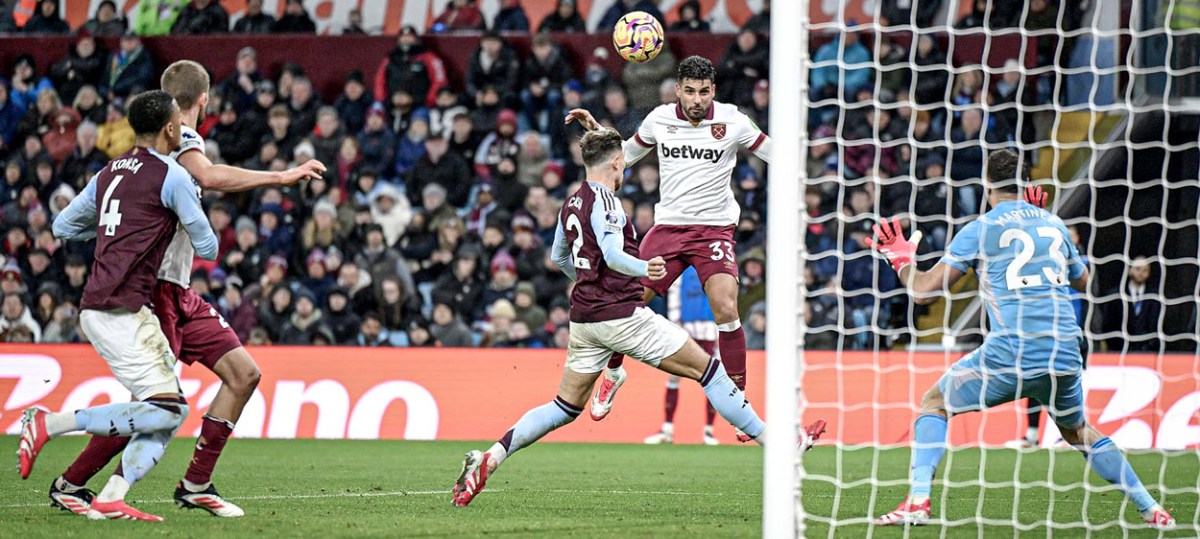
West Ham’s resistance lasted barely 15 minutes. Villa had been looking to target Mads Hermansen’s obvious weakness and uncertainty in the air at set pieces. But it was an alternative and well worked passing routine from a corner that drew first blood. The ball ending up with McGinn on the edge of area whose curled shot evaded the desperate dive of the Hammer’s keeper – who should have done better in my opinion.
The closest West Ham came to a leveller was in the immediate aftermath. Taty failing/ not trying hard enough to get firm contact onto a Bowen cross. After that it was one-way traffic with only the heroics of Konstantinos Mavropanos keeping the score respectable. Quite how referee Paul Tierney saw the excellent tackle on Watkins as a penalty is indicative of the ever-declining refereeing standards. For once, VAR did its job – clearly and obviously.
Watkins would get the last laugh, however, scrambling home in the 68th minute to finally kill the game off. It was a textbook catalogue of West Ham errors. Bowen giving the ball away cheaply in the final third. Tomas Soucek so slow in tracking Roger’s run that even VAR had announced check complete before he caught up. And finally, Hermansen spilling Rogers’ tame shot into the delighted Watkins’ path. Game over!
There was just enough time remaining for a masterclass from substitute Adama Traore, showcasing his full repertoire of comical misdirected and overhit crosses.
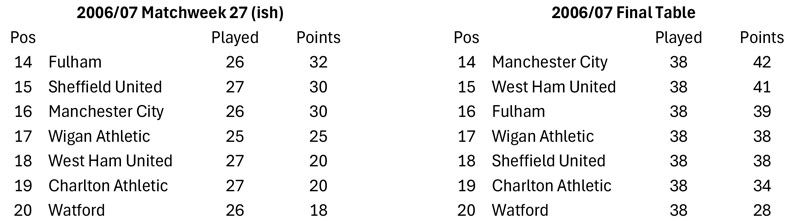
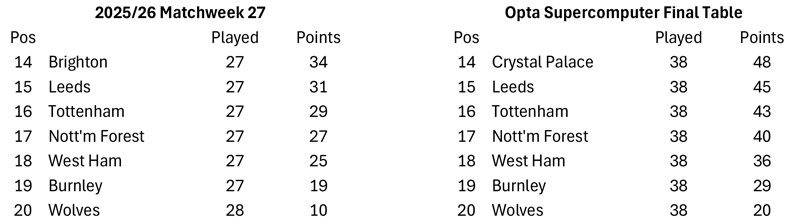
In truth, it was a game that few expected to win. But nevertheless, it was a worryingly disappointing and passive performance from Nuno’s men. Yet, in the bigger picture; in the realm of take one game at a time management, nothing has been decided. The games that we might hope to win are still to come – home to Wolves, Everton and Leeds, away at Brentford and Palace. There are points still to win.
If something good can come out from the dreaded international break, it is the opportunity to get Summerville fit for the run-in. The future may depend on his recovery rate improving considerably on his previous seven-month absence.
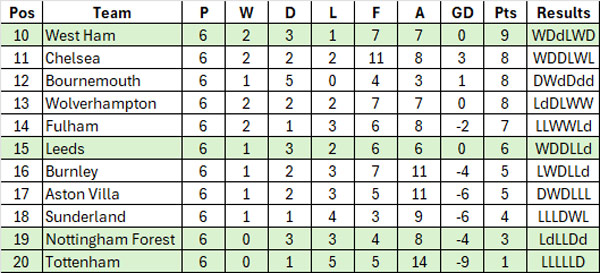
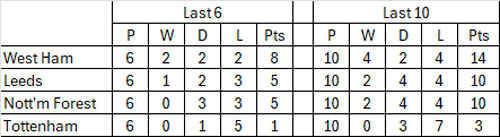
Elsewhere, Nottingham Forest were the big winners from the weekend. Picking up three points from an unexpectedly comfortable romp at the Tottenham Hotspur stadium. It turns out that reports of the north Londoner’s corner turning had been wildly exaggerated. They will no doubt now be looking for yet another replacement caretaker manager. What’s Ryan Mason doing now? Leeds will regard it as two points dropped against Brentford on Friday night.
Time to regroup then Hammers. The most recent battle was lost but the war is not yet over. As one well known presidential politician put it in a late night post:
“West Ham United, very underrated team, by the way. People don’t talk about them enough, but I do. I know football, maybe better than anyone, and I’m hearing VERY STRONG things about their survival chances. Very strong.
The so-called “experts” are saying relegation. WRONG! Total losers. They said the same thing about my many great successes and look how that turned out. West Ham has tremendous fans, really incredible people, and a beautiful stadium. London Stadium, fantastic place, I’ve heard.
They just need a little confidence, maybe a few better decisions from management (won’t name names!), and they will STAY UP. I guarantee it. People are coming up to me, big fans, tough guys, saying: “Sir, West Ham has plenty of bubbles left to blow.” And you know what? They’re right.“
MAKE THE IRONS GREAT AGAIN!

 Under The Hammers