

In the history of English football, West Ham have allowed their managers to remain in charge of the team for longer than any other club on average. Since 1902, when Syd King was manager, through our election into the Football League in 1919, right up until the present day, we have had just 15 permanent managers. A few others, most notably Trevor Brooking, acted as caretaker managers. I have been watching West Ham since 1958 and the boss at the time was Ted Fenton, who was just our third manager in over half a century. John Lyall took over from Ron Greenwood in August 1974, and remained in charge until he was sacked in May 1989, after an association of 34 years with the club.
Lyall began his career at West Ham aged 15 as a groundstaff boy and office clerk, and was a promising full back, playing 34 times for the first team before a serious knee injury ended his career. He won international youth honours playing one game for England Youth, and was a member of the West Ham youth side that reached the final of the FA Youth Cup in 1957. He then concentrated on coaching and became assistant manager to Greenwood in 1971, becoming team manager three years later when his mentor moved upstairs.
It was a topsy-turvy 15 years in charge with a lot of success (in West Ham terms) with FA Cup wins in 1975 and 1980, the latter being the last time a club from outside the top flight has won the trophy. European Cup Winners Cup losing finalists in 1976 and League Cup finalists in 1981, losing after a replay, were also notable achievements, as was an outstanding promotion season in 1980-81 where the second division title was won by a large margin with 28 wins and only four defeats. His managerial highlight was in 1985-86 where we came so close to winning the league title, eventually finishing third, which was (and still is) our highest ever placing. This was arguably our best ever season, and we certainly played some terrific entertaining football which I enjoyed enormously.
I maintain to this day that the postponed games and subsequent fixture pile up were key factors in us not winning the title that season. In John Lyall’s autobiography Just Like My Dreams he even wrote “West Ham’s last five games spanned just ten days – a demanding schedule and hardly the fairest way to settle a nine month long Championship race.” Perhaps if the club had considered installing undersoil heating like a number of clubs had done by that time, we might look back upon 1985-86 as the season we finished as champions?
The low points were two relegation seasons in 1977-78 and 1988-89, the latter resulting in Lyall’s dismissal which many felt was not handled well by the club considering his 34 years of service and his success in charge. The programme had just a few short sentences as acknowledgement of his long period of time at the club.
He deserves credit, in addition to the trophies and finals for keeping together and attracting high class players, in particular following the first relegation. Has there ever been a better second tier side in English football in history than the one that contained Phil Parkes, Ray Stewart, Frank Lampard, Billy Bonds, Alvin Martin, Alan Devonshire, Trevor Brooking, Paul Goddard and David Cross in 1980-81?
A year after being sacked he resumed his football management career at Ipswich, and in just his second season in charge led them into the newly-formed Premier League as Second Division champions. After a couple of years at the helm, he moved upstairs, and resigned soon afterwards.
John Lyall died suddenly of a heart attack in April 2006. He would have been 77 on 24th February this year. Less than a week after his death West Ham won through to the FA Cup final, our first since 1980, when he was our manager. The one minute silence at the semi-final just a few days after he died was followed by the continuous chant of “Johnny Lyall’s claret and blue army,” showing the genuine affection of our fans, and the high regard in which he was held. The main gates at Upton Park were renamed the “John Lyall Gates” in 2009, and have been moved to the London Stadium.
John Lyall managed West Ham for 779 games in 15 years. In pure statistical terms he had a win percentage of 40%, the fifth best record, after Bonds 44%, Pardew, Paynter and Fenton (all 41%). But if the club had invested in the team after our best ever season in 1985-86, who knows how much success we might have had?
How can we judge the success of football managers? Win percentages? Lose percentages? Goals scored and conceded? Trophies won? Stronger position financially? Attracting bigger crowds? A higher league position than when he came? A combination of these factors? Also do we need to consider the resources available and division we play in? You cannot really compare different eras but if I had to pick a 1-2-3 on a mixture of the above criteria, then in my opinion Greenwood, Lyall and Bonds would have to be considered the most successful. I’ll let the reader choose the order, or indeed make their own choice of who has been our best manager.
But whoever you pick, John Lyall gave great service to our club, and was considered to be a true gentleman by everyone who met him. He will always be remembered as an innovative coach who continued the tradition of his predecessor, Ron Greenwood, of playing football the “West Ham Way”.
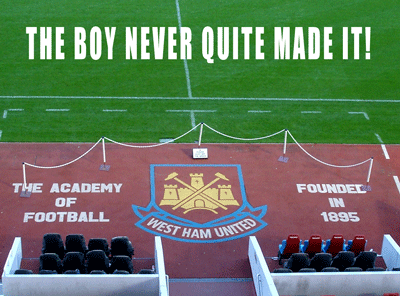 West Ham prides itself as the ‘Academy of Football’ in deference to the success it has achieved over the years in bringing through talented young players from the youth system. Most fans have a special place in their heart for home grown players but so often talented youngsters burst onto the scene only to fail to fulfil their promise. In this series we look at some of those players who despite high hopes never quite made the grade at their boyhood club. Today we look at the career of Zavon Hines; the only West Ham player ever to have a first name starting with the letter ‘Z’.
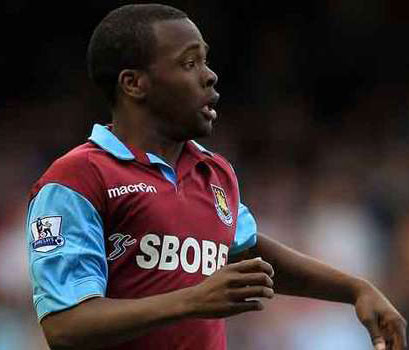 Hines had spent a brief spell out on loan at Coventry City before being given his West Ham debut, as a substitute for Valon Behrami, in a League Cup tie against Macclesfield in August 2008. Hines was one of three goal scoring substitutes that day in a 4-1 victory. A knee injury hindered progress during the remainder of the 2008/09 season but despite this he received a call-up from Jamaica for an international friendly in early 2009 although ultimately he did not play. Hines later went on to represent England at U21 level, scoring two goals in two appearances.
 In last week’s Hammer’s History we remembered the 1972 FA Cup 4th round replay with Hereford United, memorable for its midweek afternoon kick-off as a consequence of the ongoing miner’s strike affecting electricity supply. Just a few days later it was straight on to the 5th round with an away trip to Huddersfield Town. The Terriers played Manchester City in the 2016/17 competition this weekend aiming to reach the 6th round for the first time since the elimination of the Hammers in 1972. This was an all First Division at the time but the Hammers, who had recently lost out in the epic League Cup semi-final to Stoke, were favourites to go through against a team who had not scored in their last four outings and were languishing second from bottom in the league. League standings counted for nothing, however, as Huddersfield tore into the Hammers to take the lead midway through the first half. West Ham managed to level before half-time through Pop Robson but three second half goals (including one from Frank Worthington) put the hosts in control and despite a late Clyde Best consolation the tie ended 4-2. Huddersfield were beaten by Birmingham in the semi-final and finished the season bottom of the First Division.
 Enforced international breaks and early cup exits serve to create a fragmented season and leave a massive thumb-twiddling void on a winter weekend. Desperate times call for desperate measures and taking refuge in the shed on the pretext of rearranging your tools is perhaps the only chance of dodging an afternoon at the shops.
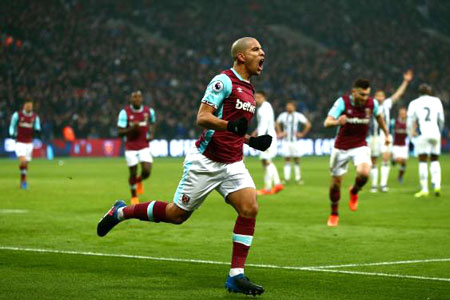 I have written on a number of occasions regarding games involving West Ham and any team managed by Tony Pulis. My articles go back years to when he was the manager of Stoke City, and how I detested their time wasting tactics, their blocking off the ball (American Football style), and their long throw game. Now that he is manager of West Brom he has produced a team of giants who have had a successful season, exceeding everyone’s expectations, and who currently sit in eighth place in the Premier League.
 That’s Entertainment
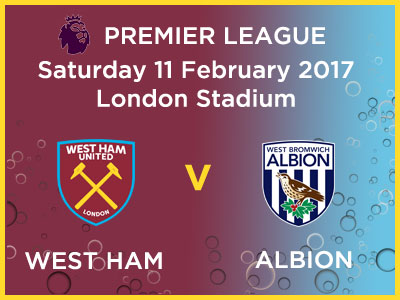 Having stealthily clawed their way to 9th in the Premier League table, with a sequence of effective rather than spectacular performances, West Ham will seek to build on the resurgent air of optimism at the London Stadium by stamping their authority of today’s encounter with West Bromwich Albion.
 Under The Hammers