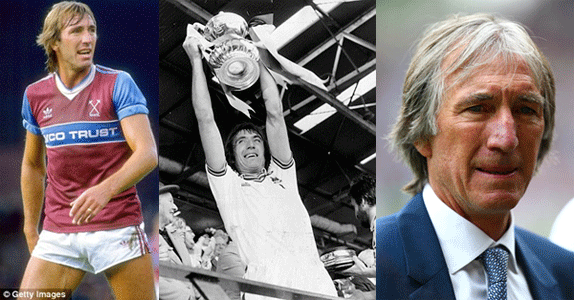
West Ham Heroes – Number 4 – Billy Bonds

Six foot two, Eyes are blue, Billy Bonds is after you!

Billy Bonds

Throughout most of the 1950’s and the early 1960’s the number 2 shirt at West Ham was owned by John Bond. He was the right back in our FA Cup winning side in 1964 and was really the only number 2 I ever remember in my early years of watching West Ham. He played his last game for us in 1965, and was followed towards the end of the European Cup Winners Cup winning season by Joe Kirkup and Dennis Burnett. But we really needed to strengthen the team in this position so Ron Greenwood signed William Arthur Bonds, known to us all as Billy, in 1967.

Those of us who were there on 19 August 1967 for the opening game of the season against Sheffield Wednesday witnessed the debut of the player who went on to play more games for the club than any other, 799, in a long career that spanned 21 seasons. He started at right back and without a doubt he was the best player I have ever seen in that position at West Ham.

Around three years later he was switched to play in midfield and formed an amazing partnership alongside Trevor Brooking. Throughout the first half of the 1970’s he continued in this role and once again, I have to say he was the best player I have ever seen at the club in the “box-to-box” midfield role.

He became captain when Bobby Moore left in 1974, and for the final ten years at West Ham he played at the back, initially alongside Tommy Taylor, and then formed an excellent partnership with the young Alvin Martin. He was one of the best centre backs I’ve ever seen at West Ham too, and in all three roles at the club he excelled.

He would be one of the first names in my all-time West Ham heroes team, and could fill any of the three positions, but perhaps he was at his playing peak in the early 1970’s when he single-handedly won so many games for the club from midfield.

To be honest I cannot recall a single game where I left the ground thinking that he hadn’t played well. He was fully committed throughout every game, and perhaps his skill was overshadowed by his commitment to win the ball when our opponents had it, but you shouldn’t be fooled, he was great with the ball too.

If I had to pick out one game that I remember above all others it was the day in March 1974 when we beat Chelsea 3-0 and Bill scored a hat-trick. He finished that season as leading scorer, which was most unusual from a midfield role, particularly in those times. Around the time of the Chelsea game I remember seeing him score a magnificent left-footed volley from outside the penalty area in a game against Coventry at Upton Park. I was standing on the North Bank directly in line with the shot.

He was always considered to be the fittest player at the club, and was almost 42 when he retired at the end of the 1987-88 season. I’ve watched the England team since the late 1950’s and when I think of some of the players who have pulled on the three lions shirt, then I am amazed that Bill never did. Without a shadow of a doubt he was the best English footballer I have ever seen (by a country mile) who never represented the full national team. He came very close a couple of times, but injury denied him in the end.

After being a youth team coach at the club, he became manager following the resignation of Lou Macari in 1990, and in his first full season at the helm led us to promotion. In the following ill-fated “Bond scheme” season that followed we were relegated, but the following year he led us back up into the top flight. He resigned in August 1994 when Harry Redknapp took over, and the two of them, who were very close friends, have never spoken since. The circumstances regarding the resignation have differing versions according to what you read.

Many consider that he was the best West Ham manager ever. Certainly those who trust statistics do. His win percentage of 44% is the highest of all full time West Ham bosses in history, his losing percentage of 30% is the lowest of all full time West Ham bosses in history, and the goals scored minus the goals conceded per game at 0.32 is also the best of all full time West Ham bosses in history.

He was Hammer of the Year four times, was awarded the MBE, won the PFA Merit award when he retired, and was the initial recipient of the West Ham lifetime achievement award in 2013. Quite simply he was an absolute West Ham legend. I’d personally like to see greater recognition for him at our new stadium.
This Week in Hammer’s History

A week that encompasses Halloween to Guy Fawkes night has produced its fair share of scary moments and fireworks.

This Week Hammers HistoryIf you had ventured along to Upton Park on 4 November 1995 you would have been one of the few people to have seen Marco Boogers in action for West Ham in the 4-1 defeat by Aston Villa . Our only signing of note in the pre-season the million pound striker’s career with the Hammers consisted of just 4 substitute appearances. We lost each of these games and in one he was famously sent off at Old Trafford for a “sickening horror tackle” on Gary Neville. Harry Redknapp who had signed Boogers on the strength of video footage claims that this was his worst ever signing although apparently Marco never did go to seek refuge in caravan.

In 1988 West Ham thumped Derby 5-0 (Stewart, Martin (2), Keen, Rosenior) in a 3rd round League Cup tie. It was a season where we reached the semi-final of that competition and the 6th round of the FA Cup but were also relegated. A feat also achieved during the Avram Grant season. So beware of good cup and poor league from! Three seasons later we had returned to the top flight but were relegated once more but not without recording a shock 1-0 victory at Highbury on 2 November through a Mike Small screamer past David Seaman.

Some excellent goals were scored in a topsy-turvey encounter with QPR on 2 November 1968 including a Bobby Moore piledriver and a spectacular Harry Redknapp volleyed winner. The goal celebrations were far more restrained back then. A few years previously on 4 November 1961 West Ham had won 5-3 away to Manchester City (Sealey (2), Dick (2), Musgrove) in a match notable for Booby Moore’s only sending off as a West Ham player.

As an aside Moore was also sent off while at Fulham in a 1976 league cup replay away to Bolton. In a game of few stoppages Bolton had equalised in the 6th minute of injury time resulting in Moore given his marching orders for dissent. Bobby stormed off the pitch taking the rest of the team with him who then refused to return to play the 30 minutes of extra time until convinced to do so by the referee and two policemen. No further goals were scored.

There have been plenty of fireworks on 5 November including a 1960 6-0 thrashing of Arsenal (Malcom, Woosnam, Dunmore (3), Dick) and a 1966 drubbing of Fulham (Peters 2, Hurst 4). Hurst went on to score 29 league goals that season and 41 in all competitions; oh for a goal scoring striker. The same day in 1975 witnessed a 3-1 ECWC success at home to Araraet Erevan (Taylor, Paddon, Keith Robson) as we made our way towards a final appearance.

The day after Bonfire Night was often spent scouring the neighbourhood for old fireworks but in 1976 we trooped off to see a bottom of the table clash between West Ham and Tottenham. The Hammers were rock bottom with just 1 win and 2 draws from 12 matches played while Tottenham had fared little better and were just 3 places better off. In a game where any pretence of defence was abandoned early on the Hammers raced into a 5-1 lead (Bonds, Curbishley, Brooking, Jennings, Pop Robson) before Hoddle and Keith Osgood threatened a late comeback. However, West Ham held on to run out 5-3 victors and end a sequence of 5 consecutive defeats. Much to our delight at the time Spurs were relegated at the end of the 1976/77 season although the euphoria was short lived as the following campaign saw our own relegation and them make an immediate return.  Day, Bonds, Lampard, Curbishley, Lock, Taylor, Devonshire, Pike, Jennings, Brooking, Pop Robson.

Notable Birthdays this week:

3 November   Ian Wright (53)
4 November   Enner Valencia (27)
7 November   Rio Ferdinand (38)
7 November   Arthur Masuaku (23)

West Ham Heroes – Number 3 – Sir Geoff Hurst

The West Ham and World Cup striking hero who had no trouble knowing where the goal was.

Sir Geoff Hurst

For a West Ham footballer of the 1960s Geoff Hurst was something of a rarity. Almost all of the team at the time were born within the sound of Bow Bells, whereas Geoff was born, as all the football programmes of the time will tell you, in Ashton-under-Lyne, Lancashire. His family moved to Chelmsford when he was a small boy, so he qualifies as another local player. His dad was a professional footballer in the lower leagues. Geoff joined the youth set-up at Upton Park around the same time as Bobby Moore.

In his early days he was a wing half, just like Bobby, but one day, in September 1963, Ron Greenwood made one of the most inspired footballing decisions of all time, when he decided that Geoff should swap his number 4 shirt for the number 10 shirt and play up front. Of course the rest is history.

In around 500 games for us he scored 249 goals, making him our second highest goalscorer of all time behind Vic Watson from an earlier era. As a centre-forward he had all the attributes needed, powerful, fast, strong in the air, two good feet, and an unshakeable temperament, where he refused to be intimidated by the tough-tackling defenders that were around at the time. He also knew how to put the ball in the net.

He played 49 games for England, scoring 24 goals. For West Ham and England he scored an average of a goal every other game. Of his type, and I know I am biased, I believe he was the best centre-forward I have ever seen. Only Alan Shearer runs him close; they had many similarities as footballers, with similar goalscoring records.

Of course he is most famous to the world at large for scoring a hat-trick for England in the 1966 World Cup Final. He remains the only footballer to have achieved the feat. He only won his first England cap in February 1966, and didn’t even start the tournament that year in the team. He came into the side for the quarter-final against Argentina when Jimmy Greaves was injured. He scored the only goal of a tough game, turning in a near post cross from Martin Peters, a goal straight from the West Ham training ground at Chadwell Heath.

He kept his place for the semi-final, setting up one of the goals in a victory over Portugal, and controversially (to some) also retained his place in the team for the final, despite Jimmy Greaves having recovered from injury. In so many ways, the hat-trick in the final was perfect. A near post header from a Bobby Moore free kick, a right footed shot that thundered down off the underside of the bar, and a left footed screamer in the last seconds of extra time (when some people were on the pitch thinking it was all over!).

But my main memories are of the goals and performances for West Ham throughout the 1960s. In many ways Geoff took over from my previous hero who wore the number 10 shirt, John Dick. Geoff was the leading scorer in seven seasons, and in the mid-sixties he twice scored forty goals in all competitions.

Perhaps the most impressive front-two partnership I have ever witnessed in almost sixty years of watching the game was the one Geoff forged alongside Johnny (Budgie) Byrne for a five year period from around 1962 until 1967. Their understanding, not to mention their prolific goal tally, was superb. He also played up front for a short time alongside both Jimmy Greaves and Pop Robson in a claret and blue shirt. Many will also recall the almost telepathic partnership with Martin Peters who played in midfield. On so many occasions they set up goals for one another, many of them coming from the near post cross that West Ham patented at the time.

I was listening to Dean Ashton (another in the Geoff Hurst mould) on the radio recently and he was bemoaning the current trend for one striker playing up front on his own. How I would love to see a change of tactic with a front pairing along the lines of Hurst and Byrne, or McAvennie and Cottee, in our attack at the moment.

Geoff was Hammer of the Year on three occasions in the 1960s at a time when we had so many great players. He is one of a handful of footballers to have been knighted, although quite why that honour was not bestowed upon the whole of the 1966 World Cup winning team is beyond me.

Of course we can’t leave a piece on Geoff Hurst without mentioning the controversial third goal (the first in extra time) in the 1966 World Cup Final. Apparently Geoff is asked the question almost every day. Did it cross the line? Well Roger Hunt says it did, as did the Azerbaijan linesman. That’s good enough for me!

This Week in Hammer’s History

The League Cup dominates the week 24 – 30 October in Hammer’s History.

This Week Hammers HistoryAppropriately in a week where we have a League Cup fourth round tie scheduled this week in Hammer’s history is dominated by various encounters across the years in the Cinderella  competition. Arguably, the easiest competition to win but one in which we remain complete virgins.

True to form there have been the expected disasters where the dreaded banana skins have fulfilled their slippery potential and sent us skidding towards the exit door. Notable among these were a 3-2 defeat to 4th division Darlington in the inaugural 1960/61 competition and 2-1 reverse to Chesterfield in 2006.

For the Darlington game a crowd of 17,057 (paying record gate receipts of £2,179 16s 9d) packed into the Feethams Ground and witnessed the hosts take the lead after just 20 seconds despite West Ham having kicked off. Dave Dunmore grabbed an equaliser to make it all square at half time before Darlington scored two midway through the second half to race into a 3-1 lead; the second of these goals following a poor backpass by full-back John Lyall. John Dick did manage to reduce the arrears with 20 minutes to play but that was as good as it got before the long trip back from the North-East.  Rhodes, Bond, Lyall, Malcolm, Brown, Moore, Grice, Woosnam, Dunmore, Dick, Musgrove.

Wednesday’s match with Chelsea will be the third League Cup meeting during this week in history with the spoils standing at one a piece to date as 1-0 advantages have favoured the home side on each occasion. We can eagerly look forward to history repeating itself in the coming days.

A particularly memorable match for me was the fourth round tie against Liverpool in 1971. With a crowd of over 40,000 and one of those electric nights under the Boleyn lights there was the elation of a late Pop Robson winner to seal an exciting 2-1 victory. I was convinced our name was on the trophy that season but the campaign was ultimately thwarted at the end of the epic semi-final series against Stoke City. Victory over Stoke would have interestingly set up a final tie at Wembly with Chelsea.

To finish on a high we will remember a second round second leg tie from 1983. Already leading 2-1 from the first leg West Ham welcomed 4th Division Bury to Upton Park on a cold Tuesday night. The crowd of just under 11,000 were rewarded for their tenacity and endurance with a 10-0 victory (a joint competition record) including a 4 goal haul for the 18 year old Tony Cottee. So impressed were West Ham by Bury’s defending that they signed the Shaker’s centre half Paul Hilton shortly after.

Take a look at the video (the date incorrectly states the 25 August) to re-live the evening along with a laconic Irish commentator and his unusual references to Bill Bonds.

There are no birthdays of note this week.

This Week in Hammer’s History

Shaking down the week 17-23 October in West Ham history.

This Week Hammers HistoryIn the new spirit of optimism that has swept into West Ham since the victory at Palace on Saturday I have decided to ignore any defeats in this week’s review of the week in Hammer’s history. The latest win completed a hat-trick of away victories at Selhurst Park and came almost a year after the previous success where goals from Jenkinson, Payet and Lanzini saw West Ham climb to 4th in the table.

Saturday also brought a welcome clean sheet courtesy of solid defending, some fine Adrian saves and Christian Benteke. The passing years have witnessed several high scoring, clean sheet performances which includes two thrashings of our next opponents, Sunderland. Most know of the 8 goal rout in 1968, famous for Geoff Hurst’s six-goal haul, but there was also a 5-0 victory in a second division clash in 1989 (two from Eamon Dolan). Ironically, Sunderland were promoted through the Play-offs that season despite losing the final when their victors, Swindon Town, were denied promotion due to irregular payments to players. West Ham meanwhile had finished in 7th place.

Other notable wins were a 4-0 European Cup Winner’s Cup second round tie against Poli Timisoara in 1980 and a 3-0 win in a bad tempered affair against Bolton Wanderers in 1997.

Dipping into the 1985/86 season it was during October that the season really started to pick up steam. We went into the month in 13th position with 13 points from 10 games (which is what winning our next two games would give us) and by the end had climbed to 7th following three wins and a draw.

On 19 October 1985 West Ham entertained Aston Villa in front of just 15,034 spectators at the Boleyn Ground. With no football on TV in the early part of the season I am relying on memory and I believe that we went 1-0 down to a Simon Stainrod goal before a brace each from McAvennie and Cottee secured a 4-1 victory. The two prolific front-men had by then scored 19 or the Hammer’s 23 league goals between them and went on to contribute 46 by the end of the campaign.

During the season a total of 9 players went on to start in 38 or more of the 42 league games played. One of these, Alan Dickens, was missing from the lineup against Villa: Parkes, Stewart, Walford, Gale, Martin, Devonshire, Ward, McAvennie, Parris, Cottee, Orr

One game to mention from this week that West Ham didn’t win was the 2-2 draw against Tottenham in 1970; a game that will always hold the record for the highest (official) attendance at the Boleyn Ground of 42,322. (As a teenager back then we would often go two people through the same turnstile click so I was always a little sceptical of the official attendances.)

The 1970 season was not one of the most memorable as we finished one place off of relegation. The match saw the debut of Tommy Taylor who I remembered as playing some nice football while being a little suspect defensively. Hurst and Eustace scored the West Ham goals: Grotier, Bonds, Lampard, Eustace, Taylor, Moore, Ayris, Lindsay, Hurst, Greaves, Dear

Birthdays this week:

18 October   Peter Grotier (66)
21 October   Paul Ince (49)
23 October   Christian Dailly (43)

This Week in Hammer’s History

Picking through the scraps of the week 10 – 16 October in West Ham history.

This Week Hammers HistoryContinuing from last week’s theme there was an unprecedented run of League Cup successes during this week in history with victories, sometimes convincing ones, over Stoke, Sunderland, Mansfield, Bournemouth and Villa (twice). It seems that if we avoid the first round ‘banana skin’ then we are on a roll in this competition; so set your expectations for the impending Chelsea clash in a few week’s time. The one League Cup defeat though was a poor one in the shape of a 1962 away defeat by 3 goals to 1 against Rotherham.

Looking through the results I am generally attracted by the high scoring games and there have been a number of these which we will look at in a little more detail.

At the start of the 1986/87 season expectations were high following the record third place place finish last time out. The season started encouragingly, stuttered a little with successive home defeats to Forest and Liverpool but then picked up again to put us on the fringes of the top 6. On 11 October 1986 Chelsea were the visitors at Upton Park; a side that represented the highs and lows from the 85/86 season including their final day defeat to Liverpool. With Devonshire and Martin absent, the Hammers had Paul Hilton in defence, a young Kevin Keen in the midfield and Billy Bonds back on the bench. It was a game of 3 penalties (including 2 that were quite debatable) and it was one of these that gave Chelsea a 1-0 lead. However, a McAvennie header and a Tonka Stewart special penalty put the home side back in front at half time. In the second half Chelsea grabbed two more goals to reclaim the lead before another Stewart penalty and two from Cottee earned a thrilling 5-3 victory.

Parkes, Stewart, Parris, Gale, Hilton, Keen, Ward, McAvennie (Bonds), Dickens, Cottee, Orr

By 1992 were sitting out the inaugural season of the Premier League following relegation from the First Division to the First Division. After a sluggish start we had started to build some momentum when we met Sunderland at home on 11 October. The game was something of a romp as goals from Keen, Morley, Martin Allen, Martin and Mark Robson (2) gave the watching 10,326 supporters an afternoon to remember with an imperious 6-0 victory. The win put West Ham back in the top 6 where they stayed for the rest of the season. By the middle of January we commenced a long run in second spot behind Newcastle until surrendering it to Portsmouth during the run-in only to nick it back at the death and secure automatic promotion on the final day of the season.

Miklosko, Breacker, Dicks, Potts, Martin, M Allen, Robson, Butler, Morely, C Allen, Keen

On 14 October 2001 new manager Glen Roeder took his floundering side to Ewood Park to take on Blackburn Rovers. In the previous match West Ham had conceded 5 without reply at Everton and so started the game looking to keep things tight at the back. The tactic worked for 18 minutes until 3 goals in 10 minutes ruined Roeder’s game plan although Michael Carrick managed to pull one back before half time. The introduction of Hayden Foxe and Grant McCann at the break gave the Hammers some added impetus and might easily have reduced the deficit further (including one shocking miss by Trevor Sinclair) until Tomas Repka was sent off (his second dismissal in 3 games) after picking up a second yellow card. Four more Blackburn goals ensued (including a Grant McCann own goal) to make it 7-1 and a humiliating afternoon for the Hammers; leaving them second from bottom in the Premier League. Despite this a post Christmas surge saw West Ham finish in a respectable 7th place.

Hislop, Schemmel, Soma, Dailly (Foxe), Repka, Hutchison, Sinclair, Carrick, Kanoute, Di Canio, Moncur (McCann)

For anyone into self-flagellation there are extended highlights of this match below:

Notable West Ham birthdays this week:

10 October        Mark Ward 54
12 October         Paul Goddard 57
13 October          Scott Parker 36

Counting Sheep – 8 – The Letters M and N

Another combined team in the search for alphabetically themed West Ham teams.

Counting SheepThis all began with me selecting teams of West Ham players whose surnames all started with the same letter. The aim was to help me drop off to sleep instead of the more traditional method of counting sheep.
So far I’ve picked seven teams, “B”, “C”, “D”, “F”, a combined “G” and “H”, a combined “J”, “K” and “L”, and “Vowels”. M comes next and it was easy to write down enough names to form a decent team. But thinking ahead to N I realised that I would have few options there, so once again I decided on a combined team. There are at least four stand-out captains in this side, although the one and only Sir Bobby would be the choice for this role.

My all-time West Ham “M” plus “N” Team in a 4-4-2 formation are:

Miklosko
McDowell
Martin
Moore
McCartney
Malcolm
Moncur
Noble
Nolan
McAvennie
Morley

So who have I left out this time? McKnight, McAllister and Mackleworth are three keepers who would have received very few votes when being compared to my selected custodian, Miklosko. Outfield players (M) were Mascherano, Morrison, Musgrove (perhaps the unluckiest to be omitted), Mullins, Moses, McAnuff, Maynard, MacDougall, Maiga, Margas, McGiven, McCarthy, McQueen, Mellor and Minto. The Ns included Neighbour, Neill, Nene, Newell and Nordtveit. Some very good players have not been included plus some who didn’t pull up any trees in a West Ham shirt.

Have I forgotten someone really good who is a must for the M/N team? And I can only remember one M/N manager. I’ll bet you don’t think of him as one of our most successful managers; Lou Macari.

This Week in Hammer’s History

A trawl through the week 3 – 9 October in Hammer’s history.

This Week Hammers HistoryThe week 3 – 9 October in West Ham history is another that has seen many Football League Cup matches since its inception in the 1960/ 61 season. My perception is that this is a competition that West Ham usually fare badly in and one where we are invariably eliminated on a proverbial damp Tuesday night somewhere up north by a lower league side. It was a surprise, therefore, to see that the week has witnessed far more League Cup successes than failures including a creditable 3-1 away victory over Arsenal in 1966 (Hurst 2, Peters) as well as comfortable wins against the likes of Darlington (1975), Southend (1979), Bristol City (1984), Swansea (1985), Preston (1986), Bradford City (1991), Chesterfield (1993) and Walsall (1994).

That is not to say that there have not been embarrassing exits and these include a straight 2-1 defeat away to Stockport County in 1972 and two legged defeats to Barnsley (1987) and Crewe (1992). Against Barnsley a goalless draw in the away leg was followed by a 2-5 home hammering at home while the Crewe tie saw a goalless home draw followed by an emphatic 2-0 away defeat.

Notable League fixtures have included a 4 goal haul for Vic Keeble in an exciting 6-3 victory over Blackburn Rovers in our first season back in the First Division in 1958 as well as the one and only Steve Potts goal in the 7-1 demolition of Hull in 1990. A victory over Liverpool is always welcome and in 1982 goals from Alvin Martin, Geoff Pike and Sandy Clarke (remember him?) helped the Hammers run out 3-1 winners and climb into second spot in the league.

The 6 October 2013 was the date of the famous Ravel Morrison goal in the surprise 3-0 win at White Hart Lane; what a player we thought we had on that day. Many of us believed going into the game that we would be on the wrong end of a hammering; a team who had yet to score an away goal against a buoyant Tottenham side. A chance to re-live the 3 goals in 13 second half minutes below:

This week’s featured game is from 3 October 1999 where two goals from Paolo Di Canio gave West Ham victory over high flying Arsenal at Upton Park. It was Arsenal who bossed the early stages of the match and went close to opening the scoring on several occasions with Bergkamp, Henry and Suker causing problems for the West Ham defence. On 29 minutes, however, PDC set off on a mazy run from inside his own half. It was not the most elegant of dribbles and there was a touch on pinballing before the ball broke wide to Trevor Sinclair. Sinclair’s initially shot was blocked but his cross broke to Paolo who slotted home to make it 1-0. On 72 minutes Di Canio got on the end of a Paulo Wanchope header, flicked the ball over the head of a confused Martin Keown and fired past Seaman for 2-0.

The two goal advantage didn’t last long, however, as Arsenal pulled one back when Steve Lomas set up Davor Suker (one of the many duds that we subsequently took off Arsenal’s hands) to make it 2-1. The remaining minutes was mostly Arsenal pressure and desperate West Ham defending and, although there was still time for Patrick Viera and Marc-Vivien Foe (RIP) to get sent off for second bookable offences, there were no further goals. Viera’s sending off sparked a mini melee which ended with him pushing and then spitting in the face of Neil Ruddock. A win for the Hammers in front of just over 26,000 supporters saw them end the day in 9th place.

Hislop, Potts, Ruddock, Stimac, Sinclair, Lomas, Lampard, Foe, Moncur (Margas), Di Canio, Wanchope (Kitson).

This time it is not much of a week for Hammer’s birthdays:

3 October Clive Charles (d 2003)
7 October Jermaine Defoe (34)
8 October Paul Hilton (57)
9 October Frank O’Farrell (89)

The Boy Never Quite Made It: Adam Newton

Remembering Adam Newton star of the FA Youth Cup winning team of 1999.

Boy Never Quite Made ItThe West Ham Under-19 side of 1998/99 swept all before them in claiming a spectacular league and cup double. The climax to the season was the two legged FA Youth Cup Final against Coventry City. The Hammer’s opened up a healthy 3-0 advantage in the first leg at Highfield Road and yet 21,000 supporters still turned out to watch the return at Upton Park a week later on Friday 14 May 1999. It took only a few minutes for West Ham to extend their lead and they eventually ran out 6-0 winners on the night (9-0 on aggregate).
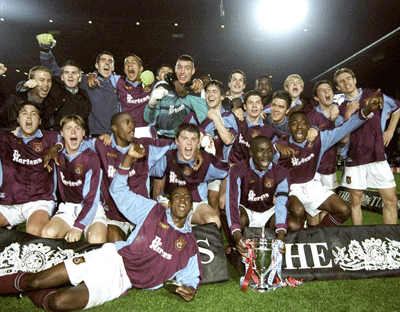
The West Ham team that night was: Bywater, Newton, Taylor, Forbes, Iriekpen, Ferrante, Cole, Carrick, Angus, Garcia, Brayley

Expectations were high for a new golden generation arising at Upton Park. Apart from the obvious talents of Joe Cole and Michael Carrick there were other promising players including Izzie Iriekpen, Richard Garcia and, in particular, Adam Newton. It is full/ wing back Adam Newton who is the subject of today’s The Boy Never Quite Made It feature; although there are plenty of other candidates from that side.

WHU Youth 1999Newton had scored in both legs of the Coventry final. In the first a delightful chip over the head of the advancing Chris Kirkland and in the second an exciting run topped off with a ‘sumptuous’ strike past the stationary keeper. In many ways Newton was the star of the show even overshadowing the better known Cole and Carrick duo. There were even rumours of a million pound bid from Spurs shortly after the final.
At the start of the 1999/ 2000 season Newton had a brief loan spell with Portsmouth before returning to Upton Park for his West Ham debut in August 1999; a substitute for Marc Keller in an away defeat to Coventry City. A week later he made another substitute appearance (this time for Trevor Sinclair) in the 3-1 UEFA Cup victory over NK Osijek of Croatia. He made his final West Ham appearance in April 2000; again as substitute (for Scott Minto) in the 5-0 home win against (surprise!) Coventry City. Harry obviously regarded Newton as a Coventry specialist.

The following two seasons were spent out on loan at Notts County and Orient before being given a free transfer to join Peterborough United in May 2002. Newton spent six seasons at Peterborough in the Second Division and although they won promotion at the end of the 2007/08 season his contract was terminated. Born in Grays, Newton had represented England at U21 level but became a full international for Saint Kitts and Nevis during his time with the Posh.

The following season Newton signed a one year deal with Brentford and helped them win the Division Two title in 2009. One more, however, his contract was not renewed and he moved on to Luton in the Football Conference. Two years at Luton ended with a Play Off final defeat, no new contract and his final move to Woking in the Conference South.

Adam Newton appeared to have all the attributes to make it to the top at West Ham; skill, speed and athleticism. Sadly, it just didn’t come together for him and he is one more bright hope from the academy that never quite made it in the first team.

That Was The Week That Was (Extra)

A special supplement looking at events in September 1998.

This Week Hammers HistoryGeoff writes some excellent features that look back on specific weeks in West Ham history. I hope he doesn’t mind if I add to this week’s article which was posted on September 26, as I have personal memories of the long weekend (in football terms) that stretched from Thursday 24 September to Monday 28 September in 1998. That is eighteen years ago. So anybody born in that week is now able to do various things legally that they weren’t supposed to beforehand. And I personally know somebody who had their 45th birthday on September 27 that year, and who therefore celebrates their 63rd this week. Happy birthday Mr. H.

The weekend in question is what might be termed Premier League Matchday 7 nowadays, although I don’t think the phrase existed at the time. So every team had played 7 games at the end of the weekend, except for Manchester United and Chelsea who had only played six for reasons that I cannot recall.

Manchester United beat Liverpool 2-0 in the Thursday game in front of the weekend’s biggest attendance of just over 55,000. Aston Villa beat Derby 1-0 to open up a five point lead at the top of the table with five wins and two draws in their seven games. Incredibly (for a team well on top) they had only scored eight goals and conceded just one. This was the first defeat of the season for Derby, who were in second place, and they too had very few goals in their games, with just six scored and three conceded.

There were far fewer goals scored at the beginning of the 1998-99 season compared to today. 153 goals had been scored in 69 matches. This season there have been 176 goals in just 60 games. Only one of the ten games that weekend produced more than 2 goals (a 3-3 draw between Tottenham and Leeds). This year, last weekend had 7 matches where three or more goals were scored.

Aston Villa were top, Derby were second and Wimbledon third, (with West Ham fourth). Other Premier League teams included Newcastle, Leeds, Sheffield Wednesday, Charlton, Forest, Coventry and Blackburn. 50% of the teams in the league 18 years ago are no longer in the top flight. To further illustrate the changing nature of teams at the top, five of those teams who are not currently in the Premier League have been champions in the top flight of English football in the last forty-five years.

Di CanioI remember the weekend for two particular reasons. Firstly, I was at Upton Park for our game which featured as the Sky Monday night football. Just over 23,000 were there to witness us beating Southampton (who were rooted to the bottom with just one point at the time) by 1-0, with an Ian Wright goal in the second half. Compare that to the attendance for our game against Southampton on Sunday!

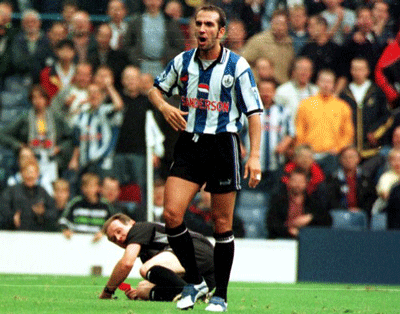
But the most remembered aspect of that weekend was in the game at Hillsborough where Sheffield Wednesday beat Arsenal 1-0 with a late goal. A certain Mr. Di Canio got in an angry exchange with both Patrick Vieira and Martin Keown. The referee, Paul Alcock, sent off Di Canio, who was so angry he pushed the official, who then fell theatrically to the ground. The red card (and of course the push) led to Di Canio receiving an eleven match ban. This was effectively the end of his time at Wednesday, and early in 1999 Harry Redknapp took what many considered to be a massive gamble, and brought Di Canio to Upton Park. In the four years he spent with us he became an Upton Park legend.

And how did the season end? Southampton, who were five points adrift of safety when we beat them, avoided relegation. Perhaps our situation is not as critical as the doom-mongers amongst our fans would have you believe after our poor start this season? Villa did not hang on to their big early season lead and finished in sixth place, 24 points adrift of Manchester United, the champions. Derby fell to eighth, and Wimbledon fell dramatically from third after seven games, to finish fifth from bottom.

We had what still remains as our best ever Premier League season finishing in fifth place. Not quite as impressive as our 1985-86 third place in the top flight, but our best ever finish since the inception of the Premier League which has been going for around 25 years now. As a result we qualified for the Intertoto cup, and our success in that meant we went on to the UEFA Cup where we were eliminated by Steaua Bucharest of Romania. What is it about Romanian teams?

Incredibly for a team finishing in fifth place, Ian Wright was our leading scorer for the season with just nine goals. Following the end of the season he never played another league game for us again, going out on loan to Forest and then finishing his career at Celtic and Burnley.

But it was the events at Sheffield Wednesday that weekend that were to have a significant impact on the history of West Ham, especially for the following four years.