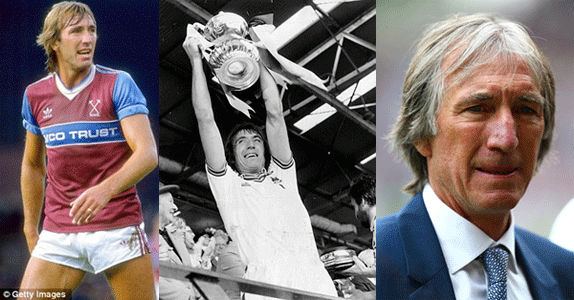
West Ham Heroes – Number 4 – Billy Bonds

Six foot two, Eyes are blue, Billy Bonds is after you!

Billy Bonds

Throughout most of the 1950’s and the early 1960’s the number 2 shirt at West Ham was owned by John Bond. He was the right back in our FA Cup winning side in 1964 and was really the only number 2 I ever remember in my early years of watching West Ham. He played his last game for us in 1965, and was followed towards the end of the European Cup Winners Cup winning season by Joe Kirkup and Dennis Burnett. But we really needed to strengthen the team in this position so Ron Greenwood signed William Arthur Bonds, known to us all as Billy, in 1967.

Those of us who were there on 19 August 1967 for the opening game of the season against Sheffield Wednesday witnessed the debut of the player who went on to play more games for the club than any other, 799, in a long career that spanned 21 seasons. He started at right back and without a doubt he was the best player I have ever seen in that position at West Ham.

Around three years later he was switched to play in midfield and formed an amazing partnership alongside Trevor Brooking. Throughout the first half of the 1970’s he continued in this role and once again, I have to say he was the best player I have ever seen at the club in the “box-to-box” midfield role.

He became captain when Bobby Moore left in 1974, and for the final ten years at West Ham he played at the back, initially alongside Tommy Taylor, and then formed an excellent partnership with the young Alvin Martin. He was one of the best centre backs I’ve ever seen at West Ham too, and in all three roles at the club he excelled.

He would be one of the first names in my all-time West Ham heroes team, and could fill any of the three positions, but perhaps he was at his playing peak in the early 1970’s when he single-handedly won so many games for the club from midfield.

To be honest I cannot recall a single game where I left the ground thinking that he hadn’t played well. He was fully committed throughout every game, and perhaps his skill was overshadowed by his commitment to win the ball when our opponents had it, but you shouldn’t be fooled, he was great with the ball too.

If I had to pick out one game that I remember above all others it was the day in March 1974 when we beat Chelsea 3-0 and Bill scored a hat-trick. He finished that season as leading scorer, which was most unusual from a midfield role, particularly in those times. Around the time of the Chelsea game I remember seeing him score a magnificent left-footed volley from outside the penalty area in a game against Coventry at Upton Park. I was standing on the North Bank directly in line with the shot.

He was always considered to be the fittest player at the club, and was almost 42 when he retired at the end of the 1987-88 season. I’ve watched the England team since the late 1950’s and when I think of some of the players who have pulled on the three lions shirt, then I am amazed that Bill never did. Without a shadow of a doubt he was the best English footballer I have ever seen (by a country mile) who never represented the full national team. He came very close a couple of times, but injury denied him in the end.

After being a youth team coach at the club, he became manager following the resignation of Lou Macari in 1990, and in his first full season at the helm led us to promotion. In the following ill-fated “Bond scheme” season that followed we were relegated, but the following year he led us back up into the top flight. He resigned in August 1994 when Harry Redknapp took over, and the two of them, who were very close friends, have never spoken since. The circumstances regarding the resignation have differing versions according to what you read.

Many consider that he was the best West Ham manager ever. Certainly those who trust statistics do. His win percentage of 44% is the highest of all full time West Ham bosses in history, his losing percentage of 30% is the lowest of all full time West Ham bosses in history, and the goals scored minus the goals conceded per game at 0.32 is also the best of all full time West Ham bosses in history.

He was Hammer of the Year four times, was awarded the MBE, won the PFA Merit award when he retired, and was the initial recipient of the West Ham lifetime achievement award in 2013. Quite simply he was an absolute West Ham legend. I’d personally like to see greater recognition for him at our new stadium.

Everton 2:0 West Ham

Twenty questions following West Ham’s disappointing defeat to Everton at Goodison Park.

Embed from Getty Images
  1. Why do Sky Sports, in their coverage of Premier League games, only believe that one team is playing in the match? The pre-match time was devoted almost exclusively to talking about Everton. An interview with Gareth Barry, analysis of Ross Barkley, talk of Lukaku’s goalscoring, and an interview with the Everton manager, Koeman filled all the lead up to the game. West Ham were playing too! Why were we completely ignored?
  2. Why are we unable to convert superiority into goals? For the first half of the first half we totally controlled the game, but somehow you knew that the failure to score in this period would come back to bite us.
  3. Do the West Ham players practice shooting? And if they do, why are they unable to make a better fist of it when playing the game? Obiang, Lanzini, Payet, Antonio and Ayew all found themselves with excellent opportunities to score, but failed to hit the target, or produced shots that never even remotely tested the Everton keeper. I’ve seen better finishing in Sunday morning football.
  4. Why does Ogbonna continue to demonstrate the Italian defender skills of holding opponents when they have corner kicks? If the incompetent officials acted on their early season promise to crack down on this, then he would have given away several penalties by now. His grappling of opponents’ shirts is so blatant I cannot understand why the officials fail to see it. He’s got away with it so far, but ….
  5. And on the subject of officials, especially referees, why are they so incompetent? There were shocking examples of the referee and his assistants failing to see obvious things. A blatant corner that we should have been awarded, the wall for Payet’s first free kick counted out by the referee at just about six or seven paces from the ball, and Lukaku being offside in the build up to Everton’s second goal (you could see he was offside purely by looking at the way the grass was cut across the pitch – and it was later confirmed when replayed), were just three of many examples. And to show that this report is not completely biased, how could the referee not give Everton a penalty in the 93rd minute? The foul by Ogbonna was so such a stone-wall penalty I just cannot see how the referee failed to award a spot kick. Why do the authorities not see the need for video replays?
  6. Why did we fade so badly in the second half of the game? We created at least half a dozen good chances in the first half, with Payet and Lanzini prominent in the moves, but those two players, and the team as a whole, were just a shadow of themselves in the second period.
  7. Why do players get booked for fairly innocuous hand ball when so many bad tackles and flailing arms go unpunished? Reid’s completely unnecessary handball means that he misses our next game at home to Stoke.
  8. Will Bilic finally give Oxford the opportunity to demonstrate his obvious potential as a replacement for Reid in the Stoke game? I doubt it, as almost certainly Collins will come into the team.
  9. Why does Adrian when making saves not push the ball away for a corner but keep it in play? This was a bad error which contributed hugely to Lukaku’s goal. He did the same against Crystal Palace last season.
  10. Why was Reid’s clearance so poor just before the first Everton goal? And why was he so slow to react when Adrian parried the ball?
  11. Why do we always have to let Lukaku score his customary goal against us?
  12. Why was the impressive Fernandes taken off to be replaced by the totally ineffectual Zaza?
  13. Why was Zaza brought to the club?
  14. Why does Payet have to take every free kick in shooting range? There was a free kick awarded in a position ideal for a left footer, and it may be appropriate to let Cresswell have a go sometimes. I realise that Payet has been very successful when taking free kicks, but why every single one?
  15. Why did we give the ball away so cheaply on so many occasions? Noble and Payet were particularly guilty in this respect, setting up dangerous Everton counter attacks.
  16. Why does Kouyate only appear to be a shadow of the player we have seen previously?
  17. Why have we now failed to keep a clean sheet against Everton in 17 consecutive Premier League games?
  18. Why have we allowed Everton to have a better record against us than against any other teams they have ever played in the Premier League?
  19. Why have we already lost four away league games this season, before the end of October? We only lost five in the whole of last season.
  20. Will we ever learn? On the evidence of today, it doesn’t appear so!

Everton Preview

Can We Halt Lukaku’s Amazing Goalscoring Run Against Us?

Everton ProgrammeWe go into this game on the back of three consecutive victories, and if we manage at least a point then we will have remained unbeaten in five games, which cover the whole of the month of October. After a disastrous beginning to the season then this is exactly what we needed. With a home game next week against Stoke City, we have the opportunity to put ourselves in a reasonable position in the league before the next international break. When we entered the last break, after seven league games, we had amassed just four points including only one victory.
We needed that break to re-charge, re-think, and work out how we could improve our performances to ensure that we did not become involved in the relegation dogfight. Of course we are not yet in a comfortable league position, and need to consolidate the recent improvement before the run of difficult games that will follow immediately after the next fortnight recess from league football. The four games that come after the interval include visits to Tottenham, Manchester United and Liverpool with just one solitary home game against Arsenal.

It is therefore vital to get something from the next two games, and then hope to spring a surprise or two in the tough fixtures. We then have relatively easier games at home to Burnley and Hull, and away at Swansea and Leicester. At that point we will have reached the end of 2016, and be exactly half way through the season.

At the equivalent stage last season we had 29 points. To reach a similar total in this campaign would require 19 points in the next ten games, of which just four are at home and six away, including the Everton game. That could be achieved with six wins, a draw, and three defeats, or alternatively five wins, four draws and just one reverse. Despite our recent improvement this scenario seems very unlikely, and if we can get anywhere close to our halfway points total last term then we will have done well.

Of course we improved still further in the second half of last season, with 33 points in the final 19 games to finish on 62 in seventh place. We will be looking for a similar upturn this time around.

Everton, on the other hand, come into this fixture on a run of five games without a win. Their early season sparkling form seems to have disappeared, although they still sit in sixth place in the table. Their new manager, Ronald Koeman appears to have halted their relatively poor defensive record under Martinez, especially at home, and the eight goals that they have conceded to date in all league games is the second best record in the division so far. Last season they conceded 30 goals in their 19 home games, a total only exceeded by Aston Villa and Bournemouth. This, of course, includes the three late goals that we put into their net in a dramatic comeback in March.

Their top scorer this term with six goals is, unsurprisingly, Lukaku, and he has netted eight times in eight games against us. He always seems to score against us and is a good bet to be the first goalscorer in the game. In fact he is odds-on with bookmakers to score against us at any time in the game, and given his previous record we cannot be surprised by that. We also need to beware of Cleverley, who, despite being a midfielder who does not have a particularly great goalscoring record (around 25 goals in approaching 200 senior games in his career), has scored against us for three different teams (for Wigan, Villa, and Manchester United).

If we can keep Lukaku quiet, and at the same time play with the same level of intensity and desire that we showed against Chelsea, then I am hopeful that we will get something from the game. A win would be great, but my prediction is for Lukaku to open the scoring, and then for Antonio to end his recent goalscoring drought, and the game to finish 1-1. Antonio hasn’t scored since netting five times in our opening four league games, which is surprising considering our improved performances of late. But that’s the way it goes sometimes, and I’m sure his goalless run will end soon.

I hope that Bilic retains the same team that played in midweek, and I also hope that my forecast for the result will be wrong, and that perhaps Ayew will come off the bench to score a late winner in a 2-1 victory. Perhaps the Everton players will get nervous thinking about last season, and remember our storming finish to win the game.

What are the chances?

I Wouldn’t Bet On It 15

Prevent that loose change making a hole in your pocket with our betting predictor.

Fancy A Bet

Last week we had some fun bets on West Ham v Sunderland. They all lost apart from the key one, where Winston Reid’s late strike saved our bacon, and gave us a healthy 38 points return bringing our balance up to 108.1.

The bet was 22 points on West Ham to beat Sunderland @8/11 (38).

This week we’ll have a look at our game at Everton. The best odds I found were on Betfair where we were quoted at 3.8/1 to win, and 2.95/1 to draw. Bearing in mind that in the 134 times we have played Everton, they have won 67, and the other 67 have been won by us or drawn, then statistically you might expect that we have a 50/50 chance of at least getting a draw out of the game.

Of course the fact that the game is at Goodison Park would change that, but then again they may have nightmares about last season. They were beating us 2-0 when they were awarded a penalty. Lukaku missed and we went on to gain a very unlikely 3-2 victory. You could have named your own odds on a West Ham win when Lukaku was stepping up to take the spot kick.

Worryingly, Everton haven’t beaten a London team in their last ten attempts – statistics like those can be broken at any time, and West Ham have often been the fall guys when a bad run such as that is broken.

I really fancy the draw, so we’ll stake:

3 points on a draw @2.95/1 (9.85)
2 points on a win @3.8/1 (8.6)
1 point on a 1-1 draw @13/2 (7.5)
1 point on Lukaku 1st goal and a 1-1 draw @22/1 (23)
1.1 points on a draw double in our game and Southampton v Chelsea @13.4/1 (14.4)

Total stake 8.1 points, reducing our balance to 100 (which is where we started!)

If we win or draw the game then we’ll be up on the day. But if Lukaku scores the first goal, the game ends 1-1, and the Southampton v Chelsea game is drawn, then our return will be 54.75 points.

What are the chances?

West Ham 2 v 1 Chelsea

A time for reflection on the EFL Cup victory over Chelsea.

Embed from Getty Images

1. Pedro Obiang – All season I have been writing about the need for Pedro Obiang to be one of the first names on the West Ham team sheet. Once again he demonstrated in the Chelsea game his importance to the team. We need a defensive midfielder who can tackle, pass, and show athleticism to get around the pitch. Players like this are vital in the modern game. To me he plays like Patrick Vieira did for Arsenal. He hasn’t yet showed an ability to score goals, but that is not his function in the team. He did, however, hit a tremendous shot from distance that could have been a goal.

The season began with Nordtveit in this role, but to me he doesn’t appear to have the all-round capabilities of Obiang. Pedro has now been with us for more than a year and I don’t believe he has been given an extended run to show his capabilities. And, despite knowing that statistics can be used to prove anything you want them to, I’ll now throw in one that I believe proves his value. In the last 31 Premier League and FA Cup games where he has been involved either as a starter, or as a substitute, we have lost just once. That’s right, one defeat in 31 games, and he only played for 45 minutes in the game that we lost. There is not another player at the club with this record. I don’t believe that it is any coincidence that our recent resurgence has come about partly because Pedro Obiang has been playing.

2. Edimilson Fernandes – Here we have a young player that I believe that the club bought with an eye to the future. But we must not underestimate his experience gained in Switzerland before he joined us. He was a regular as a teenager, and played a number of key games in European competition where he demonstrated his skills. It is early days I know, but to me he has already shown his versatility by playing in different positions. He is also athletic, appears to have a good temperament, can tackle, has good distribution, and showed that he knows where the goal is. I hope he is given an extended run, because I believe we may have unearthed an absolute gem. He seems to me to be a player ideally suited to the Premier League, and once again we look a better side with him in the team.

3. Mark Noble – A lot of people were writing off our captain following his early performances this season. To an extent I can understand this. Despite his many attributes, his lack of pace can sometimes let him down. And in some ways, our game seems more pedestrian when he is playing. However, we can get away this this if there are players with pace around him such as Obiang, Fernandes and Kouyate for example. I believe that the Chelsea game was his best so far in this campaign, and he orchestrated, and helped to dominate, the middle of the pitch. He did provide both of the assists, and can still be an important player in the team. I’m not writing him off yet.

4. Michail Antonio – Once again he has showed his versatility by playing in an unfamiliar position, and although he still has plenty to learn, we have to remember he has only really been playing top flight football for a year now. With his pace and movement he ran the Chelsea defence, and in particular, John Terry, ragged. He is definitely a better player when we don’t rely on him for his defensive capabilities, and I believe he can become a really top class forward. He has already shown his goal scoring ability, especially in the air, and with more composure can perhaps learn to score more goals with his feet.

5. Cheikou Kouyate – Once again here we have a player who has not yet shown this season the same form that he demonstrated in the last one. Nevertheless our new formation, which I assume we will continue to play, at least for the time being while it seems to be working, has shown him heading back towards his best. And not many players can score a powerful headed goal from the edge of the area such as the one that gave us the important early lead in the game.

6. The crowd trouble – For the life of me I cannot understand the mentality of individuals who support any football team, that show such hatred towards opposition fans, that they need to throw coins and seats at them with the sole purpose of causing injury. Obviously there are still issues to sort out in respect of the stadium safety issues, but if you look at some of the still photographs of the faces of some of the people involved, purporting to be both West Ham and Chelsea fans, you can see just why they are there, namely to cause trouble. There is no place for them, and if we do have a season ticket waiting list of over 50,000, as Ms Brady suggests, then anyone causing trouble must be identified, banned and face criminal proceedings. There are so many cameras that focus on the crowd this must be possible. If this continues then we will face unpalatable consequences from the authorities. An urgent solution to the problem must be found.

7. The players I haven’t yet mentioned – It is unusual to be approaching the end of an article about a famous victory without mentioning Payet, Lanzini, Cresswell, Reid and Ogbonna. The first three of these are beginning to show a wonderful understanding with quick incisive passing, movement off the ball, and marvellous skill. Reid and Ogbonna have never entirely convinced me as a partnership, although I can see the individual merits of both, and perhaps the addition of Kouyate alongside them will bring out the best in both of them. And finally Randolph in goal has many admirable qualities and will continue to push Adrian, and keep him on his toes.

8. Chelsea – I fail to understand why football managers rest key players and leave them on the bench, only to bring them on when a game may already be lost (e.g. Hazard, Costa). Surely put them on from the start to try to get into a winning position, and then perhaps take them off if the poor tired things are really in such need of a rest.

9. And Finally – We are now in the last eight of a major competition. Our season appears to be on the up. If we play as we did in this game then we can be a match for most teams. Let’s hope it continues.

West Ham Heroes – Number 3 – Sir Geoff Hurst

The West Ham and World Cup striking hero who had no trouble knowing where the goal was.

Sir Geoff Hurst

For a West Ham footballer of the 1960s Geoff Hurst was something of a rarity. Almost all of the team at the time were born within the sound of Bow Bells, whereas Geoff was born, as all the football programmes of the time will tell you, in Ashton-under-Lyne, Lancashire. His family moved to Chelmsford when he was a small boy, so he qualifies as another local player. His dad was a professional footballer in the lower leagues. Geoff joined the youth set-up at Upton Park around the same time as Bobby Moore.

In his early days he was a wing half, just like Bobby, but one day, in September 1963, Ron Greenwood made one of the most inspired footballing decisions of all time, when he decided that Geoff should swap his number 4 shirt for the number 10 shirt and play up front. Of course the rest is history.

In around 500 games for us he scored 249 goals, making him our second highest goalscorer of all time behind Vic Watson from an earlier era. As a centre-forward he had all the attributes needed, powerful, fast, strong in the air, two good feet, and an unshakeable temperament, where he refused to be intimidated by the tough-tackling defenders that were around at the time. He also knew how to put the ball in the net.

He played 49 games for England, scoring 24 goals. For West Ham and England he scored an average of a goal every other game. Of his type, and I know I am biased, I believe he was the best centre-forward I have ever seen. Only Alan Shearer runs him close; they had many similarities as footballers, with similar goalscoring records.

Of course he is most famous to the world at large for scoring a hat-trick for England in the 1966 World Cup Final. He remains the only footballer to have achieved the feat. He only won his first England cap in February 1966, and didn’t even start the tournament that year in the team. He came into the side for the quarter-final against Argentina when Jimmy Greaves was injured. He scored the only goal of a tough game, turning in a near post cross from Martin Peters, a goal straight from the West Ham training ground at Chadwell Heath.

He kept his place for the semi-final, setting up one of the goals in a victory over Portugal, and controversially (to some) also retained his place in the team for the final, despite Jimmy Greaves having recovered from injury. In so many ways, the hat-trick in the final was perfect. A near post header from a Bobby Moore free kick, a right footed shot that thundered down off the underside of the bar, and a left footed screamer in the last seconds of extra time (when some people were on the pitch thinking it was all over!).

But my main memories are of the goals and performances for West Ham throughout the 1960s. In many ways Geoff took over from my previous hero who wore the number 10 shirt, John Dick. Geoff was the leading scorer in seven seasons, and in the mid-sixties he twice scored forty goals in all competitions.

Perhaps the most impressive front-two partnership I have ever witnessed in almost sixty years of watching the game was the one Geoff forged alongside Johnny (Budgie) Byrne for a five year period from around 1962 until 1967. Their understanding, not to mention their prolific goal tally, was superb. He also played up front for a short time alongside both Jimmy Greaves and Pop Robson in a claret and blue shirt. Many will also recall the almost telepathic partnership with Martin Peters who played in midfield. On so many occasions they set up goals for one another, many of them coming from the near post cross that West Ham patented at the time.

I was listening to Dean Ashton (another in the Geoff Hurst mould) on the radio recently and he was bemoaning the current trend for one striker playing up front on his own. How I would love to see a change of tactic with a front pairing along the lines of Hurst and Byrne, or McAvennie and Cottee, in our attack at the moment.

Geoff was Hammer of the Year on three occasions in the 1960s at a time when we had so many great players. He is one of a handful of footballers to have been knighted, although quite why that honour was not bestowed upon the whole of the 1966 World Cup winning team is beyond me.

Of course we can’t leave a piece on Geoff Hurst without mentioning the controversial third goal (the first in extra time) in the 1966 World Cup Final. Apparently Geoff is asked the question almost every day. Did it cross the line? Well Roger Hunt says it did, as did the Azerbaijan linesman. That’s good enough for me!

Can We Win the EFL Cup?

Previewing the EFL Cup Fourth Round clash with Chelsea.

EFL Cup ChelseaAs I wrote prior to the last round of the competition, our two realistic chances of a trophy before the season began, and now our only two opportunities, come in the domestic cup competitions. And when you analyse the competitions in detail, you realise how relatively easy they should be to win. The EFL Cup can be won by getting through four rounds of football and then winning the final at Wembley. Sounds easy doesn’t it? To be handed a draw at home to Accrington Stanley of League Two should have been a very easy passage into the last 16, but, although we made it in the end, we made heavy weather of it.

Prior to the last round we were the seventh or eighth favourites to land the trophy (you could get odds of between 14/1 and 20/1), so the bookmakers at that time fancied our chances more than some teams higher than us in the Premier League. Now, with just sixteen teams remaining, and just one home game away from a place in the quarter-final our odds have drifted to 25/1, making us eighth favourites to land the trophy. Chelsea are fourth favourites at 11/2, so you can see who the bookmakers believe are going to win this tie. And it’s not as if Chelsea are pulling up trees themselves this season.

Recent history gives us a chance. Although they beat us with a very late goal in the opening match of this season at Stamford Bridge (by a player who should not have still been on the pitch at the time!), we won the last encounter at Upton Park on 24 October last year with goals from Zarate and substitute Carroll. This win was one that hastened the departure of Jose Mourinho. Do you recall those forlorn photographs of him standing in front of the directors’ box after he had been sent off by the referee.

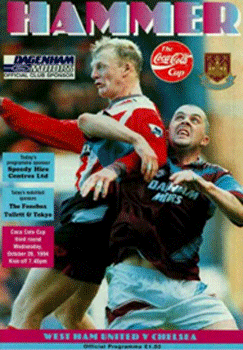
The only time that we have met them in a League Cup tie at Upton Park was in the third round of the 1994-95 competition, on October 26 1994. Don Hutchison scored the goal that enabled us to progress to the next round (where we were eliminated by Bolton!). Of course we have never won the competition ourselves, but Chelsea have won it five times, most recently in 2015. Our two friends, Terry and Costa scored the goals that beat our other friends from White Hart Lane 2-0.

In 2004 (October 27), when we were only in the Championship, we met them in this round at Stamford Bridge and they ran out winners 1-0. They went on to win the trophy that year beating Liverpool in the Final. They were also the runaway champions of the Premier League that season, winning by a dozen points, and only losing one league match in the process. So our narrow defeat, given our position at the time, was a noteworthy performance.

By coincidence we meet them once again on October 26. Despite our relatively poor form this season, this is a one-off cup tie and anything can happen. Hopefully we can take advantage of the home draw and progress into the last eight.

West Ham 1 v 0 Sunderland

Reporting by postcard from the beach in Gran Canaria.

Holiday ReportAt the end of a day of sunbathing, swimming, reading, eating and drinking, I reflect on following the fortunes of our team from further away than usual.
Although this is my 59th season watching West Ham, and I have seen far more games than I have missed in that time, I have yet to go through a whole season attending every home game, despite being a season ticket holder for some time.

Booking holidays well in advance of the fixture list being revealed is an unfortunate necessity of life if you have a specific destination in mind, and have a wife who works in a school, and you wish to take a break in the half-term holiday. But even if you arrange the break such that only one weekend is involved, it is Murphy’s (or sod’s) law that the computer will ensure that you miss a home game. Of course it is a double Murphy when we progress in the League (EFL) cup and we are drawn at home to Chelsea in the following midweek.

As a result I was forced to follow the Sunderland game from a distance of around 2000 miles on the beach in Taurito in the south of Gran Canaria.

There weren’t many people on this particular stretch of black sand, typical of Canary Island shorelines. We paid our fifteen euros for two sun beds and a parasol, I took a dip in the warm, but fairly rough sea, and then settled down to follow the game via a variety of websites and social media. Just before half time, despite there being many sun beds free on the beach, a German family decided to invade our personal space unnecessarily by choosing the beds next to ours and then moving them closer.

So at half time we retreated to the hotel pool and I followed the game from there on my phone. It appeared that we were well on top but unable to make a deserved breakthrough.

The hotel had a number of bars, including a sports bar with a giant screen. Due to the wonders of modern technology, especially satellites, despite being seventy miles off the west coast of Africa in the Atlantic Ocean, it was possible to view almost any sporting event taking place anywhere in the world as it happened. In fact the giant screen could split into nine smaller screens to satisfy a whole range of tastes simultaneously. I would have been happy to watch the West Ham game on one-ninth of the screen, but despite there not being too many people in there wanting to watch on a sunny afternoon, almost all of them were selfish gooners who wanted to view the full size screen. So I sat outside in the sun, but as the game entered injury time I was resigned to a goalless draw and popped into the Sports Bar to see how many goals that Arsenal had put into the Middlesbrough net. They were in the 93rd minute, and just like their North London neighbours earlier in the day, they had failed to score. I couldn’t be too smug as we too had not scored against lowly Sunderland. Then almost simultaneously there was a goal in both games. The Arsenal fans were jubilant until they realised it had been disallowed as Ozil was yards offside. But our goal had stood and we had picked up a very welcome, although not entirely convincing three points.

Just a few minutes later I was able to view our goal on my phone. The way we approached a corner in the 94th minute took everyone, including our manager, but not Noble, Payet and Reid by surprise. Instead of the usual last minute hoof into the danger area, a cleverly worked short corner ended with Reid firing a low shot through almost everyone on the pitch. How it evaded everyone is hard to fathom. To me it appeared that three or four of our players were offside, especially Calleri who must have been unsighting the keeper. But incredibly the goal stood, and after all the dodgy refereeing decisions that went against us last season it made a big change for one to go in our favour.

I Wouldn’t Bet On It 14

Just like printing money as we go big on a West Ham victory.

Fancy A Bet

Middlesbrough let us down last weekend, so our balance is now down to 100.1.

Today we’ll have some fun bets on West Ham v Sunderland:

22 points on West Ham to win @8/11 (38)
1 point on West Ham to win both halves @4/1 (5)
1 point on West Ham to win 3-1 @13/1 (14)
1 point on HT 1-0 FT 3-1 to West Ham @50-1 (51)
1 point on Antonio to score the first goal @13/2 (7.5)
1 point on Antonio first goal & score 3-1 @66-1 (67)
1 point on West Ham to score 3 or more goals @5/2 (3.5)
1 point on West Ham to win by exactly 2 goals @4/1 (5)
1 point on Obiang to score anytime & West Ham to win @10/1 (11)

Total stake 30 points.

If West Ham win the game then we are definitely up on the day.

But, if Antonio scores the first goal of the game, West Ham lead 1-0 at half time, West Ham win the game 3-1, and Obiang scores one of the second half goals, then our stake will win us over 200 points. Unlikely I know. But a bit of fun nonetheless.

What are the chances?

Sunderland Preview: Another Eight Goals?

Geoff Hurst’s on fire, the Sunderland defence was terrified.

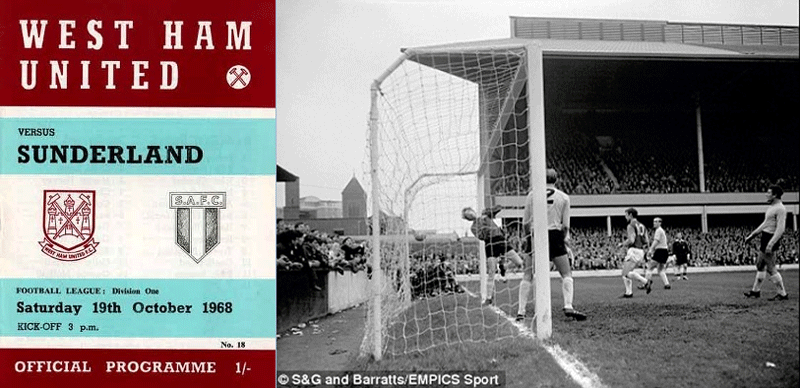
Sunderland HurstWhen we set off for Upton Park on October 19 1968 I am not sure we knew what to expect that afternoon. When we were travelling from home to the game, on those Saturdays when we weren’t playing football for Barking Abbey School in the morning, we caught the British Rail train from Rainham to Barking, then met others for the two-stop trip on the District Line to Upton Park. Last season I made the same trip to a game, visiting memory lane (and Ferry Lane), and have to confess that not much has changed in the intervening forty-eight years. The overground trains now have automatic doors and are quieter, but Rainham Station, Barking Station, the District Line, Upton Park Station and Green Street all looked and smelt just the same as they did when we were young teenagers.

In mid-October 1968, fourteen games of the season had been played and we sat in sixth place in Division One. For younger readers that was the top division, equivalent to the Premier League today. The amazing thing about our league position was that we had not won a league game since August. In August itself we were on fire, although that was not an expression we used in the 1960s. There were seven league games in the first month of the season, and we won five of them, drew one, but lost heavily 4-1 to Everton on a warm Monday evening. In those seven games we had scored sixteen goals and conceded six, so apart from the Everton game we were scoring goals and defending well.

As September began, we had briefly topped the league, and we then thrashed Bolton 7-2 in the League Cup. What we didn’t know was that throughout the rest of September, and the first half of October we would play seven league games without winning a single one (although we did draw five of them), and also get dumped out of the League Cup by Coventry after a replay.

So we weren’t expecting anything particularly special that Saturday afternoon when Sunderland were the visitors, and as Autumn days were getting colder, less than 25,000 turned up, which was to be one of the lowest crowds of the season. As the half hour point of the match approached we still hadn’t seen anything special, although we were on top. Martin Peters crossed the ball and Geoff Hurst punched the ball into the net. From our position on the North Bank (at the other end of the ground) we thought he had handled the ball, but there were no protests from the visitors, the referee didn’t spot it, and we were 1-0 up.

Bobby Moore then smashed home a free kick to double the lead, Brooking crossed for Hurst to head home the third goal, and then a Harry Redknapp corner was turned in by Hurst shortly before half-time to make it 4-0. The hat-trick goal is shown in the photograph. Fifteen minutes before we hadn’t seen it coming, but here we were at half-time, a Hurst hat-trick, and 4-0 up.

We turned on the style in the second half. We were hoping that the first half goals would not be the end of the story, and that we would witness more of the same at our end of the ground. We were not disappointed. Two further goals from Hurst were followed by a netbuster from Brooking, before a Redknapp cross was finished by Hurst to make it 8-0, and a double hat-trick from the best centre-forward I have ever seen wearing a claret and blue shirt. I had never seen anybody score six goals in a game, and I am not sure that it has ever been done in the top division of English football since that day. Three years earlier I had witnessed Brian Dear scoring five goals in a game for us, but Geoff Hurst had gone one better.

We are meeting Sunderland this weekend almost 48 years to the day since that memorable game in 1968. We were both in the top half of the table when we met all those years ago, but this time the opposite is the case, and we both desperately need the points. If the game is still goalless as the half hour approaches don’t despair. There is still time for us to rattle in eight goals before the final whistle!