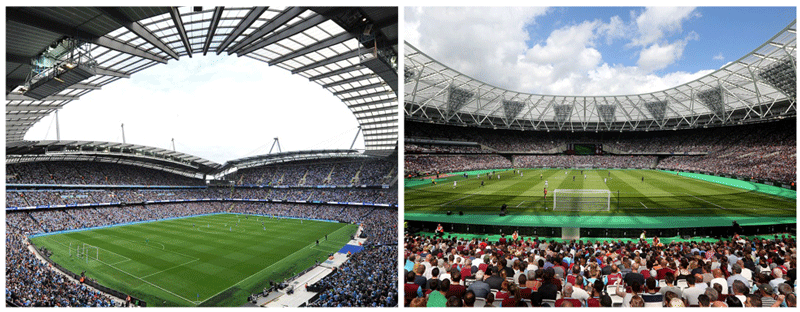
A Tale of Two Stadiums

It is the best of times, it is the worst of times. Wisdom or foolishness, belief or incredulity?

Stadiums

Imagine there was a football team with a traditional working class support that gave up the cherished memories of its full of character home ground, which it owned, and moved away to rent a taxpayer funded converted athletics stadium. The first season at the new stadium witnessed an early European exit to an obscure eastern European outfit and then patchy form resulted in them slipping to 16th place in the league. This week that team has just defeated Barcelona and were reported to be top earners from last season’s Champions League with revenues of £76 million (equivalent to about 60% of West Ham’s annual revenue from all sources). The team is, of course, Manchester City.

Despite the obvious parallels there are also important differences. Critics of the London Stadium will point out that the conversion of the City of Manchester stadium was to a dedicated football stadium rather than a multi-purpose arena; and I’m sure there is some justification in that as far as the matchday experience is concerned. In addition, although City pay more in rent than West Ham do, and are responsible for all operating overheads, they are able to benefit more from the associated (and now significant) naming rights and matchday income.

In the first 6 years in their new home City finished 18th, 8th, 15th, 14th, 9th and 10th respectively. Despite what we may believe a shiny, new high capacity stadium doesn’t guarantee success. It wasn’t until the injection of Thai (briefly) and Abu Dhabi money that City’s new successful era began. It is arguable whether that investment would have been forthcoming if they had still played at Maine Road.

I know a few Manchester City fans and all are delighted with their new found status. They are now the second most profitable English league club, after their near neighbours, and with massive financial backing are well placed to continue the upward momentum. I don’t recall too many rumblings related to the move but, if there was a lot of moaning in Royle family style sittings rooms across the City at the time, it is long forgotten now.

Famous victories under the lights against Barca may seem a long way away to the average Hammer’s fan at the moment. The optimism of the new stadium (where it existed) has been overtaken by events and with the negativity fuelled and amplified by the media. With few exceptions the media is rather patronising towards West Ham regarding them as a wayward cousin to the ‘real’ glamour London clubs or Arsenal, Chelsea and Tottenham. A rare moment in the sun is tolerated but other than that the club and its supporters are seen as a caricature that belongs in an Eastender’s plot. The nature and generosity of the deal for the London stadium has made the club a perfect target for journalists and online media sites to exaggerate and repeat half truths. It has not been helped by the actions of some supporters while similar flash-points at other grounds, with Manchester City fans smashing up the toilets at Old Trafford or Liverpool fans throwing flairs on to the pitch at Selhurst Park, barely get a mention. The stories about a return to the hooliganism of the 70’s or 80’s and the stadium being unsuitable for football are clearly risible.

I have mentioned before that in the past West Ham have relied heavily on TV money for revenues; far more so than our closest rivals in financial terms do. Staying at the Boleyn Ground (as it was) did not provide any opportunity for the club to develop or even to maintain the status quo with our peers. Whether it was viable to developing Upton Park into a stadium that could generate more revenue is another question but a moot one now. The point being that West Ham’s future depended on being able to increase Matchday and, more importantly, Commercial income. The alternative was to slip further away from any aspiration to join the leading London clubs and join the also-rans of Palace, QPR and Fulham instead. It is possible that some fans would be quite happy with this situation if it meant that traditions were maintained but, as a business decision, passing up the opportunity of the London stadium move would have been foolish; particularly with Tottenham hovering in the wings.

The gulf in earnings between West Ham and the (financially) big clubs is so huge now that even if the teething problems with the new stadium are fully resolved it can only take us a few rungs up the ladder. It is difficult to imagine a scenario where we are able to grow organically into becoming a regular Champion’s League participant. Major outside investment is the only route to such a promised land and that is something that would change the club out of all recognition.

The London Stadium and its location is ideal to attract the attention of investors (likely to be overseas) but the unanswered question is what type of club do we want?

The Fixtures Computer

Can we blame the fixtures computer for the fact that we sit seventeenth in the Premier League table after a quarter of the season?
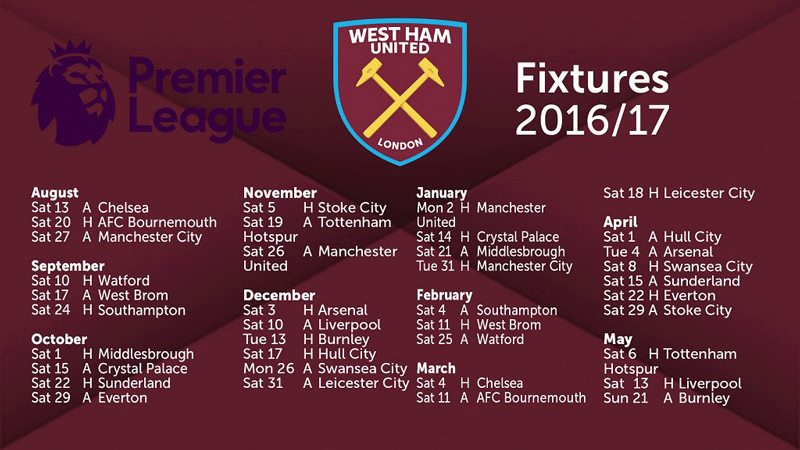
Season Fixtures

In modern times in the Premier League era, fixtures divide very neatly into two halves of the season. What I mean by this is that we play games against each of the other nineteen teams in the league in the first half of the season, which concludes very neatly on 31 December, and then play them all again between January and May. As there are twenty teams, we play nineteen matches in each half.

From August to December our nineteen games comprise nine at home and ten away. The situation is reversed in the second half with ten at home and nine away. All very logical you might think, but this has not always been the case.

My support of West Ham goes back almost sixty years, and in the first season that I remember (1958-59), our second league game of the season on 25 August was at home to the previous season’s champions, Wolves. Then our fourth game was a visit to Wolves on September 3. So, just four games into the season and we had played our quota of games against the best side in the country. Incidentally we won at home and drew away. In 1964-65 a similar situation arose when we played Manchester United at home and away on August 24 and September 2.

So, in those days there was no real balance to the season, and the league table could therefore be potentially misleading if you fulfilled all your fixtures against the top clubs early on. I’m not sure when exactly this was rectified, but the current situation of playing all nineteen teams once, before playing them all again would seem to be fairer.

If we look at this season in detail then our nine home games in 2016 are against Bournemouth (16), Watford (13), Southampton (6), Middlesbrough (P), Sunderland (17), Stoke (9), Arsenal (2), Burnley (P) and Hull (P). The figures in brackets denote last season’s league position, plus “P” for the promoted clubs. That is just three teams who finished in the top half, three in the bottom half, and all three promoted teams. On paper you would have to conclude that our home games in the first half of the season should yield a substantial points total.

Conversely the ten away games in 2016 are against Chelsea (10), Man City (4), WBA (14), Palace (15), Everton (11), Tottenham (3), Man United (5), Liverpool (8), Swansea (12), and Leicester (1). Eight of the ten games are against teams that finished in the top twelve in the league. On paper, the conclusion we can draw from this, is that it is a very tough set of away fixtures in the first half of the season.

Of course, the situation is reversed in 2017, so that in the second half of the season we have easier away games and tougher home fixtures (on paper). I’m not sure how randomly the fixtures computer allocates fixtures, but there is certainly an imbalance in the apparent strength of our opponents in our home and away fixtures in the two halves of the season. For that reason perhaps we should not take too much notice of the league table until we are a long way into the season.

Surely it wouldn’t take too much computer programming skill to ensure a much more balanced fixture list. The fixtures computer should come up with an end result such that in each half of the season we play roughly half of our home games against teams that finished in the top half in the previous season, and half against teams from the bottom half. The same should be true of the spread of away fixtures.

This would be fairer to all teams, both top and bottom, and would ensure that the league table is more representative of the strength of clubs throughout the season, and give an indication of finishing positions much sooner. As it stands, teams with tough early fixtures could find themselves in a relegation dogfight early on in the season, which then inhibits the way that they play for the remainder.

So does this explain why we sit in seventeenth place after ten games of the season? No. It may be a partial factor, but we are there because of poor defending, plus the fact that we are as weak as I can remember at scoring goals. We have only found the net ten times in ten games, and conceded nineteen at the other end. Only Sunderland and Hull have conceded more goals than we have, and have poorer goal difference statistics.

Over a whole season an average of one goal a game would give us just 38 goals. In the last twenty-five years we’ve only managed such a poor scoring record twice. In one of those seasons we were relegated, and in the other we escaped relegation on the last day of the season. And conceding 19 goals in ten games or 1.9 goals a game would equate to 72 in 38 games. When did we last concede that many goals or more in a season? Fifty years ago in 1966-67. But in that year we scored eighty!

Where Have All The Strikers Gone?

Missing in Action: The 20 Goals Per Season Striker.

StrikersAfter the encouraging victory on Saturday the emotional swingometer has turned completely on its axis shifting from doom and despair to euphoric optimism. While the positivity is welcome after such a disappointing start to the season a sense of perspective needs to be maintained as we come to the end of our run of ‘easier’ games. The formation and attitude worked well at Palace and now we need to see if that can be followed through at home to Sunderland.
I cannot yet jump on the new found enthusiasm for Simone Zaza bandwagon. I don’t see that after one hard working performance we have a solution to our long running striker dilemma. He may have ‘put in a shift’ but was he really ‘different class’? Slaven Bilic said that we wouldn’t have won without him and I can only go along with that if he meant the alternative was playing with 10 men. Now Slav’s comments may have been designed to give Zaza a boost but I would like to see a greater end product (i.e. goals) rather than good stats on aerial duels won before I become a believer.

Now this is not meant to be a Zaza bashing article but rather to consider why it is that we have failed to secure an even half prolific goal scorer for such a long period of time. If the 20 goals a season striker is elusive at most clubs then he has completely disappeared during West Ham’s Premier League tenure. A regular goalscorer has been a problem for many years.  In our 20 Premier League seasons the best return that we have had was Di Canio’s 16 goals in 1999/2000. In only 7 of those 20 seasons has any West Ham player scored more than 10 league goals. In our last 10 Premier League seasons only Harewood (14 in 2005/6) and Zamora (11 in 2006/7) have exceeded the 10 goal mark. Quite a sorry return I would say.  Sure it is great to get goals from all around the pitch but every successful team tends to have at least one consistent scorer.

Paolo is also our all time Premier League scorer with 47 goals in 118 appearances (an average of 2 goals every 5 games) followed by Carlton Cole with 41 goals in 216 appearances (1 in 5). Only 10 players in total have scored more than 20 Premier League goals for West Ham and these include penalty takers Mark Noble and Julian Dicks. Tony Cottee is the only player to have scored a Premier League goal for West Ham to appear in the list of our Top 10 all-time goalscorers; 23 of his 115 goals coming in the Premier League era.

In the modern game a striker needs to contribute more than just goals but a striker who doesn’t score is not really doing his job. It seems strange that we have not been able to unearth and keep a decent goalscorer in recent history. There have been those that didn’t stick around for long for various reasons (Defoe, Tevez, Bellamy, even Ba) plus the unfortunate Dean Ashton but otherwise there has just been a procession of misfiring lumps; often the result of emergency January transfer window loan deals.

A top striker was stated as the priority in the most recent transfer window and the names of potential targets were appearing in the media almost daily. It is difficult to know how many of these were genuine or realistic but the many players mentioned didn’t fit a profile for a particular style or type of player. In the end it seemed that most were either not interested or not available and we ended up in a last minute panic taking whatever was convenient. It reminded me a little of going shoe shopping with a woman who has nothing to match the dress she will be wearing that evening.

I would be quite happy for Zaza to prove me wrong but neither his goal scoring record nor his performances have raised expectations that he will suddenly start firing them in from all angles . As things stand I don’t see any short term end to our striker famine unless we are able to pin all our hopes on Toni Martinez.

Palace Review – Shocking Decision

The Match of The Day pundit has a very different view of the sending off to the commentator.

acress-off

Having just watched a re-run of yesterday’s Match of the Day, and still angry over the performance of the officials, I was equally appalled by the match commentary from Jonathan Pearce. In my opinion he had a very poor grasp of the “mad minute”.

Firstly he reckoned that Cresswell was barely touched and went down too easily. Wrong I reckon. Next he was virtually suggesting that you could tell how easily he went down by Cabaye’s reaction. Surely with all his years of commentating he might have realised that the clever players react in this way to try to get away with it when they know they have done wrong. And then if he was of the opinion that Cresswell went down too easily, how comes he believed that the slight brush on Zaha was worthy of a second booking.

 I like to think I can remain unbiased when watching football. Yes I am a West Ham fan and that must influence me, but I can clearly recall instances where I have been disappointed by poor officiating when opposing players have been sent off in the past too.

At least Alan Shearer, an excellent pundit in my view with a good understanding of the game, got it spot on. It was a penalty and the second booking wasn’t even a foul. But I was very unimpressed with Mr. Pearce.

Ponchos For Goalposts: Part deux!

There’ll always be an England (as long as we can find eleven players).

England TeamA few weeks back I used the tedium of the international break to take a look at the composition of the squads in the Premier League in relation to nationality. Overall it showed that only 35% of Premier League players were English although this increased to 40% if you included the other home nations. I wondered at the time whether if you looked at those actually making it onto the pitch the situation would be even worse and so have used this recent break to undertake further research in the context of the continued underwhelming performance of the England national team.
England appear to be in a Groundhog Day cycle where they generally qualify with some ease (usually from a group where even a mid-table Championship would hope to do well) and then disappoint when it comes to the finals. We then replace the manager and start the cycle again. In truth this has been going on for almost 50 years (well before the Premier League and the foreign invasion) but it does remain a conundrum whereby England has the most famous and cosmopolitan league in the world but a extremely ordinary and uninspiring national team. Are the two related in anyway?

So far this season we have had seven rounds of Premier League matches; a total of 70 games in total which have featured 414 different players of which 342 have started at least one game. Bournemouth and Burnley have been the most frugal with fewest different starters (14) while Sunderland have had the most different starters (22). Chelsea have used fewest players if you included substitute players (18) while Sunderland have been the most lavish with 25.  (It is an interesting contrast with Aston Villa winning the First Division in 1981 using only 14 players all season; how the game has changed.)

Of those starting and featuring (i.e. including substitute appearances) in a Premier League the proportion that are eligible to represent England is 34% and 33% respectively; this is consistent with the overall squad make-ups and so my assumption that it would be lower was not correct.

Bournemouth are the most English team with 72% of starters while Watford have had the least at 9% (just Troy Deeney). Only 3 clubs achieved over 50% of English starters (Bournemouth, Burnley and Palace) while Watford, Arsenal and Chelsea were all below 15%. The equivalent figure for West Ham is 25%.  Collectively, the ‘so-called’ Big 4 (two Manchester Clubs, Chelsea and Arsenal) managed to scrape together 18% of Englishmen.

The average Premier League side then has less than 4 players eligible to represent England in any given lineup. In total that is somewhere over 70 playing Premier League football on a regular basis (allowing for injuries) giving them a 1 in 3 chance of being selected for an England squad.  To my knowledge, Joe Hart is the only English player of note performing overseas.

The big ‘chicken and egg’ question that this raises is: Does the lack of quality English players lead to the recruitment of so many overseas players or does the number of foreign players restrict the development of good young home grown talent?  Whatever way it is difficult not to conclude that the the declining number of English players in the Premier League must have had an adverse effect on the national side.  How to fix this without impacting the ‘brand’?

Far be it from me to defend the largely clueless England manager’s that we have seen over the years but there has not really been the depth of talent for them to work with. All the more reason, in my opinion, to find someone (like Sir Alf) who has a system and will then find the players to fit it; rather than the other way around.

No wonder my interest in the England team is going down quicker than sterling (the currency not the Man City player that is)!

Does Size Matter? Pitch and Goal Dimensions

Running the rule over the grounds to see who measures up!

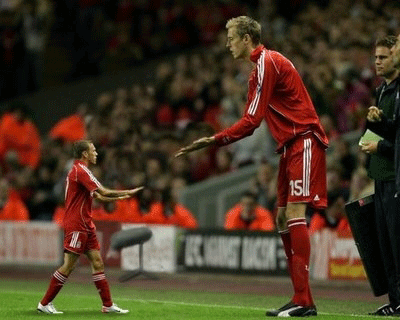
Big and LittleIt is a misconception that all football pitches are the same size. They are not. Can you imagine this applying to some other sports? What if the distance between the stumps was different at Lords compared to the Oval? But the distance between the goals at the London Stadium is greater than it is at White Hart Lane.

The FA has followed the lead of UEFA and FIFA in recommending standard pitch dimensions. I wonder how many people know what the recommended size is? The Laws of the Game permit quite a big variation in the size of the pitch. The length of a pitch can be anywhere between 90 and 120 metres. The permitted width has an even greater range, and can be between 45 and 90 metres. These dimensions came into force in the 1897 draft of the Laws of the Game.

For “official matches” the length should be between 100 and 110 metres, whereas the width can vary between 64 and 75 metres. In an attempt to achieve consistency, the recommended dimensions are 105 metres x 68 metres. The Premier League wants all teams to have a pitch of this size, but does allow exceptions if it is impossible to comply due to the construction of the ground.

The pitch sizes at Arsenal, Hull, Manchester City, Manchester United, Southampton, Sunderland, Swansea, West Brom, Middlesbrough, Watford, and now West Ham, are all identical at the recommended size. Wembley is the same, as are all the major stadiums throughout Europe. But that is only eleven of the teams in the Premier League. The pitches at Burnley, Chelsea, Liverpool, Leicester, Crystal Palace, Everton, Bournemouth, Tottenham and Stoke are all smaller than the standard size. In fact depending on which teams are in the Premier League at any given time, there can be up to 9% difference between the areas of the largest and smallest pitches.

Stoke has the smallest pitch of the current Premier League teams at 100m x 66m, and I guess this relates back to the Tony Pulis days when they wanted the pitch to be as narrow as possible for the benefit of Rory Delap’s long throws. The Tottenham pitch is the same length as Stoke but just one metre wider. The Upton Park pitch measured 100.58m x 68m.

Now I have a problem with the size of pitches. Bearing in mind that they have remained unaltered for around 120 years, the size, speed and power of human beings has increased significantly in that time. If you consider the average height of men, the 100 and 1500 metre running times, and high jump and long jump distances, to take just five examples, then we have seen increases in size and performance between 7% and 20% in those five categories. The same is true for females. So in relative terms the pitch was much bigger in years gone by. With the size, speed and athleticism of modern man (and woman), the pitch is now relatively congested compared to the past.

To allow for this, pitches should probably be at least 10%-15% bigger than they are. In order to compensate for the increases in human performance then the length of pitches should be increased to around say 115-120 metres, and the width to 75-80 metres. Of course most stadiums could not cope with this (although ours could possibly get close!). The authorities could, perhaps, order clubs to increase the size of their pitches to the maximum possible that their ground would allow. They could, alternatively give clubs a period of time, say ten years, to construct new stadiums that the revised pitch sizes would fit into. With the billions of pounds of TV money around then this shouldn’t be a problem.

The alternative is to reduce the number of players on the pitch from 11 to 10 to achieve the same effect. 11 may have been appropriate some years ago, but 10 would now allow for the human performance increases. We’ve all seen games where two players have been sent off leaving 10v10 on the pitch. There is more room for everyone to express themselves, and less congestion. I urge the authorities to move to a 10-a-side game if they don’t proceed with an increased pitch size.

And while we are at it, the size of the goals has not changed in the period either. As a result I believe we should increase the height of the goal from 8 feet to 9 feet, and the width from 24 feet to 27 feet. Modern goalkeepers must find the goals relatively small to defend when compared to the custodians of years gone by, and these increases will mean that the number of goals scored will perhaps return to the levels of 100 years ago.

Like other aspects of life, football needs to adapt to the times. It has never recognised the increases in human size and athleticism throughout the history of the game, and these changes would undoubtedly be beneficial to the entertainment value.

Offside: Changes Needed? – Part Two

Time to interfere with the offside rule and introduce video technology?

OffsideFollowing on from my previous article where I discussed a radical change to the offside law and why it is necessary, I’ll add further to my reasoning today. The optical problems for the officials that I referred to is not the end of the story. Assistant referees have to remember that it is not an offence in itself for a player to be in an offside position. A player is in an offside position if any part of his head, body or feet is in the opponents’ half, and any part of the head, body or feet is nearer to the opponents’ goal line than both the ball and the second-last opponent, but at the same time he has to disregard the hands and arms of all players, including the goalkeepers.

The linesman should only then penalise the player in an offside position at the moment the ball is played or touched by a team-mate when he becomes involved in active play. This could mean interfering with play by playing the ball itself, or interfering with an opponent by preventing the opponent from playing or being able to play the ball by obstructing his line of vision, or challenging the opponent for the ball, or clearly attempting to play a ball which is close to him when this action impacts on his opponent, or making an obvious action which clearly impacts on the ability of the opponent to play the ball.

Are you still with me because there is more to consider yet! This player in the offside position should also be penalised if he is gaining an advantage by playing the ball or interfering with an opponent when it has rebounded, or been deflected off the woodwork, or an opponent. Offside should also be penalised when the ball has been deliberately saved by an opponent. A save is when a player stops a ball which is going into or very close to the goal with any part of the body except the hands (unless the goalkeeper within the penalty area). But, a player in an offside position receiving the ball from an opponent who deliberately plays the ball (except from a deliberate save by any opponent) is not considered to have gained an advantage.

You probably think I am making all this up, but I am doing my best to interpret the rules and governance as provided in the IFAB Laws of the Game relating to offside for 2016-17. And I haven’t even finished yet! There are other considerations relating to both defending and attacking players leaving the field of play deliberately without permission. I won’t go into this in too much detail as I find it extremely hard to follow.

My proposal is simple, though. Firstly, I’d like to see the offside rule confined to the eighteen yards at each end of the pitch. I’m afraid I just cannot see the point of half of the pitch being involved. You cannot be considered to be goal hanging just inside your opponents’ half. I wonder if anybody anywhere has asked the question as to why we have persisted with offside in this great expanse for so many years?

Yes, they continue to tinker with the concept of interference, and active involvement, but it only serves to confuse the issue in a game that is generally very simple to understand. The introduction of this change would also have the benefit of stretching the game over a wider area rather than the players bunching up as they do as a result of the current offside law.

The assistant referees would still have to make the decisions that they do now, but surely it will be far simpler for them to do so if they only have the eighteen yard line to the goal line to worry about. But I then propose to take it further. To improve the accuracy of offside decisions at the higher levels of the game, then we must begin to use video technology.

Perhaps it needs to be introduced a little at a time, with extensive trials to ensure it is helping to improve the accuracy of key decision making in the game. So, for example, as a first step, when a goal is scored and there is a suspicion of offside the technology could be used to check the validity of the goal. Assistant referees must be encouraged not to raise their flag unless they are fairly certain of offside. The benefit of the doubt should always be given to the attacker. Video replays would only be necessary if a goal is subsequently scored.

It won’t be perfect but we will have greater accuracy and consistency than currently exists. Hazard was only slightly offside when he headed the ball in from Ramires cross in the Chelsea game at Upton Park in March 2015, but the replay showed within seconds that he was offside. In this example, at the moment the ball hit the net from Hazard’s header the referee would be asking the video referee “is there any reason to disallow the goal, for example for offside?” As we saw within seconds on Sky, the reply would be “yes he was offside, disallow the goal”. It wouldn’t hold up the game, the Chelsea players would still have been in the celebration process. Even if the referee had not asked the question, the video referee could have told him that the goal was offside.

If you haven’t read enough of my arguments and want to know more, then there are a number of frequently asked questions on the FA website to baffle you even further. But I’d like to think that the change suggested would improve the game. At the very least I’d like to see it tried out. It makes sense to me.  What are the arguments against trying it? But will it be tried? Of course not, because the change is too radical. But should it? Of course it should.

The complexity of the other supplementary situations that I describe in this article must also be addressed. I remember once that it used to be a straightforward question “is the player in an offside position interfering with play?” If you added this to the 18 yard offside rule change, then surely it would be simpler for us all to understand.

Let’s Talk About Money

The conundrum of stadium, money, tradition and success.

MoneyDo you ever stop to consider why you support a football club? What is it that makes you want to invest so much time, money and emotion into the fortunes of a particular team? What do you get or want out of it in return?

Of course there is no simple answer as everyone has their own story and perspective. Originally it would have been about creating bonds and a sense of community; families, friends, territories and rivalries. Perhaps this still exists in the lower leagues at places such as Rochdale or Hartlepool (who I understand to be the most unsuccessful teams in history) but it has become less relevant at the top level; particularly in the Premier League where money and success rule. The dilemma for a team such as West Ham (or more importantly its supporters) is what constitutes success and what are you prepared to sacrifice to secure it?

It is no surprise to anyone that there is a strong correlation between how much money is available to a club and the level of success on the pitch; if we measure success by league position or trophies won. The move to the London Stadium was, no doubt, seen by the owners as an opportunity for the club to progress financially, to keep Tottenham off our patch and to increase the value of their investment. I don’t want to get involved in the merits or otherwise of the new stadium and we have to accept that there is no going back; like it or not we should concentrate on making the most of what we now have.  We are now in the London Stadium; where can it take us?

“The clubs who have better financial resources have the better teams”

– A Wenger

Based on the financial accounts for 2014/15 West Ham were the 20th biggest club in Europe (in terms of revenue) and the 9th biggest in the UK.  We were one of a cluster of English clubs with reasonably similar levels of revenue comprising Newcastle, Everton, West Ham, Aston Villa and Southampton. Manchester United are way ahead of everyone else followed by a closely grouped Manchester City, Arsenal, Chelsea and Liverpool. There is then a gap to Tottenham before a further gap to our own group.

As Tottenham is the nearest financial target in our sights if we are to improve our relative position then I use them for comparison purposes only. In 2014/15 Tottenham had revenues of £196m compared to West Ham’s £122m. With a similar sized stadium they were able to generate more than us in Matchday (£41m/ £20m), TV (£95m/ £79m) and Commercial (£59m/ £24m) revenues. TV contributed 65% of West Ham’s revenue compared to Tottenham’s 49%.

The larger stadium will certainly generate incremental Matchday cash but it is difficult to see the direct impact that it will have on TV or Commercial activity; as these are more a function of team success and wider, higher profile. For the sponsors involved with football the attraction of Premier League clubs is the worldwide appeal of the major teams participating and this an area where both West Ham and Tottenham suffer in comparison with the (so-called) big 5 clubs. (In fact I ave not seen any significant major overseas profile for Manchester City yet but they can at least rely on the UAE for hefty sponsorship deals). Tottenham fare better than us with commercial sponsorship due to their longer and more regular involvement in European competition but they are still some way behind the others. It would be rare in Asia, for instance, to see locals wearing Tottenham or West Ham shirts and that is why our sponsors have tended to be local rather than international businesses. Breaking into that club and attracting overseas support is a major challenge for any new team.

So where does that leave us? Potentially with improved financial security and topping the also-rans-financial league I mentioned above, but with a mountain to climb if we want to see a sustainable step change in status. Over the last 4 years West Ham have been the 5th largest net transfer spenders (notable for our lack of large transfers out) and although this has brought relative improvement we remain firmly part of that mid-table pack. A realistic view is that it would appear virtually impossible to grow organically into a truly big club; only significant external investment can make that difference. Otherwise the future is the same mid-ranking club but in a much larger stadium.

And that brings us back to the original questions. What does success look like and how badly do we want it? Surely it should be better than 4 cups in 50 years but are we prepared to give up the remaining sense of community, tradition and what it means to be a Hammer in order to achieve it?

Source: Financial information taken from the excellent Swiss Ramble blog.

Offside: Changes Needed? – Part One

Raising the flag on problems and shortcomings of the current offside rule.

OffsideI recently wrote an article where I posed the question, “what is the point of the penalty area?” In this I suggested the removal of the penalty area as it stands to be replaced by a line, which would stretch right across the pitch. The line would have nothing to do with the issuing of penalty kicks, but would be an instrumental line for a change in the ridiculous offside law (as it stands), which I will outline further starting with this article.

I’ve got a lot of views about offside and I’ve been reading about the law, FIFA guidance, referee guidance etc. One problem I have is that it has been proven in scientific research that human beings (including linesmen!) physically cannot move their eyes fast enough to take in all the necessary action. To make a correct decision they have to assess the positions of the player passing the ball, the player receiving the ball, and the second from last defender at the exact moment a pass is made, bearing in mind that they could be some distance apart, and possibly moving at speed in opposite directions.

I believe we need to look back in history to ascertain why the offside law was introduced in the first place. If you study the development of football in the 1860s, the offside law was probably the biggest bone of contention between the clubs in existence at the time who all had their own version of it.

A compromise was eventually agreed and written into the Laws of the Game in 1866, and was eventually adopted throughout. It was similar to the rule that exists today with the difference being that at a player was offside if he was in the opponents’ half, and he was nearer to the opponents’ goal line than both the ball and at least three opponents when receiving a pass from his team-mate.

The rule changed in 1925 with three opponents becoming two opponents. In 1990 the law was amended so that a player was onside if he was level with the second to last opponent. This change was considered to be part of a movement by the authorities to make the rules more conducive to attacking football and help the game to flow more freely.

But why was it introduced in the very first place? In the very early games of football, players would stand close to the opponents goal, a term known as goal-hanging (as happened a lot in the playground games of football in my day), and the ball could be played to them, where they would be in a good position to score, and obstruct the goalkeeper too. Quite clearly as the game developed it was realised that this was an unsatisfactory state of affairs.

But why do we have the situation where you can be offside in half of the area of the pitch? Can you really be goal-hanging more than fifty yards from goal? Once we’ve dispensed with the nonsensical penalty area that I previously referred to, I believe we should draw a line across the pitch, say 18 yards from the goal line. It doesn’t have to be necessarily 18 yards; it could be 20. Some experimentation would be needed of course. We would then change the rule so that you can only be offside in this final 18 yards of the pitch. This would prevent the current condensing of play in the centre of the field and stretch it out further.

In my view it would also help the assistant referee, whose task with regard to offside can be difficult, as they need to keep up with the flow of the game, consider if players are in an offside position when the ball is played, and then decide if any players that are in an offside position become involved in active play.

As I mentioned before, officiating errors in respect of offside are inevitable from an optical viewpoint, with the eyes and brain of a human being unable to process all of the necessary action to accurately call an offside decision accurately. The risk of errors increases by the foreshortening effect, which can happen when the distances between the attacking player, the defending players, and the assistant referee vary significantly. This is exacerbated if the assistant referee is not directly in line with the defender, and with the speed of the game today, this is virtually impossible.

The assistant referee has to judge if a player is level with an opponent at the moment the ball is kicked. The ball may be kicked from a short distance away or 40 yards away, and the linesman has to be able to see all of this with one set of eyes. It becomes even more difficult if an attacker and a defender are running in opposite directions. Sometimes it is just not possible to keep all necessary players in the field of vision at once.

This article will be continued with further details of the complexity of the offside rule that most of us don’t know about, and ideas for solutions to simplify the law for players and spectators alike, together with a call for video replays that could easily be introduced without any hold up to the game.

The Penalty Area: What’s The Point?

Thinking outside the box. The existing rules on penalty awards put on the spot.

I’ll start with a question. Why do people refer to the penalty area as the penalty box? A box suggests to me a three-dimensional object, whereas the penalty area (or “18 yard box”) is just a set of lines which denote a rectangle measuring 18 yards by 44 yards or 792 square yards. This is about one-sixth of an acre which makes it sound bigger than it really is.

It’s a nonsensical area with an arbitrary size that has one main purpose. It is there so that any foul committed within it by the defending side, including intentional handball, results in the award of a penalty kick. My suggestion is that this is a ridiculous law and should be abolished immediately. I’m not petitioning for the abolition of the penalty kick itself, merely the reason for awarding it. The penalty area also has a supplementary purpose in that it exists, of course, as an arbitrary area in which the goalkeeper can handle the ball.

At the moment a foul could be committed inches inside the penalty area, and a penalty kick is awarded even if there is no way that the goal is threatened, or a goal scoring opportunity denied. The attacking player may be moving away from the goal, or the ball may be played by the defender’s hand without there being any real danger of a goal being scored. Nevertheless a penalty kick is awarded which effectively means an 85% chance of a goal being scored.  

If exactly the same offence occurs inches outside the penalty area then a free kick is awarded. This means that the defending side can build a wall, and effectively means a less than 2% chance of a goal (unless of course you’ve got Dimitri Payet in your team!). At the speed of football today, it is difficult, nigh on impossible, for the officials to be certain whether or not the offence is inside or outside the area, but the end result of their decision makes an enormous difference to the outcome.

Compare that to the situation where a player is clean through on goal, say thirty yards out, and is brought down by a defender, thereby denying a clear goal scoring opportunity. This latter situation should, to make it a more sensible rule, result in the award of a penalty kick in my opinion, even though under the current rules it would just be a free kick. 

So my proposal is that the penalty area is abolished, and a penalty kick is awarded whenever a clear goal scoring opportunity is denied, regardless of where it takes place on the pitch. We don’t need a penalty area for this and it would therefore become redundant.

And I’ll go a step further to discourage dissent from the side that have a penalty awarded against them. If anyone in the team shows dissent towards the officials, then not only does the penalty stand, but the penalty kick is taken without a goalkeeper in the goal, thus increasing the possibility of a goal to very close to 100%.

These changes will mean that penalties are only awarded for good reasons, and dissent will be eliminated at a stroke. It makes sense and must be introduced. But will it? Of course not, because the change is too radical. But should it? Of course it should.

But, I hear you say, what about knowing where keepers should be allowed to handle the ball? I would have a line all the way across the pitch 18 yards from goal, allowing the keeper to handle the ball anywhere within it. Those diehards amongst you can keep the penalty area where it is, if you must, for goalkeeper handling purposes. But it should no longer have anything to do with the award of penalty kicks.

My line, which would stretch right across the pitch, would also have nothing to do with the issuing of penalty kicks, but would be an instrumental line for a change in the ridiculous offside law (as it stands), which I will outline in a future article.

To be continued ……