Counting Sheep – 9 – The Letters P and Q

Another combined team in the alphabeti spaghetti tangle of Hammer’s dream teams.

Counting SheepI’ve really enjoyed putting my thinking cap on and trying to come up with West Ham all-time football teams where the players surnames all begin with the same letter. When I began I thought that I would be able to make teams out of most of the letters of the alphabet, but it has proved to be a little more difficult than I envisaged. The original aim was to help me drop off to sleep instead of the more traditional method of counting sheep, but now it has turned into a brain training exercise (always useful when you reach my age!).

So far I’ve picked eight teams, “B”, “C”, “D”, “F”, a combined “G” and “H”, a combined “J”, “K” and “L”, a combined “M” and “N”, and “Vowels”. P is next and I was able to think of enough names to form a team. But thinking ahead to Q, that was one letter where I knew I would fail. I realised that I would have few options there, so once again I decided on a combined team, this time the P’s and Q’s. So I’ll mind my Ps and Qs, combine my Ps and Qs, and hope you don’t mind!

My all-time West Ham “P” plus “Q” Team in a 4-4-2 formation are:

Parkes
Parris
Pearce (I)
Potts
Pearce (S)
Paddon
Parker
Peters
Payet
Pearson
Quinn

I think you’ll agree I have picked a very strong midfield. Players left out include Pantsil, Pike, Powell, Poyet, Parks, Piquionne, Pogatetz, Porfirio and Quashie.

Have I forgotten someone really good who is a must for the P/Q team? And I can only remember one P/Q manager; Alan Pardew.

Does Size Matter? Pitch and Goal Dimensions

Running the rule over the grounds to see who measures up!

Big and LittleIt is a misconception that all football pitches are the same size. They are not. Can you imagine this applying to some other sports? What if the distance between the stumps was different at Lords compared to the Oval? But the distance between the goals at the London Stadium is greater than it is at White Hart Lane.

The FA has followed the lead of UEFA and FIFA in recommending standard pitch dimensions. I wonder how many people know what the recommended size is? The Laws of the Game permit quite a big variation in the size of the pitch. The length of a pitch can be anywhere between 90 and 120 metres. The permitted width has an even greater range, and can be between 45 and 90 metres. These dimensions came into force in the 1897 draft of the Laws of the Game.

For “official matches” the length should be between 100 and 110 metres, whereas the width can vary between 64 and 75 metres. In an attempt to achieve consistency, the recommended dimensions are 105 metres x 68 metres. The Premier League wants all teams to have a pitch of this size, but does allow exceptions if it is impossible to comply due to the construction of the ground.

The pitch sizes at Arsenal, Hull, Manchester City, Manchester United, Southampton, Sunderland, Swansea, West Brom, Middlesbrough, Watford, and now West Ham, are all identical at the recommended size. Wembley is the same, as are all the major stadiums throughout Europe. But that is only eleven of the teams in the Premier League. The pitches at Burnley, Chelsea, Liverpool, Leicester, Crystal Palace, Everton, Bournemouth, Tottenham and Stoke are all smaller than the standard size. In fact depending on which teams are in the Premier League at any given time, there can be up to 9% difference between the areas of the largest and smallest pitches.

Stoke has the smallest pitch of the current Premier League teams at 100m x 66m, and I guess this relates back to the Tony Pulis days when they wanted the pitch to be as narrow as possible for the benefit of Rory Delap’s long throws. The Tottenham pitch is the same length as Stoke but just one metre wider. The Upton Park pitch measured 100.58m x 68m.

Now I have a problem with the size of pitches. Bearing in mind that they have remained unaltered for around 120 years, the size, speed and power of human beings has increased significantly in that time. If you consider the average height of men, the 100 and 1500 metre running times, and high jump and long jump distances, to take just five examples, then we have seen increases in size and performance between 7% and 20% in those five categories. The same is true for females. So in relative terms the pitch was much bigger in years gone by. With the size, speed and athleticism of modern man (and woman), the pitch is now relatively congested compared to the past.

To allow for this, pitches should probably be at least 10%-15% bigger than they are. In order to compensate for the increases in human performance then the length of pitches should be increased to around say 115-120 metres, and the width to 75-80 metres. Of course most stadiums could not cope with this (although ours could possibly get close!). The authorities could, perhaps, order clubs to increase the size of their pitches to the maximum possible that their ground would allow. They could, alternatively give clubs a period of time, say ten years, to construct new stadiums that the revised pitch sizes would fit into. With the billions of pounds of TV money around then this shouldn’t be a problem.

The alternative is to reduce the number of players on the pitch from 11 to 10 to achieve the same effect. 11 may have been appropriate some years ago, but 10 would now allow for the human performance increases. We’ve all seen games where two players have been sent off leaving 10v10 on the pitch. There is more room for everyone to express themselves, and less congestion. I urge the authorities to move to a 10-a-side game if they don’t proceed with an increased pitch size.

And while we are at it, the size of the goals has not changed in the period either. As a result I believe we should increase the height of the goal from 8 feet to 9 feet, and the width from 24 feet to 27 feet. Modern goalkeepers must find the goals relatively small to defend when compared to the custodians of years gone by, and these increases will mean that the number of goals scored will perhaps return to the levels of 100 years ago.

Like other aspects of life, football needs to adapt to the times. It has never recognised the increases in human size and athleticism throughout the history of the game, and these changes would undoubtedly be beneficial to the entertainment value.

Offside: Changes Needed? – Part Two

Time to interfere with the offside rule and introduce video technology?

OffsideFollowing on from my previous article where I discussed a radical change to the offside law and why it is necessary, I’ll add further to my reasoning today. The optical problems for the officials that I referred to is not the end of the story. Assistant referees have to remember that it is not an offence in itself for a player to be in an offside position. A player is in an offside position if any part of his head, body or feet is in the opponents’ half, and any part of the head, body or feet is nearer to the opponents’ goal line than both the ball and the second-last opponent, but at the same time he has to disregard the hands and arms of all players, including the goalkeepers.

The linesman should only then penalise the player in an offside position at the moment the ball is played or touched by a team-mate when he becomes involved in active play. This could mean interfering with play by playing the ball itself, or interfering with an opponent by preventing the opponent from playing or being able to play the ball by obstructing his line of vision, or challenging the opponent for the ball, or clearly attempting to play a ball which is close to him when this action impacts on his opponent, or making an obvious action which clearly impacts on the ability of the opponent to play the ball.

Are you still with me because there is more to consider yet! This player in the offside position should also be penalised if he is gaining an advantage by playing the ball or interfering with an opponent when it has rebounded, or been deflected off the woodwork, or an opponent. Offside should also be penalised when the ball has been deliberately saved by an opponent. A save is when a player stops a ball which is going into or very close to the goal with any part of the body except the hands (unless the goalkeeper within the penalty area). But, a player in an offside position receiving the ball from an opponent who deliberately plays the ball (except from a deliberate save by any opponent) is not considered to have gained an advantage.

You probably think I am making all this up, but I am doing my best to interpret the rules and governance as provided in the IFAB Laws of the Game relating to offside for 2016-17. And I haven’t even finished yet! There are other considerations relating to both defending and attacking players leaving the field of play deliberately without permission. I won’t go into this in too much detail as I find it extremely hard to follow.

My proposal is simple, though. Firstly, I’d like to see the offside rule confined to the eighteen yards at each end of the pitch. I’m afraid I just cannot see the point of half of the pitch being involved. You cannot be considered to be goal hanging just inside your opponents’ half. I wonder if anybody anywhere has asked the question as to why we have persisted with offside in this great expanse for so many years?

Yes, they continue to tinker with the concept of interference, and active involvement, but it only serves to confuse the issue in a game that is generally very simple to understand. The introduction of this change would also have the benefit of stretching the game over a wider area rather than the players bunching up as they do as a result of the current offside law.

The assistant referees would still have to make the decisions that they do now, but surely it will be far simpler for them to do so if they only have the eighteen yard line to the goal line to worry about. But I then propose to take it further. To improve the accuracy of offside decisions at the higher levels of the game, then we must begin to use video technology.

Perhaps it needs to be introduced a little at a time, with extensive trials to ensure it is helping to improve the accuracy of key decision making in the game. So, for example, as a first step, when a goal is scored and there is a suspicion of offside the technology could be used to check the validity of the goal. Assistant referees must be encouraged not to raise their flag unless they are fairly certain of offside. The benefit of the doubt should always be given to the attacker. Video replays would only be necessary if a goal is subsequently scored.

It won’t be perfect but we will have greater accuracy and consistency than currently exists. Hazard was only slightly offside when he headed the ball in from Ramires cross in the Chelsea game at Upton Park in March 2015, but the replay showed within seconds that he was offside. In this example, at the moment the ball hit the net from Hazard’s header the referee would be asking the video referee “is there any reason to disallow the goal, for example for offside?” As we saw within seconds on Sky, the reply would be “yes he was offside, disallow the goal”. It wouldn’t hold up the game, the Chelsea players would still have been in the celebration process. Even if the referee had not asked the question, the video referee could have told him that the goal was offside.

If you haven’t read enough of my arguments and want to know more, then there are a number of frequently asked questions on the FA website to baffle you even further. But I’d like to think that the change suggested would improve the game. At the very least I’d like to see it tried out. It makes sense to me.  What are the arguments against trying it? But will it be tried? Of course not, because the change is too radical. But should it? Of course it should.

The complexity of the other supplementary situations that I describe in this article must also be addressed. I remember once that it used to be a straightforward question “is the player in an offside position interfering with play?” If you added this to the 18 yard offside rule change, then surely it would be simpler for us all to understand.

Offside: Changes Needed? – Part One

Raising the flag on problems and shortcomings of the current offside rule.

OffsideI recently wrote an article where I posed the question, “what is the point of the penalty area?” In this I suggested the removal of the penalty area as it stands to be replaced by a line, which would stretch right across the pitch. The line would have nothing to do with the issuing of penalty kicks, but would be an instrumental line for a change in the ridiculous offside law (as it stands), which I will outline further starting with this article.

I’ve got a lot of views about offside and I’ve been reading about the law, FIFA guidance, referee guidance etc. One problem I have is that it has been proven in scientific research that human beings (including linesmen!) physically cannot move their eyes fast enough to take in all the necessary action. To make a correct decision they have to assess the positions of the player passing the ball, the player receiving the ball, and the second from last defender at the exact moment a pass is made, bearing in mind that they could be some distance apart, and possibly moving at speed in opposite directions.

I believe we need to look back in history to ascertain why the offside law was introduced in the first place. If you study the development of football in the 1860s, the offside law was probably the biggest bone of contention between the clubs in existence at the time who all had their own version of it.

A compromise was eventually agreed and written into the Laws of the Game in 1866, and was eventually adopted throughout. It was similar to the rule that exists today with the difference being that at a player was offside if he was in the opponents’ half, and he was nearer to the opponents’ goal line than both the ball and at least three opponents when receiving a pass from his team-mate.

The rule changed in 1925 with three opponents becoming two opponents. In 1990 the law was amended so that a player was onside if he was level with the second to last opponent. This change was considered to be part of a movement by the authorities to make the rules more conducive to attacking football and help the game to flow more freely.

But why was it introduced in the very first place? In the very early games of football, players would stand close to the opponents goal, a term known as goal-hanging (as happened a lot in the playground games of football in my day), and the ball could be played to them, where they would be in a good position to score, and obstruct the goalkeeper too. Quite clearly as the game developed it was realised that this was an unsatisfactory state of affairs.

But why do we have the situation where you can be offside in half of the area of the pitch? Can you really be goal-hanging more than fifty yards from goal? Once we’ve dispensed with the nonsensical penalty area that I previously referred to, I believe we should draw a line across the pitch, say 18 yards from the goal line. It doesn’t have to be necessarily 18 yards; it could be 20. Some experimentation would be needed of course. We would then change the rule so that you can only be offside in this final 18 yards of the pitch. This would prevent the current condensing of play in the centre of the field and stretch it out further.

In my view it would also help the assistant referee, whose task with regard to offside can be difficult, as they need to keep up with the flow of the game, consider if players are in an offside position when the ball is played, and then decide if any players that are in an offside position become involved in active play.

As I mentioned before, officiating errors in respect of offside are inevitable from an optical viewpoint, with the eyes and brain of a human being unable to process all of the necessary action to accurately call an offside decision accurately. The risk of errors increases by the foreshortening effect, which can happen when the distances between the attacking player, the defending players, and the assistant referee vary significantly. This is exacerbated if the assistant referee is not directly in line with the defender, and with the speed of the game today, this is virtually impossible.

The assistant referee has to judge if a player is level with an opponent at the moment the ball is kicked. The ball may be kicked from a short distance away or 40 yards away, and the linesman has to be able to see all of this with one set of eyes. It becomes even more difficult if an attacker and a defender are running in opposite directions. Sometimes it is just not possible to keep all necessary players in the field of vision at once.

This article will be continued with further details of the complexity of the offside rule that most of us don’t know about, and ideas for solutions to simplify the law for players and spectators alike, together with a call for video replays that could easily be introduced without any hold up to the game.

The Penalty Area: What’s The Point?

Thinking outside the box. The existing rules on penalty awards put on the spot.

I’ll start with a question. Why do people refer to the penalty area as the penalty box? A box suggests to me a three-dimensional object, whereas the penalty area (or “18 yard box”) is just a set of lines which denote a rectangle measuring 18 yards by 44 yards or 792 square yards. This is about one-sixth of an acre which makes it sound bigger than it really is.

It’s a nonsensical area with an arbitrary size that has one main purpose. It is there so that any foul committed within it by the defending side, including intentional handball, results in the award of a penalty kick. My suggestion is that this is a ridiculous law and should be abolished immediately. I’m not petitioning for the abolition of the penalty kick itself, merely the reason for awarding it. The penalty area also has a supplementary purpose in that it exists, of course, as an arbitrary area in which the goalkeeper can handle the ball.

At the moment a foul could be committed inches inside the penalty area, and a penalty kick is awarded even if there is no way that the goal is threatened, or a goal scoring opportunity denied. The attacking player may be moving away from the goal, or the ball may be played by the defender’s hand without there being any real danger of a goal being scored. Nevertheless a penalty kick is awarded which effectively means an 85% chance of a goal being scored.  

If exactly the same offence occurs inches outside the penalty area then a free kick is awarded. This means that the defending side can build a wall, and effectively means a less than 2% chance of a goal (unless of course you’ve got Dimitri Payet in your team!). At the speed of football today, it is difficult, nigh on impossible, for the officials to be certain whether or not the offence is inside or outside the area, but the end result of their decision makes an enormous difference to the outcome.

Compare that to the situation where a player is clean through on goal, say thirty yards out, and is brought down by a defender, thereby denying a clear goal scoring opportunity. This latter situation should, to make it a more sensible rule, result in the award of a penalty kick in my opinion, even though under the current rules it would just be a free kick. 

So my proposal is that the penalty area is abolished, and a penalty kick is awarded whenever a clear goal scoring opportunity is denied, regardless of where it takes place on the pitch. We don’t need a penalty area for this and it would therefore become redundant.

And I’ll go a step further to discourage dissent from the side that have a penalty awarded against them. If anyone in the team shows dissent towards the officials, then not only does the penalty stand, but the penalty kick is taken without a goalkeeper in the goal, thus increasing the possibility of a goal to very close to 100%.

These changes will mean that penalties are only awarded for good reasons, and dissent will be eliminated at a stroke. It makes sense and must be introduced. But will it? Of course not, because the change is too radical. But should it? Of course it should.

But, I hear you say, what about knowing where keepers should be allowed to handle the ball? I would have a line all the way across the pitch 18 yards from goal, allowing the keeper to handle the ball anywhere within it. Those diehards amongst you can keep the penalty area where it is, if you must, for goalkeeper handling purposes. But it should no longer have anything to do with the award of penalty kicks.

My line, which would stretch right across the pitch, would also have nothing to do with the issuing of penalty kicks, but would be an instrumental line for a change in the ridiculous offside law (as it stands), which I will outline in a future article.

To be continued ……

Counting Sheep – 8 – The Letters M and N

Another combined team in the search for alphabetically themed West Ham teams.

Counting SheepThis all began with me selecting teams of West Ham players whose surnames all started with the same letter. The aim was to help me drop off to sleep instead of the more traditional method of counting sheep.

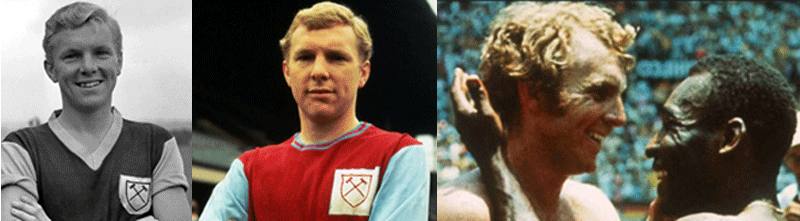
So far I’ve picked seven teams, “B”, “C”, “D”, “F”, a combined “G” and “H”, a combined “J”, “K” and “L”, and “Vowels”. M comes next and it was easy to write down enough names to form a decent team. But thinking ahead to N I realised that I would have few options there, so once again I decided on a combined team. There are at least four stand-out captains in this side, although the one and only Sir Bobby would be the choice for this role.

My all-time West Ham “M” plus “N” Team in a 4-4-2 formation are:

Miklosko
McDowell
Martin
Moore
McCartney
Malcolm
Moncur
Noble
Nolan
McAvennie
Morley

So who have I left out this time? McKnight, McAllister and Mackleworth are three keepers who would have received very few votes when being compared to my selected custodian, Miklosko. Outfield players (M) were Mascherano, Morrison, Musgrove (perhaps the unluckiest to be omitted), Mullins, Moses, McAnuff, Maynard, MacDougall, Maiga, Margas, McGiven, McCarthy, McQueen, Mellor and Minto. The Ns included Neighbour, Neill, Nene, Newell and Nordtveit. Some very good players have not been included plus some who didn’t pull up any trees in a West Ham shirt.

Have I forgotten someone really good who is a must for the M/N team? And I can only remember one M/N manager. I’ll bet you don’t think of him as one of our most successful managers; Lou Macari.

Seven games played, four points!

A review of the season to date as we go into the second international break of the season.

Embed from Getty Images

The first four home games of the season have been played. Bournemouth, Watford, Southampton, and finally Middlesbrough. Three games away at Chelsea, Manchester City and WBA. Before the season began, when we looked at the seven games that the fixtures computer gave us in the run-up to the second international break, how many points were we hoping for at this stage? If we were going to be making a realistic challenge towards the top, as we did last year, then I would have said a minimum of 11, and possibly anything up to 15, based on those games.

So our return of 4 is way below expectations, puts us into the relegation places, and leaves us with a fight to climb the table from this point. Our only realistic aim in the league this season is to obtain a comfortable mid-table position. Even at this early stage it would be unrealistic to even contemplate the possibility of a finishing position similar to that attained last year. Last season we had 20 points after 11 games, so we can measure ourselves against that position after the four games that come up following the resumption after this international break.

Those four games are away at Palace, who currently sit eighth in the table, and Everton who are fifth, both of whom have had good starts to the season. With our current form we wouldn’t expect to get anything out of those two games, but we really need to start to win away from home. Last season we won both of those away games, scoring three goals in each, and we must really be hoping for a repeat, however unlikely it seems at the moment.

Our run of “relatively easy” home games, you know the ones that look easier on paper, continues with the visits of Sunderland and Stoke who occupy the bottom two places in the table after seven games, with neither having managed a win yet. Of course these are games where we often don’t perform as well as we should, and in the comparative fixtures last season we only scored one goal (in the 1-0 victory over Sunderland, the Stoke game being an entertaining 0-0 draw).

So who knows what this year will bring? To bring us up to the level of averaging a point a game (which is something we need to do as soon as possible) then we would need 7 points from the four games between this break and the next, and this is the minimum that we must hope for. Because even if we have 11 points after 11 games, our next four fixtures are away games at Tottenham, Manchester United and Liverpool, and a home game against Arsenal, four of the teams currently occupying the top six places in the league.

We then return to four of the easier games on paper against teams currently in the bottom half, with home matches against Burnley and Hull, and visits to Swansea and Leicester. At that point we will be exactly half way through the season, having played 19 games, including every other team once, by 31 December. We really need to have at least 19 points by then, giving us an average of a point a game. Even with this tally we would still be in a lowly position, so let’s hope we are above that level.

Last season only the three clubs who were relegated didn’t achieve a point a game. Newcastle, who finished third from bottom had 37 points and were relegated, Sunderland just escaped with 39 points. Even a point a game is no guarantee against going down, so we must really start to improve very quickly if we don’t want to be in that position.

The Middlesbrough game was an improvement defensively, although in a creative attacking sense there is a lot more needed. Let us hope with the return to fitness of more players, and a nearly full squad to choose from, that we can start to climb the table sooner rather than later. Once teams become embroiled in the relegation dogfight, then psychologically it becomes more difficult as fear of losing inhibits performances.

On paper, when you look at our squad of players, then most people would say we are too good to go down. But that’s what they said in 2002-03. In the 2001-02 season we finished seventh, and hopes were high for the following season. But we finished third from bottom and were relegated.

Last season we also finished seventh, and hopes were high for a repeat performance this time. Let’s hope we don’t get an exact repeat of what happened following our seventh place finish in 2003!

West Ham 1 v 1 Middlesbrough Part 2

Continuing the review of the Middlesbrough game, and the season to date, as we go into the second international break of the season.

Embed from Getty Images

Part Two – Pedro Obiang

From the very first time I saw Pedro Obiang pull on a claret and blue shirt last season I thought that he was just the sort of player we needed to play in front of our back four. I have always liked the all-action mobile player in that position, doing the job that Makelele used to for Chelsea, that Kante did for Leicester’s title winning team last season, and to an extent like Scott Parker did for us a few seasons back.

Every time I watched him last season I thought he did a good job, but he had few opportunities, starting around a dozen games, and coming on as a substitute even more times to try to help to close out a game that we were winning, such as the 2-1 victory over Chelsea. It must have seemed strange to him as he appeared from the bench in one season more times than he did thoroughout his time at Sampdoria.

I thought he was particularly impressive in the early season victories away at Liverpool and Manchester City, both FA Cup games against Liverpool, and especially in the home victory over Tottenham which was the beginning of the end of their title hopes. Oxford, playing in a similar role in the opening game of last season at the Emirates was equally effective.

However, the manager’s views appear to differ from my own, as evidenced by the restricted opportunities given to Obiang and Oxford in that role. This season he has started with Nordtveit filling that position, which, on the evidence to date, surprises me.

Anybody who has read my writing will know that I have championed the inclusion of Obiang in the side, and so I was pleased to see him selected to start against Middlesbrough. And I thought he was our man of the match notwithstanding Payet’s wonder goal.

What is there not to like about Pedro Obiang? He is massively reliable, consistent, composed, and provides a shield in front of the defence that has not been seen this season. He is quick, athletic, strong in the tackle, has good distribution, and for me he should be one of the first names on the team sheet.

I have written before about my reservations for statistics in football, but despite this I felt compelled to look up Pedro’s numbers for Saturday’s game to confirm my thoughts of his effectiveness. His figures for successful tackling, interceptions, clearances, and blocks made him the best West Ham player from a defensive viewpoint. In possession he made more passes than any one of our team, with greater accuracy than most. A touch map on the West Ham website that I saw shows his all-over- the-pitch, and all-round contribution in an outstanding performance both statistically, and to the naked eye.

Surely he did enough to show the manager that we need a player in this role, and that he should be first choice to fill the position. Statistically, too, our results have been better when he has been included in the team, compared to when he hasn’t been on the pitch. I may be wrong but I think that we have only lost one league match in the past twelve months when Pedro Obiang has been involved (either starting or as a substitute), and he only featured for part of that game (the 2-1 away defeat at Newcastle in February). You’ll find that the games we did lose he wasn’t involved. A co-incidence?

Trust the stats Slav! We want to see more of Pedro Obiang.

West Ham 1 v 1 Middlesbrough

A review of the Middlesbrough game, and the season to date, as we go into the second international break of the season

Embed from Getty Images

Part One – I Was There

What makes a great goal? Goals can be scored in a variety of ways. A spectacular volley, a long range screamer, a team goal scored as a culmination of a number of passes, a mazy dribble where a player goes past a number of defenders before slotting the ball home, a deflection, an element of luck, a tap in; these are just some of the ways that a goal can be scored. A goal can seem greater if it is scored in an important match, or if it is a critical goal in a close match, as opposed to say one of the goals scored in a one-sided game.

And, after Saturday I will add a further enhancement. To actually be there when the goal is scored rather than just seeing it on TV adds to the greatness of the goal for the person viewing it. But however it is scored doesn’t really matter because at the end of the day, every one counts as a goal; you don’t get anything extra based on the degree of difficulty.

When I wrote my book, Goodbye Upton Park, Hello Stratford, at the end of last season, I devoted a chapter to describing the great West Ham goals that I could recall. My favourite one of all time was scored by Martin Peters v Leicester in November 1968. I stood on the North Bank behind the goal that it went in. It was a length of the field move from the goalkeeper, and culminated in a spectacular volley.

I also loved a goal I witnessed on Boxing Day 2001. We had a corner at the North Bank end taken by Sebastian Schemmel. He played the ball in the air to Joe Cole standing near the corner of the penalty area on the same side that the corner was taken. With two touches and masterful ball control, without the ball touching the ground, Joe volleyed the ball to the opposite side about ten yards from goal just beyond the six yard box. Trevor Sinclair took off and with an acrobatic scissor kick blasted the ball into the corner of the net.

Trevor scored many spectacular goals. He scored the goal of the season (and possibly the most spectacular of all time) for QPR v Barnsley before he joined us. And he scored many for us as well, including a magnificent volley against Charlton on Boxing Day again, in the year 2000.

On Saturday Dimitri Payet added to the list of great goals I have witnessed when, starting close to the touchline, he dribbled around five Middlesbrough defenders, and calmly put the ball in the net. It wasn’t just the incredible skill involved though; to some extent it was the importance of the goal. Coming on the back of four straight defeats we really needed to win this game. And although we didn’t do so, at least we stopped the rot and picked up a point against one of the teams in the lower reaches of the table.

The atmosphere in the stadium was tremendous throughout the game, and I suspect that the decibel level reached when we saw the ball nestled in the net was as high as anything I have ever experienced at a football match. I actually lost my voice on Saturday evening. But a goal is a goal. It just counts as one goal.

Around five minutes earlier, Middlesbrough had a corner which was headed straight in. To concede goals in this manner should not happen in my opinion, and if Mark Noble is meant to cover the post, then at least he should be in front of the line and not behind it. Goal line technology went against us here because I suspect that the referee and linesman, both of whom had poor games in my opinion, didn’t realise that the ball had crossed the line.

It is a goal that should not have happened but it did. I hate it when we concede a goal in this way. But it counts as one goal, just as Payet’s wonderful effort does. Those of us who were there will remember Payet’s goal for a long time, but I suspect we won’t remember the Middlesbrough one.

I Wouldn’t Bet On It 11 – Let’s Have Another Go at Goals Galore

What to do with all the loose change from down the back of the sofa?

Fancy A BetLast week we tried out the Betfred “Goals Galore” bonus coupon that pays fixed odds based on both teams scoring at least one goal in a match. Depending upon the number of games you choose, fixed odds are paid at varying rates. On their Goals Galore Bonus coupon, which we tried, they pay 9/2 for 3 correct, 9/1 for 4 correct, and 16/1 for 5 correct, going right up to 5000/1 for 15 correct.

We selected the following games:

Bournemouth v Everton
Brighton v Barnsley
Bolton v Bradford
QPR v Birmingham
Fulham v Bristol City

It would have been difficult to have made worse selections! Despite both teams scoring in 31 out of the 46 games in the four English Leagues we only managed to select one match where both teams scored (at QPR), and even managed to select the only 0-0 draw out of all the games (at Bolton).

But we’ll have another go at this and try two batches of four games, each at 9-1, and then all eight games at 100-1. So we need both teams to score in the following games:

Group One:
West Ham v Middlesbrough
Leeds v Barnsley
Preston v Villa
Sheffield W v Brighton

Group Two:
Reading v Derby
Rotherham v Newcastle
Bury v Scunthorpe
Chesterfield v Bradford C

One point stake on each group, and one point stake on all eight games. Total 3 points.

And to finish I am convinced that West Ham will end their poor run in the game against Middlesbrough, so I’ll stake 5 points at 11/10 on a victory for us.

The balance at the start of the day was 111.1, so with a total of 8 points staked we are now down to 103.1. If everything goes our way today (a very long shot) we could win 131.5 points, but we’ll be up on the day with a West Ham victory on its own.

What are the chances?