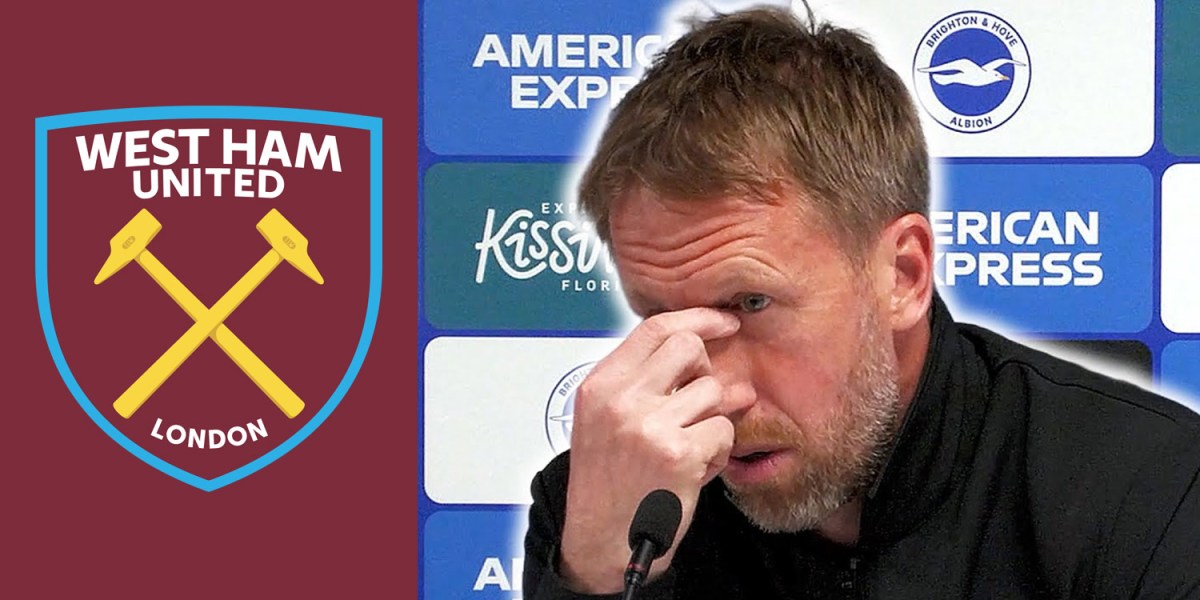
What Can West Ham Expect This Season From The Four Ps Of Potterball

The promised squad overhaul has yet to materialise as the new season gets ever closer. Potter’s preference for patience, possession, passing and probing has looked more cohesive in pre-season but has yet to be put to the test.

Pre-season preparations have changed significantly over the years. What were once low-key trips down the road to Oxford or Southend have been repurposed into fully fledged televised tournament extravaganzas. Hosted in any far-flung corner of the planet prepared to stump up enough cash for Premier League clubs to play exhibition games.

The idea of a Premier League Summer Series seemed to have all the appeal of the low budget seaside specials – starring Vince Hill, Mike and Bernie Winters and the dancers of the Young Generation – that dominated holiday TV schedules many years ago. In the event it wasn’t so bad. Fans were able to watch a handful of nearly competitive games blissfully free from VAR interference. The clubs banked a bounty of PSR boosting pre-season revenue. And the organisers happily settled for the desired outcome of a Manchester United victory.

It was obvious from the outset that the Red Devils were the big draw here. An opportunity to celebrate the latest in an ongoing series of corners turned since the retirement of Sir Alex in 2013. The remaining three clubs duly obliged by playing the role of the Washington Generals to Manchester United’s Harlem Globetrotters.

The wider context here, however, is the increasing interest and involvement in the business of Premier League football by US investors, with more than half of this season’s top flight clubs having American owners. Just short of the majority needed to enforce rule changes should their financial interests align. How long before regular Premier League games are actually staged in North America?

With the advent of live TV coverage comes the pressure on pundits to analyse what we have seen. So, what can be read into performances and what does it mean for the upcoming season? In truth, nothing we didn’t already know as far as the style and approach of Potterball are concerned. The major conundrum is whether the squad will have more and better options to accomplish it by the time the transfer window closes (slams shut, surely) on 1 September. The promised squad overhaul has seen plenty of departures but just the one significant addition at time of writing. It is a situation that would suggest another year of lower table struggle is on the cards.

Graham Potter is now fully committed to a preferred 3-5-2 formation. That one significant signing of the summer (El Hadji Malick Diouf) underlines the desire for attacking width to be provided by the wing backs. The club is now well placed in this area with Kyle Walker-Peters and Ollie Scarles as backup.

The middle three of the midfield five is less clear cut. There are plenty of names to throw in here from the current payroll: Edson Alvarez, Tomas Soucek, Guido Rodriguez, JWP, Lucas Paqueta, Andy Irving and Freddie Potts for a start. Plus, a coiple of youth players waiting in the wings. But how to get the right attacking and defensive balance from that group of (at best) tidy rather than explosive players. Potter’s caution is likely to favour a double pivot and one attacking midfielder rather than a more adventurous one defensive and two box-to-box midfielders. The obvious gaps in pace, power and someone with the ability to carry the ball forward from the middle of the park have yet to be addressed.

Another puzzle is whether there is a role in the system for wide attacking players such as Crysencio Summerville and Luis Guilherme? Both are quick, direct players which may be at odds with Potter’s pass, probe, possession, patience preference which contributed to the poor goal attempts statistics in the second half of last season. The limited game time for Guilherme in pre-season is probably telling – a shame for a player who reminds me of a Brazilian Alan Devonshire.

The primary innovation from pre-season has been the way the front two have operated. Niclas Fulkrug regularly dropping deep to receive the ball from central defenders with Jarrod Bowen deployed in a much narrower role than we are used to seeing him. Fulkrug has looked sharp and keeping him fit may be essential to West Ham’s attacking intent. The wisdom of bringing Bowen in from wide left remains to be seen given how effective he has proven from that position in the past.

Pre-season indications are that Potter’s preferred combination in central defence will be Nayef Aguerd, Max Kilman and Jean-Clair Todibo. It is a surprise rehabilitation for Aguerd who appeared to have had one foot out the exit door at the start of the summer. His pace and passing may serve him well on the left-hand side of a three but doubts remain over the physical aspects of his game. He also offers more of a threat in the opposition box at set pieces than his defensive colleagues. Kilman and Todibo are both good passers of the ball but each have their own defensive frailties. Kilman a tendency to spectate when he should be putting his body on the line. Todibo never looking to have the stamina to last beyond the hour mark.

Recruitment of a goalkeeper is the current hot topic on the transfer grapevine. The release of Lukasz Fabianski and a handful of recent errors by Alphone Areola have made this a priority position. Areola’s clear discomfort with using his feet and playing out from the back look to have shattered his fragile confidence. I need a lot of convincing that this tactic is anything other than suicidal. Perhaps teams with ball players in every position and possessed with fluid movement can carry it off but the Hammers are a long way off that level. It is a play that is fine to use when appropriate to do so but it is a liability once the opposition have cottoned on.

As ever with West Ham recruitment, there is the usual conflict between the players identified by the coach/ recruitment team and the deals that the Chairman is prepared to get done. The suspicion that only players with the right agent ever get signed never goes away. It is debateable whether any of the summer signings to date have come from the Potter/ Macaulay wish list. With all the misinformation circulating on transfer sites and the smoke and mirrors that PSR compliance generates, we really have little clue as to what is going on.

A new season should always be a time of excitement. For me, it has become a little less so with each passing year as professional football incrementally moves away from its community roots towards corporate ownership. The game has taken itself into an endless doom spiral. Each year, maximising revenues is pursued at the expense of loyal support to keep pace with the rising squad costs required for success or survival. It is a problem for everyone but even more apparent at West Ham, a club which has never made any attempt to plan beyond the here and now.

To end on a more upbeat note. There have been a few positives during the summer. The squad have looked to be in good spirits, the weight of a lifetime ban has finally been lifted from Paqueta’s shoulders and there were encouraging performances from academy products during the pre-season games. Potter would do his standing with the club’s support a great deal of good by putting more trust in youth and giving them the opportunity to develop as the season progresses. We can but hope. COYI!

West Ham Wednesday Bulletin: Graham Plotter And The Window Of Uncertainty

As other clubs fine tune their squads for the upcoming season, the promised squad rebuild at West Ham remains stalled in the planning and plotting stage. It’s all looking disastrously last minute.

Updating Transfer Windows – 13% Complete – Please Do Not Switch Off

What better way to undertake a massive summer squad overhaul than to leave everything until the last minute. While other clubs move with purpose to secure their chosen signings, the good folks at the London Stadium are left paralysed in an endless loop of talk but no action.

At the time of writing, eight players who featured in the first team last season have already checked out. If reports are true, the club are also willing to push a further three or four through the departure gates over the coming weeks. Regardless of the quality of the departed, it’s one hell of a gap to fill with just over four weeks to go before the big kick-off – despite yesterday’s welcome signing of El Hadji Malick Diouf from Slavia Prague.

As fans we are frequently reminded how important it is to get in a full pre-season. It is the go-to excuse manager’s use after every poor start. And yet the cunning West Ham plan is to enter theirs with barely half a team. Past performance caveats notwithstanding, Graham Potter’s inability to create a cohesive unit in five months last season does nothing to dispel fears that there’s a season of struggle ahead – and the further hit of revenues that comes with it.

If anything can be read into the Diouf signing, it is that Potter intends to settle on a formation that involves wing backs providing width in advance of three central defenders. Possibly a 3-4-3 but, more plausibly, the less enterprising 3-5-2 underpinning the coach’s dream of competitively losing most games by a single goal. All that’s needed now then are the missing, keeper, central defenders, midfielders, and forwards to convert the dream into possession-based reality.

The transfer window stays open beyond the start of the season until September 1. There are sure to be more ins and outs – eventually, and almost certainly later than desirable. As always the list of online speculative targets is as lengthy, abstract and mysterious as Jeffrey Epstein’s’.

The Madness of Chairman Dave

It would be unfair to point the finger of indecision exclusively at Potter and Kyle Macaulay for the absence of transfer activity. For all we know, they have been working diligently and with laser sharp focus on a data driven list of potential young and athletic recruits to fit their chosen style of play. Players who would both improve the squad technically and ensure that it is faster, fitter, and younger. The signing of Diouf looks an excellent first step in that direction.

But as we all know, hovering in the background of any transfer negotiation is the malignant interference of Chairman Dave and his Baroness sidekick. Ready to scupper or derail the latest recruitment plans as he had with Husillos, Newman and Steidten in the past.

By chance, I came across an article I had written in 2017 (below) after hearing a Sullivan radio interview where he “accepted that by focusing on proven and experienced ability the club had adopted a short-term view for its player recruitment.” The suggestion being that this short-term thinking was about to change. But here we are eight years later beating the same drum on the club’s failure to adopt any semblance of long-term strategic thinking.

The West Ham friendly media continue to frame the Hammers transfer dealings as a delicate PSR balancing tightrope. Indeed, there may well be trouble ahead if PSR is not abandoned (as many expect) in favour of a simpler squad cost ratio. But this is not a today problem. And if the worse comes to the worse, why not sell the women’s team to yourself as others have already done?

The most recent financial distraction has involved scare stories circulating about the need to repay the club’s overdraft facility with Barclays Bank. This is an arrangement that has been in place some years and its relevance has been significantly exaggerated. In fact, a standout feature of West Ham accounts in 2024 was that the club has next to no financial debt, having paid off any external loans at the time of the last cash injection into the club. This is quite unusual for a Premier League club where financial debts of £300 million or more are not uncommon. It should be noted, however, that financial debts do not include outstanding instalments on player transfers.

Clearly West Ham do have a cash flow problem. It is something the Board must address independently of any PSR considerations. The need to inject capital on a regular basis is now an essential requirement for any Premier Club with ambition. If the current board are not up for that, then it’s time to find someone who is.

It’s Been The Ruin of Many A Poor Buy

I have mixed feelings about the transfer of Mohammed Kudus. Not that he was sold but the size of the fee that he finally went for.

Unless the club is bought by a sovereign wealth fund or similar, the only way West Ham can hope to mount a consistent challenge at the right end of the table is to profit from player sales. When you consider that Manchester City’s kit partnership with Puma earns more in a single deal than the Hammer’s combined Commercial and Matchday revenues then the size of the gulf is clear.

Kudus should have been a perfect model of buy low, sell low. Pick him up from a lesser league, develop him over a couple of seasons and sell on at a handsome profit. Yet despite early promise, it didn’t work out like that.

Some may say it’s good riddance to a player with a bad attitude. Others may see a player who became fatally frustrated with how he was handled by a succession of poor management decisions. Whichever it was, his first season promise evaporated to the point where none of the truly rich clubs were tempted by the lure of his buy-out clause. Throw in Sullivan’s bizarre decision to let the world know how skint West Ham were and it provided the perfect storm for Daniel Levy to nip in and buy Kudus at a knock down price. The transfer fee may represent an accounting profit of £30 million or so – a rare bounty for West Ham – but it should have been far higher.

Tottenham has often (along with West Ham and Manchester United) been one of the Premier League career graveyards for big money signings, but I predict Kudus will be a big hit there if Thomas Frank translates his rapid counterattacking style of football from west to north London.

Young, Gifted and Back (On The Bench)

For a club that styles itself as the ‘Academy of Football’, the record for developing young talent in recent years has been abysmal. In the last ten years, new academy graduates have made a total of 253 Premier League starts for the Hammers. Of those, 190 were Declan Rice with the remainder comprising Ben Johnson (38), Ollie Scarles (7), Grady Diagana (6), Jeremy Ngakia (5), Reece Burke (4), Reece Oxford (3). Without the good fortune of picking up Rice when he was rejected by Chelsea it is very sorry reading.

The idea then that today’s current batch of youngsters might come to the club’s rescue as ‘Potter Gives Youth A Chance’ sits somewhere between wishful thinking and clutching at straws. I am as thrilled as anyone whenever a player emerges from the youth setup to become a West Ham regular. And hopefully, one or more of the current crop can do so. But history advises caution.

I try to keep tabs on the players out on loan from West Ham season but did not get the sense of outstanding successes that some have been reporting. No-one really pulling up the proverbial trees. I would be very happy if there are breakthroughs this season but I wouldn’t want to bet our Premier League future on it.  

West Ham Monday Briefing: Too Quiet On The Transfer Front

With less than seven weeks to go before the big kick-off what is happening to the much needed rebuild at the London Stadium. How skint are we, who will be sold, who will be banned and are we ever going to sign any new players?

It was Kick-Off Day minus 47. The wind howled around the empty, soulless Rush Green portacabins, as dust swirled across the cracked, abandoned car park. A single corner flag flapped rhythmically in the breeze, forgotten when the last training session ended just a few short weeks earlier. Nothing stirred except for an old man and the squeaking wheels of a white line marker in the far distance – otherwise, no life, no sound; only silence and despair.

In one corner, a rusty padlock hung above a door marked ‘Head of Recruitment’. A handwritten paper sign sellotaped to the splintered window read: ‘First Class Players Wanted – All Positions. Please state age, experience and preferred agent.’ Welcome to West Ham in the Transfer Window!

***

 If You Can’t Convince Them, Confuse Them

A few weeks ago, I published an article on the realities of the financial situation at West Ham. Although, it is now accepted that West Ham had never faced an immediate threat of a PSR breach, the rules continue to be waved around as a portent for troubled times ahead – possibly the 2026/27 season but more probably the one after that. Yet in all likeihood, the existing PSR rules won’t survive that long now that Chelsea have destroyed their credibility.

Not surprisingly, it was in the Board’s interest to point the finger at ‘externally’ imposed rules rather than admit their own mismanagement for the club’s current woes. I had often wondered why the remaining Premier League clubs had voted for PSR in the first place given its major impact was to preserve the rich club status quo. But then you realise that for most, the priority is not to compete with the rich but to maintain their own advantage over those who are newly promoted.

The dilemma in understanding what is going on at West Ham in this age of misinformation is whether what we read has genuinely been leaked by the club, has been misunderstood/ misreported by the messengers or simply been made-up in the interest of internet clicks.  

The major talking points in recent weeks have been the suggestion that only 75% of player sales will be made available for purchases, and the hint that a £90 million injection of capital is about to be made by the Board. The former is almost certainly a confusion arising from PSR accounting principles where only the excess of sale price over book value can be shown as player sale profit. I’m guessing that someone has made a back of an envelope calculation that this might equate approximately to 75%.  As for the latter, the Board now find themselves in a position where they are obliged to invest further or face the prospect of PSR losses over the next three years being limited to £15 million, rather than £105 million. What form the investment takes, who puts their hands in their pockets, and how the money is used will provide interesting insights into the mindset and intentions of each of the owners.

Such is the dislike and distrust of David Sullivan by many supporters that is has spawned all manner of wacky conspiracy theories. Allegedly the Chairman has a secret plan to get the club relegated as a deliberate act of revenge, making a moonlight flit out of Stratford and baling out of an airplane over the nearest tax haven hugging his parachute payment. Personally, I believe the woeful management of the club is better expalined by Hanlon’s razor which suggests: “never attribute to malice that which is adequately explained by stupidity.” For stupidity, read collective incompetence driven by a gaggle of overblown egos.

 What A Waste of Money

It should come as no surprise to many that the effectiveness of West Ham’s transfer spending over the years has been atrocious. Take Declan Rice out the equation and the player trading profits are at the bottom of the league. If there was any lingering doubt, then take a look at the estimates of squad value calculated by the Transfermkt website (below). Not just that West Ham is ranked in 14th place – despite their relatively high spending – but how far they are behind clubs such as Brighton, Bournemouth and Forest.

1) Man City – €1.35 BN, 2) Chelsea – €1.21BN, 3) Liverpool – €1.09 BN, 4) Arsenal – €1.01BN, 5) Man United – €818 M, 6) Tottenham – €805 M, 7) Brighton – €732 M, 8) Newcastle – €597 M, 9) Aston Villa – €574 M, 10) Bournemouth – €466 M, 11) Nottingham Forest – €444 M, 12) Brentford – €432 M, 13) Crystal Palace – €426 M, 14) West Ham – €370 M, 15) Fulham – €318 M, 16) Wolves – €276 M, 17) Everton – €257 M, 18) Leeds – €211 M, 19) Burnley – €187 M, 20) Sunderland – €137 M

This is no accident or from run of bad luck but a direct consequence of failing to move with the times. Refusing to adopt a professional approach to scouting, recruiting and longer-term planning. Taking the easy option of relying on agents to identify targets rather than trusting the club’s own resources. Paying lip service to the trends of data analytics and appointing experienced football directors in the belief that a bunch of amateurs can do it better.

Profits on player sales is a significant component of football finances – and will continue to be important if/ when squad cost ratios replace PSR. A smarter club in West Ham’s position would have recognised this long ago and planned for the recruitment and development of younger players who can sustain and raise the club out of its current stagnation. It is a strategy that also calls for the setting aside of sentiment. There is an optimum time to sell any player, no matter who they are.   

All Quiet On The Transfer Front

As usual the early days of a West Ham transfer window has been all noise and no action. Last summer I made of point of making a note of every player linked to the club but gave up after the list broke through the one hundred barrier.

The backdrop to this summer’s business have been the baffling public announcements of “we’re skint and must sell before we buy.” Quite why anyone would show all their cards before entering into any negotiations is beyond bizarre. Was the intention solely to manage supporter expectations, an attempt to hide behind PSR regulations or something more sinister. Now we know the club’s problem is cash flow (and not PSR), we also know that it is something the Board can quite easily fix – after all they broke it in the first place. The promised £90 million injection – in whatever form it takes – should serve to partially ease the impasse.  

We know very little about the direction Graham Potter and Kyle Macaulay’s thoughts. The assumed principles of pursuing younger emerging talent sounds eminently sensible. Hopefully they are locked away in a quiet corner somewhere, methodically poring over the rows and columns of a recruitment spreadsheet. Keeping tabs on the players that the data has identified and preparing the bids to be put forward. But will they be allowed to excel themselves in the transfer window or will their preferred targets end up as more names in the list of the ones who got away? Sacrificed to the rubbish bin of low-ball bids, take-it-or-leave-it offers and DFS style payment terms.

Potter and Macaulay have a massive job on their hands to rebuild the Hammer’s sqaud. If they also to lose Kudus and Paqueta as predicted to fund recruitment the challenge becomes even greater – both in finding the players and subsequenting moulding a team from a bunch of strangers. My preference is that they are shopping in the under £25 to £30 million aisle, prioritising pace and excluding anyone aged 27 or over, except in exceptional circumstances. Otherwise, it will be a case of rinse and repeat when we reach the same time next year, requiring a third consecutive summer reconstruction.  

Today, is when the majority of Premier League clubs get to close their accounts (West Ham’s closed at the end of May), so we can expect activity to pick up this week. There may also be last minutes manoeuvrings by any club (e.g. Aston Villa) who find themselves on the cusp of a PSR breach.

In truth, transfer business has been relatively slow across the board, but we have been here before at West Ham. Looking patiently at the clock as the minutes, hours and days tick by. When others start to spend while West Ham sit on their hands, making enquiries, considering targets and preparing talks.

As things stand the Hammers are deep in the ‘conversation’ for relegation. We cannot rely on there being three worse promoted teams again. We have to make ours better. It really is time to act. COYI!   

Counting And Spilling The Beans On West Ham United’s Finances

Here we go! The silly season of transfer bids, player wages, contract lengths, amortisation and PSR breeches is upon us. How does this leave West Ham’s Finances. Strong and stable, or in a mess?

The once simple beautiful game has mutated into a strange and complicated beast for its followers in recent years. A plague of over analysis, statistical overload, tactical complexities, formation paralysis, and eccentric rule interpretations requires fans to understand double pivots, false 9s, low blocks, high presses, inverted wingers, box-to-box midfields and whether a player was entitled to go down. But making matters even worse is the need to be a financial wizard, understanding concepts such as profit and sustainability rules, associated party transactions, player amortisation, shareholder loans and squad cost ratios.

As we enter the summer madness of the transfer window, we take a look at the current state of West Ham’s finances and how they compare with selected other clubs.

Revenues – Where Does The Money Come From?

Despite being ranked as a top twenty club in the 2024 world football rich list – a status they will struggle to retain in 2025 in the absence of European competition – a massive gulf remains between West Ham’s income and the ‘rich 6’ of English football.  Clubs such as Liverpool and Arsenal are able to generate revenues 2.7 times larger than those currently earned by the Hammers. The gap is impossible to narrow for any club lacking regular Champions League participation; or the financial muscle and ambition to challenge for it.

Broadcasting revenues (the central distribution of funds from the Premier League and UEFA for TV rights and prize money) continue to dominate at West Ham where they account for 60% of all income received. Comparable metrics for Liverpool and Arsenal are 33% and 43% respectively, illustrating how the bigger clubs use their global appeal to drive Matchday and Commercial revenues that dwarf those achieved at the London Stadium.

Although West Ham can boast the second largest matchday attendance in the Premier League, they drop to eighth in terms of matchday revenues, even in a season that saw a creditable Europa League campaign. Average revenue per fan is on a par with Fulham and Brentford, and behind the rich six, Newcastle and Brighton. The move to the London Stadium has not proven to be the money spinner promised and attempts at squeezing more from those attending, removing concessions, or attracting a greater proportion of higher spending casual visitors (tourists) have met with understandable resistance.

Commercial revenues have seen incremental growth through additional or improved sponsorship deals, pre-season tours and retail merchandising, but with a slower rate of growth than broadcasting. However, certain income streams, such as naming rights, food and beverage sales and income from the staging of non-football events, are not available due to the stadium ownership. This is a flip side to Brady’s much heralded ‘deal of the century’ in securing a low rent 99-year lease.

Expenses – Where Is The Money Spent?

The principal, and most high-profile, expenses at a football club are those related to player wages and transfer fees. While wages have increased significantly at West Ham over the years, they rank 9th in the league overall for staff costs (wages plus player amortisation). Unsurprisingly, these are way below the ‘rich’ clubs but they have also fallen further behind Newcastle and Villa as they pursue their Champions League ambitions. In total staff costs represented 91% of revenues in 2023/24.

To avoid confusion, it is worth taking a moment to consider how transfer fees are accounted for in profit and loss statements. Suppose a player is purchased for £50m on a 5-year contract. The £50m cost will be amortised in the accounts over 5 years at £10m per year, not as a lump sum. This is independent of how the transfer fees is actually paid in practise. For example, the whole fee up front or against a schedule of instalments.

Brighton provides an interesting comparison here. While their wage bill is not far behind those at West Ham, amortisation is significantly lower. A reflection of their strategy of unearthing emerging talent at a lower cost than the lazier West Ham obsession with experience and/ or recruiting players recommended by agents.  

With many of the operating expenses at the London Stadium paid for by the stadium owners, other expenses at West Ham are relatively modest. Not owning the stadium possibly also contributes to the club being in the rare position of having no financial debt. They do, however, owe significant amounts in future transfer instalments which we will return to later.

Transfers and Player Amortisation

If there are limited options for West Ham to achieve a significant increase in matchday and commercial revenues – and become less dependent of broadcasting income – then surely, they must pay more attention to generating player trading profits. For reasons best known to the owners, the club has chosen to ignore the model of buying low and selling high pioneered by the likes of Brighton. The policy of recruiting older, already established players and selling later resulted in an average annual player sale profit of just £15.4m in the nine years from 2014-23. A figure that was below the league median in seven of those nine years.

Indeed, it is rare for clubs to achieve operating profits. Most rely heavily on profits from player sales to comply with the Profitability and Sustainability Rules (PSR). West Ham’s poor record on player sales – the direct result of a transfer policy prioritising experienced, older players – has been a consistent drag on the club’s progress.

The reason the sale of Declan Rice was such a massive bonus for West Ham’s accounts is that, as an academy product, he had no ‘book value’. The entire sale proceeds could be shown as pure profit. Just as Rice’s contribution papered over the cracks on the pitch during his last season, his sale may have done the same for the club’s finances. The record profits in 2023/24 were almost entirely down to the one-off sale of a single player.

The financial implications of selling a player who had previously been purchased is not so clear cut. Consider the following example of a player bought two years ago on a five-year contract for £50m.

After the completion of two years, the player has a book value of £30m. If he has been a success and can be sold for £75m then great, a profit of £45m can be shown in the accounts. Conversely (and the more usual West Ham scenario) if the transfer has not worked out and he is sold for less than book value then the negative difference must be recorded as a loss. Thus, selling Gianluca Scamacca and Nikola Vlasic may have brought in some much-needed cash but did not generate any profit, as their transfer fees were aligned with current book values.

PSR and All That

The Athletic recently published a club-by-club table of Premier League PSR positions over the latest three-year period. Although interesting in that it confirmed West Ham did not have an immediate PSR problem (as many suspected), it was also a largely irrelevant rearview mirror exercise given the club’s financial year had already closed on 31 May. Whatever transactions take place this summer will become part of the 2025/26 accounts and factored into the three-year PSR period 2023/24 to 2025/26.

In calculating PSR limits, certain allowable costs (depreciation, woman’s football, youth and community development) are added back in to the profit and loss totals. For West Ham this is estimated at approximately £14m per year. Thus, for PSR purposes, West Ham’s 2023/24 profit would increase to £71m and allow for equivalent losses of up to £170+m in the two subsequent seasons without falling foul of the rules. Beyond that timeframe (once the Rice transfer drops out of the equation), the PSR outlook (assuming it remains) looks bleak unless the club significantly ramps up revenues or increases profits on player sales on a regular basis.  

The caveat to the above is that clubs can only lose £15m of their own moneyacross a three-year PSR period. Anything above that, and up to the £105m threshold, must be guaranteed by owners providing ‘secure funding’. According to The Athletic report, the most recent capital injection at West Ham has expired for the purpose of PSR calculation. If the Board (combined wealth £8 billion) do not address this, future PSR consequences would look very serious indeed.

Where Has All The Cash Flow  Gone?

When David Sullivan presented the 2023/24 accounts he gushed “It fills me with immense pride, as a steward of this illustrious club, to see West Ham United on solid financial ground, with all profits reinvested into our squad, infrastructure, and local community, providing a strong basis for our ongoing progress and long-term objectives”.

If we are to believe that is true, then why are we now hearing noise about the finances being in a mess? Or that players must be sold before signings can be made? And what exactly are the Board’s long-term objectives?

There is clearly a problem with cash flow that is beyond the hysterical headlines on the usual clickbait sites. There is nothing sinister about the club resorting to receivables finance or revolving credit facilities. They are standard business practices which I’m sure other clubs must also use.

A standout statistic from West Ham finances is that they are among the leaders for transfer fees owed, with a staggering £191m outstanding when the 2023/24 accounts were published. The equivalent figures available for selected other clubs are Brighton £104m, Newcastle £160m, Arsenal £268m and Liverpool £128. In part this will reflect the Hammers activity in the transfer market but may also be the result of holding out for extended payment terms – a kicking the can down the road tactic that anecdotally scuppers many a West Ham deal at the last minute.   

And here lies the conundrum. On the face of it, West Ham accounts have shown strong operating cash flows in recent seasons, and the club have successfully cleared all outstanding debts. In a normal business it would be an enviable position; but football is an abnormal business. Clubs are not owned for annual profits but for reasons of prestige, ego, and asset accumulation. In 2007, Forbes valued West Ham at £195m. Last May that had increased to £882. An increase achieved with limited shareholder funding beyond the issue of £125m in shares in 2022/23, much of which was used to reduce debt.

This has left a net funding/ investment in the past 5 years of just £54m, compared to £496m at Villa and £391m at Newcastle. It feels like an act of self-harm if the owners decline to make further investment now both to ease PSR pressures and to assemble a squad capable of competing at the right end of the table. This brings us back to the question of long-term objectives. Does this go any deeper than preserving Premier League status (and hence asset value) as a plodding mid-table team?

 What is apparent is that caution gets the better of ambition in the West Ham boardroom. No-one wants a reckless club owner, but some risks are worth taking where the rewards are high. Sound financial management is fine, but a clubs ultimate success lives or dies on its player and management recruitment. As the overall steward of West Ham’s recruitment, I’m not sure whether Sullivan should be ashamed or embarrassed by his record – probably both! Is there any chance of it ever changing? COYI!

They Think It’s All Over; It is Now – And It’s A Massive Relief for All West Ham Fans!

It’s nose bleeds all round at West Ham as Graham Potter’s side climb to the dizzy heights of 14th place on the closing day of a dreadful season. Miracles are needed in the next 12 weeks if a repeat is to be avoided.

And so, there you have it. A dull, turgid, unimaginative season is finally over to the relief of the many. The very worst of seasons since the last one we had suffered; and further proof of the futility of raised expectations when it comes to supporting West Ham.

The record books will show the 2024/25 had actually outperformed 2022/23 on most of the metrics in the league campaign. But, of course, those painful memories had been swept away by the euphoria of a famous night in Prague. There was no such redemption this time round though, as woeful Premier League fortunes were equally matched by early, limp cup exits.

It would be nice to think the slate could be wiped clean during the summer; allowing next season – which begins in just 12 weeks time – to be approached with a renewed sense of optimism. Sadly, there is little evidence to suggest the Hammers are capable of metamorphosing into next year’s Nottingham Forest. It would take a transfer window of momentous brilliance and a road to Damascus style conversion for the coach if the side is to be transformed into credible top eight material.

It was already known that Graham Potter would finish the season with a worse record than the manager he replaced in January. The final day victory at Ipswich did make the points per game difference marginal in the end (1.11 vs 1.15). And the late strike by Mohammed Kudus edged Potter ahead of Lopetegui on goals scored per game (1.22 vs 1.20). This in addition to the more significant improvement on goals conceded per game (1.28 vs 1.95). The tiniest crumbs of comfort in the boardroom, perhaps.

The eventual 14th place finish was ultimately unexpected but was fitting given the amount of time West Ham had been marooned there earlier in the season. Lopetegui’s side had, in fact, spent only one week lower than 14th, while yesterday’s last gasp win earned Potter his loftiest position since defeat at Chelsea on February 3.

Long time West Ham fans have been raised with a wary eye on disappointment. Even if it sometimes appears to be hiding, in the back of your mind you know it’s never very far away. A couple of decent league finishes and three years of European adventures are now in the rearview mirror as a distant false dawn; an accidental temporary anomaly rather than the first steps of a new golden age. A glance at the club’s record across all prior 38-game Premier League seasons does not lie; there is an underlying equilibrium that centres on a mediocrity which underperforms the club’s financial standing. While the season just finished was undeniably awful, it is not an obvious outlier and sits as 14th out of 27 for goals scored, and 17th out of 27 for points won.

Adding to the current pain has been that any pretence of serving up entertaining and enterprising football that was once the West Ham trademark has long been lost and forgotten. For too long, the club has resorted to dull, pragmatist managers whose overriding philosophy has been to concede fewer than the opposition, not to outscore them. Although individual approaches may be different, Potter has done nothing to suggest he is an upgrade on Lopetegui, Moyes or Allardyce when it comes to enterprise. Potter’s media representation as a bright, young coach puzzles in the light of his reputation at Brighton and Chelsea for pointless possession and lack of shot creation. Can or will he prove us wrong over time?

The Ipswich game was a largely unremarkable affair punctuated by several well-taken goals. West Ham enjoyed plenty of early possession but (unsurprisingly) made few penalty area entries. Once again, the team selection left us scratching our heads, with the inclusion of just two attack minded players in front of the most workmanlike midfield imaginable. Fortunately, Ipswich contrived to lend a hand by gifting the Hammers the lead just before the break; Jarrod Bowen’s assist setting up James Ward-Prowse for his only goal of the season.

Parity was restored early in the second half when Jean-Clair Todibo (who played all afternoon as if under the influence) couldn’t be bothered to put in a challenge, allowing Broadhead free access to stroke past an exposed Lukasz Fabianski.

The Hammers finally put the match to bed courtesy of fine strikes from Bowen and Kudus. The first, the result of neat interplay between Bowen and Aaron Wan-Bissaka before the skipper blasted home from just outside the area. According to Tony Gale the ball continued to gather pace as it went, despite this being scientifically impossible. You cannae change the laws of physics, Galey! The second arrived when Kudus exchanged passes with a ‘rampaging’ Guido Rodriguez to curl home and put the result beyond doubt. A low key game with low key goal celebrations. No Ward-Prowse golf swing, and no Kudus advertising hoarding pose. I wonder how many of those featuring will still be with us come the end of the summer!

***

I’ve always been of the view that the only statistic than wins games is goal scored. Nevertheless, who doesn’t like a selection of improbable Premier League statistics (harvested from the FBRef site) which show how West Ham players compare in the statistical scheme of things. Here are the categories which feature Hammers in the top ten leader board positions for the season.

Assists: Jarrod Bowen (Joint 10th)
Goals + Assists: Jarrod Bowen (Joint 9th)
Shots on Target: Jarrod Bowen (Joint 8th)
Goals per Shot of Target: Tomas Soucek (Joint 9th)
Goals minus xG: Jarrod Bowen (4th)
Through Balls: Lucas Paqueta (10th)
% of Dribblers Tackled: Max Kilman (1st), Jean-Clair Todibo (7th), Aaron Wan-Bissaka (Joint 9th)
Blocks: Max Kilman (8th)
Interceptions: Aaron Wan-Bissaka (1st)
Clearances: Max Kilman (5th)
Successful Take-Ons: Mohammed Kudus (2nd), Aaron Wan-Bissaka (7th)
Successful Take-On %: Max Kilman (3rd)
Minutes Played: Max Kilman (10th)
Yellow Cards: Lucas Paqueta (Joint 10th)
Aerials Won: Max Kilman (5th), Tomas Soucek (Joint 8th)
% of Aerials Won: Konstantinos Mavropanos (7th), Max Kilman (10th)
Fouls Drawn: Mohammed Kudus (Joint 5th), Lucas Paqueta (7th)
Save Percentage: Lukasz Fabianski (2nd)

Who Do You Think You Are Kidding Mr Potter If You Think West Ham Are Done?

With Potter’s ‘competitive’ Hammers tumbling to the eighth defeat of his reign, he is now destined to end the season with a worse record than the derided and sacked Lopetegui. Where on earth do we go from here?

Whatever the outcome of West Ham’s season closer at Ipswich next weekend, Graham Potter will end the season with an inferior points per game record to the sacked manager he replaced. Being unable to raise even this lowest of bars makes a mockery of his claim that the team have become more competitive under his stewardship. How can a football team be more competitive, yet the outcomes be worse? The operation was a success, but the patient died!

One wonders what Potter’s objectives for the season were when he sat down on day one at the Rush Green training ground. Time would, of course, be needed to get to know the squad of players he had inherited; their strengths, their limitations and how they would fare as part of a possession-based team. But after that, what next? What if the players were not suited to his preferred style of keep the ball at the expense of anything else football? What if his mission to become tighter at the back could only be achieved by stifling the attacking threat of your most valuable players? Experience suggests there was no apparent plan for such scenarios. No desire to find an equilibrium between the ‘vision’ and what the resources could deliver. Just carry on repeating what didn’t work, or couldn’t be accomplished, regardless. The pursuit of perfection as the enemy of good.

If a significant proportion of the squad are unlikely to be still at the club come the start of next season anyway, why fixate so stubbornly on converting them to an alien style of play in the interim? And why not use the risk-free time for experimentation and to take a look at the club’s youth?  

The predicament has been no more obvious than in the games played at the London Stadium. The record speaks for itself: two wins and four defeats in nine games with just ten goals scored. Hardly the stuff to keep supporters entertained or on the edge of their seats. Where there have been decent performances (or results) they have all come in away games. The coach has spoken about turning performances into points, but no home fixture springs to mind where the team picked up fewer points than deserved.

It was a rinse and repeat performance for Sunday’s visit of Nottingham Forest. Flattered by the previous week’s success against a disinterested and demotivated Manchester United, Potter elected to field an unchanged starting eleven. He obviously anticipated no downside to pitting the world’s slowest midfield against an opponent famous for the speed and precision of their counterattacks. Oblivious also to the idea that supporters might welcome a display to shout about in the final home game of a dismal season. What has so often been celebrated as a carnival occasion had turned into a wake. Leave them wanting more, isn’t that what they say? Who in their right mind would want more of what the coach has served up so far?

As ever there was an all too brief opening flurry from the Hammers. A lively start that saw a smart save from a Tomas Soucek header and a moment where Vladimir Coufal might have broken his West Ham goal scoring duck. In his post-match comments, Potter said they had tried to be on the front foot, but it was never going to last long with the unambitious lineup he had chosen. True to form the visitors first took control of the game, if not possession, and then took the lead when the folly of playing out from the keeper was mercilessly exploited by the impressive Gibbs-White. It is clear to even the most casual observer that Alphonse Areola is like a deer in the headlights with the ball at his feet, and yet the tactic has persisted.

For a team that scores so few goals, falling behind is a routine fatal error. Not once this season have West Ham recovered from conceding first to win a game. It was a record that never looked like coming to an end this time either. Forest were happy to concede possession, sit deep in the knowledge their opponents lacked the craft and imagination to break through, and wait patiently for the opportunity to score a second.

In a break with tradition, the Hammers passed on the half-time substitution ploy in favour of a quadruple change just before the hour mark. The switch had an immediate impact when the visitors doubled their lead shortly afterwards. Two changes at the break and two on the hour would surely have been less disruptive.

However, with the slowest players removed and the introduction of several with a more progressive mindset, the intensity of the West Ham attacks increased. An intensity fuelled by a growing frustration at the visitor’s blatant and unpunished time-wasting tactics.

This game has to be up there with the worst ever when it comes to the combined efforts of the officiating team. The referee was criminally weak on the time wasting and play acting employed by the visitors – a tactic that descended into embarrassing as the clock ticked down. He had lost control well before the end and the bizarre drop ball sequence that preceded the final whistle. Meanwhile VAR taking six minutes to decide whether an offside player had impacted play or not was a further example of how it has failed to fulfil its original purpose of checking for obvious errors. It has taken on a life of its own to look for things that no-one wanted from it and which had never been an issue in the past. If the authorities want to take action to improve the integrity of the football, then it should look at eliminating the cancer of dark arts that is increasingly creeping into the game (I’m looking at you, Nottingham Forest). Not checking for sub-millimetre offside calls.

We were at least treated to a wonderful Jarrod Bowen goal before the game ended. To repeat what many others have said: where would we be without him? There was also a very respectable cameo from the talented Luis Guilherme in the closing stages. Why haven’t we seen more from him – or from the academy players come to that – given the overall pointlessness of the past dozen games or so? And what the hell happened to Andy Irving who after a promising start at Chelsea has only played one more minute of first team football.

Thankfully, there is only one more game of the campaign to endure. I’m assuming we will start next season with Potter in charge but there is a mountain for him to climb if he is to convince as the right man for the job at West Ham. Even if he and Macaulay do manage to work wonders in the transfer market (and I believe their contribution to Brighton’s success in that area is wildly exaggerated) there are still many questions as to how well the football fits with supporter expectations. The media holds him in high esteem, but I do wonder what that is based on. It’s not from winning games and enterprising football. COYI!

Groovin’ On A Sunday Afternoon: West Ham’s Dad’s Army See Off Manchester’s Young Rascals

A welcome win for West Ham against an awful and disinterested Manchester United side in the weekend sunshine. Does it tell us anything we didn’t know? Probably not!

If you had woken suddenly from a season long coma to the news that West Ham had completed the double against the mighty Manchester United – and climbed above the two ‘big six’ Europa Cup finalists in the league table – then you might have been fooled into thinking this must surely be a time of great joy. A reason for good old east-end knees-up.  

Surely, it had to mean Champions League football at the London Stadium next year with a victorious open top bus parade already planned. Only later would it be realised that the game was in fact an inconvenient, end-of-season affair. A match between two of the bottom six where, due to a bizarre alignment of the planets, the hapless Red Devils are still in with a shout of qualifying for the Champions League. Whatever the one-game-at-a-time mutterings from the Manchester United manager, next week’s final is clearly a far greater priority than was the visit of West Ham for Matchweek 36.

At a club where baffling team selections have become as commonplace as a chorus of Bubbles, scientists were able to measure reaction to the announcement of Graham Potter’s starting eleven on the Richter scale. Niclas Fullkrug and Edson Alvarez were once again left on the naughty step, there was not a youth player in sight, an unnecessary full back shuffle, and (as a coup de grace) a recall for the much-maligned Guido Rodriguez.  It was the Argentine’s first start since the home defeat by Crystal Palace in mid-January. Not a player that we had ever expected to see line up in the claret in blue ever again.

Even by West Ham standards it was a very old team. An average age of 29.6 – six players aged over 30 and just one younger than 25. Confidence was low that the Premier League Dad’s Army would have any chance of putting an end to the dismal run of eight games without a win.

What we didn’t know, however, was that agreement had been reached to play the game as a demonstration of walking football. With a level of intensity expected at an OAP’s Sunday morning tai chi lesson on the Common. Ironically, it was ideally suited to many of our players whose undoubted training ground competence is routinely undone when put under pressure by fast pressing opponents. Fortunately, Manchester United did none of that. Either because they lack the players to execute it or were more concerned about picking up injuries in advance of their trip to Bilbao.

It is between amusing and surprising to see the poor value and quality that poses as the present-day Manchester United squad.  Assembled at huge expense it is prima facie evidence of how not to run a football club. It’s possible that some of the younger signings will turn out to be future gems, but overall, you would have to say their transfer policy is even more shoddy than the Hammers. The exception to the rule is Bruno Fernandes who appears to have carried them single handedly over the past four of five seasons. So ineffective were they in attack that it was only after the introduction of Harry Maguire that the threat level was raised in the West Ham defence. I had read an article at the weekend that Hojlund was eager to prove himself at the highest level. It made me wonder whether he had considered a career change to scaffolder.

Predictably, the West Ham goals were scored by Tomas Soucek and Jarrod Bowen. Together, they have notched over a half of their side’s Premier League total this season. I am conflicted about the contribution made by the big Czech. You couldn’t hope for more committed player and, of course he regularly weighs in with important goals from an otherwise impotent midfield. Yet, he is anonymous for long periods allowing the game to pass him by. Is that enough in the modern game where speed of thought and action – press, pass, carry – have set the standards of midfield play?

To be fair, Soucek had a decent game; put in some important blocks and even got involved in the exhibition of one touch passing that the Hammers put on towards the end. But that was the story of the game for other West Ham players too. Given time and space they can look at home at this level. Sadly, it all falls to pieces against quicker, aggressive opponents.

Despite sitting on an apparently comfortable 2-0 lead, it wouldn’t be a West Ham game without a nail-biting finale. In his wisdom, Potter elected to remove Bowen and Mohammed Kudus in a double substitution on 73 minutes with both players looking equally unimpressed with the decision. Removing his only out-ball runners is a tactic that hadn’t worked well for the coach in the past, so he decided to try it once again anyway – just in case. It immediately invited extra pressure as the Hammers found it increasingly difficult to clear their lines. Was it part of Fullkrug’s punishment to abandon him up top without any recognised service or support?

Still a win is a win; and they don’t come along frequently enough to belittle. I am not sure we learned anything new from the experience, although we are now TOP of the bottom six and can go into the remaining two games with a modicum of positivity. The magical 40-point mark has been reached, and if another four can be mustered it will raise Potter’s points-per-game above that of Lopetegui. I suppose that would be progress of sorts!

The opening gambit in the annual player clear out was revealed a few days back with the announcement that Aaron Cresswell, Vladimir Coufal, Lukasz Fabianski, and Danny Ings would be leaving the London Stadium in the summer. The signing of Ings was a monumental blunder for both club and player. Another casualty of not bothering to sign a striker that suits your style of play. While I find it hard to associate millionaire footballers with the concept of being great servants, the other three have each had distinguished careers at the club. Cresswell’s 11 years at West Ham (360+ games, 11 goals) deserve our recognition and the opportunity for his greatest send-off since that night in Frankfurt; Coufal will not now get the chance to equal Tomas Repka’s modern record of the most games played by an outfield player without scoring; and Fab will fall eight short of 100 career Premier League clean sheets (43 at West Ham). We wish them well. COYI!

Lazy Sunday Afternoon: West Ham’s Shameful Attempts To Get On With Their Neighbours

Oh, Mr Potter what shall we do? We wanted a young dynamic coach, and we ended up with you! The Hammers extend their winless run to eight games in instantly forgettable El Naffico.

For a contest billed as one of the most eagerly anticipated of the season by both sets of fans, this was a spectacularly grim, dull, featureless, and uninteresting affair. The dampest of squibs, where having been thoroughly soaked beforehand, an attempt was made to set off the squib in full sunlight, behind a huge, soundproof wall. It was as if all involved (players and managers) saw the battle for 16th place as an unimportant inconvenience. Paying no heed to the significance of the clash for supporters.

It goes without saying that it has been a dreadful season for both West Ham and Tottenham. It is impossible to deny the evidence of the league table despite any flannel you might hear about injuries or periods of transition. Yet despite this, Tottenham are on the brink of a Europa Cup final – and the allure of Champions League qualification beyond that. They could be excused for regarding Sunday’s game as one of secondary importance – especially in an away game. A second-string team selection clearly underlined that position.

For West Ham, there was no excuse whatsoever and a virtually fully fit squad to choose from. It was a perfect opportunity to end a run of seven winless games while getting one of over on local rivals at the same time. But they offered nothing. With a couple of notable exceptions (in Jarrod Bowen and Aaron Wan-Bissaka) there was only disinterest and apathy. It was a shameful insult to the many thousands of home fans, to whom a full and frank apology needs to be made by all concerned. The Tottenham players couldn’t have hoped for an easier afternoon allowing Big Ange to leave his more experienced substitutes on the bench.

It’s now eight games (and four points) without a win for Potter’s team. There’s every chance it will be 11 by the end of the season with a failure to hit 40 points. The coach’s personal tally is now a shabby 15 games and 14 points. It’s not just a lack of improvement since his appointment; results are even worse than under a manger who was deemed underperforming enough to get the sack. Isn’t the job of a supposedly top coach to get the best from the resources at his disposal? It is hardly an endorsement of coaching skills if half-decent performances must wait until he has the right type of players assembled. And a complete waste of time to employ such a coach mid-season. Are we really to trust him with the transfer millions in the summer? The man who believed the old-pals act of bringing in the unfit Evan Ferguson as a sole January signing was a wise move. Jordan Hugill Mk 2 more like.

We have written in these columns many times before that under the current ownership, West Ham is a club with no discernible football strategy, beyond the taking of random decisions designed to stroke egos in the Boardroom. It stumbles along from year to year, making arbitrary razmataz appointments and signings, hoping for the best and that the occasional gem pops out from the academy. Fans (or customers) have been seriously alienated and the community connection that one underpinned the great club has long been severed. Who among us believes that when Potter is eventually given the heave-ho, that his replacement will be anything other than short-sighted, expedient, unplanned and unimaginative.

There is no doubt that the current squad has plenty of holes in it. It started with Moyes and his preference for a small squad of players suited to his low-block style of play. One that he allowed to age with no plan for succession. The triumvirate of Sullivan, Lopetegui and Steidten then wasted millions on recruitment without addressing the fundamental structural issues whereby a host of players were past their prime and lacked the pace, power and athleticism now necessary in Premier League football. The squad’s a mess, but too big a mess to sort out in one go.

Many comments overnight have suggested that Bowen and Wan-Bissaka are the only two regular first-teamers worth keeping. I don’t disagree with the sentiment but am afraid we will have to put with some of the others for a little while longer yet.

I’m in two minds about the keeper situation. Areola is up there with the best as a reliable shot stopper but is clearly uncomfortable with the ball at his feet. I’m not particularly a fan of playing out from the keeper and saw a suggestion recently that only very few teams scored more than they conceded as a direct consequence of this tactic. With all the other squad priorities, I wonder where a ball-playing keeper should rank. A younger keeper to replace Fab as number two, and eventually become first choice might be a more reasonable option.

In defence, I see no reason not to keep faith with Todibo. Although there have been concerns with his fitness record while at West Ham, I’m not sure that is why he was substituted yesterday. He looks a decent defender to me. I am less confident about the other central defensive options where Kilman has become as ineffective as Mavropanos of late. His gaffe for the Tottenham goal being as bad as anything the Greek has served up this season. He did appear to play as less of a spectator yesterday, although his newfound aggression mainly manifested itself by fouls on Richarlison. Ironically, the ageing Creswell put in one of the better performances – but he is hardly one for the future.

As for the full backs, Coufal’s best days are well behind him – and he has proved one of the club’s best value for money signings – while Emerson (despite having good technique) gives the impression of someone more interested in topping up their retirement pot. Although Scarles early promise took a hit from several bouts of defensive uncertainty, it is a peculiar management approach to drop him completely from matchday squads. Especially, when you see forgotten men such as Ings and Rodriguez getting a regular seat on the bench.

Midfield is even more of a muddle. There is no player we should be desperate to hang on to. Surely Alvarez has burned his boats after falling out with the last two managers and there is clearly an attitude problem in there somewhere. As nice a guy as Soucek is, I don’t get why some regard him as a West Ham legend. According to an Opta analysis published in March 2025, he is the top jogger (and one of the slowest players) in the entire Premier League. Alongside him as top joggers are Guimaraes, Tielemans, Fernandes and Caicedo – yet each of those players have close to twice the number of touches as big Tom. And therein lies the problem, the game goes on around him with minimal contribution other than the occasional goal.

Paqueta’s future is inextricably tied up with the ongoing spot fixing investigation. Whatever the outcome, he is likley to be leaving in the summer; the only question being whether the club pick up some cash as a transfer fee in the process. I must admit I have always struggled to see him as a Pep Guardiola type of player given his casual attitude to giving away possession – and then pretending he is injured. It will surprise me if he has any suitors in the Premier League. The same goes for all our midfield players unless Moyes is stupid enough to go for Soucek. Soler has not done enough to earn a permanent deal, and Rodriguez will also surely be back off to Spain. There’s a chance that JWP will stick around unless he returns to Southampton in a player-coach role.

The one moment of intrigue on Sunday’s game was Paqueta coming close to tears after being booked by the increasingly fussy refereeing by Michael Oliver. I wonder whether Betway are already scouring through the number of Paqueta not to receive a yellow record bets placed from Brazil.

The biggest hope for a cash windfall in the summer is the sale of Mohammed Kudus to either a Champions League club or the Saudi league. His performances this season must surely have put a dent in the number of clubs willing to stump up the full release clause fee. Hopefully they haven’t been watching too closely or else view his insistence on performing a series of tricks, turns, and showboating before releasing the ball as a West Ham specific frustration. Why he wasn’t replaced by Guilherme in the second half yesterday is another mystery known only to the gaffer.

While a new striker remains a top priority (as it has done since Tony Cottee retired) I would like to see Fullkrug stay on for another season. His wasn’t a great performance against Tottenham and he seemed more interested in drawing a second yellow card challenge from Davies than getting involved in open play. But he has the right attitude for shaking up the dressing room and can play an importnat role as backup striker.

So, there you have it. Not much work needs to be done; other than two central defenders, a left back, three or four midfielders and a striker or two. All for whatever money can be found down the back of the boardroom sofa. The challenge will be in spending all that change wisely. Not on established stars but those with bags of potential. We cannot afford to again blow a huge part of the budget (whatever that turns out to be) on a single player. COYI!

Careful What You Wish For: Is This David Sullivan’s Self-Fulfilling Prophecy

Another desperate week sees West Ham pluck defeat from the jaws of victory at Brighton while the head coach goes berserk in his post-match press conference. It’s now seven games without a win for Potter!

And so here we are again. Another game featuring questionable team selection, a shocking first half performance, improvement after the break, baffling substitutions and the sucker punch of a late goal. Topped off this week by our head coach – a student of psychology and emotional intelligence – melting as quickly as a slice of American cheese during his post-match press conference.

Pre-match expectations are increasingly managed these days by the announcement of the teams 75 minutes before kick-off. I had fully expected Graham Potter to fall back on a 3/ 5-man defence for this much anticipated return to Brighton. After all the 4-1 defeat he suffered as Chelsea manager must still have hurt and there was no way he was going to let that happen again.

Having complained that Niclas Fullkrug’s outburst after of the Southampton game had been unhelpful, and that such frank exchanges were best aired in private, Potter made a very public statement by relegating the German to the bench. No amount of denials or flannel about managing the striker’s fitness can disguise the obvious truth, Graham. Will he now drop himself for next week’s match following his own red-faced rant?

Fullkrug’s omission meant it was a switch back to a 3-5-2 formation of sorts, with Jarrod Bowen and Mohammed Kudus taking up narrow forward positions in front of a midfield three of Lucas Paqueta, Tomas Soucek and James Ward-Sideways. The bonus was the return of Aaron Wan-Bissaka to resume his one-man campaign for the Hammer of the Year award.

As ever, the fly in the ointment of the Potter machine are the struggles in midfield. Again constrained by a combination of individual limitations of the players involved and the role asked of them to maintain possession purely for the sake of it. The dilemma (or should that be dullema) is that having played out reluctantly and uncomfortably from the back to beat a high press, the midfield faffs around with the ball for so long that opponents have ample opportunity to retreat and set a second press. The result: no creativity, forward momentum and few scoring opportunities. Like Lopetegui before him, Potter has prioritised a system over the player’s ability to deliver it.

Does that mean we will see improvements once the coach has assembled a squad in his own image? Possibly yes, but how many windows and how many seasons is it going to take to assemble a team capable of competing at the right end of the table? It is a luxury and timescale that is rarely available to Premier League managers in an environment where revenues generated from league position and European competition are crucial to releasing the funds required for effective squad building. A case of forever chasing ones tail.

The high point of an otherwise drab first half at the Amex Stadium was a fine strike by Ayari for Brighton’s opener. As good a goal as it was, it owed much to the Hammer’s failure to put him under pressure. When he received the ball, there were eight West Ham outfield players inside the box but none withing 15 yards of the ball. A token Paqueta challenge was the best on offer.

 Half time saw Fullkrug replace JWP allowing Bowen and Kudus to take wider positions in a 3-4-3. Whether it was the formation and personnel changes or whether it’s just that the team are prepared to try harder after the break is anyone’s guess. The shape certainly looked better. While the performance never convinced consistently, West Ham did contrive to take the lead through goals from Kudus and Soucek. Both courtesy of Bowen assists underlining how more effective he is from wide positions.   

The euphoria was short lived however as two Brighton goals in the closing minutes not only denied the visitors a rare victory but left them empty handed once again. Was it a recurrence of the mentality problem? Were the players astonished – just like the week before – at the weirdness of the late substitution? The increasingly slow Vladimir Coufal brought on to play on his wrong side to fix a problem that didn’t exist. Was the real reason for Potter’s post-match meltdown a case of embarrassment for this managerial masterstroke?

There has been a Pavlovian response this season to blame Dinos Mavropanos for any goal conceded by West Ham – just as Thilo Kehrer was designated scapegoat in the past. I find the Greek not guilty on all charges this week and would go further to suggest that Max Kilman has increasingly developed into the greater worry. But due to negligence rather than obvious gaffes. He may be adept at winning aerial duels when they are directed straight at him, but he rarely attacks the ball or puts his body on the line – in the style of Craig Dawson or James Collins. It’s no surprise that such a casual approach is never a threat in the opposition box at set pieces. We should rightly expect more from a £40m defender who supposedly came with leadership qualities. Oh well, he’s only here for another six years.

The Brighton equaliser was the result of leaving a man completely unmarked at the far post and then allowing Mitoma to nip in unmarked to head home. Leaving Coufal and Kilman looking at each other in bemusement. The winner was another great strike by Baleba who again was given oceans of room to pick his spot as every West Ham player looked on admiringly from in and around their own box.

It’s 14 games now under Potter’s command. That’s no win in seven, and a grand total of 13 points earned and 14 goals scored. It’s long enough to have taken a good look behind the curtain; to get past the bluster, puff and hot air and discover this Potter is no wizard when it comes to coaching football. It’s a long way back from here. The question that has to be asked is whether the broken man seen in the post-match interview has what it takes to front up the challenge.

The consensus is that Potter will be (and should be) given the opportunity to preside over a summer pre-season and transfer window in an attempt to re-model the squad. Estimates vary on how much money is available to do this and who might need to be sacrificed to fill the coffers first. After that his future will be down to results. How ironic to find the club back in the self-same position as the previous summer. Needing to identify, negotiate, recruit and integrate a significant number of new faces – and all the problems that comes with this for a slow-burn manager needing a good start to the season.

If I was the type of person inclined towards conspiracy theories, I might suggest that all of the mayhem surrounding West Ham’s season was a dastardly act of vengeance by the West Ham chairman. In his eyes, his genius had saved the club from oblivion, provided a world class stadium, with a world class team that had delivered a European trophy. Yet the ungrateful supporters demanded entertainment in addition to the opportunity to buy merchandise, subscribe to membership schemes, and enjoy an open-top bus parade. What better way to teach them a lesson and get rid of the unwanted Technical Director (who had been foisted on him by that Czech geezer) than hiring a duff manager of two. That’ll learn them to be careful what they wish for. And show them the Chairman knows best.

I really don’t care about Sullivan’s private life, his choice of hats, or how he earned his (considerable) fortune. But I do care about how is holding back the club at a time of increasing change. Left alone, the club will fall further and further behind. As I have written before, its not that the board hasn’t invested in players – even if they will only ever consider recruiting out of work managers. The problem is that West Ham is run as the owners’ plaything. For prestige and to massage their egos. A glitzy, razmataz, exotic signing will get them moist while the hard work of data analysis, scouting and developing players leaves them cold. Does any other aspiring top club have an enthusiastic but amateur Chairman working in the role of Director of Football. No wonder its a shambles.

Modern day West Ham has abandoned its history and community roots except when it suits for PR purposes. It has no discernible identity and lacks even a half decent strategy for competing against the much richer clubs which dominate the football elite. While the owners will be desperate to preserve Premier League status – and hence the club’s asset value – there lies the limit of their ambitions. Unfortunately, current trajectory will see the Hammers among the favourites for the drop next season. We won’t always be able to rely on all three promoted clubs being rubbish. Sort it out. COYI!    

Saints Preserve Us: The West Ham Masterclass On Game Mismanagement

There’s no looking on the brighter side of life as West Ham struggle to a point against one of the Premier League’s worst ever teams. Is it the manager or players who are to blame?

Yet another dreary afternoon in West Ham’s dismal season received a belated brush of colour by the post-match comments from Niclas Fullkrug. His honesty and passion are to be admired; and the mentality of the players may well be contributing to the recent trend of conceding late goals and dropped points. However, it does not tell the whole story of why performances have been so poor, and why the club appears to be a downward spiral to disaster.

The context of Saturday’s game is that West Ham put in a dreadful first half performance against one of the statistically worst sides ever to take part in a Premier League campaign. Once again, the Hammers were fortunate – or thankful for poor finishing – not to be a goal or two down at the half time whistle.

For a brief period, Jarrod Bowen’s well taken goal early in the second period looked like it might spark further goals and a repeat of the collapse the Saints experienced a week earlier against Aston Villa. But the threatened deluge never materialised and allowed the visitors to deservedly claw their way back into the game and claim their sixth away point of the season.

The essence of Fullkrug’s anger was that the players (or at least some of them) had ignored Graham Potter’s instructions by dropping deep rather than continuing to push forward for more goals. If that was the coach’s intent, then his sequence of strange substitutions had the entirely opposite effect. He may not have planned for his team to defend with seven across the back, but it was the unintended consequence of removing each of his realistic goal threats from the pitch.

We could perhaps offer Potter a degree of understanding – given that he had inherited such a ramshackle squad – were it not for his prior admission that his priority was sorting out the defence; and the fact that possession for the sake of it, and a reluctance to shoot, were very much central to the teams he has previously managed. If he can prove he has learned from those experiences all well and good but simply repeating them at West Ham will never end well.

The starting lineup for the game looked reasonably promising and attack minded. The notable absences being Aaron Wan-Bissaka through injury and Edson Alvarez who was dropped from the matchday squad without explanation. No doubt having fallen out with the manager due to either lack of game time or being asked to play out of position to accommodate others.

Any hopes of an attacking masterclass against the league’s leakiest defence, however, did not materialise. With JWP and Carlos Soler competing for the crown of the most pointless passes in a single match, momentum was quickly lost whenever West Ham gained possession. It was a Green Cross Code style of midfield play – Think, Stop, Look, Listen, Wait. If the coast is clear, pass it sideways.

At this time of year, we are always encouraged to look on the brighter side of life. To this end, the coach will happily pat himself on the back with the boast that his team have been competitive in every match, and supporters can take comfort that there are only five more games to endure. Just 13 points and 13 goals in 13 games is a funny kind of competitive though. As Niclas might have said “we’re a piece of sh*t when you look at it.”  

Personally, I see at Potter’s style as part of the general malaise that is smothering entertainment in English football. Keeping possession and playing out from the back are just two useful tactics that have been developed into entire football philosophies where discipline and shape are preached at the expense of improvisation and flair. So many managers and coaches are fixated on the genius of their intricate systems for control and build up – like a game of 4-dimensional Mousetrap – while disenchanted supporters delight in fast, aggressive, forceful football.

Success may be able to paper over those cracks for a while – as we know from the Europa Conference victory- but will ultimately fail to satisfy the legacy fans who have a deep emotional connection to their club, as opposed to followers who look out for results and are happy to consume online content. Whoever said “football is a results business” is missing an enormous part of its true appeal. It’s not that results (or trophies) are unimportant – of course, they are – but they are not the be all and end all. It’s why so many had had enough of David Moyes.

With nothing of interest happening on the pitch, attention has inevitably turned to the summer transfer window. An endeavour which may or may not involve a massive overhaul of the squad. Reading from the more detailed analyses of West Ham’s finances – rather than the more hysterical headlines – the club does not have an immediate PSR problem. However, two seasons of poor performances in league and cups (and no European competition) will have stored up issues for future years reporting. The summer will likely see both comings and goings but that is true of all clubs in the current financial environment. The trick is in developing players and selling on at a profit – one of the many failings in West Ham recruitment policy over the years. Isn’t it the case that Declan Rice is the only player the club have sold for more than £25 million?

There are a good number in the squad I’d happily see depart and only a handful I’d be disappointed to lose. I doubt we have the capacity to shift all the deadwood in one go or can avoid sacrificing one or more of the better players.  We can only sit back and see what Potter and Kyle Macaulay have up their sleeves. I hope the plan is far more cunning than just going back to the clubs they used to work at or signing duds from relegated clubs. Based on current direction of travel, a big turnaround is necessary if the Hammers are to avoid a genuine relegation battle next season.

Ultimately, West Ham’s woes stem from a lack of leadership in the Boardroom. Since the Gold and Sullivan takeover the club has been treated as a vanity project by the owners. It’s not fair to say they haven’t invested but the overriding motivation has been glitz, glamour and self-promotion. The hard work required to establish a strategic football philosophy, based on continuity and succession planning has been repeatedly ignored. Happy to stumble along from year to year as long as the asset value is not threatened by the loss of Premier League status. The involvement of Daniel Kretinsky has had little effect on constraining David Sullivan’s erratic running of the club – I guess West Ham is little more than another minor investment for the Czech sphinx.

The apparent scrapping of the Director of Football role is another backward step which reinforces Sullivan’s continued meddling in football matters that he doesn’t understand. It may only be speculation, but my sense is that he did whatever he could to undermine Tim Stediten’s role. Both by appointing a manger against his wishes and then not giving him full control over transfers – I’m fairly confident that none of Max Kilman, Guido Rodriguez or Carlos Soler were the German’s choices. With Sullivan now restored to the position of de facto DoF he can confidently repeat all the mistakes and missteps of the past 15 years.

In hindsight, West Ham should have stuck with Julen Lopetegui for the remainder of the season. Uninspiring as his tenure was, performances haven’t improved since his departure while results and league position have become worse. It would have saved on compensation and allowed a thorough recruitment process for a new head coach to take place during the summer when more options than the Chief Executive’s husband’s mate would be available.

I do wish Potter the best of luck and a fruitful transfer window, but he has made a dreadful start to his London Stadium career. The breath of fresh air that heralded his arrival has now been replaced by a man who never looks convinced himself by what he is saying. He will do well to survive to the end of next season. COYI!