

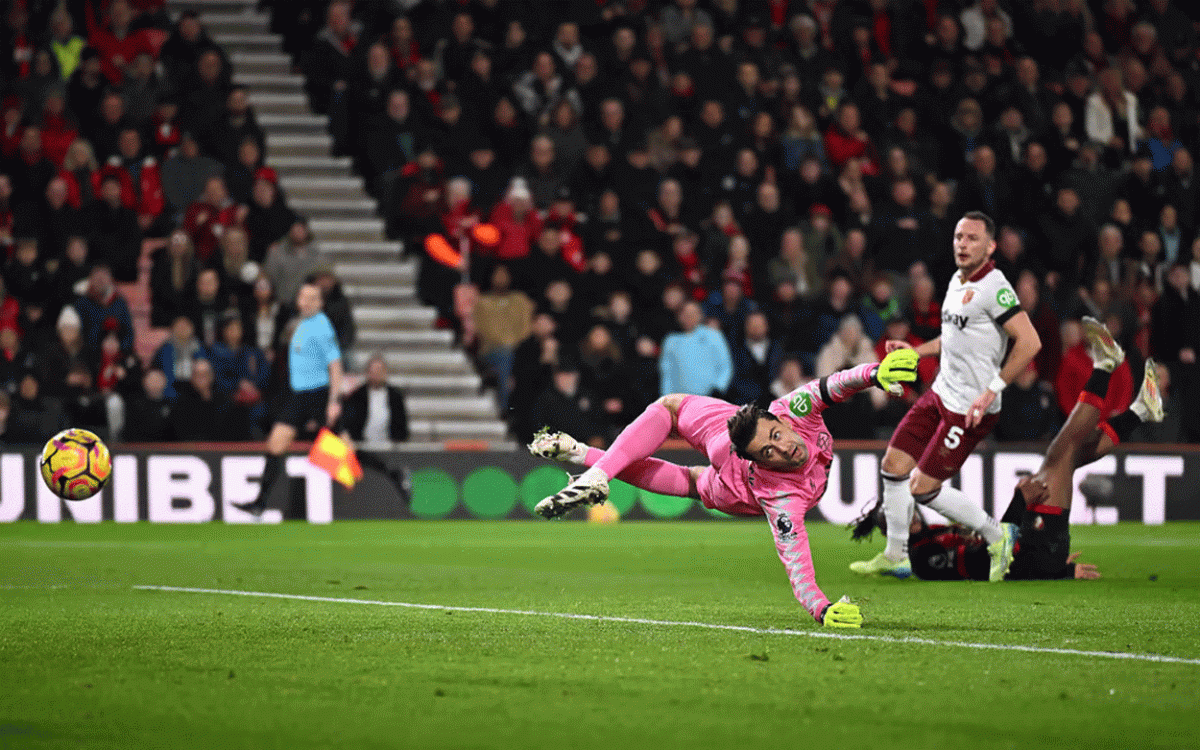
On the face of it, returning from the Vitality Stadium with one point in the bag could be seen as a job well done. Bournemouth are no mugs and many of us would have taken the draw prior to kick-off. And seven points from the last three games is not to be sniffed at. So, why so much post-match negativity among supporters? The simple answer: because it felt very much like two points thrown away rather than one earned.
Nuno had received plenty of media plaudits following the two consecutive home victories against Newcastle and Burnley. They were much needed wins, the league table looked less desperate and there was a sense he may have “turned things around”. Yet, I can’t shake the doubts from my mind that he was as much the architect of our dire situation – from his bewildering selections and tactics against Brentford and Leeds – as he was our saviour. A sleight of hand like the firefighting arsonist who first sets the blaze and later returns as the hero to put it out.
It’s now eight points from seven games for Nuno. An improvement over the hapless Graham Potter but still well within the realms of disappointment. The next seven games take us through to the end of the year; the halfway stage of the season and the opening of the transfer window. Following the first three of those games, players will depart for AFCON 2025 – and may potentially be missing until the last week of January. It’s a tough run of fixtures during which the Hammers cannot afford to lose touch with our fellow stragglers. A point per game is a minimum return.
Having carved out the two home wins with a solid, dependable and unspectacular 4-3-3, Nuno elected to exercise his tactical chops with a return to a three-man central defence. What might have looked liked a 3-4-3 from the safety of the white board turned into a uninspiring 5-4-1 for most of the game. The driver for change was either to compensate for the absence of Lucas Paqueta, to counter the Cherry’s swift attacking threat, or just for the hell of it. Whatever way, it served to set the tone of the afternoon. The Hammers would be competing as underdogs.
How we have arrived at a situation where Bournemouth (£169 m in revenues and average attendance 11,200) have superior resources and depth to their squad than West Ham (£268 m in revenues and average attendance 62,400) is staggering. But we know the answer, don’t we? It is the direct consequence of the fetid band of grifters, chancers and charlatans in the boardroom responsible for sullying the great name of West Ham United for the past 15 years. As with Robin Banks, the detective, or Clara Knet, the musician, we can see nominative determinism at work here. Sully – verb: to damage, soil, or tarnish a reputation. BS Out!
As for Bournemouth, it is a very well-run club. They ditched a safety-first coach to appoint a progressive, visionary coach in Iraola. They have coped with (and profited from) the lucrative sales of Zabarnyi, Huijsen, Kerkez, Ouattara, and Solanke. And yet still have a more valuable squad than West Ham according to Transfermkt.
Reaching half-time two goals up came as a huge surprise. The lead courtesy of two expertly taken Callum Wilson goals rather than any tactical superiority displayed by the Hammers. How refreshing to have a main striker who understands the role with an opportunistic eye for goal. A great shame he’s not half a dozen years younger.
Apart from the goals, West Ham had been happy to surrender possession for most of the half. But in doing so, managed to limit the Bournemouth threat to a handful of half chances. Aside from a couple of dangerous Malick Diouf crosses, the wing backs rarely left their own half. Both Jarrod Bowen and Luis Guilherme looked uncertain in their narrow roles and too often they occupied the space the wing backs were meant to run into. As a front three, they were never close enough to operate as a functioning unit. And there were never enough attacking bodies in the box at any one time.
Still, it was a nice position to be in at the break. A third win on the bounce was certainly not out of the question. Until everything started to go wrong.
First change (46 minutes): KWP for Guilherme. There was some debate whether this was a tactical switch or due to injury. Introducing KWP had worked well in previous games as a wide midfielder in front of a back four. He appeared to have little idea what to do or what was expected of him as a theroretical part of a front three. Either George Earthy or Soungoutou Magassa would have made more sense as Guilherme replacements.
Second change (52 minutes): Tomas Soucek for Wilson. This was wrong for two reasons. One, it was far too early to take off Wilson who had showed no signs of tiredness – the look on his face said it all. And two, Soucek was the wrong replacement. Deploying him as the main striker was laughable. Iraola had withdrawn one of his central defenders at the break and this change played straight into his hands. The switch should have been delayed for at least another 15 minutes with either a straight Niclas Fullkrug swap or moving Bowen into the centre and introducing Magassa or Earthy behind.
Third change (74 minutes): Fullkrug for Fernandes. A contender for the Most Stupid Substitution of The Month award. Leaving aside the fine individual exploits of Wilson and Alphonse Areola, Fernandes was the standout West Ham performer again. Had Brian Clough been in the dugout he would have hooked Soucek straight off again, having seen how far off the pace he is now in open play. But no, Nuno took off the one player capable of putting in a tackle and holding on to the ball. As it was, Fullkrug was hardly involved – either isolated or lazy depending on your point of view – and Fernandes’ absence opened gaping holes in the midfield for Bournemouth to breeze through.
It beggars belief that any professional manager or coach would come up with Nuno’s cunning five part plan to defend a lead: abandon all attacking intent, remove any outlet for retaining possession, defend as deep as humanly possible, resort to punted upfield clearances to no-one in particular, and invite wave after wave on attacks on their own goal. Madness, surely! It was a basement level of cowardness and caution that would leave even the Moyesiah reeling with embarrassment. And remember, these were tactics developed in the full knowledge that the club has a collection of the flakiest defenders in living memory.
There is often a debate as to whether the on-field approach is down to the players or the tactical instructions prescribed by the coach. All I can say is that at no time did I see Nuno imploring his team to push up or demanding that a higher defensive line be adopted. I can only assume he thought it made sense.
Every watching West Ham supporter would have been fully aware it was only a matter of time before Bournemouth started scoring. It was good fortune that they ran out of time after drawing level. There could have been little argument if they had racked up another two or three goals.
At the final whistle, the disappointment was as much about the manner as the fact of losing a two-goal lead. One second half goal attempt (in the 51st minute) and 22% possession after the break says it all. Only eight touches in the opposition box all game and no saves for their keeper to make illustrate the luckiest of snatched points, not a hard-fought draw.
The Hammers ended the weekend just outside the relegation places on goal difference. It’s going to a much tougher struggle at the bottom of the league this year. Although two of the promoted clubs currently sit below us, they are stronger sides than we saw promoted the season before. Clubs have learned that survival chances improve immensely when you have physically imposing players scatered around the team. In the modern game it is almost a pre-requisite for every player to be quick, athletic and strong. A lesson that a succession of West Ham managers have been slow to learn.
A shrewd transfer window in January is now essential for survival. And then I read of links to Adama Traore. It’s enough to tear out the few remaining hairs on my head. COYI!



 Under The Hammers