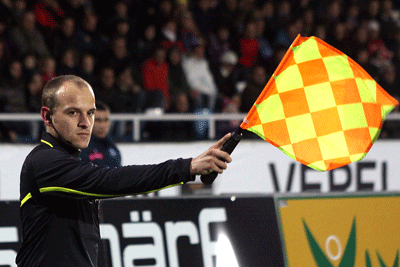
Offside: Changes Needed? – Part One

Raising the flag on problems and shortcomings of the current offside rule.

OffsideI recently wrote an article where I posed the question, “what is the point of the penalty area?” In this I suggested the removal of the penalty area as it stands to be replaced by a line, which would stretch right across the pitch. The line would have nothing to do with the issuing of penalty kicks, but would be an instrumental line for a change in the ridiculous offside law (as it stands), which I will outline further starting with this article.

I’ve got a lot of views about offside and I’ve been reading about the law, FIFA guidance, referee guidance etc. One problem I have is that it has been proven in scientific research that human beings (including linesmen!) physically cannot move their eyes fast enough to take in all the necessary action. To make a correct decision they have to assess the positions of the player passing the ball, the player receiving the ball, and the second from last defender at the exact moment a pass is made, bearing in mind that they could be some distance apart, and possibly moving at speed in opposite directions.

I believe we need to look back in history to ascertain why the offside law was introduced in the first place. If you study the development of football in the 1860s, the offside law was probably the biggest bone of contention between the clubs in existence at the time who all had their own version of it.

A compromise was eventually agreed and written into the Laws of the Game in 1866, and was eventually adopted throughout. It was similar to the rule that exists today with the difference being that at a player was offside if he was in the opponents’ half, and he was nearer to the opponents’ goal line than both the ball and at least three opponents when receiving a pass from his team-mate.

The rule changed in 1925 with three opponents becoming two opponents. In 1990 the law was amended so that a player was onside if he was level with the second to last opponent. This change was considered to be part of a movement by the authorities to make the rules more conducive to attacking football and help the game to flow more freely.

But why was it introduced in the very first place? In the very early games of football, players would stand close to the opponents goal, a term known as goal-hanging (as happened a lot in the playground games of football in my day), and the ball could be played to them, where they would be in a good position to score, and obstruct the goalkeeper too. Quite clearly as the game developed it was realised that this was an unsatisfactory state of affairs.

But why do we have the situation where you can be offside in half of the area of the pitch? Can you really be goal-hanging more than fifty yards from goal? Once we’ve dispensed with the nonsensical penalty area that I previously referred to, I believe we should draw a line across the pitch, say 18 yards from the goal line. It doesn’t have to be necessarily 18 yards; it could be 20. Some experimentation would be needed of course. We would then change the rule so that you can only be offside in this final 18 yards of the pitch. This would prevent the current condensing of play in the centre of the field and stretch it out further.

In my view it would also help the assistant referee, whose task with regard to offside can be difficult, as they need to keep up with the flow of the game, consider if players are in an offside position when the ball is played, and then decide if any players that are in an offside position become involved in active play.

As I mentioned before, officiating errors in respect of offside are inevitable from an optical viewpoint, with the eyes and brain of a human being unable to process all of the necessary action to accurately call an offside decision accurately. The risk of errors increases by the foreshortening effect, which can happen when the distances between the attacking player, the defending players, and the assistant referee vary significantly. This is exacerbated if the assistant referee is not directly in line with the defender, and with the speed of the game today, this is virtually impossible.

The assistant referee has to judge if a player is level with an opponent at the moment the ball is kicked. The ball may be kicked from a short distance away or 40 yards away, and the linesman has to be able to see all of this with one set of eyes. It becomes even more difficult if an attacker and a defender are running in opposite directions. Sometimes it is just not possible to keep all necessary players in the field of vision at once.

This article will be continued with further details of the complexity of the offside rule that most of us don’t know about, and ideas for solutions to simplify the law for players and spectators alike, together with a call for video replays that could easily be introduced without any hold up to the game.
This Week in Hammer’s History

Picking through the scraps of the week 10 – 16 October in West Ham history.

This Week Hammers HistoryContinuing from last week’s theme there was an unprecedented run of League Cup successes during this week in history with victories, sometimes convincing ones, over Stoke, Sunderland, Mansfield, Bournemouth and Villa (twice). It seems that if we avoid the first round ‘banana skin’ then we are on a roll in this competition; so set your expectations for the impending Chelsea clash in a few week’s time. The one League Cup defeat though was a poor one in the shape of a 1962 away defeat by 3 goals to 1 against Rotherham.
Looking through the results I am generally attracted by the high scoring games and there have been a number of these which we will look at in a little more detail.

At the start of the 1986/87 season expectations were high following the record third place place finish last time out. The season started encouragingly, stuttered a little with successive home defeats to Forest and Liverpool but then picked up again to put us on the fringes of the top 6. On 11 October 1986 Chelsea were the visitors at Upton Park; a side that represented the highs and lows from the 85/86 season including their final day defeat to Liverpool. With Devonshire and Martin absent, the Hammers had Paul Hilton in defence, a young Kevin Keen in the midfield and Billy Bonds back on the bench. It was a game of 3 penalties (including 2 that were quite debatable) and it was one of these that gave Chelsea a 1-0 lead. However, a McAvennie header and a Tonka Stewart special penalty put the home side back in front at half time. In the second half Chelsea grabbed two more goals to reclaim the lead before another Stewart penalty and two from Cottee earned a thrilling 5-3 victory.

Parkes, Stewart, Parris, Gale, Hilton, Keen, Ward, McAvennie (Bonds), Dickens, Cottee, Orr

By 1992 were sitting out the inaugural season of the Premier League following relegation from the First Division to the First Division. After a sluggish start we had started to build some momentum when we met Sunderland at home on 11 October. The game was something of a romp as goals from Keen, Morley, Martin Allen, Martin and Mark Robson (2) gave the watching 10,326 supporters an afternoon to remember with an imperious 6-0 victory. The win put West Ham back in the top 6 where they stayed for the rest of the season. By the middle of January we commenced a long run in second spot behind Newcastle until surrendering it to Portsmouth during the run-in only to nick it back at the death and secure automatic promotion on the final day of the season.

Miklosko, Breacker, Dicks, Potts, Martin, M Allen, Robson, Butler, Morely, C Allen, Keen

On 14 October 2001 new manager Glen Roeder took his floundering side to Ewood Park to take on Blackburn Rovers. In the previous match West Ham had conceded 5 without reply at Everton and so started the game looking to keep things tight at the back. The tactic worked for 18 minutes until 3 goals in 10 minutes ruined Roeder’s game plan although Michael Carrick managed to pull one back before half time. The introduction of Hayden Foxe and Grant McCann at the break gave the Hammers some added impetus and might easily have reduced the deficit further (including one shocking miss by Trevor Sinclair) until Tomas Repka was sent off (his second dismissal in 3 games) after picking up a second yellow card. Four more Blackburn goals ensued (including a Grant McCann own goal) to make it 7-1 and a humiliating afternoon for the Hammers; leaving them second from bottom in the Premier League. Despite this a post Christmas surge saw West Ham finish in a respectable 7th place.

Hislop, Schemmel, Soma, Dailly (Foxe), Repka, Hutchison, Sinclair, Carrick, Kanoute, Di Canio, Moncur (McCann)

For anyone into self-flagellation there are extended highlights of this match below:

Notable West Ham birthdays this week:

10 October        Mark Ward 54
12 October         Paul Goddard 57
13 October          Scott Parker 36

The Penalty Area: What’s The Point?

Thinking outside the box. The existing rules on penalty awards put on the spot.

I’ll start with a question. Why do people refer to the penalty area as the penalty box? A box suggests to me a three-dimensional object, whereas the penalty area (or “18 yard box”) is just a set of lines which denote a rectangle measuring 18 yards by 44 yards or 792 square yards. This is about one-sixth of an acre which makes it sound bigger than it really is.

It’s a nonsensical area with an arbitrary size that has one main purpose. It is there so that any foul committed within it by the defending side, including intentional handball, results in the award of a penalty kick. My suggestion is that this is a ridiculous law and should be abolished immediately. I’m not petitioning for the abolition of the penalty kick itself, merely the reason for awarding it. The penalty area also has a supplementary purpose in that it exists, of course, as an arbitrary area in which the goalkeeper can handle the ball.

At the moment a foul could be committed inches inside the penalty area, and a penalty kick is awarded even if there is no way that the goal is threatened, or a goal scoring opportunity denied. The attacking player may be moving away from the goal, or the ball may be played by the defender’s hand without there being any real danger of a goal being scored. Nevertheless a penalty kick is awarded which effectively means an 85% chance of a goal being scored.  

If exactly the same offence occurs inches outside the penalty area then a free kick is awarded. This means that the defending side can build a wall, and effectively means a less than 2% chance of a goal (unless of course you’ve got Dimitri Payet in your team!). At the speed of football today, it is difficult, nigh on impossible, for the officials to be certain whether or not the offence is inside or outside the area, but the end result of their decision makes an enormous difference to the outcome.

Compare that to the situation where a player is clean through on goal, say thirty yards out, and is brought down by a defender, thereby denying a clear goal scoring opportunity. This latter situation should, to make it a more sensible rule, result in the award of a penalty kick in my opinion, even though under the current rules it would just be a free kick. 

So my proposal is that the penalty area is abolished, and a penalty kick is awarded whenever a clear goal scoring opportunity is denied, regardless of where it takes place on the pitch. We don’t need a penalty area for this and it would therefore become redundant.

And I’ll go a step further to discourage dissent from the side that have a penalty awarded against them. If anyone in the team shows dissent towards the officials, then not only does the penalty stand, but the penalty kick is taken without a goalkeeper in the goal, thus increasing the possibility of a goal to very close to 100%.

These changes will mean that penalties are only awarded for good reasons, and dissent will be eliminated at a stroke. It makes sense and must be introduced. But will it? Of course not, because the change is too radical. But should it? Of course it should.

But, I hear you say, what about knowing where keepers should be allowed to handle the ball? I would have a line all the way across the pitch 18 yards from goal, allowing the keeper to handle the ball anywhere within it. Those diehards amongst you can keep the penalty area where it is, if you must, for goalkeeper handling purposes. But it should no longer have anything to do with the award of penalty kicks.

My line, which would stretch right across the pitch, would also have nothing to do with the issuing of penalty kicks, but would be an instrumental line for a change in the ridiculous offside law (as it stands), which I will outline in a future article.

To be continued ……

Counting Sheep – 8 – The Letters M and N

Another combined team in the search for alphabetically themed West Ham teams.

Counting SheepThis all began with me selecting teams of West Ham players whose surnames all started with the same letter. The aim was to help me drop off to sleep instead of the more traditional method of counting sheep.

So far I’ve picked seven teams, “B”, “C”, “D”, “F”, a combined “G” and “H”, a combined “J”, “K” and “L”, and “Vowels”. M comes next and it was easy to write down enough names to form a decent team. But thinking ahead to N I realised that I would have few options there, so once again I decided on a combined team. There are at least four stand-out captains in this side, although the one and only Sir Bobby would be the choice for this role.

My all-time West Ham “M” plus “N” Team in a 4-4-2 formation are:

Miklosko
McDowell
Martin
Moore
McCartney
Malcolm
Moncur
Noble
Nolan
McAvennie
Morley

So who have I left out this time? McKnight, McAllister and Mackleworth are three keepers who would have received very few votes when being compared to my selected custodian, Miklosko. Outfield players (M) were Mascherano, Morrison, Musgrove (perhaps the unluckiest to be omitted), Mullins, Moses, McAnuff, Maynard, MacDougall, Maiga, Margas, McGiven, McCarthy, McQueen, Mellor and Minto. The Ns included Neighbour, Neill, Nene, Newell and Nordtveit. Some very good players have not been included plus some who didn’t pull up any trees in a West Ham shirt.

Have I forgotten someone really good who is a must for the M/N team? And I can only remember one M/N manager. I’ll bet you don’t think of him as one of our most successful managers; Lou Macari.

Where Does It Go From Here?

The devil sent his advocate to keep me awake last night and this is what he told me.

Embed from Getty Images

Deep down the football supporter is generally an optimistic creature even if this is concealed under a self preservation fear the worst, hope for the best cloak. Most West Ham fans with any mileage on the clock will have experienced disappointment, false dawns and exasperation on numerous occasions but even allowing for this only the most pessimistic would have predicted such a woeful start to the current season.

Notwithstanding the emotional and operational issues with the move from Upton Park to the new stadium; forgetting that, for the second season running, we were eliminated in Europa League qualification by an obscure Romanian side now anchored to the bottom of Group E; it is the fact that we sit third from bottom of the Premier League that is the primary concern.  All else will soon enough be a part of history whereas (dare we say it) relegation would be a disaster; and the signs are not good so far.  A benign set of opening fixtures having seen us concede more goals than any other team (only Stoke having a worse goal difference) and with no striker yet having found the net.

Men in sharp suits often remind us that “Past Performance is Not Necessarily Indicative of Future Results” and maybe we can take some comfort from that, but it will take some significant changes on the pitch to drag us out of the current rut. You cannot say, with any honesty, that we are playing well but not getting the results. In general we have got what we deserved; possibly even more when you consider the slightly fortunate Bournemouth victory. Leaking goals at one end and no strikers at the other can only end one way with the only crumb that there might be three teams worse than us.

On paper our squad looks reasonably strong. On the pitch it lacks balance and hasn’t been improved by the summer signings. There have been comments made before and after the last game that overseas players may need time to adjust to the Premier League. There may be some truth in this from the point of view of a player delivering maximum performance but it is a forlorn hope to expect a Morris Marina (or a Vauxhall Zaza) to suddenly turn into a Rolls Royce. It may have taken Bergkamp a while to start scoring regularly but he wasn’t playing like a donkey (that was Tony Adams) before it happened.

For some reason fans are often able to make better and quicker judgements about players than coaches. From the assorted duds that have shown up at West Ham each transfer window I don’t recall ever being surprised by an ugly duckling turning into a swan. On that basis I am happy to predict that none of Zaza, Tore and Calleri are potential Premier League players and accordingly see no benefit in playing them in preference to an untried youngster. My assertion is that they could be no worse.

So far in this season’s League games we have used 23 players in total with 20 different players in the starting line-up. Only Sunderland have used more players (25 and 22). Of the 77 starting berths 18 have been filled by new arrivals comprising Masuaku (5), Nordtveit (4), Zaza and Tore (3 each), Fletcher, Arbeloa and Ayew (1 each). With a fully available squad you would imagine only Ayew to be a probable starting candidate; in retrospect the outcome of the summer transfer business was very poor although maybe there was some good potential that was recruited at the same time.

Without new creativity or goal threat and other sides getting wise to how we play (i.e. the reliance on Payet and crosses) we have to find a way to adapt if performances are to be improved. There is some hope from returning players. We have missed Cresswell as an attacking option, Carroll is an upgrade to Zaza even though he is not the complete answer, Sakho is a better all-round option as a lone striker due to mobility and workrate (but has other issues), and Ayew looked good at Swansea. It is rumoured that Cresswell, Carroll and Sakho are all possibles for the next game at Crystal Palace.

Oddly I do not see the defence as a massive problem despite some stupid individual mistakes that we have witnessed this season. Don’t play players out of position all the time and provide better midfield cover, especially if the full-backs are expected to push forward, and it should be competent enough.

The centre of midfield is the bigger conundrum for me at present. On paper there are plenty of options competing for 3 places (assuming Payet and Antonio are the preferred wide players). Hopefully Obiang will now get a chance as the much needed defensive midfielder but after that it becomes difficult. The Noble – Kouyate partnership seems to be a large part of the problem and on current form neither deserves a place. For all his commitment Noble is too slow both in movement and thought and with a tendency to go sideways and backwards rather than forwards.  Kouyate can be great for the occasional surging burst forward but it is not enough and his passing skills are very limited. It is the deficiencies in central midfield that dictate our low tempo, low penetration style and its resultant predictability; Dimitri Payet apart. To mix things up I would like to see Lanzini and Fernandes given the opportunity to show what they can do.

It is only 7 games in and not yet a crisis but swift and decisive action is required to stop the rot. Carrying on regardless with more of the same and hoping it will be better is a foolish and short-sighted strategy.

Seven games played, four points!

A review of the season to date as we go into the second international break of the season.

Embed from Getty Images

The first four home games of the season have been played. Bournemouth, Watford, Southampton, and finally Middlesbrough. Three games away at Chelsea, Manchester City and WBA. Before the season began, when we looked at the seven games that the fixtures computer gave us in the run-up to the second international break, how many points were we hoping for at this stage? If we were going to be making a realistic challenge towards the top, as we did last year, then I would have said a minimum of 11, and possibly anything up to 15, based on those games.

So our return of 4 is way below expectations, puts us into the relegation places, and leaves us with a fight to climb the table from this point. Our only realistic aim in the league this season is to obtain a comfortable mid-table position. Even at this early stage it would be unrealistic to even contemplate the possibility of a finishing position similar to that attained last year. Last season we had 20 points after 11 games, so we can measure ourselves against that position after the four games that come up following the resumption after this international break.

Those four games are away at Palace, who currently sit eighth in the table, and Everton who are fifth, both of whom have had good starts to the season. With our current form we wouldn’t expect to get anything out of those two games, but we really need to start to win away from home. Last season we won both of those away games, scoring three goals in each, and we must really be hoping for a repeat, however unlikely it seems at the moment.

Our run of “relatively easy” home games, you know the ones that look easier on paper, continues with the visits of Sunderland and Stoke who occupy the bottom two places in the table after seven games, with neither having managed a win yet. Of course these are games where we often don’t perform as well as we should, and in the comparative fixtures last season we only scored one goal (in the 1-0 victory over Sunderland, the Stoke game being an entertaining 0-0 draw).

So who knows what this year will bring? To bring us up to the level of averaging a point a game (which is something we need to do as soon as possible) then we would need 7 points from the four games between this break and the next, and this is the minimum that we must hope for. Because even if we have 11 points after 11 games, our next four fixtures are away games at Tottenham, Manchester United and Liverpool, and a home game against Arsenal, four of the teams currently occupying the top six places in the league.

We then return to four of the easier games on paper against teams currently in the bottom half, with home matches against Burnley and Hull, and visits to Swansea and Leicester. At that point we will be exactly half way through the season, having played 19 games, including every other team once, by 31 December. We really need to have at least 19 points by then, giving us an average of a point a game. Even with this tally we would still be in a lowly position, so let’s hope we are above that level.

Last season only the three clubs who were relegated didn’t achieve a point a game. Newcastle, who finished third from bottom had 37 points and were relegated, Sunderland just escaped with 39 points. Even a point a game is no guarantee against going down, so we must really start to improve very quickly if we don’t want to be in that position.

The Middlesbrough game was an improvement defensively, although in a creative attacking sense there is a lot more needed. Let us hope with the return to fitness of more players, and a nearly full squad to choose from, that we can start to climb the table sooner rather than later. Once teams become embroiled in the relegation dogfight, then psychologically it becomes more difficult as fear of losing inhibits performances.

On paper, when you look at our squad of players, then most people would say we are too good to go down. But that’s what they said in 2002-03. In the 2001-02 season we finished seventh, and hopes were high for the following season. But we finished third from bottom and were relegated.

Last season we also finished seventh, and hopes were high for a repeat performance this time. Let’s hope we don’t get an exact repeat of what happened following our seventh place finish in 2003!

West Ham 1 v 1 Middlesbrough Part 2

Continuing the review of the Middlesbrough game, and the season to date, as we go into the second international break of the season.

Embed from Getty Images

Part Two – Pedro Obiang

From the very first time I saw Pedro Obiang pull on a claret and blue shirt last season I thought that he was just the sort of player we needed to play in front of our back four. I have always liked the all-action mobile player in that position, doing the job that Makelele used to for Chelsea, that Kante did for Leicester’s title winning team last season, and to an extent like Scott Parker did for us a few seasons back.

Every time I watched him last season I thought he did a good job, but he had few opportunities, starting around a dozen games, and coming on as a substitute even more times to try to help to close out a game that we were winning, such as the 2-1 victory over Chelsea. It must have seemed strange to him as he appeared from the bench in one season more times than he did thoroughout his time at Sampdoria.

I thought he was particularly impressive in the early season victories away at Liverpool and Manchester City, both FA Cup games against Liverpool, and especially in the home victory over Tottenham which was the beginning of the end of their title hopes. Oxford, playing in a similar role in the opening game of last season at the Emirates was equally effective.

However, the manager’s views appear to differ from my own, as evidenced by the restricted opportunities given to Obiang and Oxford in that role. This season he has started with Nordtveit filling that position, which, on the evidence to date, surprises me.

Anybody who has read my writing will know that I have championed the inclusion of Obiang in the side, and so I was pleased to see him selected to start against Middlesbrough. And I thought he was our man of the match notwithstanding Payet’s wonder goal.

What is there not to like about Pedro Obiang? He is massively reliable, consistent, composed, and provides a shield in front of the defence that has not been seen this season. He is quick, athletic, strong in the tackle, has good distribution, and for me he should be one of the first names on the team sheet.

I have written before about my reservations for statistics in football, but despite this I felt compelled to look up Pedro’s numbers for Saturday’s game to confirm my thoughts of his effectiveness. His figures for successful tackling, interceptions, clearances, and blocks made him the best West Ham player from a defensive viewpoint. In possession he made more passes than any one of our team, with greater accuracy than most. A touch map on the West Ham website that I saw shows his all-over- the-pitch, and all-round contribution in an outstanding performance both statistically, and to the naked eye.

Surely he did enough to show the manager that we need a player in this role, and that he should be first choice to fill the position. Statistically, too, our results have been better when he has been included in the team, compared to when he hasn’t been on the pitch. I may be wrong but I think that we have only lost one league match in the past twelve months when Pedro Obiang has been involved (either starting or as a substitute), and he only featured for part of that game (the 2-1 away defeat at Newcastle in February). You’ll find that the games we did lose he wasn’t involved. A co-incidence?

Trust the stats Slav! We want to see more of Pedro Obiang.

This Week in Hammer’s History

A trawl through the week 3 – 9 October in Hammer’s history.

This Week Hammers HistoryThe week 3 – 9 October in West Ham history is another that has seen many Football League Cup matches since its inception in the 1960/ 61 season. My perception is that this is a competition that West Ham usually fare badly in and one where we are invariably eliminated on a proverbial damp Tuesday night somewhere up north by a lower league side. It was a surprise, therefore, to see that the week has witnessed far more League Cup successes than failures including a creditable 3-1 away victory over Arsenal in 1966 (Hurst 2, Peters) as well as comfortable wins against the likes of Darlington (1975), Southend (1979), Bristol City (1984), Swansea (1985), Preston (1986), Bradford City (1991), Chesterfield (1993) and Walsall (1994).

That is not to say that there have not been embarrassing exits and these include a straight 2-1 defeat away to Stockport County in 1972 and two legged defeats to Barnsley (1987) and Crewe (1992). Against Barnsley a goalless draw in the away leg was followed by a 2-5 home hammering at home while the Crewe tie saw a goalless home draw followed by an emphatic 2-0 away defeat.

Notable League fixtures have included a 4 goal haul for Vic Keeble in an exciting 6-3 victory over Blackburn Rovers in our first season back in the First Division in 1958 as well as the one and only Steve Potts goal in the 7-1 demolition of Hull in 1990. A victory over Liverpool is always welcome and in 1982 goals from Alvin Martin, Geoff Pike and Sandy Clarke (remember him?) helped the Hammers run out 3-1 winners and climb into second spot in the league.

The 6 October 2013 was the date of the famous Ravel Morrison goal in the surprise 3-0 win at White Hart Lane; what a player we thought we had on that day. Many of us believed going into the game that we would be on the wrong end of a hammering; a team who had yet to score an away goal against a buoyant Tottenham side. A chance to re-live the 3 goals in 13 second half minutes below:

This week’s featured game is from 3 October 1999 where two goals from Paolo Di Canio gave West Ham victory over high flying Arsenal at Upton Park. It was Arsenal who bossed the early stages of the match and went close to opening the scoring on several occasions with Bergkamp, Henry and Suker causing problems for the West Ham defence. On 29 minutes, however, PDC set off on a mazy run from inside his own half. It was not the most elegant of dribbles and there was a touch on pinballing before the ball broke wide to Trevor Sinclair. Sinclair’s initially shot was blocked but his cross broke to Paolo who slotted home to make it 1-0. On 72 minutes Di Canio got on the end of a Paulo Wanchope header, flicked the ball over the head of a confused Martin Keown and fired past Seaman for 2-0.

The two goal advantage didn’t last long, however, as Arsenal pulled one back when Steve Lomas set up Davor Suker (one of the many duds that we subsequently took off Arsenal’s hands) to make it 2-1. The remaining minutes was mostly Arsenal pressure and desperate West Ham defending and, although there was still time for Patrick Viera and Marc-Vivien Foe (RIP) to get sent off for second bookable offences, there were no further goals. Viera’s sending off sparked a mini melee which ended with him pushing and then spitting in the face of Neil Ruddock. A win for the Hammers in front of just over 26,000 supporters saw them end the day in 9th place.

Hislop, Potts, Ruddock, Stimac, Sinclair, Lomas, Lampard, Foe, Moncur (Margas), Di Canio, Wanchope (Kitson).

This time it is not much of a week for Hammer’s birthdays:

3 October Clive Charles (d 2003)
7 October Jermaine Defoe (34)
8 October Paul Hilton (57)
9 October Frank O’Farrell (89)

West Ham 1 v 1 Middlesbrough

A review of the Middlesbrough game, and the season to date, as we go into the second international break of the season

Embed from Getty Images

Part One – I Was There

What makes a great goal? Goals can be scored in a variety of ways. A spectacular volley, a long range screamer, a team goal scored as a culmination of a number of passes, a mazy dribble where a player goes past a number of defenders before slotting the ball home, a deflection, an element of luck, a tap in; these are just some of the ways that a goal can be scored. A goal can seem greater if it is scored in an important match, or if it is a critical goal in a close match, as opposed to say one of the goals scored in a one-sided game.

And, after Saturday I will add a further enhancement. To actually be there when the goal is scored rather than just seeing it on TV adds to the greatness of the goal for the person viewing it. But however it is scored doesn’t really matter because at the end of the day, every one counts as a goal; you don’t get anything extra based on the degree of difficulty.

When I wrote my book, Goodbye Upton Park, Hello Stratford, at the end of last season, I devoted a chapter to describing the great West Ham goals that I could recall. My favourite one of all time was scored by Martin Peters v Leicester in November 1968. I stood on the North Bank behind the goal that it went in. It was a length of the field move from the goalkeeper, and culminated in a spectacular volley.

I also loved a goal I witnessed on Boxing Day 2001. We had a corner at the North Bank end taken by Sebastian Schemmel. He played the ball in the air to Joe Cole standing near the corner of the penalty area on the same side that the corner was taken. With two touches and masterful ball control, without the ball touching the ground, Joe volleyed the ball to the opposite side about ten yards from goal just beyond the six yard box. Trevor Sinclair took off and with an acrobatic scissor kick blasted the ball into the corner of the net.

Trevor scored many spectacular goals. He scored the goal of the season (and possibly the most spectacular of all time) for QPR v Barnsley before he joined us. And he scored many for us as well, including a magnificent volley against Charlton on Boxing Day again, in the year 2000.

On Saturday Dimitri Payet added to the list of great goals I have witnessed when, starting close to the touchline, he dribbled around five Middlesbrough defenders, and calmly put the ball in the net. It wasn’t just the incredible skill involved though; to some extent it was the importance of the goal. Coming on the back of four straight defeats we really needed to win this game. And although we didn’t do so, at least we stopped the rot and picked up a point against one of the teams in the lower reaches of the table.

The atmosphere in the stadium was tremendous throughout the game, and I suspect that the decibel level reached when we saw the ball nestled in the net was as high as anything I have ever experienced at a football match. I actually lost my voice on Saturday evening. But a goal is a goal. It just counts as one goal.

Around five minutes earlier, Middlesbrough had a corner which was headed straight in. To concede goals in this manner should not happen in my opinion, and if Mark Noble is meant to cover the post, then at least he should be in front of the line and not behind it. Goal line technology went against us here because I suspect that the referee and linesman, both of whom had poor games in my opinion, didn’t realise that the ball had crossed the line.

It is a goal that should not have happened but it did. I hate it when we concede a goal in this way. But it counts as one goal, just as Payet’s wonderful effort does. Those of us who were there will remember Payet’s goal for a long time, but I suspect we won’t remember the Middlesbrough one.

5 Things From West Ham v Boro

What are we to deduce from the latest West Ham travails against Boro?

5 Things WHUSlav Loves to Try Out New Positions

New father Slaven Bilic can’t resist trying out a new position. This time we had Antonio playing the role of lone striker, Ogbonna moved to left back and Tore……….,well Tore was also on the pitch somewhere although it wasn’t totally clear what he was supposed to be doing. To be fair Antonio made as good a fist at his new role than any of the specialists employed so far this year, and at least brought some energy to the party. Also Ogbonna was good enough defensively at left back although was unable to offer much going forward. The re-shuffle saw Byram return, albeit temporarily, at right back with Abeloa joining Lanzini on the bench.

Tempo and Approach

Of all the Premier League football I have seen this season no other team plays with such a slow tempo as do West Ham. I am never too bothered about possession statistics but if you are conceding possession then the response needs to be pace and movement. We have not demonstrated either of these attributes except maybe in very short bursts. To me it is impossible to deduce what style of play we are actually aiming for. Our two most dangerous players Payet and Antonio are generally out wide leaving no creativity in the central areas with a huge gap behind the lone striker. It improved to some extent when Lanzini came on but even then we failed to exploit the momentum following Payet’s wonderful equaliser.  We clearly didn’t bring the kitchen sink in the move from Upton Park.

You Have Scored One with No Passes

I have not looked to see what the statistics were for pass completion. They might be quite good but all passes are not created equal. My guess is that our most common combinations are Noble back to Collins and Collins to the opposition. For a team who have centre backs with such poor distribution it is ironic that we use them so frequently as the springboard for our attacks. Not that it is entirely their fault as their are few options available by either the central midfield players or static frontmen.  Years ago Ron Greenwood used to say that West Ham play on their toes; this is definitely not the case at the moment. Several times what looked like promising attacking positions ended up with the ball back with Adrian. Even free kicks around the half way line end up going backwards. It is a very strange tactic. I don’t recall from the game any sequence of quick passing that engineered an opening or a half chance; even against one of the weakest sides in the division.  The ability to pick out players in space is well below standard and, as for the kick for touch from the kick-off, that was straight from the Graham Taylor coaching manual..

At Last a Defensive Midfielder

I was pleased to see Pedro Obiang start. Partly because I don’t believe he has been given much of a chance since he was signed and partly because we have desperately needed a dedicated defensive midfield player. I though he acquitted himself pretty well performing better both with and without the ball than anything we have seen fro Nordtveit. Although it was only Boro, the defence looked more solid yesterday apart from the lapse at the corner; whose idea was that goal-line technology? I hope Obiang gets a run in the team with possibly Fernandes coming in to provide some spark in a more attacking central midfield role.

A Chance Would a Fine Thing

If you ever played Sunday morning park football you may remember that a high percentage of goals were the result of the hopeful ball forward where either the defender misjudged it or the striker muscled him out of the way. Like a cruder version of Leicester tactics and the game plan that we now seem to have adopted but without players of the right quality. I still can’t see a future for Zaza but, in mitigation, the way we are playing is never going to suit his style; even Dennis Bergkamp would have struggled. We created no chances from open play and had to rely on a stunning solo goal to salvage something. OK, so Noble was unlucky to hit the bar, Antonio should have done better when he did muscle his way through but other than that there were just a few pointless long range balloon shots. The Boro keeper could have brought a book along to keep himself occupied. Carroll might be an upgrade on Zaza but our best hope is for both Ayew and Sakho to return physically and mentally prepared.