
 The early season international break, transfer dealings extending past the early games and players returning late due to the Euros and injuries give today’s game the feel of another new beginning; not just for West Ham but also for other clubs including today’s visitors, Watford.
Going in to our game against the Hornets last April there was a lot of publicity about how few penalties had been awarded to West Ham compared with other teams at the top end of the table. Watford, with Premier League safety assured, fielded a weakened side due to their approaching FA Cup semi-final appearance with Crystal Palace. Anti-grappling referee, Mike Dean, duly obliged the critics by awarding the Hammers two penalties; both ably converted by Mark Noble in a largely comfortable 3-1 victory. A late Deeney penalty for Watford was saved by Adrian.
“With the injuries it was tough. Now hopefully a few of them are back. It’s not a new start for us but with the players who are back I am very optimistic.”
– Slaven Bilic
For Watford, defying the pundits to secure a second season in the Premier League while reaching a cup semi-final was not enough for the difficult to please owners who replaced Spanish (Hugh Laurie lookalike) manager Quique Flores in the summer by itinerant Italian coach Walter Mazzarri. Mazzarri has since embarked on a thorough overhaul of his squad which has seen them pick up just a single point so far this season.
Head to Head
West Ham have won 23 of 37 League and Cup encounters with Watford since the first senior meeting in 1978. At Home, the Hammers have won 13 out of 18 losing just 3 times, 2 of which a month apart in early 2007 under Alan Curbishley. The full record is:
| P | W | D | L | F | A | Sequence | |
| Home | 18 | 13 | 2 | 3 | 19 | 16 | WWLLDW |
| Away | 19 | 10 | 4 | 5 | 25 | 22 | DWDLWL |
| 37 | 23 | 6 | 8 | 44 | 38 |
Team News
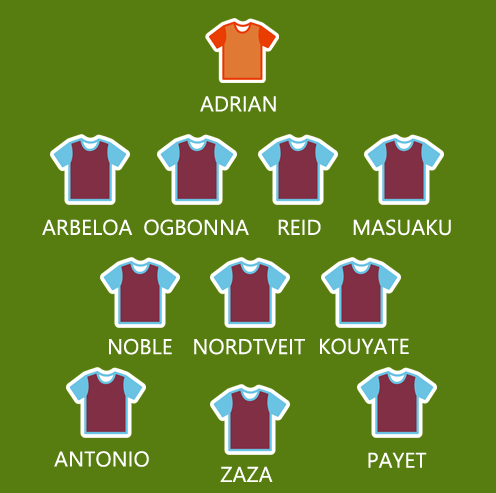
According to Physio Room the injury list is at an all time low with just Carroll (due back 17 Sep), Ayew (Nov 27), Cresswell (Nov 26) and Sakho (Oct 1) still unavailable. All the signs are that Dimitri Payet will make his first start of the season and that we will see the striking debut of Simone Zaza up front. It will be interesting to see how the remainder of the midfield is set up and whether Manuel Lanzini also gets a start or whether Havard Nordtveit returns as a more defensive option despite failing to impress so far. I suspect Lanzini will be on the bench, along with Sofiane Feghouli, for this one.
“We can say that from this week the job that I perform can be judged. I like to work with a group that I choose myself, and I’m very happy with this one.”
– Walter Mazzarri
Slaven Bilic may also prefer to bring in Alvaro Arbeloa (assuming he is deemed to be match fit) at right back but personally I believe Sam Byram has done enough to keep his place and would be unlucky to miss out.
Watford have no injury problems. Much of last season’s heroics were founded on the goals of Odion Ighalo and Troy Deeney but neither have scored this term (yet!). Deeney is a fine professional but looked off the pace when I watched Watford lose to Arsenal recently. The Hornets certainly improved after the break in that game after the introduction of new signings Isaac Success (great name) and Roberto Pereyra, both of whom looked to carry a threat. On the other hand; Kaboul is always worth a goal to the opposition; former Hammer Behrami good for a yellow card and defenders Cathcart and Britos sound like they belong in old TV sitcoms.
Here is my predicted line up in a 2-1 victory:
Man in the Middle
Today’s referee is Martin Atkinson from West Yorkshire. Atkinson officiated 3 West Ham games last season; away victories at Arsenal and Bournemouth and the home draw with West Bromwich Albion. Atkinson is known for his reluctance to brandish red cards and award penalties.
 I am currently living in Asia and, at just a shade under 6 foot, happen to be rather taller than most of the local population. This is just as well, for at the moment, I am unable to look anybody straight in the eye. The reason for this discomfort is that it seems I am worse at predicting the results of Premier League matches than even Lawro.
 There is nothing more satisfying as a supporter than seeing a young player come up through the youth system (or academy in modern parlance) and establish himself in the first team. Over the years we have been blessed with golden ages of plenty from our academy but there have also been periods of famine. In the Premier League age it is becoming increasingly rare for youth players to make it through the ranks and academies have become multi-cultural establishments; much different from bygone days when a youngster from Kent would have been considered exotic in our youth setup.
 For every successful youth team product there are many more who simply fade away. Among these there are those who are hotly tipped for stardom but who ultimately do not deliver. We shall be taking a look at some of these ‘Boys Who Never Quite Made It‘.
 The doldrums of the International Break is the perfect time to look elsewhere for entertainment rather than seeking it from that collection of expensive labourers masquerading as craftsmen in the national team.
 If Michail Antonio picks up an England Cap today he will become the 40th player to represent England as a West Ham player. I don’t know about you but my interest in the England team is always heightened if there is a chance of seeing a Hammer in action. There has to be some incentive to watch the national team these days when there are so many alternative entertainment options such as sorting your CDs into alphabetical order.
 Never mind the largely predictable World Cup qualifiers, today also sees the arrival of the First Qualification Round of The (Emirates) Football Association Challenge Cup. Still packed with romance for the clubs at the lower end of the football pyramid, dreams of Wembley, or at least a Third Round meeting with a Premier League team, will be at the back of many a non-league player’s mind as they rub in the pre-match White Horse Oil this afternoon. The big question up and down the country is can the ‘minnows’ from Ashby Ivanhoe, Brimscombe & Thrupp or Sporting Bengal United find their way into the bag along with the big boys next January?
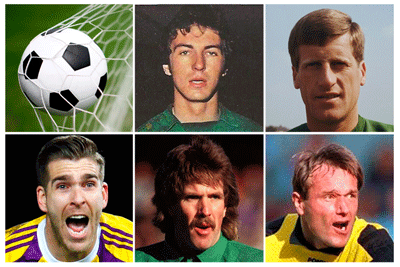 When West Ham play Accrington Stanley in the next round of the League Cup (or whatever it’s called these days) it will be the first encounter between the two clubs. Someone who did once play against Stanley though was legendary goalkeeper Willie ‘Fatty’ Foulke; at the time plying his trade with Bradford City. When Accrington visited Bradford for an FA Cup tie in February 1907 it was discovered that Foulke, who stood 6ft 3in and weighed in at circa 22 stone, was wearing a jersey that clashed with the red shirts of the visitors. After a fruitless search for a suitably large replacement Foulke was wrapped in a sheet borrowed from a neighbouring house. The game ended in a Bradford victory by the only goal and with Foulke barely called into action his makeshift attire was as pristine as it had been at the outset. Thus, the origin of “keeping a clean sheet”. [Incidentally, it is also claimed that the chant “Who ate all the pies?” was originally directed at Foulke.]
 Somewhere in the depths of the FA Headquarters there is a room where every single piece of transfer paperwork is processed. In the room there are two middle- aged men (Kevin and Malcolm) both dressed in sleeveless jumpers and FA ties whose job it is to stamp ‘APPROVED’ on the transfer forms when they are happy that everything is in order. All relevant papers are placed in a buff folder before being passed through a glass partition to a lady called Sonia who enters details into the ‘system’. At 11 pm on 31 August, Sonia will leave her seat for the final time and slide the partition closed representing the metaphorical slamming shut of the window for another summer. Our sources close to the matter understand that this is what actually happens.
 The Super Sunday Contractual Obligation Match
 Under The Hammers