The Lawro Challenge: Week 4

Where we attempt to show Lawro how predictions should really be done.

Lawro Crystal BallI am currently living in Asia and, at just a shade under 6 foot, happen to be rather taller than most of the local population.  This is just as well, for at the moment, I am unable to look anybody straight in the eye.  The reason for this discomfort is that it seems I am worse at predicting the results of Premier League matches than even Lawro.

However, fresh from warm weather training during the international break I am determined to claw back some of the disadvantage between myself and the early pacemakers.  This week’s naval-gazings are shown below and see Lawro depart from his usual cautious tradition by actually predicting a team to score more than two goals.  In the circumstances, I am quietly confident that my redoubled efforts will see me far better placed following this current round of matches.

   Rich    Geoff    Lawro
Cumulative Points     28     22     26
Saturday
Man United v Man City     1-1     1-0     1-0
Arsenal v Southampton     2-1     2-0     3-0
Bournemouth v WBA     1-0     1-1     1-1
Burnley v Hull     2-2     1-0     2-1
Middlesbro v Palace     2-1     2-2     0-2
Stoke v Tottenham     1-1     1-2     1-1
West Ham v Watford     3-1     2-1     2-0
Liverpool v Leicester     2-1     1-1     2-1
Sunday
Swansea v Chelsea     1-2     0-2     0-2
Sunderland v Everton     1-1     1-2     1-1

* Our scoring system is one point for a correct results plus two bonus points for the correct score.

More Damned Statistics

Studies have shown that accurate numbers aren’t any more useful that the ones you make up!

stats

For a while as a young boy I collected London bus numbers; not route numbers but the fleet number that was painted next to the driver’s cab. It was the budget version of train spotting because you didn’t need to buy a platform ticket. I would carefully write the numbers down in a small notebook but I didn’t stick at it very long before realising the whole exercise was a complete waste of time.

Nowadays any millennial geek fascinated by collecting and recording pointless information can ‘monetise’ their proclivity through gainful employment with an organisation such as Opta, the sport’s data specialists. Football, like most sports, is now awash with data that provides a minute by minute analysis of every action and incident so that at any time we can know how far Mark Noble has run today. My assertion, however, is that while the resulting statistics might be interesting they are nothing more and there is no cause and effect between the data presented and the actual outcome of a game i.e. that the stats are basically meaningless. I have written about this previously and undertook to keep a watchful eye as the season progresses to see if I could be proved wrong.

For the purposes of my study I am using the data presented on the Whoscored website, which despite my scepticism over the usefulness of the stats is an excellent resource. The Whoscored data is, I understand, sourced from Opta and fed real-time to a large number of media companies . For each game, the website provides a match report showing summary details for possession, passes completed, shots on goal, aerial duels won, tackles made and dribbles won. I am making an assumption here that having selected these categories the folks at Whoscored consider them to be the most pertinent to the outcome of a game.

Of the 30 Premier League matches played to date there have been 22 which have had a positive outcome (with 8 drawn games). Of these, the winning team had the advantage in possession, passes completed, shots and dribbles won while the losing side more often came out on top for aerial duels won and tackles made. In only 1 of 30 games (Burnley v Swansea) did the winning side dominate every category while there was also 1 game (Palace v WBA) where the losing side was on top across the board.

So are there any conclusions that we can make? Should managers tell their players that losing aerial duels and tackles is the best way to win the game? Or is it obvious that more shots on goal increase the chance of winning? Or that if you are forced to defend it is likely that you will need to make more tackles?

There was a school of thought last year that conceding possession bore some relation to winning the game; probably because it was a prevalent feature of Leicester’s season (and our own to some extent). This has not been reflected in the games so far this season although I am still not convinced as to how possession is actually measured; the only time I have seen it explained (a few years back) it was suggested that possession is, in fact, derived from passes completed. That in all 30 games the team with most possession also completed most passes may confirm this.

Maybe the only purpose for the stats is the fun of collecting them in a similar vein to the bus numbers and I am over-thinking them.  But I don’t believe that is how they are used by TV producers and pundits who present them as if they define the game. For now it remains case unproven as far as I am concerned but I will keep on tracking developments.

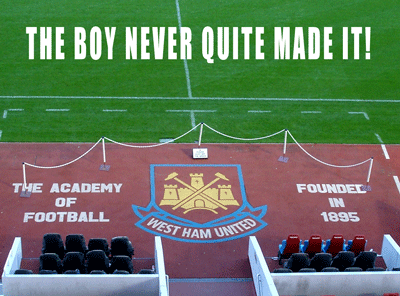
The Boy Never Quite Made It: Roger Cross.

Firs in a series of Hammer hopefuls that didn’t quite make the grade.

Boy Never Quite Made ItThere is nothing more satisfying as a supporter than seeing a young player come up through the youth system (or academy in modern parlance) and establish himself in the first team. Over the years we have been blessed with golden ages of plenty from our academy but there have also been periods of famine. In the Premier League age it is becoming increasingly rare for youth players to make it through the ranks and academies have become multi-cultural establishments; much different from bygone days when a youngster from Kent would have been considered exotic in our youth setup.

Roger CrossFor every successful youth team product there are many more who simply fade away. Among these there are those who are hotly tipped for stardom but who ultimately do not deliver. We shall be taking a look at some of these ‘Boys Who Never Quite Made It‘.

As a young teen in the late 1960’s it was not uncommon to arrive at the game two hours before kick-off on a Saturday afternoon in order to get the favoured view from the North Bank terrace. This allowed plenty of time to read the match programme from cover to cover to discover, not only what the current state of play was in the unofficial London championship, but also what was happening in the Football Combination (reserves) and South East Counties League (youth teams).

For several years running the name of Roger Cross repeatedly appeared in the back of the programme as he rattled in the goals for youths and reserves. He scored when he wanted to even before that idea was born.

Cross was part of the same youth intake as Trevor Brooking (they were born just a few weeks apart in October 1948) and Sir Trev mentions Cross as one of his pals at the club in his autobiography, My Life in Football. Strange to think that I had never heard of Trevor Brooking before his debut but was eagerly awaiting a first sighting of Roger Cross.

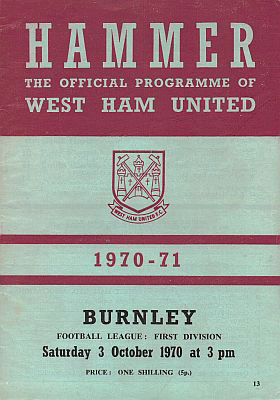
Cross made his debut as a substitute (for John Sissons) in August 1968 during a 5-0 home win against Burnley and later that season went out on loan just down the road at Leyton Orient. The start of the 1969/70 season saw Cross get a brief run of games in the first team, scoring his only goal in the 1-1 draw with Arsenal at Upton Park; but that run came to an end by October and he was transferred to Brentford.

His playing career then took him to Fulham, Brentford (again), Seatle Sounders and Millwall before going into coaching with QPR. Cross renewed his association with West Ham in 2001 and held a number of coaching and scouting roles before parting company in 2011 as a cost-cutting measure during the Avram Grant revolution.

The Hammer’s Week in History 1

How has the week 5 – 11 September shaped up in Hammer’s history?

This Week Hammers HistoryThe doldrums of the International Break is the perfect time to look elsewhere for entertainment rather than seeking it from that collection of expensive labourers masquerading as craftsmen in the national team.

The mission that I chose to accept was to travel back in time and forage through the annals of this week in Hammer’s history; here is what I discovered for the period 5-11 September.

The first weeks of September over the years have been characterised by an abundance of goals; before early season exuberance on flat, grassy pitches in late summer sunshine gives way to a cold, muddy mid-winter’s slog with floodlights switched on before half-time.

This week in history has witnessed some heavy home defeats which includes 1-5 and 2-5 reverses to the ‘scallies’ of Liverpool in both 1965 and 1968; had there been Twitter in 1965 it would have been awash with abuse, as less than a week after the 1965 Liverpool game, came a further 2-5 defeat at home to Leicester. Not a great start to the season for a team that would provide 3 world cup winners the following summer.

There have been a fair share of big wins as well though including two which featured rare Bobby Moore goals; home to Wolves in 1964 (5-0) and away to Sunderland in 1967. Other big wins were 6-1 away at Manchester City (1962), a Dave Swindlehurst hat-trick in the 5-2 home hammering of Coventry (1983) and a Frankie Van Der Elst goal in a 5-0 mauling of Birmingham (1982).

Goals galore also in two 7 goal thrillers; one being Sam Allardyce’s first home win against Portsmouth in 2011; and the other the 1998 encounter with Wimbledon, which is this week’s featured match.

The fourth game of the season saw both teams undefeated going in to the midweek encounter at Upton Park. West Ham had beaten Wimbledon twice the previous season and a repeat performance was anticipated by the expectant home support.

The Hammers raced into a 3-0 lead midway through the first half, with goals from John Hartson (7 mins) and Ian Wright (14 and 27 mins) and all seemed to be going to plan despite Marcus Gayle pulling one back for Wimbledon in the 30th minute to make it 3-1 at half time.

The second period was a very different affair. After 64 minutes, a defensive miscue from home debutant Javier Margas (he of the claret and blue hair-do) allowed Jason Euell to reduce the arrears to 3-2 and then Gayle struck again in the 77th minute to bring the scores level. Rather than sit back and admire their handywork Wimbledon kept pushing forward for substitute Efan Ekoku to score the winner in one of the most remarkable come-backs seen in the Premier League.

Hislop, Pearce, Ruddock, Lampard, Margas, Moncur, Sinclair, Berkovic (Impey), Hartson, Wright, Lazaridis

Notable West Ham players born this week (a very defensive week) include:

5 September Malcolm Allison (d. 2010)
7 September John McDowell (65)
7 September Ray Stewart (57)
11 September Slaven Bilic (48)
11 September George Parris (52)

3 Lions and a Hammer

Will Michail Antonio be flying down the wing for England today or will he be right back on the bench?

England TeamIf Michail Antonio picks up an England Cap today he will become the 40th player to represent England as a West Ham player. I don’t know about you but my interest in the England team is always heightened if there is a chance of seeing a Hammer in action. There has to be some incentive to watch the national team these days when there are so many alternative entertainment options such as sorting your CDs into alphabetical order.

The 39 previous England Hammers, the last being Stewart Downing in 2014, have pulled on the 3 Lions shirt a total of 415 times. Of these over 25% of the caps belong to Bobby Moore (108 ) followed by Hurst (49), Brooking (47), Peters (33) and Martin & James (17 each). Peters earned a further 34 caps following his transfer to the North London retirement home.

In fact, Tottenham top the list for supplying the most England players with 75 followed by Villa (73), Liverpool (70), Everton (66), Manchester United (65) and Arsenal (60). West Ham occupy 12th place in the rankings surprisingly below teams such as Blackburn Rovers, West Bromwich Albion and Sheffield Wednesday.

Congratulations on the call up, Michail and hope you get a look in on what is largely an uninspiring squad. It is again a weak Qualifying Group that England fortunately find themselves in with the opening game, away to Slovakia, possibly being the toughest that they will face. It is not a shock that the new Manager is already talking about “respecting the point”.

Minnows and Banana Skins

A look back as West Ham battle it out with non-league opposition.

FA CupNever mind the largely predictable World Cup qualifiers, today also sees the arrival of the First Qualification Round of The (Emirates) Football Association Challenge Cup. Still packed with romance for the clubs at the lower end of the football pyramid, dreams of Wembley, or at least a Third Round meeting with a Premier League team, will be at the back of many a non-league player’s mind as they rub in the pre-match White Horse Oil this afternoon. The big question up and down the country is can the ‘minnows’ from Ashby Ivanhoe, Brimscombe & Thrupp or Sporting Bengal United find their way into the bag along with the big boys next January?

Littered in West Ham’s FA Cup history have been numerous ‘potential banana skins’ with sadly far too many of them turning out to be real. The litany of tame surrender to lower league teams includes defeats by Tranmere, Torquay, Newport. Plymouth, Hereford, Wrexham, Grimsby and Mansfield (if you were to include League Cup defeats then you have a list longer than a James Collins clearance!).

To date, however, we have yet to suffer the embarrassment of defeat to a non-league side and here we look back at our unconvincing yet ultimately successful encounters with clubs from outside the top 4 divisions.

FA Cup 1971/ 72 4th Round (Southern League Premier Division v First Division)
9 February 1972 Hereford United 0 v 0 West Ham United
14 February 1972 West Ham United 3 v 1 Hereford United

Hereford were fresh from dispatching First Division Newcastle United in the Third Round. Following a creditable 2-2 draw at St. James Park they won the replay 2-1 in the Herefordshire mud with a spectacular Ronnie Radford goal that still gets shown on FA Cup specials now. I can’t tell you much about the first game at Hereford’s Edgar Street ground other than it ended goalless. Jeff Powell in the Daily Mail wrote: “‘Hereford blew a rich, ripe, agricultural raspberry at West Ham and all the football they represent. Colin Addison’s part-timers reduced West Ham to a rabble, scrambling to prevent Hereford’s historic FA Cup run escalating into the sensation of our time.”

Five days later the teams met again at Upton Park. Due to an industrial dispute involving power workers (or it may have miners) the game kicked off at 2:15 on a Monday afternoon – Hereford’s players having to take a day off work to play. I can remember bunking off school to watch and many others had a similar idea with over 42,000 crammed into the Boleyn Ground that day. The opening exchanges were evenly contested with both sides going close but a Geoff Hurst goal just before half time served to settle the nerves. After the break, Hurst notched two more before Hereford scored a late consolation goal through Billy Meadows. Hereford winger Dudley Tyler later joined West Ham for a then non-league transfer record of £25,000.

West Ham who had played the same eleven in both 1972 games against Hereford went on to lose 4-2 away to Huddersfield Town in the 5th round.

Ferguson, McDowell, Lampard, Bonds, Taylor, Moore, Redknapp, Best, Hurst, Brooking, Robson

Hereford exacted their revenge two seasons later beating us 2-1 at their ground after a 1-1 draw at Upton Park; but by then had been elected to the Football League.

FA Cup 1991/ 92 3rd Round (Football Conference v First Division)
4 January 1992 Farnborough Town 1 v 1 West Ham United
14 January 1992 West Ham United 1 v 0 Farnborough Town

Farnborough Town beat Torquay United in a 2nd Round replay to set up a home tie against West Ham. As Farnborough’s stadium had a capacity of less than 2,500 they agreed to switch the game to Upton Park. West Ham were struggling at the bottom of the First Division (and would ultimately be relegated in last place) and so this was as slippery as banana skin’s came. Farnborough were able to match West Ham in an evenly contested affair with few chances at either end. Just after the hour though Mike Small laid the ball back to Julian Dicks who rifled home right footed from just inside the area. Cue the customary defensive panic as Farnborough strived for an equaliser which eventually came when a goal bound shot was handled on the line by Dicks. Miklosko almost saved the resultant penalty from Dean Coney but the ball squirmed across the line to force a replay.

Miklosko, Breacker, Dicks, Gale, Potts (Morley), Thomas, Bishop, McAvennie, Small, Keen, Slater

With home advantage (!) for the replay and Kenny Brown drafted into the midfield West Ham were far more dominant in the second game. Apart from some early Farnborough chances it was mainly West Ham pressure with corner after corner but with few clear cut goalscoring opportunities. With the game looking to drift into extra time the Farnborough keeper flapped at yet another cross only for the ball to cannon of a defender and set up a simple chance for Trevor Morley to net the winner; to the palpable relief of the Upton Park crowd.

Miklosko, Breacker, Dicks, Gale, Foster, Thomas, Bishop, McAvennie, Brown, Morley, Slater

After seeing off 4th Division Wrexham, following a replay in the next round, the Hammers went out as 5th round losers to 2nd Division Sunderland – the eventual losing finalists.

Clean Sheets and Favourite Keepers!

Recalling some of the men who have kept goal for the Hammers over the years.

West Ham KeepersWhen West Ham play Accrington Stanley in the next round of the League Cup (or whatever it’s called these days) it will be the first encounter between the two clubs. Someone who did once play against Stanley though was legendary goalkeeper Willie ‘Fatty’ Foulke; at the time plying his trade with Bradford City. When Accrington visited Bradford for an FA Cup tie in February 1907 it was discovered that Foulke, who stood 6ft 3in and weighed in at circa 22 stone, was wearing a jersey that clashed with the red shirts of the visitors. After a fruitless search for a suitably large replacement Foulke was wrapped in a sheet borrowed from a neighbouring house. The game ended in a Bradford victory by the only goal and with Foulke barely called into action his makeshift attire was as pristine as it had been at the outset.  Thus, the origin of “keeping a clean sheet”. [Incidentally, it is also claimed that the chant “Who ate all the pies?” was originally directed at Foulke.]

Our own erstwhile manager, and fellow ‘Fatty’, was a great proponent of the clean sheet as a tool in ‘respecting the point’.  Until recently it was unusual to hear people talking about number of clean sheets but with dawning of the age of soccer statistics anything that can be counted will be counted.  Now you will see the clean sheet cited as one of the measures in comparing the relative merits of Premier League goalkeepers.

Given that this article is meant to be about West Ham keepers I took a look at the record of all our keepers that I could think of who had played more than 50 games and this is how they ranked in terms of clean sheets:

Player Appearances Clean sheets %
Ludek Miklosko 373 125 33.51
Jussi Jaaskelainen 60 20 33.33
Phil Parkes 440 146 33.18
George Kitchen 205 67 32.68
Stephen Bywater 68 22 32.35
Shaka Hislop 157 50 31.85
Edward Hufton 402 113 28.11
Robert Green 241 62 25.73
Bobby Ferguson 277 70 25.27
Mervyn Day 237 59 24.89
Peter Grotier 54 12 22.22
Ernie Gregory 422 89 21.09
Lawrie Leslie 61 12 19.67
Jim Standen 236 45 19.07
Tom McAlister 100 18 18.00
Brian Rhodes 71 7 9.86

The obvious conclusion from the clean sheet stats is that, and we probably knew this already, the game has become more defensive in the later years.  It is certainly not an absolute measure that can realistically be used to compare keepers over the years.  The records of both George Kitchen and Edward (Ted) Hufton, however, look most commendable since they belong to a more adventurous bygone age;  or perhaps West Ham had better defenders back then.  It was Hufton who appeared in the 1923 White Horse Cup Final and was the first West Ham keeper to represent England.  George Kitchen who played for West Ham from 1905 to 1912 is our only keeper ever to score a goal.  As a regular penalty taker he notched 6 in total including the only goal of the game on his debut against Swindon Town.  The other point of interest being that at the time a goalkeeper was allowed to handle the ball anywhere in his own half; this rule was abolished in 1912.

A total of 73 goalkeepers have played in league matches for West Ham since 1898.  The keeper in the first game I saw live at Upton Park was Brian Rhodes but I couldn’t tell you anything about his custodian prowess.  A further 34 keepers have appeared between the sticks since Rhodes although 13 of these only made a handful of appearances.  The first keeper I do remember with any certainty is Lawrie Leslie; a fearless competitor his trademark was rushing out to throw himself at the feet of onrushing forwards with the inevitable resulting injuries.  In pre-substitute days I can recall him finishing the match on the wing after injuring his arm and it was a subsequent broken leg, sustained at home to Bolton, that led to Jim Standen joining the club as an emergency replacement.

Continue reading for my list of Top 5 Hammer’s keepers.

Shut That Window

The closing of the transfer window sees the culmination of months of speculation. Will anything interesting happen?

Transfer WindowSomewhere in the depths of the FA Headquarters there is a room where every single piece of transfer paperwork is processed. In the room there are two middle- aged men (Kevin and Malcolm) both dressed in sleeveless jumpers and FA ties whose job it is to stamp ‘APPROVED’ on the transfer forms when they are happy that everything is in order. All relevant papers are placed in a buff folder before being passed through a glass partition to a lady called Sonia who enters details into the ‘system’. At 11 pm on 31 August, Sonia will leave her seat for the final time and slide the partition closed representing the metaphorical slamming shut of the window for another summer. Our sources close to the matter understand that this is what actually happens.

With a day to go in the window West Ham have spent a net £43 million on transfers and loan fees made up of 10 incoming players at a cost of £53 million and the departure of James Tomkins for close on £10 million. The players in includes the permanent transfer of Manuel Lanzini at the end of his original loan spell. The complete list of new players is:

Andre Ayew
Manuel Lanzini
Arthur Masuaku
Edimilson Fernandes
Simone Zaza
Jonathan Calleri
Gokhan Tore
Sofiane Feghouli
Ashely Fletcher
Havard Nordtveit

Despite the large number of new arrivals already competing for locker space at Rush Green it has done nothing to dampen the ever increasing number of names to be linked with a move to the East End. It was also revealed today (albeit by The Sun) that at one point during the window we had actually offered £43 million to bring Alexandre Lacazette to the London Stadium. It is difficult to envisage any further big money deals taking place and the latest links are generally of the loan variety and include Wilfred Bony, Calum Chambers and Jack Wilshere; all surplus to requirements at their current clubs or else seen to meet the Hammer’s predilection for injured players.

On the subject on injured Gunners I read at the weekend that forgotten man Carl Jenkinson is still in the process of being rebuilt by the Arsenal surgeons. Not content to just repair the cruciate ligament that he damaged playing for us against Manchester City last January, they have also operated on both of his shoulders – presumably to remove those rather large chips.

No doubt the last hours of the transfer window will bring the usual hysteria as clubs finally realise that time is running out; despite having known the deadline for months beforehand. Sky Sports will have the rolling ticker-tape on hyper speed with reporters roaming the nation for the latest news; managers will drive in and out of training grounds; players will be spotted at airports and service stations; and Chairman’s sons will be tweeting furiously well past their bedtime.

Even though Sky make a big deal of it I don’t think that the commercial possibilities of Window Closing Day have yet to be fully exploited. A Friday evening red-nose day type event hosted by James Corden or similar would be a sure fire ratings winner. There could be audience participation phone in polls as 3 players display their free-style ball skills to decide which one signs for Arsenal. Or perhaps David Gold could come on ask us to “Give us your f*ck*ng money!” in an attempt to fund the purchase of a new right back. As a finale an X Factor or Big Brother winner could countdown the slamming of the window to the chiming of Big Ben. Big potential missed in my opinion.

I’m not expecting will be much business done by West Ham so no need to stay up late. It could possibly be farewell Pedro Obiang and some outgoing loans but that’s about all folks!  All said and done it has been a good window.

5 Things Learned From MatchWeek 3

Our collection of random observations from Premier League Matchweek3

Five Things EPLThe Super Sunday Contractual Obligation Match

It is difficult to believe that some high powered TV people actually sat around in a meeting room with white boards, flip charts and Powerpoint presentations and selected WBA versus Middlesbrough to be a live televised match. Ordinarily the only purpose of such clubs on TV is as opposition for one of the big boys to dispatch with ease except, on rare occasions, where they met each other in an end-of-season relegation six pointer.

The Premier League still has a number of these underwhelming contests but they are normally buried among the left over Saturday 3 pm kick-offs. The game certainly delivered what it said on the tin and even the referee seemed reluctant to tag on any added time.

You Don’t Always see them Given

Last year I watched a Development Squad game where Shay Given was between the sticks for Stoke City in front of a few hundred supporters. This week he was back in the big-time of the Premier League where his notable contribution was heading in Leighton Baines penalty after it had come back off the post.

The Baines penalty was one of those awarded under the new Grappling interpretation of Law 12. As usual there is much inconsistency between different referees in how the rule is interpreted causing apparent confusion with players, pundits and supporters alike. In some situations a penalty is awarded straight away while in others players have escaped punishment and let off with a warning. Personally I have always taken a possibly naive view that a foul is a foul no matter where it is committed and that there should be some form of intent, bad timing or negligence involved. It seems nowadays a simple collision, expecting a tackle or tripping over your own feet is sufficient justification.

Last year there were 91 Premier League penalties awarded (equal to an average of 2.4 each week).  The first 3 rounds this season has seen 13 penalties (or 4.3 per week).

Terry and the Pace Setters

With just 3 games gone and we are already into an enforced international break in which the latest new dawn of English football will rise from the mixed metaphor ashes of Roy’s Euro disaster. After the first 3 games what can we deduce about the destination of the Premier League title?

There are 3 teams remaining on maximum points and each will expect to be in the running next Spring. The two Manchester clubs are the most likely champions in my view and it is difficult to choose which is now the lesser evil. Prepare for the over the top build up to their derby meeting immediately after the international break. Chelsea are only level on points due to cheating but with Hazard looking on top of his game and no European distraction they are probable candidates for 3rd or 4th.

Of the other teams Tottenham have been the most encouraging in how flat and uninspiring they look as if they haven’t recovered from last season’s blow-out. Liverpool look very workmanlike which is what you would expect from a midfield that includes Milner, Henderson and Lallana. Koeman’s Everton are undefeated and will be unspectacularly efficient in picking up points. Arsenal are like every other Arsenal team of the last decade only increasingly less-good; they may even miss out on a top 4 finish this time. We need to start getting players back and getting our act together. Losing away at two of the top three is no disgrace in itself but performances need to be far better.

Relegation or The HSmell of Success

History tells us that in all probability 2 of the promoted clubs will be relegated. Despite Hull’s promising start I can’t see them keeping this up given the turmoil that the club is in. I also expect Burnley to struggle massively whereas Boro might do enough to bore the opposition into surrender. The other suspects include Watford, Bournemouth, Sunderland and Swansea. I am relying on Eddie Howe to do enough to keep Bournemouth afloat and, although Watford looked very poor in the first half against Arsenal, they brightened up considerably after introducing new signings Isaac Success & Roberto Pereyra – two players we will need to keep an eye on when we meet them in 2 weeks.

Isaac Success is one of the best footballer names since Danny Invincible

A Substitute for Another Guy

Finally, a very strange occurrence in the Tottenham versus Liverpool game at White Hart Lane where in the very last of 3 added minutes at the end of the second half both teams brought on a substitute for their league debuts. I didn’t spot whether the respective number 2’s had given the players detailed instructions from the notepads as to what to do for the remaining 10 seconds.

5 Things From West Ham at Citeh

Observations and talking points from our defeat at the Etihad.

5 Things WHUThe Half Time Pep Talk

Managers and coaches do their best to bellow and point out instructions from their technical areas during as the game progresses but it is questionable how much of that actually gets through to the players. Half-time is generally the best opportunity to throw things around the dressing room to get the player’s attention. At half time on Sunday we were on the ropes and a crushing defeat was on the cards. City were playing well and at a high tempo and we seemed to be doing everything possible to help them out.
After the break some Slavic wisdom and a minor rearrangement of personnel and it was a different game. We started to compete and City were no longer free to strut their billion pound stuff. We couldn’t quite do enough to snatch an unlikely point but the performance was far more encouraging.

Unnatural Formations

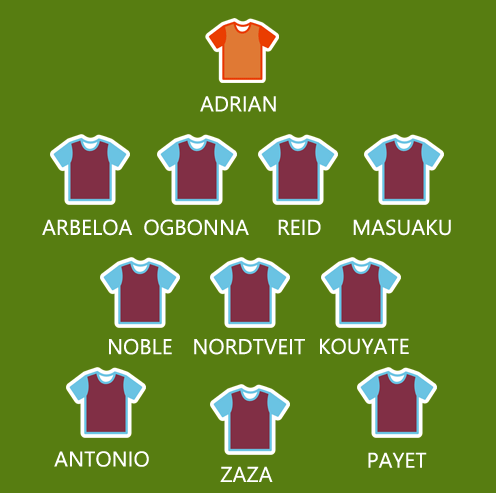
In the Under The Hammers Match report Richard Bennett provides an excellent summary of the shortcomings in our line-up, formation and first half performance. Whether it was 3 or 5 at the back or some form of hybrid the tactic misfired badly with City’s mobile and pacey forward players allowed all the space and ball that they could want. The task wasn’t made easy due to injuries but the selected side lacked balance and we far too often conceded unforced possession. If Lanzini was unable to last a full game then why not play him first half rather than second? He would have been a better option than Tore who has a lot to do to prove himself.

Once we changed to two proper full backs we looked far more compact and threatening and Antonio’s goal came early enough to strive for a second. The momentum was lost after Aguero’s Costa moment caused Reid to leave the pitch and we went 4 at the back. I have read since that Slaven Bilic was about to make the change anyway which I find puzzling.
There are differences of opinion but I am certain that Aguero deserved a red card. The unfortunate thing with retrospective punishment is that it is other teams that benefit. Better if he was banned for the next 3 times that we play against him.

In that Round Mr Collins you have No Passes

I am sure we all love Ginge’s commitment to the cause and that the way that he is prepared to throw his body in the way regardless of the consequences. From a defensive point of view these qualities allow me to overlook his occasional rushes of blood and bloopers. However, he has to be one of the worse passers of the ball that I have ever seen from a professional footballer. This would not be such a problem if it didn’t seem to part of our game plan to use him as a major distribution outlet every time he plays.

There was one occasion in the first half where we had a free-kick inside the City half and, let’s face it, an industrial route one goal was the best we could hope for at that point. Yet rather than lump it forward Noble decided to play it backwards to Ginge; from where it probably found its way back to keeper or out of play. I really don’t understand what the players expected to happen. A defenders prime responsibility is to defend (and Ginge does this well enough) but when he has the ball he should play it short to someone who knows what to do with it. Whether we have the right players with right attributes to make themselves available as an outlet then becomes the issue.

Arthur Masuaku ‘E’s Alright

I like Arthur Masuaku. Over the course of the whole game he was our best player against Manchester City. I love his energy, his dribbles, his beard and his thousand yard stare. On these early performances he looks an excellent signing and will be stiff competition when Cresswell is fit again. He did exceptionally well in creating the goal for Antonio.

His battle with Sterling was one of the high points of the match and a less lenient referee may well have given him a second yellow (even though I thought the first rather harsh). Mr Mariner made amends by calling over Mark Noble to tell him it was Arthur’s last warning and then booking the captain for dissent instead.

Pay-et Forward?

The Payet situation is a strange one. His continued absence with little explanation has fuelled a host of non-specific transfer speculation which even Paul Merson sobered up long enough to posit upon. The club through ace tweeter dg have strenuously denied any ulterior motives for Payet’s non appearance.

Now it appears that he is off to join up with France squad for their friendly against Italy. If his ‘knock’ is so serious that we didn’t want to rush him back how is it wise for him to join the national squad? Have we made a secret deal with him to give him a longer rest in return for staying put?