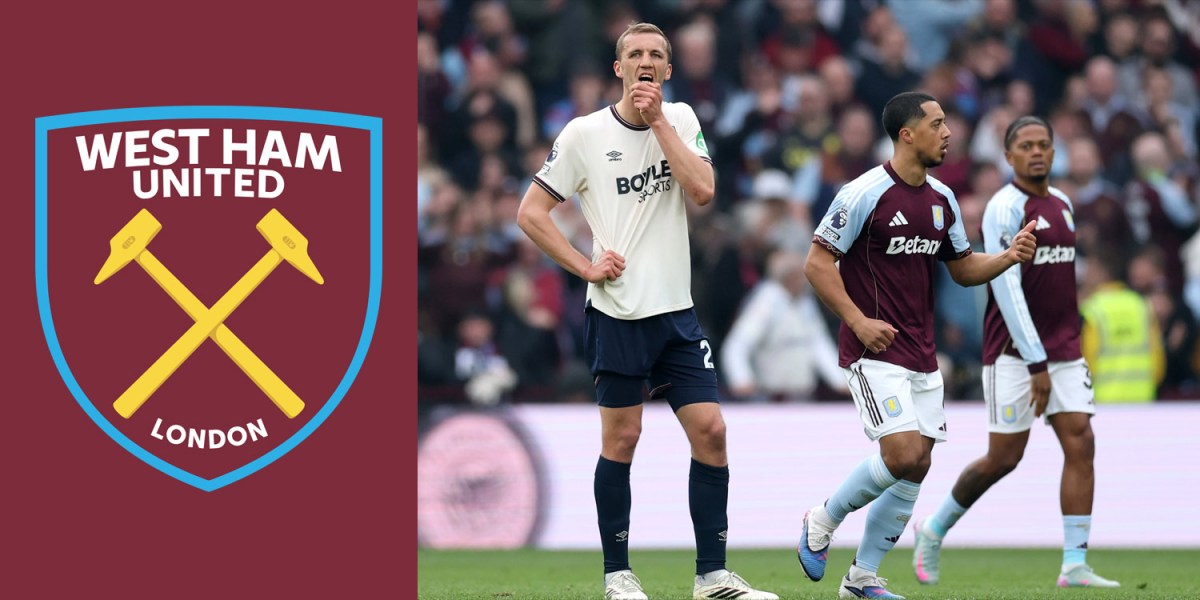
Indiana Santo and The Villa of Doom: Roof Collapses on West Ham Escape Plan

Defeat might have been expected in Sunday’s Villa Park encounter but it was the disappointing nature of the performance which raises serious questions about the Hammer’s survival credentials.

A pivotal moment in the genre of action-adventure movies – the Indiana Jones franchise popular in the 1980s and 90s, for example – is when the protagonists must navigate a series of perilous traps, rotating blades, and concealed pressure plates to avoid an ancient booby trap that would seal an inevitable fate.

The West Ham escape plan seems very much like that. Either by accident or design, Nuno had hit upon a balance of personnel, formation and style of play which, with a good following wind, might just get them out of trouble. The problem is that there is zero margin for error. Take away a single component, attempt anything in the wrong order then an ancient curse is activated and the ground beneath our feet crumbles to dust.

The bad news had already been received a few days previously. Crysencio Summerville, the talisman of West Ham’s current revival, had yet to recover from the injury picked up in the FA Cup tie against Brentford. Will we come to regret this half-time substitution? But there was even worse news to come.

When the teams were announced it was no surprise that Nuno had opted to start with the eleven who had wrestled a precious point from Manchester City a week earlier. The subliminal message was clear. Another point here would do very nicely. Let’s face it, away at Villa Park wasn’t high on anyone’s the list of winnable games. The only grain of optimism being the hosts poor recent run of form in the absence of several influential midfielder players.

Whatever the game plan was going to be, it was thrown into disarray when Jean-Clair Todibo was injured in the warmup. Assuming they had trained all week with a three centre-back formation in mind, the obvious solution would have been a like-for-like swap. But nothing says a lack of trust in your £40 million, £100 per week backup better than deciding to disrupt the entire plan instead. If he can’t be called upon for this type of emergency, why is he on the bench in the first place?

What actually happened was a repeat of one of those genius Nuno moments from earlier in the season. A plan which, in his mind, was imagined as a complex game of four-dimensional snakes and ladders. Aaron Wan-Bissaka man-marking Morgan Rogers, Jarrod Bowen filling in as emergency right back, and Pablo Felipe deployed in wide left midfield. With Pablo and Tomas Soucek about as mobile in midfield as a pair of clowns on stilts, the game was lost before it had begun. No structure, no cohesion and no goal threat. The trap had been triggered. Darts flew, tunnels collapsed, and a giant rolling boulder thundered towards the West Ham goal as Villa awoke from their slumbers awoke to rediscover Champions League bound form.

To think that a few years ago the two clubs occupied a similar position as hopeful pretenders to the rich six throne. Oh, what a sprinkling of boardroom competence and ambition can bring you in the right hands. In contrast, all we have learned (to our cost) from West Ham’s board is that incompetence not only makes them bad at running the club but also prevents them from recognising how bad they are.

West Ham’s resistance lasted barely 15 minutes. Villa had been looking to target Mads Hermansen’s obvious weakness and uncertainty in the air at set pieces. But it was an alternative and well worked passing routine from a corner that drew first blood. The ball ending up with McGinn on the edge of area whose curled shot evaded the desperate dive of the Hammer’s keeper – who should have done better in my opinion.

The closest West Ham came to a leveller was in the immediate aftermath. Taty failing/ not trying hard enough to get firm contact onto a Bowen cross. After that it was one-way traffic with only the heroics of Konstantinos Mavropanos keeping the score respectable. Quite how referee Paul Tierney saw the excellent tackle on Watkins as a penalty is indicative of the ever-declining refereeing standards. For once, VAR did its job – clearly and obviously.

Watkins would get the last laugh, however, scrambling home in the 68th minute to finally kill the game off. It was a textbook catalogue of West Ham errors. Bowen giving the ball away cheaply in the final third. Tomas Soucek so slow in tracking Roger’s run that even VAR had announced check complete before he caught up. And finally, Hermansen spilling Rogers’ tame shot into the delighted Watkins’ path. Game over!

There was just enough time remaining for a masterclass from substitute Adama Traore, showcasing his full repertoire of comical misdirected and overhit crosses.

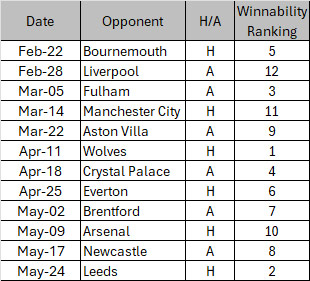
In truth, it was a game that few expected to win. But nevertheless, it was a worryingly disappointing and passive performance from Nuno’s men. Yet, in the bigger picture; in the realm of take one game at a time management, nothing has been decided. The games that we might hope to win are still to come – home to Wolves, Everton and Leeds, away at Brentford and Palace. There are points still to win.

If something good can come out from the dreaded international break, it is the opportunity to get Summerville fit for the run-in. The future may depend on his recovery rate improving considerably on his previous seven-month absence.

Elsewhere, Nottingham Forest were the big winners from the weekend. Picking up three points from an unexpectedly comfortable romp at the Tottenham Hotspur stadium. It turns out that reports of the north Londoner’s corner turning had been wildly exaggerated. They will no doubt now be looking for yet another replacement caretaker manager. What’s Ryan Mason doing now? Leeds will regard it as two points dropped against Brentford on Friday night.

Time to regroup then Hammers. The most recent battle was lost but the war is not yet over. As one well known presidential politician put it in a late night post:

West Ham United, very underrated team, by the way. People don’t talk about them enough, but I do. I know football, maybe better than anyone, and I’m hearing VERY STRONG things about their survival chances. Very strong.

The so-called “experts” are saying relegation. WRONG! Total losers. They said the same thing about my many great successes and look how that turned out. West Ham has tremendous fans, really incredible people, and a beautiful stadium. London Stadium, fantastic place, I’ve heard.

They just need a little confidence, maybe a few better decisions from management (won’t name names!), and they will STAY UP. I guarantee it. People are coming up to me, big fans, tough guys, saying: “Sir, West Ham has plenty of bubbles left to blow.” And you know what? They’re right.

MAKE THE IRONS GREAT AGAIN!
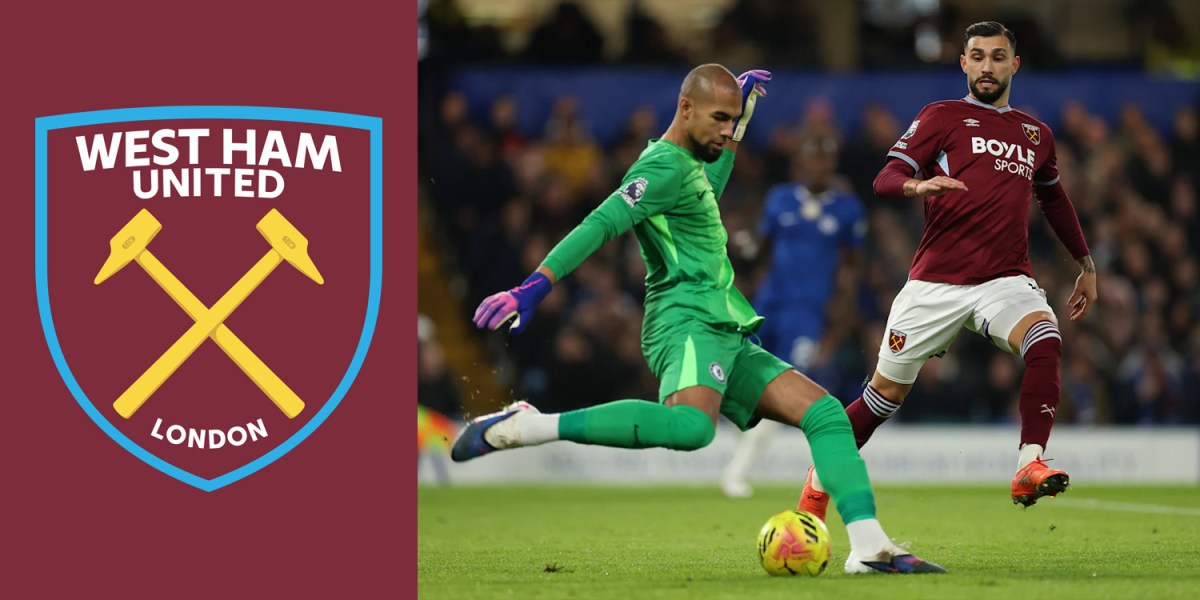
The Fall and Rise of Nuno’s West Ham: A Path to Safety Or Too Little Too Late

The last two months has seen an amazing turn around in spirit and fortunes at West Ham. Will that momentum be enough to keep their heads above the relegation line?

Do you remember the coin pusher machines that were a common feature in seaside amusement arcades? Where no matter how many pennies you fed in, the moving tray refused to push the huge pile of cash over the edge and into the collection trough. Well, this season’s relegation battle is starting to take on a similar appearance.

This time last year, it was all over bar the shouting. Ipswich and Leicester were 12 points from safety and Southampton a further eight points behind them. In the final table, 26 points would have been sufficient to survive. This season, the pieces are far more reluctant to fall.

The weekend’s results were as inconclusive as it was possible to get. Leeds, Tottenham, Nottingham Forest and ourselves each picking up a single point. Forest will be the most disappointed having dropped valuable points at home to Fulham. A point apiece for West Ham and Tottenham, however, probably exceeded expectations. But then, predicting the outcome of games as the season draws to a close and attention is focused elsewhere always becomes increasingly troublesome.

For the briefest of overnight moment, the Hammers managed to climb out of the bottom three for the first time since 30 November. While there’s no doubt the situation remains on a knife edge, it is West Ham who are the side with moment. Another great escape feels possible but, as they say, “there’s many a slip ‘twixt cup and lip”

When West Ham lost at home to Nottingham Forest on 6 January, it was their tenth consecutive game without a win. The Guardian match report opened as follows:

“West Ham are drifting towards the most gutless of relegations. The London Stadium was half empty on another dismal night, encapsulating the apathy gripping this miserable club, and it is hard to see a way out for Nuno Espirito Santo’s accident prone side after a combination of misfortune and dismal defending left them seven points below Nottingham Forest in 17th place.”

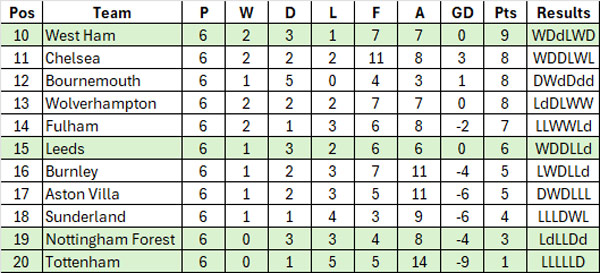
As well as being seven points behind Forest, they were eight behind Leeds and 13 behind Tottenham. Those gaps are now zero, three and one point respectively. The last six games table illustrates West Ham’s current momentum advantage. It is a period where the three rivals have won just one game between them – ironically Leeds victory over Nottingham Forest.

After the Forest defeat, many of us had already resigned themselves to relegation even if we didn’t say it out loud. Now, making the drop from the current resurgent position would be doubly disappointing. So, what has changed?  How did we progress from gutless performances and dismal defending to the fighting spirit and dogged resilience that was on show against Manchester City?

The answer lies in a combination of factors. The arrival of Paco Jemez, an adventurous foil to Nuno’s caution. The signings of Taty and Pablo allowing higher pressing and creating space for Jarrod Bowen and Crysencio Summerville to operate in. The introduction of Alex Disasi, a formidable presence in the centre of defence that has brought the best out of Dinos Mavropanos and Jean-Clair Todibo. Indeed, a defence that was once Keystone Cops and is now operating with all the competence and precision of a Formula 1 pit crew is one of the biggest turnarounds in my personal football memory.

The clincher, though, has been the ability to take the field without Lucas Paqueta and Max Kilman in the side. For different reasons each was detrimental to the cohesion, unity and team spirit we now see on the pitch.

The bottom line is a system that suits the players. One that is aligned with capabilities, that the players can understand, and which has bred belief and confidence. The antithesis of Potter’s ‘here’s how I want to play regardless of whether you can do it’.

Looking back, it is unfortunate that it took so long to get here. The slow recovery under Nuno could still be our undoing if we cannot outrun our opponents as the season draws to a close. In that sense, the improvement mirrors the Great Escape season of 2006/7 where Alan Curbishley only managed six points from his opening 12 games in charge – including a first day victory.

I am already starting to experience pre-match tension at the thought of having to win on the final day to preserve our Premier League status. I’m really hoping it doesn’t come to that.

As Richard pointed out in his latest Supercomputer article, the Manchester City fixture was something of a free hit in the run-in. They are the one team we rarely get anything from even in the best of times. So, to come away with a point was exceptional despite the ‘needs must’ pragmatic approach to the game. A 100% goals to shots ratio is a rare occurrence indeed.

It was a tremendous effort from the Hammers and further endorsement of the spirit that now exists within the team. I find it intensely irritating when the click bait sites feel obliged to hand out a 3/10 rating to whoever they claim ‘stank the place out’ this weekend just to justify a headline. These are not fan sites!

As much as it was a team performance, Mavropanos and Todibo were both superb at the back with excellent support from Disasi, Diouf and Hermansen in goal. It is a solid foundation for the remaining eight games and the FA Cup adventure to come.

As far as Manchester City are concerned, they are well below the standards they have set for themselves in previous seasons. They are not yet out of the title race – with a game in hand and a home fixture with Arsenal to come – but the current side lacks the charisma it once had in the shape of Kompany, Toure, De Bruyne, (David) Silva and Aguero.

It’s possible that we are seeing the end of days for Pep Guardiola as City manager. I would love to see him prove his chops outside a big two club in any league. Just to see how good he really is without boundless funds to support him.

Next stop for West Ham is Villa Park next Sunday. The Villains have experienced a massive injury inspired slump over recent weeks and have a midweek Europa League tie in midweek to overcome. It might not be as formidable a test as it once appeared. If Summerville makes a return from injury, I could even be quietly confident. COYI!

West Ham Treble Dream: FA Cup Success, Premier League Survival and Tottenham Relegation

Happy Hammer Talk. You got to have a dream, if you don’t have a dream. how you gonna have a dream come true?

I didn’t get to watch Monday evening’s cup match live and so ended up following the penalty shootout on the LiveScore phone app. It brought back memories of waiting for Ceefax to refresh. The text version delivered the same result but without the beauty of witnessing five expertly taken spot kicks – and the stupidity of Ouattara’s Panenka.

Pre-match speculation centred on how the two managers would approach the game. With the Hammers mired in a relegation battle and Brentford with an outside chance of European qualification, would it be another contest between two makeshift second string teams? As it turned out, both managers (to their credit) named near full-strength sides. Giving the mother of all cup competitions the respect its rich and glorious history deserves.

I’m at a loss to understand why Fulham and Sunderland had elected to rest key players for their ties over the weekend. Appropriately, both felt the wrath of the football gods – ejected from the competition to concentrate on securing tenth place in the league.

When West Ham and Brentford took the field, they already knew that a home tie against Leeds awaited the victors in the sixth round. It was yet more evidence of TV’s grip on football when schedules are deemed more important than traditions.

The game itself made for a lively hard fought cup tie. The Hammers should really have wrapped the game up in normal time but for the third round in succession had to endure an energy sapping period of extra time to reach a conclusion. Then came the penalties. I’ve never been a fan of settling games by penalties but there’s no denying they are dramatic. The tension wasn’t obvious on my phone when Dinos Mavropanos stepped up to take the deciding kick, and I can imagine how nervous it was in the ground. And what a strike it was to win the game. From Greek Tragedy to Greek God in 12 yards.

West Ham had made it through to the quarter finals for the first time in ten years, and only the second time since the Liverpool final of 2006 which we don’t talk about– a far less happy penalty shootout experience. Avoiding the ‘big’ teams in the draw means progression to the semis is a distinct possibility although Leeds will be no pushover. Beyond that, a good following wind and the jeopardy of two one-off games are all that remain.

If you are looking for omens from previous FA Cup wins then you will be delighted to know that eliminating London opposition has been the consistent feature. It was Charlton and Orient in 1963/4, QPR, Arsenal and Fulham in 1974/5 and Orient and Arsenal in 1979/80. The minimum requirement for a 2025/6 win has already been met (QPR and Brentford), setting things up nicely for a final victory against Chelsea or Arsenal.

The mistakes of 1922/3 and 2005/6 were in not playing any London teams at all on the road to Wembley/ Cardiff.

For all the heady excitement of cup football it is a return to the harsh realities of Premier League survival at the weekend. With Wolves and Burnley effectively out of the picture, the final relegation place is almost certainly between West Ham, Nottingham Forest, Tottenham and Leeds. Nine games to save their respective skins.

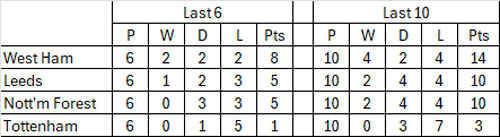
The good news for West Ham is that they are the form team of the four as the following table shows.

If the form of the last six and/ or ten games was extended over the remaining games, then West Ham would top the mini league on 40/ 41 points. Tottenham would be relegated on 31/ 32 points. Unfortunately, there are sure to be hiccups along the way to prevent this ideal outcome playing out.

I’ve seen lots of online debate about who has the hardest/ easiest run-in, but it’s fairly inconclusive in my opinion. Especially where results become more unpredictable as the season draws to a close and players have one eye on the beach, glamourous finals or World Cup call-ups. Those in the boardroom might wring their hands over the incremental rewards of each rung of the Premier League table. But I doubt it’s much of a motivating factor for players, unless European qualification comes along with it.

The less good news for the Hammers is that the two games before the international break are against Manchester City and Aston Villa. It is over 10 years since we last beat the Abu Dhabi outfit. A run that includes17 defeats and just three draws. The chink of light is maybe they are not as formidable as they once were, and that the game is sandwiched the two legs of their annual Champions League encounter with Real Madrid. A defeat tonight in Madrid followed by an air traffic controller’s might tilt the scales a little in our favour.

The Villa game might also offer hope if they continue to be without the influential midfield presence of McGinn, Tielemans and Kamara.

It is important that the Hammers keep a degree of momentum and two or three points from those two games would be awesome (but unexpected). They are games which do not feature high on my list of ‘winnables’ but there is a psychological need to keep the gap manageable.

It was great to see the return of Pablo on Monday night. Although he has yet to bother the scorer, his presence does appear to have made a clear difference if results are anything to go by. If we mark the QPR cup game as the start of the West Ham recovery, then they have won an impressive seven from 11 in all competitions since.

The less encouraging injury news concerns Crysencio Summerville who has very much been at the centre of the recent uptick in performances and results. There’s a lot of internet noise about the severity of his injury and so everything will be kept crossed for a speedy return. The last time he went off injured, he wasn’t seen again for seven months. Get well soon. COYI!           

The Return Of The Set Piece Chumps And West Ham’s Financial Oblivion

Woe, woe and thrice woe for West Ham as their set piece vulnerability returns with a vengeance in heavy loss at Liverpool.

History has a way of repeating itself at West Ham.

When Graham Potter replaced Julien Lopetegui, there was zero overall improvement in the team’s results. But he did manage to plug the gaping holes in what had been a disastrously leaky defence. In Potter speak: “we were competitive in every game despite eventually losing.”

This newfound defensive resilience however did not survive the summer break as the Hammers conceded goals left, right, and centre at the start of the campaign. And were especially vulnerable from set pieces. Once again, the arrival of a new manager – this time in the shape of Nuno Espirito Santo – initially did little to impact the club’s overall trajectory. Except, that defending from corners and free kicks did significantly improve. Until Saturday that is.

Premier League football is rapidly becoming defined by either breakaway goals or set piece shenanigans. Facilitated by the expected level of ineffectual and inconsistent refereeing, every corner kick promises to be a messy tangle of pushing, shoving, bundling, holding, blocking and shirt tugging. What an indictment it is of the beautiful game that scrambled goals from corners are the principal weapon of this year’s potential champions. How long before we have a Golden Dead Ball – Ballon Mort d’Or – awarded each season to the most profitable set piece coach?

Although Liverpool are latecomers to the Premier League party of corner kick aerial bombardment, it is something they have embraced wholeheartedly in recent weeks. Games are now won and lost in a six-yard box battlefield which has become no place for passengers or onlookers. West Ham were typically ill-prepared for such an assault with the three goals it earned the home side in the opening 45 minutes effectively killing the game.

Defending is a collaborative discipline, and most goals are down to collective failure rather than individual error. But having said that, the slight Mads Hermansen looks totally unsuited to the physical challenges that opponents can unleash at set pieces. He is far better than Alphonse Areola with the ball at his feet but as a shot stopper and for aerial ability he is obviously worse. A keeper who lacks presence, who is unable to dominate in the air always spreads panic and uncertainty across the entire defence. We have seen how this works repeatedly over the years. Hermansen had done OK on his return to the first team but when put under physical pressure for the first time, the terrified keeper from early season was back for all to see.

It’s not that others weren’t implicated in the goals. Mateus Fernandes could have been stronger in clearing the lines before goal number one; Aaron Wan-Bissaka inexplicably refusing to get close to Gakpo for the fourth. But, for me, too much of the vulnerability stemmed from a lack of belief in the keeper.

Aside from the goals conceded, there were some positives to the Hammer’s performance. They had plenty of the ball, heads didn’t drop and if games were settled on xG we would be laughing.

It is either paradox or coincidence that West Ham have failed to win any of their league games since the injury sustained by Pablo. Nuno’s effective tactical approach, discovered by accident, having fallen apart due to the unavailability of one technically limited component.

A second positive from the weekend was defeats for all the other relegation ‘hopefuls.’ We are in no worse a position than we were a week ago but have one fewer game to make up the deficit. While I had Liverpool down as the least winnable of our remaining games, the visit to Fulham is one of the potential victories if we are to survive. It will be the second favour of the week to be asked from the Cottagers if we are to pull it off. To win, Nuno must earn his corn with a more front foot lineup than we saw at Anfield. Possibly starting with both Taty and Callum Wilson up front.

***

West Ham’s long awaited accounts were finally published at the back end of last week. Although largely consistent with all the estimates leaked during the preceding months, this didn’t prevent a social media furore over the bleakness of the accounts. Confirmation of what a badly run club West Ham is.

It was a given that the absence of European competition and poor league performance would severely hit the broadcasting revenues on which the club is overly reliant. It is a situation that will not be improved by the next set of account due to continuing struggles on the pitch and the constraints of not having operational control of the stadium.

From my perspective there are two ways of looking at football finance. One is what must be done to comply with PSR/ FFP regulations. The other is the appetite of owners to invest in the club and what they hope to achieve from their ownership.

If West Ham survive this season, it will be the last year of PSR. Relegation would upset the whole apple cart; there is no doubt about that. But I’ll go no further down that particular rabbit hole until necessary.

As far as PSR for the current season is concerned, West Ham loss of £104 million in 2024/25 would be added to the prior season’s profit of £57m. On the face of it, this allows a £47m loss in 2025/26 to stay within the three-year £105m loss limit. However, these numbers do not take account of allowable deductions for women’s football and youth and community development. Over three years this might total anywhere between £35 to £50 million according to the estimates I have seen. Thus, allowable PSR losses in the current season could be up to £97 million.

I have no idea whether this still leaves West Ham in a hole. If it does, then selling a stake in the women’s team may be the preferred or only avenue available. Relying on player sales would be problematic as they would need to be completed by 31 May to appear in this year’s accounts.

When it comes to club ownership, we can see from the wider world of football that no-one buys a football club any more in the hope of making annual operating profits. Sustained success almost always requires surplus revenues to be ploughed straight back into player transfers and wages.

The allure of football club ownership is either asset appreciation, personal prestige, or to further other non-financial goals. Owning a club is like owning a rare piece of art. Something to show-off about and then sell for a hefty profit at some point in the future. Or else ownership is a vehicle to promote outside business interests or for the purposes of sovereign state soft power.

For most owners, a football club is a high-risk, low-income investment in the short term. With the potential for massive, high-prestige, long-term capital appreciation in the future. If West Ham’s owners can’t or won’t play that game, then they should get out. It is not a business where success can be achieved through penny pinching and seat of the pants management. COYI!

Anatomy Of A Relegation: Why West Ham Are In Trouble And Is There Any Way Out?

As West Ham show late season signs of life is there any chance that the battle for survival can outrun the culture of neglect surrounding the London Stadium club.

I recently came across an online comment that it was “players who win games, not formations.” It’s an interesting opinion and not one that I agree with, but it does sit at the heart of West Ham’s battle to avoid relegation over the coming weeks.

Ultimately, the recipe for sustained success is a squad with depth in every position. There is no getting away from the strong correlation that exists between revenues, the money invested in players and success on the pitch. But it is not the full story. If it were, the role of the coach would be largely redundant, other than ensuring appropriate levels of fitness are maintained.

The core competence of the effective coach/ manager is to unlock the full potential of his squad through the tactical arrangement of players on the field. Attempting to achieve the optimum balance between defensive stability, midfield control and attacking strategies relative to the strengths and weaknesses of the players available. Tactics and formations must support those goals, but more importantly must be understood and achievable by those expected to exeute them. We must cut our coat according to our cloth.

While the club’s degenerating and chronic ill-heath has been years in the making – a poor diet of short-termism, cheap alternatives and superficial ostentation by an egotistical board – it is the disastrous managerial appointments in the wake of Moyes’ departure which would take prominence in the final autopsy report.

Lopetegui was puzzling. An apparently successful coach who was locked in a permanent state of confusion. No discernible style of play and a laboured tactical approach which was completely incompatible with the Premier League’s unswerving direction of travel towards pace, energy and athleticism.

If that wasn’t bad enough, what folowed with Potter was even worse. He was the perfect example of a man with a one size fits all plan who was determined to stick to it regardless of whether it would ever work again, or whether those involved were suited to playing it. No lessons had been taken on board from his calamitous spell at Chelsea. The operation had been a success even if the patient had died.

The we come to Nuno. At the end of the year, it had looked like a pattern repeating itself. A ten-game winless streak and countless points thrown away from winning positions had left the club teetering on the precipice. But then two things happened. Two strikers were signed in the transfer window and Paco Jemez was appointed as sNuno’s assistant. The resulting change of approach – whether by accident or design – suddenly produced a positive change of fortunes. Where only 14 points had been accumulated from the opening 21 matches, the last six have yielded an additional 11. A repeat of the great escape continues to be a long shot but at least it’s not impossible to imagine. All that’s needed is for multiple planets to align.

The challenge for Nuno is the weakness of the squad in depth and its reliance on key players for specific roles. We have already seen this following the injury to Pablo Felipe. Let’s be honest, Pablo is a wholehearted workhorse, not a thoroughbred, yet there is apparently no-one available to cover his absence. No-one to offer a physical presence, run around a lot, close down, and make a nuisance of themselves. Instead, it has required a re-shuffle. Abandoning the 4-4-2 that has underpinned recent improvements and reverting to the 4-2-3-1 which had proven so ineffective in the past. If an injury to Pablo can be this disruptive, what might happen in the long term absence of Bowen, Summerville or Fernandes? If there is a bright spot to the season, it is that we have been very lucky with injuries. Touch wood!

A midfield of Fernandes, Soucek, and Magassa (or Potts) simply doesn’t have the variety to worry opponents or unlock defences. Against Bournemouth, Fernandes had his least influential game for some time when playing the deepest of the three. While there was no-one from midfield to push forward regularly or get in the box to support attacks. With fewer threats to deal with, the visitor’s defence were able to double up on Bowen and limit his usual influence on the game.

Having said that, the Hammers created enough chances to win the game comfortably. This included an uncharacteristic four shots in the opening five minutes and a flurry of late attempts following the introduction of Callum Wilson. If only Wilson were five or six years younger!

I didn’t think the challenge on Bowen at the death was a penalty, even though Keith Hacket felt differently. Anyway, I’ve always been convinced VAR have started packing away that late in the day and will only get involved in their favourite pastime of disallowing goals. Refereeing decisions are increasingly a lucky dip that are impossible to second guess and too easily influenced by external factors. I’m looking forward to the time when AI (Artificial Inconsistency) can be introduced into the equation.

In a parallel universe, West Ham might well have won both their last two league games. What a difference an additional two to four points would make to the optics of the relegation fight. As it is, the Hammers remain marooned in 18th place for the 12th consecutive week. Saturday’s visit to Anfield is an unlikely springboard for escaping this current plight.

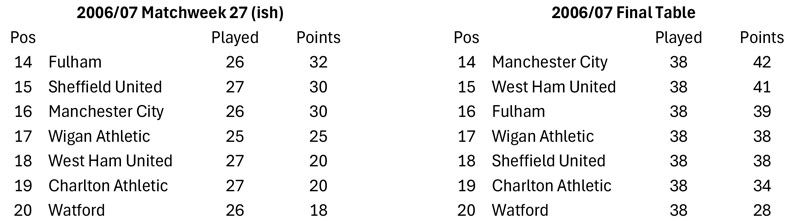
We can take a crumb of comfort from history where West Ham got out of a far worse position in the great escape season of 2006/7. The respective tables after 27 and 38 games are shown below. The Hammers earning 21 points from their final 11 games while Fulham took only seven points from their final 12. Had they not been presented with a get out of jail card by a very understrength Liverpool, they may well have been destined for the drop instead of our friends from Sheffield.

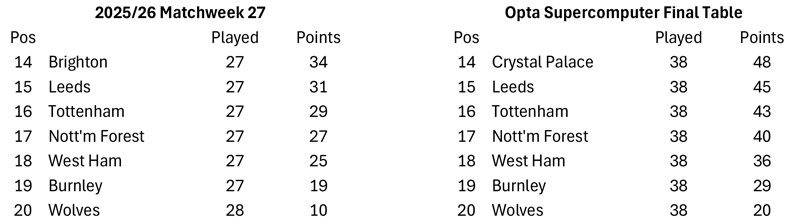
Few observers anticipate a repeat of such a feat this time around, but let’s not yet abandoned all hope. Richard’s analysis before the Bournemouth game estimated a 38-point finish for West Ham while this week’s Opta Supercomputer suggests the Hammers will be relegated with a meagre 36 points (see below). For perspective, the Opta Supercomputer managed to predict just three of last weekend’s ten Premier League games correctly. The computing equivalent of sticking a pin in.

If you are of a more optimistic nature, a repeat of the form from the last six matches would see West Ham surge to safety with 45 points. Wishful thinking, no doubt, but what else is there to look forward to. COYI!

West Ham Survive The Brewer’s Droop But Face Stiff Bees Test To Remain Up For The Cup

Despite a dire performance in the substandard FA Cup tie at Burton, the Hammers are through to the 5th Round to face Brentford. Before that it is back to league football and the desperate battle for survival.

In the world of modern football, the entry of Premier League and Championship clubs into the FA Cup has developed into a series of phoney rounds in this glorious old competition. For the fans, it promises dreams, excitement, and anticipation. An outside chance of snatching silverware just five matches away on the road to Wembley. For the media, there are potential banana skins and giant killing heroics that make for thrilling content as an antidote to the tactical morass of league football.

But in the dugouts and technical areas things are far more cynical. Where the romance of the cup is increasingly viewed as an unwelcome inconvenience – a contractual obligation distracting from the real business of titles, European qualification, promotions and relegations. The manager’s conundrum: how much can I get away with while still making it look like we’re taking it seriously?

And so, this was how it was as the Hammers headed up the M1 to Burton for their 4th round tie against lowly League 1 opposition. Ten changes from the side who had faced Manchester United four days earlier including first starts for Adama Traore, Keiber Lamadrid and Mohammadou Kante. To test our patience even further, Nuno also reverted to his favoured cup formation of three centre-backs to cope with the anticipated threat from the mighty Brewers front line.

I’ve never been a fan of three at the back given it is generally adopted as a negative formation. To make it work requires high energy wing backs continually pushing up to provide attacking width; and wide forwards who are deployed narrower to create space on the wings and provide threat through the middle. None of that happened. And with two central midfielders seemingly instructed to sit deep it was a dire and disjointed effort. Perhaps no surprise from a team of relative strangers playing in a formation that didn’t suit them.

The entertainment was as far from a pulsating cup tie as could be imagined. Little of note happened for the entire 90 minutes of regulation time and it was only the introduction of Crysencio Summerville that lifted the game from its fitful slumber. The quality of his sixth goal in seven games totally out of character from the substandard game.

In line with current trends, the game’s major talking point revolved around the weak refereeing of Lewis Smith. The tackle by Freddie Potts was a clear foul and deserving of the yellow card originally selected by Smith. For the referee to change his mind, not due to advice from some guy in a bunker at Stockley Park, but due to the reaction of the Burton players was diabolical. Yet another irony of officiating whereby waving an imaginary card gets you a booking, but mobbing the referee gets the decision changed.

By the end, the Hammers were hanging on. But Nuno’s gamble or resting key players for the relegation battle had paid off. As with the previous round extra time had been required but we were into the hat for the 5th round draw. We shouldn’t scoff at this. It is an above average achievement for the club who since their last FA Cup win in 1980 have been dumped out of the competition by this stage in 60% of seasons.  

It was difficult to judge the performances of the young players in the circumstances. I have a general concerning our academy graduates in that they tend to be developed as tidy rather than exciting. Competent at receiving the ball, controlling it and making a simple pass, but lacking enough va va voom to make them special. Of those I’ve seen, Ezra Mayers looks to be the leading prospect.  

Last night’s 5th round draw turned up a home tie against bogey side Brentford. Games will be played on the weekend of March 7/8 after three more league games have taken place. Teams will be starting to take the cup more seriously by this stage, giving the managers plenty more to think about in what is shaping up to be an open tournament. West Ham will still be in survival chasing mode by then, while Brentford might well be eyeing Champion’s League qualification. It’s not the worst of draws but still a very difficult obstacle to overcome.

During the FA Cup hiatus, the Under The Hammers supercomputer, Deep Block, has been analysing the thousands of possible permutations and scenarios for the remaining league games. It concluded that the answer to the ultimate question of life, the universe and points needed to guarantee Premier League survival is 42. A target that would require West Ham to pick up 18 points from the upcoming 12 games. That’s a minimum of 5 wins and a handful of draws. Not impossible but still a huge change of fortune for a team that has won just 30 of their last 100 league games, while averaging 1.15 points per game. Repeating such form would take us only to 38 points which may well not be enough. Below is my own winnability ranking of the 12 games to go.

The uphill challenge begins on Saturday with the visit of Bournemouth to the London Stadium. It is one of the games I feel that must be won if safety is to be achieved. But Bournemouth are an enigma. Losing player after player but then finding they have another one hidden up their sleeve. This time a teenage Brazilian (Rayan) who has slotted seamlessly into English football with two goals and an assist in 198 minutes played.

The Hammer’s preparations have been hampered by a mysterious injury to new signing Pablo. The striker becoming the latest occupant of the Andy Carroll suite at West Ham’s Rush Green Infirmary. Pablo’s absence will require a change to the more adventurous formation that had kickstarted our recent revival. My instinct is that Nuno will use Jean-Clair Todibo’s return from suspension as the excuse for a reprise of the three at the back experiment as follows: Hermansen – Todibo, Disasi, Mavropanos – Wan-Bissaka, Fernandes, Soucek, Diouf – Bowen, Taty, Summerville.

COYI!

West Ham At Burnley: Fernandes Outstanding, Summerville On Fire And The Return Of The Mads

There may yet be life left in the floundering Hammers. A third win in four games and fine individual performances raises the prospect of another great escape and puts pressure on a handful of teams immediately above us.

The welcome victory and clean sheet at Turf Moor was not quite the game of two halves that we have come to expect from West Ham. But it was a close call. The fearless ambition of the first half certainly didn’t make it back out of the dressing room after the break.

It is rare for a Nuno lineup not to prompt at least a moment or two’s head scratching when it is first announced. On this occasion it was a recall for Mads Hermansen, the keeper most responsible for the Hammer’s unhappy title as set piece concession kings. Nuno’s rationale was that Hermansen had been outstanding in training and merited a second chance. More likely was that Alphonse Areola was designated scapegoat for the manager’s poor game management at Chelsea.

In fairness, Mads did all that was asked of him and did nothing wrong. He can proudly boast to have kept goal for all (both) of the team’s league clean sheets this season. He is also far more comfortable with the ball at his feet than Areola. But I couldn’t escape the heebie jeebies whenever a high ball was drilled into the box. It’s not that Areola is the most commanding of keepers, but Mads lack of stature is an added worry. Fortunately, Burnley didn’t put him to the test apart from a brief spell of pressure after the break. More knowing opponents will surely look to target this short(!)coming.

On a positive selection note, Nuno opted to throw new loan signing Axel Disasi straight into the mix than relying on the hapless Max Kilman. It was a solid debut for Disasi who showed no sign of ring rustiness as a result of his lack of game time. Again, the caveat is that none of the defence were not unduly troubled by a poor Burnley team for whom Premier League survival is now a lost cause. It is unlikely that Scott Parker will follow in the footsteps of previous failed Burnley manager, Vincent Kompany, by landing a job at a European heavyweight.

Both West Ham goals came during a dominant first half display. The first, Mateus Fernandes’ powerful run from his own half before releasing Crysencio Summerville to dink a smart finish over the keeper. The second, a pleasing retro West Ham passing movement. Fernandes from deep to Summerville; a delightful layoff to Malick Diouf; and an excellent cross expertly headed home by Taty Castellanos. They are what I call genuine assists.

It was a fifth goal in five games for Summerville. Quite a turnaround for someone who looked like he couldn’t hit a barn door earlier in the season. And, of course, it should have been six in six had it not been for incompetent officiating in the Nottingham Forest fixture.

The second half was an anti-climax as far as West Ham attacking intent was concerned. They might have snatched a third had Jarrod Bowen’s final pass been better at the end of an impressive run, but the master plan was to protect what they had at half time without adding to the points lost from winning positions.

With Burnley making a bright start after the break, the Hammers were temporarily in panic mode and experienced several narrow escapes at the back. Nuno’s reaction was to replace a striker, Callum Wilson, with Freddie Potts in midfield. The game settled down after this with goalmouth action at a premium. While I would have liked to have seen a more adventurous change in an attempt to boost the woeful goal difference, it can be argued that the end justified the means. It was a precious three points in the bank.

As in the majority of recent games, Fernandes was the standout West Ham perfromer. A presence in midfield not seen since the departure of Declan Rice. Just a shame there is not a more influential partner to share central midfield duties with than Tomas Soucek. Aside from providing extra height in either box, the game mostly passes Soucek by. Every pass made is safe and predictable. It’s really not good enough in the modern midfield frenzy and will surely be exposed by pacier and more energetic adversaries.

The scourge of inconsistent refereeing was my other takeaway from the game. The slightest coming together in a tackle is often needlessly penalised, fouls outside and inside the box are treated differently, extravagant dives and play acting are rewarded, defenders are routinely allowed to manhandle forwards while forwards are pulled up for merely jostling defenders. Time and again Kyle Walker was allowed to get away with pushing and shoving Summerville because he knew he was lost for pace. If Adama Traore had been brought with the sole intention of clattering Walker into the advertising hoardings, I would have looked more favourably on his signing.

Victory made it three wins in the last four games for West Ham. We’re still deep in the smelly stuff but the outside prospect of escape has been renewed. No accident that the uptick in performances have coincided with the arrival of El Paco as Nuno’s right-hand man. Was it really blatant penny pinching that prevented him bringing in his own staff?

West Ham sit an encouraging seventh place in the Premier League form table (last six games) and to survive we must hope results can continue to improve. Ominously, leading that table are Tuesday night’s opponents, Manchester United. My impression of the Red Devils is a team that is lively in attack yet vulnerable at the back. That must drive our approach to the game.

It is tempting to get caught up in assessing all the odds and permutations that could arise between now and the end of the season for each team at the bottom of the table. But as Shakespeare wrote (in ‘When Saturday Doth Approach’) “That way madness lies.” Best just to focus on our own results and performances. Win as many games as we can and hopefully someone else will end up below us.

History tells us that as the season progresses, results start to become even more unpredictable. There are teams with nothing to play for, teams focusing on cup competitions and outcomes that are already settled. The Hammers face Manchester City and Aston Villa immediately after midweek Round of 16 European games. Arsenal may already have won the league by May 9 and have an eye on the chance of a double/ treble/ quadruple. Less likely but still possible, Newcastle may be preparing for a Champions League final when we play them on May 17. Does any of that help? Who knows? But at least it’s a few straws to clutch at. COYI!   

Nuno’s Game Management Weakness Costs West Ham Dear In Stamford Bridge Battle

The Hammer’s specialty of throwing away hard-earned points was to the fore on Saturday when Nuno needlessly pressed the defensive panic button in response to Chelsea pressure

Saturday’s game at Stamford Bridge managed to encapsulated the entire emotional range of supporting West Ham in recent seasons. A spectrum of hope, expectation, false dawns, frustrations, disbelief and anger.

A run of three straight wins had allowed the merest hint of optimism to seep into an otherwise hopeless situation. Things were still desperate but at least there was a sense that the players were prepared to give it a go. That if we went down, we would go down fighting.

In the build up to Saturday’s game, only the recklessly optimistic were predicting victory at Chelsea. Their glass half-full prophecies possibly the result of glasses being topped up too quickly and too frequently with intoxicating liquor. For the rest of us, a spirited performance capable of boosting morale and confidence for the winnable fixtures to come was the essential requirement. A point would be great, but a narrow defeat wouldn’t be a disaster if it was backed by a performance to be proud of.

It’s funny how perspectives on games can be changed by events. If you had only seen the final score, you might imagine an action-packed end-to-end thriller that was only settled in added time. But that was not the reality. It was another two-goal lead tamely thrown away after the break. Another West Ham game of two halves. No wonder Hammer’s fans were fuming. Not for the first time this season, a comfortable two goal half-time lead surrendered thanks to poor game management. The media focus would be on Chelsea’s sensational comeback. But one man’s comeback is another man’s capitulation.

West Ham have now dropped 18 points from winning positions this season (15 since the appointment of Nuno). They have taken the lead in 12 games and ended up losing four and drawing three of those matches. Had they preserved only a third of the points, then the gap to safety would be far more presentable. A half and they would be mid-table.

Exactly what goes on in the dressing room at half-time? What signals does Nuno give out to the players. Does he convey nervousness and caution? Does a half-time lead come as so much of a shock that he doesn’t know what to do or how to react? Does he permanently carry a panic button around with him ready to revert to type at the first sign of pressure? Convinced that the worst defence in the league – the one without a clean sheet since they last played against a Nuno side – are capable of holding out for an entire half as you invite the opposition to attack. And that the worst defender in the league is just the man to shore things up. There is no chance West Ham can defend their way to survival. And why try it when the relative strength is with the attacking players?

From what we have seen so far, Nuno’s game management expertise is shocking. Tactical and personnel changes when they come have been late and misguided. The common themes have been replacing forwards with defenders, defending deeper, creating massive gaps between defence and attack, isolating forwards and abandoning all pretence of ambition. Failing to occupy the opposition defenders is an open invitation to push forward and create the overloads that are invariably our undoing.

The reaction to Chelsea’s second half resurgence shouldn’t have been a change to three central defenders; but to inject fresher legs and more pace into midfield. Or fresh ideas in attack. I can just about accept the case for Tomas Soucek when his role is predominantly as an auxiliary central defender. But once Max Kilman was introduced, he should have been replaced by Freddie Potts or Soungoutou Magassa. His alarming lack of pace simply no longer works as a more advanced midfielder.

Once the twin striker formation was jettisoned, the very foundation of first half success – creating space for Jarrod Bowen and Crysencio Summerville to exploit – disappeared. The approach was doomed to failure. If a change upfront was needed, then a straight swap of Callum Wilson for Pablo would have been my preference. Continue to ask questions of the Chelsea defence, not give them the rest of the evening off.

By the end of the game, Nuno had removed all three of Pablo, Taty and Bowen to provide fans with a first glimpse of muscle-bound serial underachiever Adama Traore. We can’t say he didn’t make an impact as it was his petty confrontation with Cucurella which sparked the melee leading to Jean-Clair Todibo’s red card. I’m not saying that the eternally irritating Cucurella doesn’t deserve all the grief that comes his way, but this did not work out well for West Ham. Todibo’s absence through suspension will be critical considering who his likely replacement is likley to be.

It is difficult to know where to start with West Ham’s defending. There has been improvement at set pieces but goals against remains the highest in the league. The latest Achilles heel is the cross to the far post where central strikers are isolating aerially challenged full backs. The first two Chelsea goals both coming via this route – as had the goals conceded to QPR, Tottenham and Sunderland.

***

All eyes today will be on the slamming shut of the transfer window. The vague messages intentionally leaked from the club are that they are working hard on new signings – with the caveat that it is always a difficult environment in January. Of course, leaving your most important business to the very last moment will always be difficult – if not downright negligent.

The centre back situation is farcical given how critical it has been all season. It is now perfectly setup for the typical West Ham showdown featuring a Sullivan special foisted onto the latest reluctant manager. A no-nonsense centre back and attack minded midfielder would be an acceptable final day’s work for me, but I am fully prepared for disappointment.

Once the dust has settled and the transfer curtains finally drawn until the summer, we have only the uphill struggle to survival to concerns us. Throwing away leads and shipping an average two goals per game is not a habit that can lead to safety. The challenge starts with a massive must-win if we are to have any hope game at Burnley next Saturday. The best hope for winning the game may rely on Paco being able to lock Nuno in the Turf Moor broom cupboard while he delivers the half time pep talk. COYI!

Experts Are Baffled As Half Decent Football Team Are Spotted At The London Stadium

A third win on the bounce and a more attacking philosophy has raised spirits around West Ham. It shouldn’t have taken this long to get here, but hope has been given a new lease of life.

It had been a spluttering start in Saturday’s early kick-off but once the Hammers got into their stride it transformed into their most adventurous and accomplished performance of the season. A third consecutive win in all competitions has served to lift the mood at the club and, although the situation remains desperate, there is hope that an outside chance of safety remains possible. Despite the known gaps, there is now more quality in the squad than results have led us to believe.

For a pleasant and welcome change, Nuno resisted meddling with either personnel or formation for the visit of Sunderland. Returning AFCON winner, Malick Diouf, had to settle for a berth on the bench where there was also a surprise return for the estranged James Ward-Prowse. JWP taking over the seat recently vacated by the departing Guido Rodriguez.

Witnessing West Ham attack in numbers might take some getting used to. While the introduction of Taty Castellanos and Pablo Felipe may not have glut of goals written all over it – they are no McAvennie and Cottee – their presence does occupy defenders and make space for others to exploit. Both are prepared to work hard with or without the ball and will hopefully to contribute more in front of goal as they become acclimatised to English football.

It was amusing to hear Nuno talking post-match about the importance of getting more bodies into box – as if it was a genius tactical revelation known only to him. I would ask why it has taken so long to realise this, when fans (including myself) have railed against the lack of penalty box action for the last three or four managers. Perhaps it is Paco Jemez who must be given the credit for the uncharacteristic change of direction.

The opening goal was a perfect example of its benefits. When Jarrod Bowen crossed the ball, he was one of five West Ham shirts in the area. While Sunderland defenders are distracted by the presence of Pablo, Castellanos and Tomas Soucek, space is created for the salmon-like leap of Jimmy ‘The Fish’ Summerville to thunder home his header.

In real time, the penalty looked a little soft to me, although Ollie Scarles was definitely caught as he jinked his way into the box. Bowen neatly dispatched the resultant penalty but the icing on the cake of an excellent, high energy first half ame when Mateus Fernandes long range cracker fizzed into the net. His first ever goal from outside the box.

Fernandes was excellent throughout. He runs all day, tackles hard and has an added creative spark that is lacking elsewhere in the squad. With Lucas Paqueta out of the way, it gives him extra opportunity to sparkle. I suspect he is one of those players who is only passing through at West Ham and we must enjoy him while we can.

If anything, his second long range effort in the dying seconds was even better than the first – but was unfortunately thwarted by the woodwork. The shot initiated a comedy phase of play which saw a handbags, face-off between Dinos Mavropanos and Alderete of Sunderland, and the ball crossing the line after bouncing in off Soucek’s shoulder blade. No-one seemed to know for sure what was going on or why it was eventually disallowed. If Soucek fouled the keeper, it was only because he was shoved by a defender. I did wonder whether Soucek was offside but don’t have any evidence whether this was checked.

The second half was not the usual Nuno retreat into low defensive shape, but they did take their foot off the pedal as an attacking force. The high hopes for a first London Stadium clean sheet of the season disappeared midway through the half when, for the third game in a row, a cross from the right was headed firmly past Alphonse Areola.

It was a goal out of nowhere really. Jean-Clair Todibo had been drawn out of position, Scarles went to ground too easily when he might easily have put the ball into touch, Fernandes didn’t track the runner, Mavropanos was drawn towards the ball and Soucek was slow getting back to cover. It was a team goal but not of the type we love to see.

Overall, Sunderland were disappointing. Without the injured Xhaka (who was busy starting an argument in the stands) they lacked authority and organisation; and were exposed as the strong, athletic but technically limited outfit they are. Good luck to them. It is a strategy that will see them comfortably survive their first season and is indicative of the direction that Premier League football is taking. Where athleticism has become the most important player attribute.

The buoyancy of the West Ham mood was somewhat dampened by Nottingham Forest’s victory at Brentford last night. Their five point advantage over the Hammers disappointingly restored. Closing the gap a little over the weekend would have been a welcome and timeley boost to morale. Tonight, we should all be rooting for Moyesie as his team take on Leeds United at the Hill Dickinson Stadium.

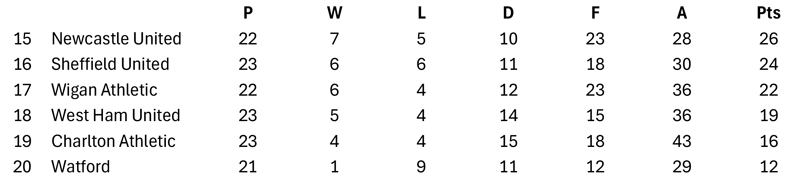
With a perfect sense of timing, the Ironcast podcast this week featured an interview with Alan Curbishley where among other things he talked through the Great Escape of 2006/07. It’s worth a watch/ listen. As a crumb of comfort, here is the league table at the equivalent stage of that season.

And here we are, six games later, just the one point better off and ten points adrift from safety.

So, remember, it is not yet a lost cause. Impossible is Nunothing. We must remain positive while we can. Embrace optimism, overcome those worrying limitations that we see, and believe that rediscovered potential will turn our dreams into reality. We can survive. COYI!

West Ham Midweek Briefing: Late Joy in N17, All Kicking Off at Corners and the Customary Transfer Mayhem

Winning at Tottenham with last minute scrambles, Laughing out loud cos the Spuds are a shambles, Buying defenders but not Tyrone Mings, These are a few of my favourite things!

Last Gasp Jubilation at the Tottenham Stadium

Any win against Tottenham carries with it an extra layer of smug satisfaction. Winning away makes it doubly so. Four-goal David Cross in 1981, the 1984 Easter massacre, Dani’s header in 1996, Ravel Morrison’s 2013 solo effort, and that first defeat at their new stadium in 2019. They are all part of West Ham folklore.

Whether Saturday’s game will live as long in the memory will depend more on what happens from here on in than events in the match itself. Will it kickstart another great escape or be just a momentary highlight in an otherwise miserable season. Like Kenny Brown scoring the winner against Manchester United in 1992.

With none of the bottom six teams losing at the weekend, it was a crucial time to get a result. Critical, in fact, to return home with three points rather than just the one. At least some ground was made up even if the size of the challenge remains daunting for a team whose resting state defaults to caution.  

Whether it was inspired or not by the arrival of new coach and fellow countrymen, Paco Jemez, Nuno announced a surprisingly attacking line-up to face Spurs. A retro 4-4-2 formation that featured both Taty Castellanos and Pablo Felipe up front supported by Jarrod Bowen and Crysencio Summerville on the flanks. There was no place for either Freddie Potts or Soungoutou Magassa with Tomas Soucek preferred to partner Mateus Fernandes in central midfield. The adventurous selection adding a sense of ‘Make or Break’ to the afternoon.

As we have come to expect though, it was a game of two halves from the Hammers. Or more accurately, given the amount of added time we get these days, a game of two nine-sixteenths. It’s either, an adventurous first 45 followed by ultra caution should we take the lead. Or a lethargic opener, followed by a burst of second half energy as the result of multiple half-time substitutions.

West Ham were easily the better side before the break with goalscorer Summerville and the impressive Fernandes as standout players. With only one goal to show for their efforts, however, it was always going to be a fragile lead if the intention was to defend it in the second half. Which is exactly the tactic that Nuno employed.

As for Spurs, they were dreadful in the first period but came out with more purpose in the second. Even then, despite bossing possession, their threat came mainly from hopeful long shots. But with the West Ham game plan a senseless combination of low blocking and panicked clearances, the hosts only needed one clearcut chance to draw level. Any pretence by the Hammers of rapid counterattacks or holding the ball up to ease the pressure on the defence had been left on the dressing room whiteboard. Win possession then immediately give the ball back to Spurs was the accepted modus operandi.

The goal when it came was almost a carbon copy of the one conceded to QPR in the previous weekend’s cup game. A cross from the right bypassed the centre backs who had been drawn to the near post, and the scorer stole in front of Aaron Wan-Bissaka’s token challenge to head home.

At that point, if felt that the home side were sure to go on to win the game. So, the sucker punch, when it came was completely out of the blue. Let’s not kid ourselves that introducing Callum Wilson was an inspired tactical masterstroke. The purpose was solely to waste a few more precious seconds of added time. The change should have been made 20 minutes earlier, especially with Taty on a yellow card.

The goal itself was a scrappy affair just after Wilson might have scored anyway with a decent opportunity. The resultant corner kick from Ollie Scarles was a typically benign floaty affair but Vicario flapped, the ball bounced loose and Wilson demonstrated his predatory striking skills. Amazing what a striker with an eye for goal can come up with.

I was convinced that after the wild celebrations had died down, VAR would find a way to disallow it. But this time they couldn’t, and we could all sleep soundly in our beds for a change.

All Kicking Off At The Corners

Set piece goals – and goals from corners in particular – are becoming increasingly significant in Premier League games as the antidote to the tactical stalemate of open play. More attention is paid towards their execution by (most) coaches, and teams take far longer to set up for corner kicks and throw-ins than ever before.

West Ham were once a feared set piece outfit but now, without anyone to fearlessly attack the ball in the opposition box, they have slipped down the rankings. Equally, they have no long throw exponent and have yet to score direct from a free lick this season. A set piece winner was therefore most welcome.

A by-product of the set piece shenanigans are the frequent melees in every penalty area. A confusion of pushing, pulling, holding and shoving that referees mostly ignore but, where every so often, the music stops and a penalty is awarded. Malick Diouf experienced this to his (temporary) cost in the AFCON final. In isolation, it was a stupid piece of holding. But if all similar incidents were given, we’d have six or seven penalties per game. I am sure PGMOL are frantically working on the most implausible response to stamp it out for next season.

Semi Annual Transfer Mayhem

The West Ham transfer window is its usual muddle of too many cooks spoiling the soup in a basket. There’s Max Hahn trawling through his spreadsheets, Nuno rifling through old Panini sticker albums with super-agent Jorge Mendes and the Chairmen undermining all and sundry in cahoots with his traditional transfer connections and unveiling the latest David Sillyloan special.

Sullivan may well have had a valid point about not releasing Callum Wilson but why not keep the difference of opinion in-house rather than broadcasting it to the world. Quite what we’ll end up with by the time the window closes is anyone’s guess.

From reading various West Ham discussion boards, there are plenty of opinions as to where the transfer priorities should be. A reflection of how threadbare and unbalanced the squad has been allowed to come. It is impossible to fix or fill each and every gap in the next two weeks and so any further recruitment needs to be carefully targeted to the cause of survival. To me that means players able to make an immediate impact, not extra bodies brought in as cover. The reality is that we will have to muddle through and hope for the best in some positions.

I still feel the addition of a creative ball carrying attacking midfielder is the most significant gap. Someone to replace the ineffective Paqueta in making things happen – a Morgan Gibbs-White equivalent. Others make a strong case for an additional winger or two on the basis that we mostly attack down the flanks. But my answer to that is we attack down the wings because no-one is capable enough to go through the middle. Our attacking play needs mixing up and must become much less predictable.  

It looks like the 22-year-old Venezuelan, Keiber Lamadrid will be joining on loan in the next day or two. An inexperienced South American winger to replace the one we have just let go. Will we just leave him hanging around the training ground like Luis Guilherme. It was odd that Guilherme wasn’t sent out on loan or get at least some game time with the U21s. Good luck to Keiber. If he ever gets a game, he would be the third Venezuelan after Fernando Amorebieta and Salomon Rondon to play in the Premier League. It should be noted that both experienced relegation during their stays. COYI!