
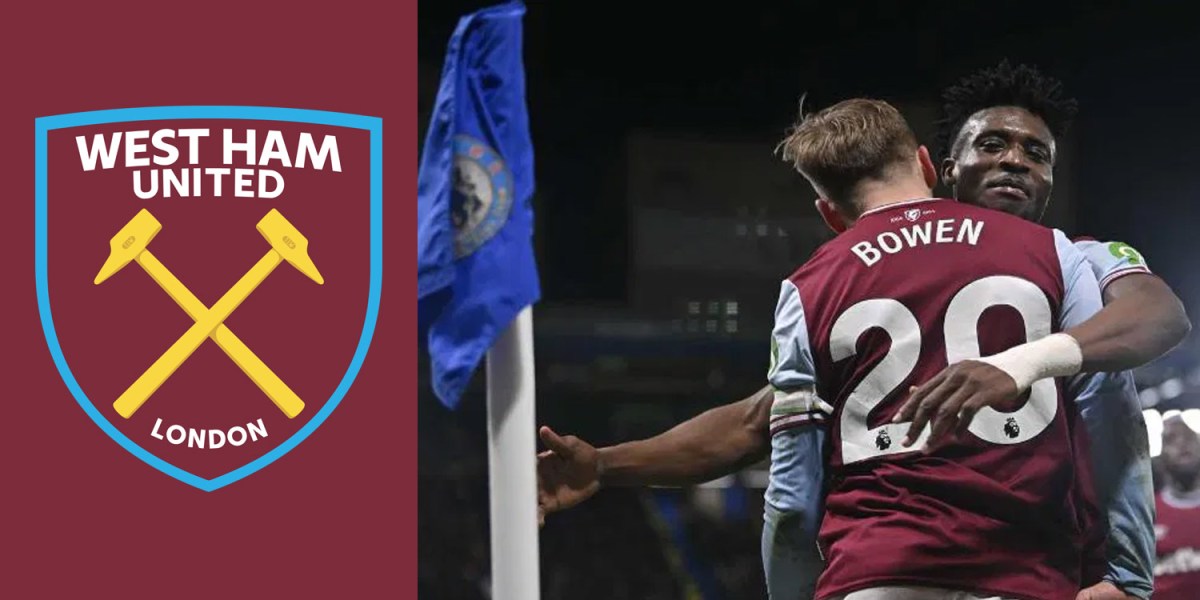
So, here we go. Not in the Fabrizio Romano sense of the phrase to announce an imminent incoming transfer; but rather in resigned contemplation of yet another blank weekend of West Ham football. Early cup exits, international breaks and routinely exiled to the graveyard Monday night slot due to the absence of European competition, the Hammers will feature on a maximum of 29 of the season’s 41 weekends. They will play just twice in the whole of March, with those two games – at home to Newcastle and away at Everton – coming just four days apart.
It’s been a good many years now that TV has called all the shots on scheduling with little concern for the inconvenience to the matchday supporters who create the atmosphere for their product. More and more of Saturday afternoons are now 100% football free for the typical Premier club. Free from a lunchtime pint or two in the Central or Boleyn, a burger in a bun (no onions for me, mate) from the sizzling food stand, Percy Dalton’s peanuts (tanner a bag), golden goals ticket, the brass band playing on the half-way line, and half-time scores hung on the alphabetical grid behind the goals (that’s enough misty-eyed nostalgia for now – Ed!)
During the course of this season, West Ham will play a total of just 41 revenue generating games, compared to 53 last term and 57 in 2022/23. Where Aston Villa have already earned an estimated €71m from their Champion’s League group games – and fellow strugglers Manchester United and Tottenham have pocketed €20m+ from the Europa League equivalent – the Hammers are poised to fall ever further behind in the rich league stakes.
And with little left to play for, apart from avoiding the highly remote possibility of being dragged into the relegation dogfight, it promises to be an underwhelming four months until the end of May. Less of a problem when football was an affordable, Saturday afternoon ritual with fellow supporters, friends and family; but less appealing now that we are customers with membership schemes and high ticket prices. As the old Queen might have said as she tucked into a portion of pre-match pie and mash, it has been a ‘seasannus horribilis’ at the London Stadium.
Last Monday’s match at Chelsea reached its inevitable conclusion when the hosts came from behind to claim their customary victory. If you read Richard’s preview you would have been aware how rare West Ham wins have been at Stamford Bridge in the recent past.
The West Ham versus Chelsea rivalry perfectly encapsulates the influence of money in football today. In the Football League, the Hammers statistically held the upper hand. Even in the early days of the Premier League – before the arrival of dirty Russian money in 2003 and the new low bar for football club ownership – the Hammers led the Blues with nine victories to eight. Since then, Chelsea have won 24 of the 38 league encounters. Of West Ham’s seven wins, one was at Stamford Bridge, two at Upton Park, and four at the London Stadium.
The game itself saw another patched up Hammer’s side put in a committed but ultimately fruitless performance. It was reminiscent of the Aston Villa cup game with West Ham’s holding a slender but comfortable lead, but losing the faith once the scores were levelled. Graham Potter gave an honest assessment after the game highlighting the effort, shape and application of his players but accepting they had not done enough with the ball themselves.
There was a welcome return for Jarrod Bowen but injuries to Lucas Paqueta and Edson Alvarez required adjustments to the starting eleven – the underused and undervalued Andy Irving putting in a mature performance for his first league start. While Bowen had made a text-book recovery from his fractured foot, Crysencio Summerville has joined Jean-Clair Todibo in the Rush Green treatment triangle where precautionary substitutions have mysteriously developed week by week into extended long-term injury absences.
Potter’s honeymoon at West Ham continues to hold good despite results not yet picking up. The massive turnaround in attitude and atmosphere since he replaced Lopetegui is clear to all, and we now see a team not resigned to its fate before a ball has been kicked. There have been extenuating circumstances with injuries but at some point, positivity needs to be converted into points. The six Premier League clubs who have sacked their managers since the start of the season comprise six of the bottom seven clubs in the current standings. The bounce isn’t always obvious and here is how they have performed pre and post the change in terms of points per game.

Monday evening also saw the slamming shut of the January transfer window. As usual, very little happened despite the daily speculation peddled on the made-up rumour sites – which have already turned their goldfish like attention to potential summer signings.
I’m in two minds about the straight loan signing of Evan Ferguson. A potentially excellent striker if he can rediscover his fitness and the form of two seasons ago; but without any option to buy, the deal surely favours the player and Brighton more than it does West Ham. If we get him fit and he starts to knock in the goals, then great for time being but bigger clubs with bigger budgets will then be chasing for his signature. If he’s a flop, then it will all have been a waste of time.
Also making a comeback at the London Stadium is James Ward-Prowse following a mostly unsuccessful loan period at Champion’s League chasing Nottingham Forest. No surprise he didn’t get much of a look-in at a team based on rapid transition and fast counterattacking. He joins a pool of older, slower, unadventurous midfield players – but at least he can take a decent corner. And perhaps he will finally equal that Beckham direct free-kick record. Despite any reservations I may have, I wish both players well whenever they turn out in the claret and blue.
The final expected news of the week was the announcement that Tim Stediten has left his role as Technical Director. It is not clear whether any replacement is anticipated or whether the entirety of the role is viewed as a failure. A clear vindication in the eyes of the Board for reverting to the shambolic system of boardroom meddling, agent influence and short-term thinking that has held the club back for the last 15 years. Lasting improvement is impossible until the club addresses its inability to adopt a long-term strategy and direction.
It is fascinating how widely repeated the narrative has spread that West Ham’s current woes are all down to Steidten’s recruitment. Not just from in-the-knows with cosy relationships at the club but also from the supposedly more thoughtful and balanced reporters at the Athletic and Guardian who have given a free pass to the most significant mistake of all – the disastrous appointment of Lopetegui by David Sullivan. The flaw of modern journalism where if you want access to the inside track, you mustn’t say anything bad about the source.
I’ve no idea if Steidten is difficult to work with or not, but he was set up to fail and was clearly not in full control of recruitment. He might have believed he was driving the transfer bus but in reality, he was the kid in the front seat on the upper deck imagining it to be true – until it hit the low bridge of the club’s ambition. The ironic thing about football transfers is that the number of people claiming responsibility is inversely proportional to how badly they work out.
Enjoy your free weekend. COYI!
 Under The Hammers
Nice to read a more balanced approach to an assessment of Steidten’s impact on the club -I think you are probably correct- he wasn’t given full control, and quite a few of the players he brought in have done, or can do a really good job if developed properly. Knee jerk reaction does no one any favours. While I wasn’t keen on J-Lo’s appointment I’m not altogether convinced that Potter will provide the answer to a regular top six finish and European football every season which many of us crave….
LikeLike
Really hope Potter does well. The main criticism of his time at Brighton and Chelsea was nice approach play but not enough goal attempts. We can only wait and see whether he has learned from that and how his time at West Ham pans out. Turning the club into regular top six challengers will take anyone a long time to achieve
LikeLike
Hi Geoff, as always an accurate if a little depressing read. I think that not a lot will change until Sully moves on, as I believe you have said previously “a leopard never changes spots”. Having said that we really need a commercial company takeover rather than a wealthy owner who may be worse than Sully looking at a few other clubs recently. When Steidten arrived a lot of us welcomed a ‘new’ WH era. Unfortunately Lope arrived and I really believe that he caused the majority of the following chaos of an on the pitch. I see he now ‘quoted’ as saying that most of the buys were not his but Steidten forced them on him and that he could not get them to play as he wanted. Could anyone have played his mind games? Let’s forget the past and concentrate on the future which looks brighter (if only for young ages being suggested). I think that Potts is definitely better than the the last two (Moyes after his fabulous Euro run) so let’s get behind him and see. Difficult few games coming up and the lack of games coming up in March is disgraceful but just may suit Potter and the lads. COYH. Regards Michael >
LikeLike
Hi Michael, it’s certainly not worth getting depressed about but the season has been a huge disappointment. For me, 99% of the problem lies with Sully. He has no goal, plan, idea or strategy to develop the club beyond retaining top flight status and protecting the value of his investment. Everything he does is a reaction to external events with no sense of any ultimate objective. To view the rest of the season as some form of contractural obligation is not what I had imagined. Take care, Geoff
LikeLike
One thing i forgot to ask Geoff is what is the difference between ‘technical director’ and our new ‘recruiter’ please. All we ever read about Steidten was his pursuit of players and that seems what our new guy will do. Why would we want technical director which has been suggested in a couple of other articles. Regards Michael
LikeLike
The difference as I see it is that a Technical Director or Director of Football would have a responsibility for establishing a football philosophy for the club that would extend beyond any individual manager’s tenure. It offers greater continuity given that managers often only last a couple of years. Thus, a Technical Director would look beyond immediate first team player recruitment with a longer term view of finding young players for succession development. He should also be responsible for planning managerial succession. Potter’s recruitment guy would be more focused on immediate first team needs. That’s how I see it and I’m sure there are overlaps. The important thing is they should all be working to a common goal
LikeLike
Thanks Geofff, it will be interesting to see if they appoint another Director. They were allegedly talking about the MU guy who got sacked but knows and has worked with Potter before. To me little point whilst Sully is there. Regards Michael
>
LikeLike