
 A few weeks back I used the tedium of the international break to take a look at the composition of the squads in the Premier League in relation to nationality. Overall it showed that only 35% of Premier League players were English although this increased to 40% if you included the other home nations. I wondered at the time whether if you looked at those actually making it onto the pitch the situation would be even worse and so have used this recent break to undertake further research in the context of the continued underwhelming performance of the England national team.
England appear to be in a Groundhog Day cycle where they generally qualify with some ease (usually from a group where even a mid-table Championship would hope to do well) and then disappoint when it comes to the finals. We then replace the manager and start the cycle again. In truth this has been going on for almost 50 years (well before the Premier League and the foreign invasion) but it does remain a conundrum whereby England has the most famous and cosmopolitan league in the world but a extremely ordinary and uninspiring national team. Are the two related in anyway?
So far this season we have had seven rounds of Premier League matches; a total of 70 games in total which have featured 414 different players of which 342 have started at least one game. Bournemouth and Burnley have been the most frugal with fewest different starters (14) while Sunderland have had the most different starters (22). Chelsea have used fewest players if you included substitute players (18) while Sunderland have been the most lavish with 25. (It is an interesting contrast with Aston Villa winning the First Division in 1981 using only 14 players all season; how the game has changed.)
Of those starting and featuring (i.e. including substitute appearances) in a Premier League the proportion that are eligible to represent England is 34% and 33% respectively; this is consistent with the overall squad make-ups and so my assumption that it would be lower was not correct.
Bournemouth are the most English team with 72% of starters while Watford have had the least at 9% (just Troy Deeney). Only 3 clubs achieved over 50% of English starters (Bournemouth, Burnley and Palace) while Watford, Arsenal and Chelsea were all below 15%. The equivalent figure for West Ham is 25%. Collectively, the ‘so-called’ Big 4 (two Manchester Clubs, Chelsea and Arsenal) managed to scrape together 18% of Englishmen.
The average Premier League side then has less than 4 players eligible to represent England in any given lineup. In total that is somewhere over 70 playing Premier League football on a regular basis (allowing for injuries) giving them a 1 in 3 chance of being selected for an England squad. To my knowledge, Joe Hart is the only English player of note performing overseas.
The big ‘chicken and egg’ question that this raises is: Does the lack of quality English players lead to the recruitment of so many overseas players or does the number of foreign players restrict the development of good young home grown talent? Whatever way it is difficult not to conclude that the the declining number of English players in the Premier League must have had an adverse effect on the national side. How to fix this without impacting the ‘brand’?
Far be it from me to defend the largely clueless England manager’s that we have seen over the years but there has not really been the depth of talent for them to work with. All the more reason, in my opinion, to find someone (like Sir Alf) who has a system and will then find the players to fit it; rather than the other way around.
No wonder my interest in the England team is going down quicker than sterling (the currency not the Man City player that is)!
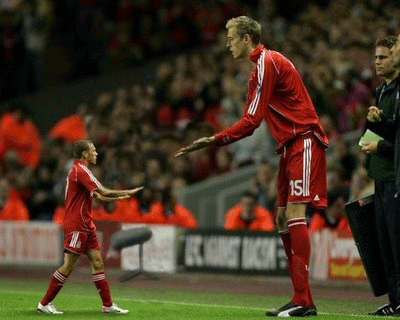 It is a misconception that all football pitches are the same size. They are not. Can you imagine this applying to some other sports? What if the distance between the stumps was different at Lords compared to the Oval? But the distance between the goals at the London Stadium is greater than it is at White Hart Lane.
 OK, so to suggest that someone who won 2 League Championships, 2 FA Cups, 2 League Cups, played in 2 World Cups and a Euro Finals ‘didn’t quite make it‘ may be something of a stretch. In the context of this series though Ray Houghton is another West Ham academy graduate who, for some reason, never became an established first-team player at the club.
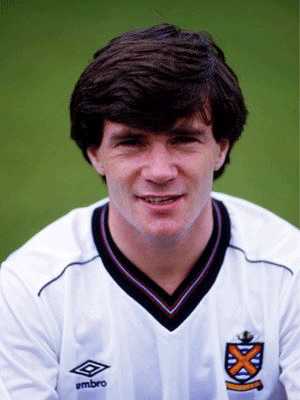 Houghton was allowed to leave in the summer of 1982 and joined Fulham, then in Division 2, on a free transfer. There is not much written about the circumstances of his leaving and so it is difficult to tell if he was simply a late developer, whether his rejection spurred him on to what he subsequently achieved or whether his style just didn’t suit West Ham . Whatever the case manager John Lyall and the coaching staff did not see any potential that merited a further contract.
 Following on from my
  Do you ever stop to consider why you support a football club? What is it that makes you want to invest so much time, money and emotion into the fortunes of a particular team? What do you get or want out of it in return?
 Continuing from last week’s theme there was an unprecedented run of League Cup successes during this week in history with victories, sometimes convincing ones, over Stoke, Sunderland, Mansfield, Bournemouth and Villa (twice). It seems that if we avoid the first round ‘banana skin’ then we are on a roll in this competition; so set your expectations for the impending Chelsea clash in a few week’s time. The one League Cup defeat though was a poor one in the shape of a 1962 away defeat by 3 goals to 1 against Rotherham.
 This all began with me selecting teams of West Ham players whose surnames all started with the same letter. The aim was to help me drop off to sleep instead of the more traditional method of counting sheep.
 Under The Hammers