
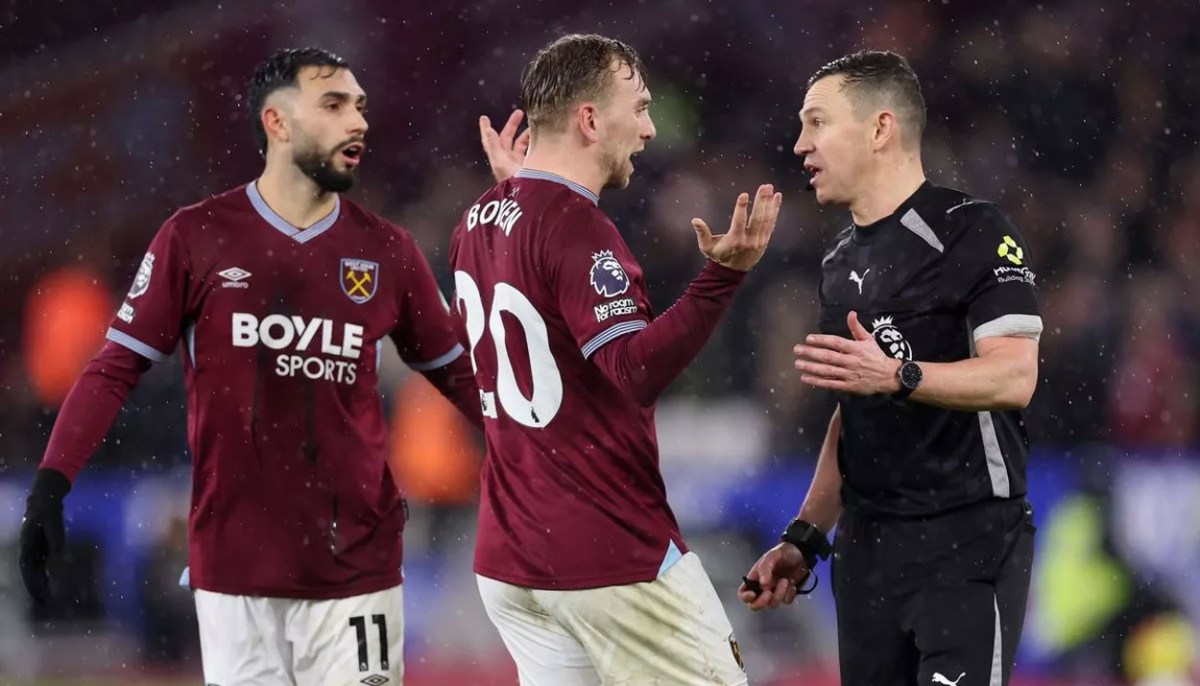
I’ll start by looking back at the Forest game in the week. West Ham thought they had doubled their lead early in the second half when Crysencio Summerville scored, but VAR intervened and ruled the goal out for offside. The controversy centred on Taty Castellanos, who was deemed offside in the build-up. The confusion for fans and pundits was heightened because the ball reached Castellanos after a block tackle by Forest defender Nikola Milenkovic. According to current offside law, a defender’s block or tackle does not reset the offside phase unless it’s a “deliberate play” (i.e., a controlled pass or clearance). In this case, Milenkovic’s intervention was not considered deliberate, so Castellanos remained offside, and the goal was disallowed. I would disagree. I believe that the intervention was deliberate (if it wasn’t deliberate then why was he trying to win the ball?) and that the goal should have stood.
Former referees and experts have criticised this interpretation, arguing that the law is too technical and fails to reflect the spirit of the game. The exact moment the ball is played is also notoriously difficult to judge, especially with frame-by-frame video, and the difference of a split second can mean a player is onside or offside by millimetres. The interpretation of deliberate or uncontrolled intervention is also impossible to judge. Surely it is deliberate if the defender is trying to win the ball?
The offside law was originally introduced in the 19th century to prevent “goal hanging”—players loitering near the opposition’s goal waiting for a pass. Over the years, the law has been revised several times (notably in 1925 and 1990) to encourage attacking play and make the game more exciting. However, the law now hinges on technical definitions of “deliberate play” and “active involvement,” which can be difficult to interpret even with video technology. Many (including me) have argued that it should be amended even further to the attacking team’s advantage. This could easily be done by introducing the clear daylight rule in that there has to be a gap between the attacker and defender before offside decisions are given. Let’s do away with this nonsense about parts of the body that can legitimately play the ball.
Many argue that the law is out of date and does not reflect the modern game, where split-second decisions and marginal offsides are decided by technology rather than the naked eye. The spirit of the law, to prevent unfair advantage, has been lost in a sea of technicalities.
Late in the match, Nottingham Forest were awarded a penalty after Alphonse Areola caught Morgan Gibbs-White in the face while attempting to punch clear a set-piece. VAR advised the referee to review the incident, and the penalty was given. West Ham midfielder Tomas Soucek labelled the decision “a joke,” arguing that such incidents happen frequently and that goalkeepers should be given more leeway when challenging for the ball. Former referee Mark Clattenburg, however, said the decision was correct because Areola failed to make contact with the ball and caught the player instead. I have always argued that penalties should only be awarded when an obvious goal scoring opportunity is denied which is not the case when so many penalties are awarded in football games.
Is VAR ruining football? VAR was introduced to eliminate clear and obvious errors, but its use has become far more pervasive. Instead of correcting blatant mistakes, VAR now scrutinises marginal offsides and subjective fouls, often leading to long delays and confusion. Fans and players complain that the flow of the game is disrupted, celebrations are muted, and the joy of football is diminished.
Should VAR only be used for clear and obvious errors? According to IFAB, the game’s law-makers, VAR should only intervene for “clear and obvious errors” or “serious missed incidents” in four match-changing situations: goals, penalties, direct red cards, and mistaken identity. However, in practice, VAR is often used for marginal decisions that require multiple replays. Many (including me) argue that if a decision needs to be viewed more than once, it cannot be “clear and obvious,” and the original on-field decision should stand. We shouldn’t have to wait so long for a decision to be made. These delays ruin the spontaneity of the game.
If the decisions had not gone against us the gap to Forest might now be just one point or perhaps four points. But our defeat to Forest leaves us seven points adrift of safety, with relegation odds now as short as 8/11 or even 1/5 with some bookmakers. The team is winless in ten matches, and the pressure on manager Nuno Espirito Santo is mounting. While mathematically possible, survival looks increasingly unlikely unless there is a dramatic turnaround in form, which is hard to see at the moment.
There have probably been games this season when controversial decisions have gone in our favour although I cannot recall any important ones. But these are not the reasons behind why we are very likely to be relegated. So often we put ourselves in situations where marginal calls become decisive, but a whole book could be written to describe why we are in the position we are where Championship football next season is probable. We’ve written about them all through this miserable season and I won’t return to them now!
West Ham host QPR in the FA Cup third round at the London Stadium on Sunday. I can remember when I was young there was magic and romance attached to the FA Cup competition right from the early rounds when local non-league clubs took part in the qualifying rounds, then when West Ham entered in Round 3 and all 32 games kicked off at 3 o’clock on an early January Saturday, and right up to Cup Final day itself in May. But has the magic and romance disappeared from the FA Cup?
The Premier League and UEFA Champions League now overshadow the FA Cup in terms of prestige, financial reward, and global attention. Top clubs often prioritise these competitions, fielding weakened teams in the FA Cup’s early rounds, which can diminish its importance and allure. The crowded football calendar means the FA Cup sometimes feels like an afterthought. Kick-off times are often dictated by TV schedules rather than tradition, making it harder for match-going fans to attend and reducing the sense of occasion.
The financial gap between Premier League and lower-league clubs has widened. The FA Cup’s prize money is modest compared to league placements or European qualification, reducing its incentive for bigger clubs. Having said that the big clubs are almost always the winners in the end.
Changes such as the abolition of replays and the moving of the final from its traditional Saturday 3pm slot have eroded some of the competition’s unique traditions, making it feel less special to some supporters.
Does the magic and romance still endure in any way? The FA Cup remains famous for “giant-killings”, when smaller clubs defeat Premier League giants, it still makes news. Recent years have still produced memorable upsets, such as Stevenage beating Aston Villa, Crawley Town thrashing Leeds, Plymouth Argyle’s shock win over Liverpool, and even yesterday when statistically we had the biggest upset of all time with sixth tier Macclesfield deservedly knocking out the holders Crystal Palace. These moments capture the essence of the competition and keep the romance alive. As West Ham fans we’ve been on the receiving end of so many of these giant killings in my lifetime!
As the world’s oldest national football competition, the FA Cup still carries a unique historical and cultural significance. For most fans and clubs, winning the FA Cup is still a dream and a source of immense pride. How we’d love to repeat 1964, 1975 and 1980!
For lower-league and non-league teams, the FA Cup offers a rare chance to play on a big stage, secure financial windfalls, and create lifelong memories for their fans. These stories, like non-league teams reaching the later rounds, are the heart of the FA Cup’s enduring appeal. The competition still inspires passion, especially in local derbies or when underdog teams are involved. For many, the “magic” is now more selective, shining brightest in these moments rather than universally.
Some fans and commentators argue that the FA Cup’s “magic” is now a cliché, used to paper over the reality that the competition has lost some of its former glory. Others point out that the romance is still there, but it’s harder to find amid the dominance of elite clubs and commercial pressures. There is nostalgia for the days when the FA Cup final was the highlight of the football calendar, but also recognition that the competition still produces drama, upsets, and moments of pure football joy.
The FA Cup may not hold the universal magic and romance it once did, especially for top clubs and younger fans raised on the Premier League and Champions League. However, for smaller clubs, traditionalists, and those who cherish football’s unpredictability, the FA Cup still provides unforgettable moments and upsets that keep its spirit alive. The “magic” hasn’t disappeared, it’s just harder to find, and perhaps more precious when it appears.
There was a time when I was young when I would have been really excited by this third round game against Queens Park Rangers and hoping that we would still be in the draw for the fourth round that I would listen to on the radio on the following Monday lunchtime, another tradition that has disappeared. But this season has been such a miserable one that my interest is much diminished. In times gone by there was always a hope that we could win a few games and reach Wembley. This time around I would love us to do this but I reckon there is less chance of us going to Wembley than escaping relegation. But it is so long since we won a game that it would be good to beat QPR (even a weakened QPR with several players out injured and chasing a play-off position in the Championship) and perhaps give some of our fringe players a run out to show what they can do (or not!). I remain hopeful!


 Under The Hammers