

The games are coming thick and fast now. All 20 Premier League teams have fixtures on Tuesday, Wednesday or Thursday this week, all available to view on Amazon, and ours is the final game to kick off on Thursday when we visit Tottenham.
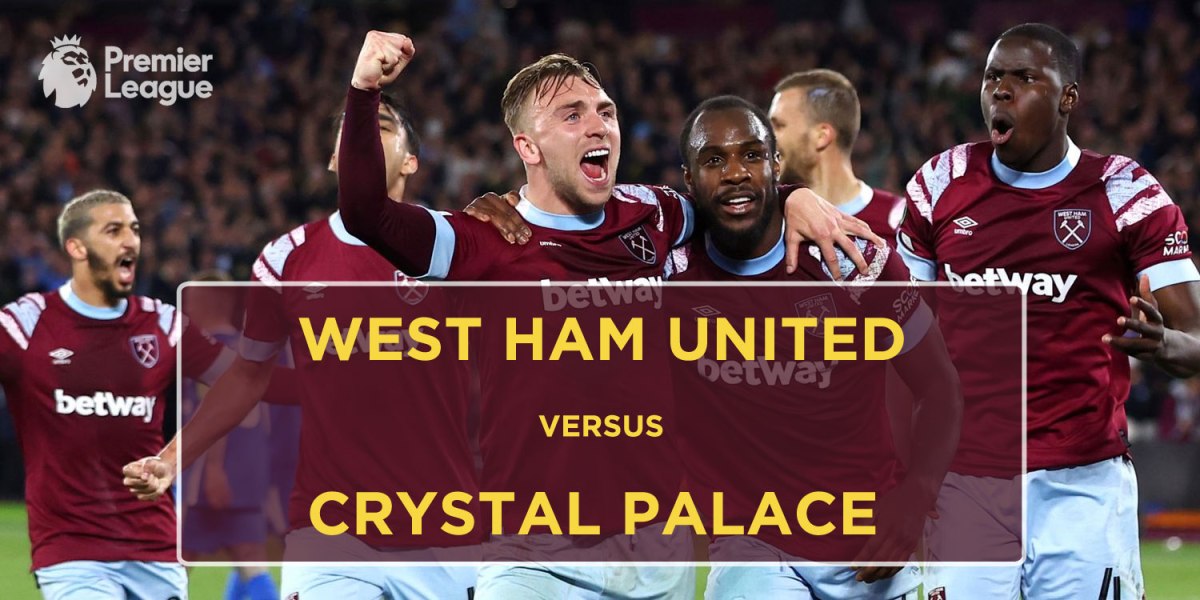
On Sunday we faced Crystal Palace and once again we scored the opening goal of the game. When I remember games against Palace I think back to two of the best West Ham goals that I remember. One of them was the stunning overhead kick scored by Andy Carroll at the London Stadium from the cross by (Antonio?). I haven’t seen it again for some time but it was definitely one of the great goals of its type, every bit as good as the one scored by a Manchester United player recently which has sent all the pundits into raptures, and certainly superior to Rooney’s famous one which came off his shin. The other memorable one was the free kick from Payet in one of the final games at the Boleyn Ground that dipped and swerved and went into the goal at the side where the Palace keeper stood and barely moved. Our opening goal this time wasn’t quite in the same class but was an excellent team goal just the same. Kudus flicked the ball over a Palace player, it went to Paqueta to JWP who then produced an inch perfect 50 yard pass to Coufal who then cut the ball back for the inrushing Kudus to sweep the ball into the net with a slight deflection.
If my memory serves me well this is the ninth time in our 14 league games this season where we have scored the first goal in the game. Holding on to the lead after going ahead scoring the first goal would mean 27 points to date plus any picked up after coming from behind. Alas our total is 21 points after Palace equalised via Edouard following a gift from our Greek defender Mavropanos whose woeful backpass was shockingly short and the game ended 1-1.
The famous saying is to ‘beware Greeks bearing gifts’. The phrase originates from Greek Mythology, specifically the story of the Trojan War in which the Greeks left a Trojan horse at the gates of Troy. The Trojans thought this was a gift but the ‘horse’ was filled with Greek soldiers who emerged from the beast and destroyed the city of Troy. Perhaps our Greek defender had fooled them by lulling them into a false sense of security by then going up the other end and bagging a hat trick himself? Alas this was not to be and the gift really was a gift.
When we last won a league game at the Tottenham Hotspur Stadium in April 2019, less than five years ago the scorer of our goal was Antonio. We became the first visiting team to win at their new stadium and Antonio became the first visiting player to score there. It just goes to show how teams evolve in a relatively short period of time these days in that probably none of our starting eleven that day will start the game this week. The team that day was Fabianski, Fredericks, Balbuena, Diop, Masuaku, Rice, Anderson, Noble, Snodgrass, Antonio, Arnautovic. Our bench that day comprised Adrian, Zabaleta, Ogbonna, Obiang, Wilshere, Hernandez and Perez. Of the 18 players only Fabianski and Ogbonna will be involved, and both almost certainly on the bench.
Our previous league win there was the infamous 3-0 victory in 2013 where Morrison scored the third goal running from our half to seal the victory. Apart from a couple of League Cup wins, they are our only wins there in the last ten seasons. We go into this game unbeaten in our last five, with five wins in our last seven games (in all competitions) retaining our position of ninth in the table. Seven points from our last five league games is superior to Tottenham’s recent record of just one win and one draw in the last five.
The debate over the style of football continues to rage on and the manager continues to be attacked frequently on social media, although many continue to defend his record quoting win percentages, a European trophy won, and continuous involvement in Europe. The question remains, with the squad now at our disposal should we not be doing even better? Social media attracts extremes of opinion both for and against and is only a small proportion of West Ham supporters but I wonder how much support the manager has from the fan base as a whole?
Geoff made the point recently that only pundits or others watching from afar believe that we are enjoying a decent season. Shouldn’t we be happy with sitting in ninth place in the league, progressing nicely in the EFL Cup, a favourable home draw in the third round of the FA Cup, qualified for the knockout stages in Europe with a game to go, and with as many European victories as any club anywhere in Europe in the last two seasons? Or the alternative view that despite this, those of us who watch every game are not happy with the apparent negative approach, poor tactics, and lack of entertainment on offer?
Personally, I am inclined towards the latter view whilst not wishing to diminish the achievements since the manager arrived. As someone who has been watching West Ham since 1958 I can recall some success but the best memories come from being entertained. I remember the entertainment on offer when we won the FA Cup in 1963-64 despite a final league position of 14th, or the following season when we won in Europe and finished 9th (our current position). One of my favourite ever seasons was 1968-69, the entertainment was superb, we scored four or more goals seven times, including a couple of fives, a seven and an eight! We finished eighth which was OK but the key thing was we were regularly entertained royally.
The cup winning season of 1974-75 was entertaining at times, at one stage we scored 20 goals in a four game, 10-day period, but we only finished 13th, and some of the best and most exciting games came in our European run to the final the following season, although we only won one game after Christmas and finished a lowly 18th.
The FA Cup win of 1980 as a second-tier side despite only finishing seventh in the league was memorable as was the record-breaking promotion to the top tier the following season when we won so many games in an entertaining fashion (which included losing in the final of the League Cup). Our most successful season in the top tier ever was our third-place finish in 1985-86. It was disappointing to go out of the FA Cup at the quarter final stage at home to Sheffield Wednesday, but that season gave us great entertainment as well as success. When Allardyce was in charge we had some limited success in regaining and consolidating our position in the top-flight but I hated the football on offer.
Memories are made from both success and being entertained and at times in the past 65 years I remember having both. It is possible to have both results and entertaining performances. The manager seems to believe that the former precludes the latter. Perhaps a more positive approach and forward-thinking man in charge might achieve both?



 Under The Hammers