
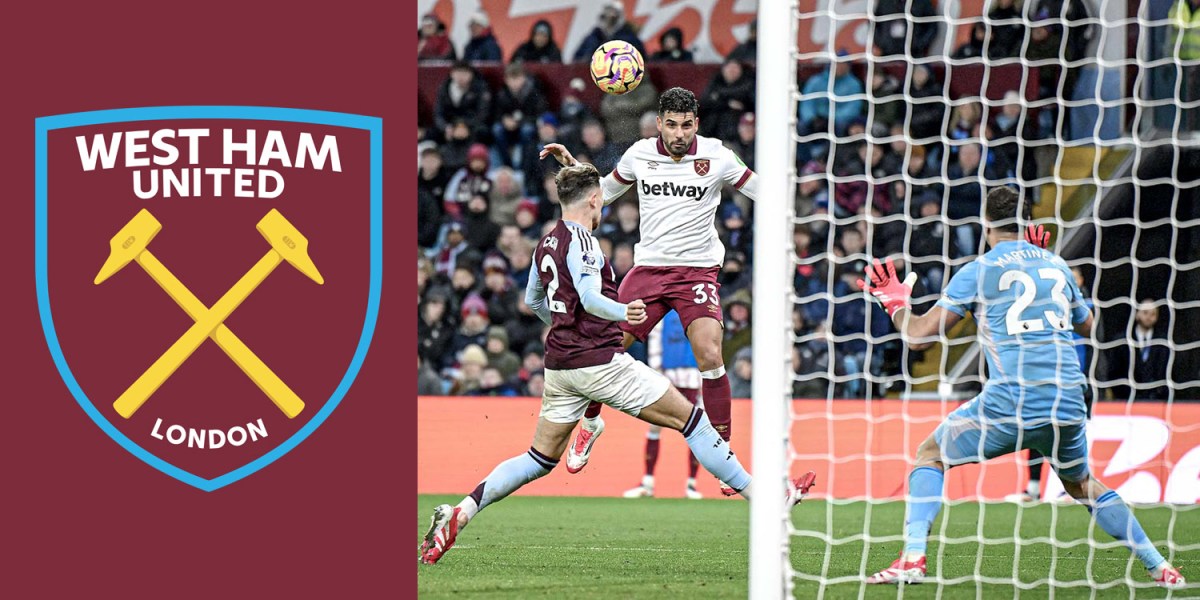
Looking back at the opening exchanges of last weekend’s visit to Villa Park and it had all the hallmarks of a Super Sunday evening to forget. Only ten minutes had passed, and I was already watching the game through my fingers. With a patched-up defence, the back three/ five formation that had failed to impress against Crystal Palace, and still not a striker in sight, a severe mauling was on the cards.
Villa were carving through the Hammer’s rearguard at will and when Ramsey breezed past Tomas Soucek’s lack of mobility in midfield to open the scoring on eight minutes, it threatened to be the first of many. But gradually the complexion of the game changed. Did the hosts become complacent, believing this was going to be all too easy, and with one eye on their midweek Champions League fixture with Celtic? Or was it down to the visitors eventually settling into their unfamiliar formation? Either way the remainder of the first half was a more balanced affair, even if it was largely scrappy and lacking in technical quality.
No-one has conceded more goals in the opening ten minutes of Premier League games than West Ham this season – and they would be a bottom three team in a table based on first half performances alone. True to form though, the second half Hammers were a very different proposition to what had gone before. They were well worth the point earned thanks to Emerson’s fine header from Edson Alvarez’s wonderful cross; and looked the far likelier of the two teams to grab a winner in the closing stages.
The second half was an excellent all-round team performance which may well reflect the result of a solid week’s work on the training ground under Graham Potter. The standout performers may have been Aaron Wan-Bissaka and Lucas Paqueta but all of those involved looked up for the challenge and put in a decent shift. We can ask for no more.
There was also an underlying feistiness to the game thanks largely to the wayward officiating of the consistently inconsistent Peter Bankes. Alongside death and taxes, baffling refereeing decisions are just as inevitable these days it seems. Officials have created their own self-important world where they randomly choose to either exercise discretion or apply the letter of the law depending how the fancy takes them.
For example, a case for common sense could be made in stopping the game when Mings went down with what looked to be a serious injury (even though it wasn’t a head injury) – and also in not booking the same player when he caught the ball having felt a recurrence of the injury. But no such discretion was available when Max Killman was forced to leave the field after receiving treatment, even though it was patently obvious that no pretence was involved. A goalkeeper can stay on but not a central defender despite being equally critical in defending set plays.
Not that West Ham were not also recipients of Bankes’ unpredictable largesse. Notably when he failed to act upon two attempts by Alvarez to secure a second yellow card. It is probable that I am in a minority believing the Mexican to be a fine player who will likley improve under Potter once freed from the obligation of “tackling for two” in the defensive midfield double pivot. But his commitment had for some reason boiled over into recklessness in the lead up to his late sensible substitution.
The other big news of the week was the apparent departure of Tim Steidten from his role as Technical Director. I say apparent because I have yet to see (or have missed) any official confirmation of his dismissal. Potter’s buddy Kyle Macaulay has been appointed Head of Recruitment but that is a different role from the one that Steidten left. Does that mean the Technical Director role has been demised to allow Sullivan free rein in doing deals with his favourite agent mates?
One can rightly question how well the transfer funds were spent in the summer but even a cursory examination reveals too many fingers in the pie with no coherent strategy in place. It was never made clear who was responsible for which signings, while most of what we heard on shortcomings the result of intentional leaks from the Boardroom to useful in-the-know reporters. Some of the criticism of Steidten may well be justified, but was the club’s transfer business any worse than any of the other 14 years under Sullivan’s stewardship? For me, Steidten was setup as the fall-guy to distract attention from the major recruitment blunder of the summer – the appointment of Julen Lopetegui as coach – against the advice of the Technical Director. In a hotly contested competition, it was up there with the most disastrous managerial appointments in West Ham’s recent history.
None of the current debacle should really come as any surprise. It has been Sullivan’s MO since his days at Birmingham City. It’s not that he refuses to invest – far from it – but he has rarely spent wisely or with the future in mind. Deep down he may even mean well, but any benevolence is overshadowed by an overwhelming preference for self-promotion; a desire that manifests itself in the fruitless pursuit and occasional purchase of what he sees as showbiz signings. As one Birmingham City fan summed it up (speaking of Gold and Sullivan): “While I’ve always quite admired Sullivan’s bluntness, I would have to admit that I’m one of those who are sceptical of his and David Gold’s motives. If you want a steady club, with a chairman who likes interviews with helicopters in the background, they’re the men for you. If you want a bit more substance to the words, maybe not.”
The essence of football club ownership has been a contradiction ever since the ne’er-do-wells in N17 created a holding company in the 1980s to circumvent the FA rule that had previously protected the game from undue commercialisation. It has been downhill ever since as business priorities has eaten away at the sporting and community roots of football; and where supporters are now regarded as customers to be milked for replica kits, exhorbitant matchday pint and programme prices, and other assorted paraphenalia. The media hype machine will have us believe the game is better for it, but I am not convinced the overall entertainment and experience has improved.
The corporatisation of football was reinforced by the publication of the annual Deloitte Football Money League which was published this week. On the surface, it is satisfying to see West Ham ranked as the 17th richest in the world by revenues. But look into the detail and it becomes apparent how huge the gulf is between clubs such West Ham, Newcastle, and Aston Villa and the so-called Big 6.

West Ham’s Matchday and Commercial income is tiny compared to those generated Tottenham and Chelsea. Where the Hammers rely on Broadcasting for 60% of their revenues this reduces to 32% and 35% respectively at the Tottenham Stadium and Stamford Bridge. With squad costs becoming increasingly tied to a percentage of revenues there seems little hope of closing the gap.
The London Stadium is a conundrum for West Ham. Seen by some as the “deal of the century” when the tenancy was first agreed, it is apparent that it also imposes severe limitations on the club’s ability to pursue some of the more lucrative retail and sponsorship revenue opportunities.
If West Ham are to punch above their weight on a regular basis, then adopting the smart recruitment strategies practised by clubs like Brighton, Brentford, and Bournemouth has to be the way forward. Identify emerging talent from lower leagues, recruit for the future and succession, improve through coaching, and sell at a profit. It is the very antithesis of the traditional West Ham Transfer Way where players have been regularly sold at a significant loss. It is a strategy that should have been apparent for many years, but hubris, arrogance, incompetence and stubbornness have routinely prevailed.
We are, of course, in mid transfer window at the moment with just six more days before its ceremonial slamming shut. The January window is forever the poor relation to its summer cousin but that doesn’t stop the speculation factories pumping out the usual nonsense. West Ham are one of nine Premier League clubs yet to complete a deal as rumours of strikers, centre backs and box-to-box midfielders abound. Whether to recruit now or wait until the summer when there is more time and choice is the immediate dilemma facing Potter. His greater challenge will be navigating past Boardroom meddling and the Chairman’s propensity to scupper preferred deals because they have the wrong agent.
For the second season running the Hammers have a fixture on the night the window closes which might be considered a constraint or an excuse, depending on your point of view. COYI!
 Under The Hammers