

As much a part of summer as flood alerts, hosepipe bans and angry wasps, close season recruitment at West Ham begins with an improbable anticipation of marquee signings; but, as the nights draw in, inevitably transforms to a resigned acceptance of season long loan deals. As was so perfectly illustrated in yesterday’s article, 48 Hours in the Life of West Ham Transfer Speculation, we are now firmly in that positive upswing phase of gratuitous optimism, where you could easily be forgiven for thinking that players are falling over themselves (and not in the simulation sense) to earn a move to the London Stadium.
If history has taught us anything, however, a more likely reality is a series of high profile snubs and rejections, generating a heightened level of desperation that culminates in an eleventh hour appeal to the loan system. The forlorn hope being that, somewhere, a club is inexplicably prepared to lend us that twenty goals per season striker that has proved to be so elusive for so long.
It seems incongruous to me that one of the top 20 richest clubs in the world (in terms of revenue) and one that boasts how it is in the top 10 of highest attendances in Europe should so regularly find itself scrabbling around in the bargain basement of the loan market. If you are confident about what you need and have thorough and professional scouting arrangements there should be no need to consider a try before you buy policy. Even in those circumstances where a loan proves successful, and there is right to buy clause, it will eat a large hole in the transfer kitty for the following summer, for a player that you already have, leaving no option but for the cycle to repeat next time around when further improvement is required. Such deferred payment deals simply have the whiff of an over cautious short-term approach about them.
Of course, there are examples of successful loans, such as our own Manuel Lanzini or Lukaku at Everton, but these are exceptions rather than any form of justification. You could argue that without loans we could have been lumbered with Zaza and Tore as permanent signings but, really, these were just shocking misguided decisions in the first place. A club with a sound recruitment policy would not need to hedge its bets in this way.
On the flip side of the coin is the topic of sending young players out on loan; the theory being that loans give a young player experience and that they will return a better player. Recently we have seen David Gold tweeting that young players cannot make it in the Premier League without first going out on loan and then there were reports that West Ham were looking to send two of their hottest prospects, Reece Oxford and Domingos Quina, out on season long loans next season. Further it was reported that it was hoped these loans could be arranged early so that the players had a full pre-season with their new clubs.
Contrast this approach with the more progessive club managers (Pochettino and Klopp, for example) who prefer to keep their young stars close-by in order to oversee development and to ensure that they are schooled in the club’s philosophy and style of play. Even though Klopp has softened his stance he has ensured that players are only loaned to clubs with managers that he knows and trusts, such as Wagner at Huddersfield. Last season West Ham loaned out ten t twelve players, largely to struggling Championship and League 1 sides and it is debatable, in those circumstances where they got a regular game, what development resulted from the experience; a possible exception being Josh Cullen at Bradford City.
Looking back to the days when the West Ham academy was actually prolific and you will see a preference for short term loans with each of Rio Ferdinand, Lampard Junior, Carrick and Johnson only playing ten games or so away from the club. Joe Cole did not go out on loan and only Defoe, who spent the best part of a season at Bournemouth, was subject to a longer deal. Even in more recent times both Noble and Tomkins only spent brief periods away from the club. With the Hammers now competing in the top tier of Premier League 2 young players should encounter more accomplished opponents than at the bottom of League 1. Maybe short loans can be seen as toughening up exercises or a way to get used to larger crowds but it need not be seen as a mandatory rite of passage. If there are wider development needs in our young players then this suggests deficiencies in the academy. Experience off the bench, not just sitting on it, would be far more useful in my eyes.
Loans are a significant part of the modern game and the way that it is abused by clubs such as Chelsea and Manchester City is a separate subject in itself. My hope for West Ham is that the system can be used sparingly and wisely and only where there is compelling benefit.

 We continue to hand out the end of season report cards in the second and final part of our rear-view mirror assessment of the workers and the shirkers from the recently concluded 2016/17 campaign.
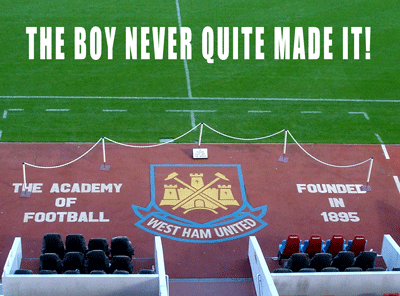 West Ham prides itself as the ‘Academy of Football’ in deference to the success it has achieved over the years in bringing through talented young players from the youth system. Most fans have a special place in their heart for home grown players but so often talented youngsters burst onto the scene only to fail to fulfil their promise. In this series we look at some of those players who despite high hopes never quite made the grade at their boyhood club. Today we look at the career of Zavon Hines; the only West Ham player ever to have a first name starting with the letter ‘Z’.
 Hines had spent a brief spell out on loan at Coventry City before being given his West Ham debut, as a substitute for Valon Behrami, in a League Cup tie against Macclesfield in August 2008. Hines was one of three goal scoring substitutes that day in a 4-1 victory. A knee injury hindered progress during the remainder of the 2008/09 season but despite this he received a call-up from Jamaica for an international friendly in early 2009 although ultimately he did not play. Hines later went on to represent England at U21 level, scoring two goals in two appearances.
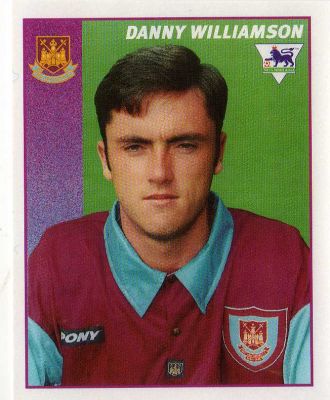 Danny Williamson was the perfect academy star, a keen West Ham supporter who was born in Plaistow and played locally for Newham and Essex boys before committing his future to the Hammers, despite the lure of interest from Arsenal. After signing his first professional contract Danny enjoyed short loan spells at non-league Farnborough Town and third division Doncaster Rovers before getting his first team opportunity at West Ham.
 When I was young (I’m talking about between the ages of around 8 to 11, so over 50 years ago) I used to badger my dad to buy the People newspaper every Sunday. Apart from liking their match reports, they were the only paper (to my limited knowledge at the time) who gave the players ratings out of 10 for the game played the day before. You have to remember that all games were 3pm kick offs on a Saturday at that time, so apart from midweek games, I was able to collate the figures for most of the West Ham games throughout the season. I used to painstakingly write out on a schedule the subjective scores of the reporter at the game, and then as the season progressed I would calculate the averages. In this way I believed I was working out which players were the best. I didn’t keep my schedules, although I can recall that Bobby Moore and Johnny Byrne always figured highly at the time.
 Under The Hammers