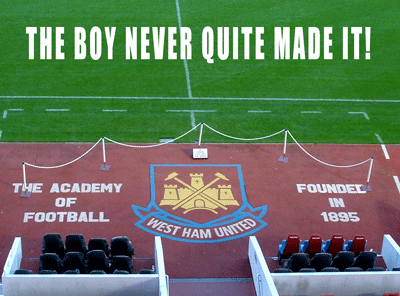
The Boy Never Quite Made It: Johnny Ayris

We had Johnny, Johnny, Johnny, Johnny Ayris on the wing…..

Boy Never Quite Made ItIn the first installment of this occasional series, which looks at players who came through from the youth team (or academy) but never quite made it as first team regulars, we featured Roger Cross whose debut was against Burnley in 1968. A year earlier a certain Trevor Brooking had also made a league debut against Burnley and continuing this theme into 1970 Johnny Ayris made his first team introduction against the same opponents.
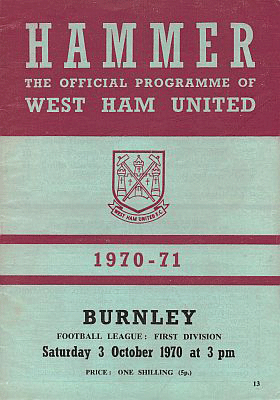
Burnley ProgrammeWapping born Ayris was just 17 at the time and was seen as the next generation marauding winger to follow the fleeting footsteps of John Sissons and Harry Redknapp into the first team. His debut was a successful one providing the crosses (or assists in today’s terminology) for a Geoff Hurst hat-trick in a 3-1 victory. Ayris was used sparingly during the remainder of the 1970/71 season making a further 7 starts including in the infamous 4-0 FA Cup defeat at Blackpool where Moore, Greaves, Clyde Best and Brian Dear had been spotted partying into the early hours the night before the game.

At the commencement of the 1971/72 season Ayris had become a regular starter as the club recovered from a poor start to climb to a respectable mid-table position prior to a home clash against West London rivals Chelsea. The young Ayris started brightly and was giving the Chelsea full-back a torrid time much to the delight of the Chicken Run crowd as West Ham attacked the North Bank end in the first half. The full back in question was notorious 1970’s footballing hardman Ron ‘Chopper’ Harris who eventually decided it was time to let the young winger ‘know he was there’! The tackle itself became part of Upton Park folklore with some accounts describing Harris attempting to launch Ayris into row six of the terracing but my memory is that it was more of a robust bodycheck. Nevertheless, Ayris went right over the top of Harris and landed with a thump on the turf. He was to play no further part in the game, which West Ham won 2-1, and was hurried to hospital to be treated for a serious lung problem.
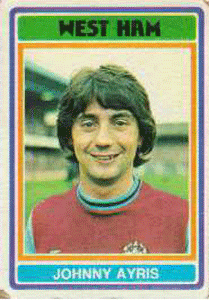
Johnny AyrisThe Harris incident may not directly have ended his career but it had a large part to play. At just 5 feet 5 inches and a slender 9 stone he was utilised selectively in subsequent seasons by manager Ron Greenwood who felt the need to protect the young winger from the more agricultural players who inhabited top flight football at the time. Ayris made a further 33 starts over the next 5 seasons before being given a free transfer to non-league Wimbledon in 1977 and drifted out of the game at just 24 years of age.

In total Johnny Ayris made 50 starts for West Ham and scored 2 goals; the only league goal in a 3-4 away defeat at Manchester City. He had announced his arrival in the team with great excitement but ultimately was not able to make the grade. He had been a regular at England Youth level and possibly his career highlight was winning the 1971 UEFA Youth Tournament including a goal scoring appearance in the 3-0 final win against Portugal. The victorious England lineup that day: Tilsed, Dugdale, Dillon, Parker, Shanks, McGuire, Busby, Ayris, Francis, Eastoe, Daley.

Counting Sheep – 4 – The Vowels

Trouble sleeping on the hottest September day since 1949?

Counting SheepIf you have seen my previous articles you will know that when I’ve had difficulty dropping off to sleep then instead of counting sheep I’ve been picking a West Ham team where all the surnames start with the same letter.
I’ve completed letters B, C and D, but decided that there weren’t enough players whose names begin with any of the individual vowels. So what I’ve done is combined all the vowels to select one team. This gave me enough options to pick a decent enough side.

So here is my all-time West Ham “Vowels” line-up in a 4-3-3 formation:

Adrian
O’Brien
Upson
Oxford
Ogbonna
Allen (P)
Obiang
Ince
Antonio
Allen (C)
Ashton

So who did I leave out? There was Ayew (because I haven’t seen him yet), Arbeloa (who has only just joined but it won’t take too much to oust O’Brien from the number 2 shirt), Almunia, Amalfitano, Armero, Omoyimni, Otalokowski, O’Neill, Ilic, Impey, Orr, Allen (M) – I couldn’t have three Allens in the team, Ilunga, Eustace, Unsworth, Ilan, Emenike, Etherington (who probably came closest to getting in) and Ayris. You’ll see what I’ve done there – I’ve even included Joey O’Brien in the team otherwise I might have had to put Antonio at right back! And I certainly wasn’t going to do that!

I’ve probably overlooked someone really good. Can you pick a team of “Vowels” to rival mine? Would you change my team?

And who would manage the “Vowels” teams? Only one I could think of, the current England manager, Big Sam.

This Week in Hammer’s History

A look back at the week 12 – 18 September in Hammer’s History.

This Week Hammers HistoryToday we dust off the covers of the Under The Hammers almanac and take a sneaky look at the week 12 to 18 September in the Hammer’s history.

If in 1964 you were lucky enough to own a 625 line UHF TV then you may have been one of the 20,000 viewers who tuned in to the new BBC2 football highlights programme, Match of the Day. Week 4 of the show on 12 September 1964 featured the game at Upton Park between West Ham and Tottenham which was hailed by presenter Kenneth Wolstenholme and summariser Wally Barnes as the most exciting game shown to date. A Johnny Byrne hat-trick (he also had a penalty saved) saw the Hammers secure a 3-2 victory with Jimmy Greaves netting two for the opposition.

A video of the second half can be seen below. West Ham were leading 1-0 at the break.

https://www.youtube.com/watch?v=9EiumbtOdj4

Also on 12 September, but over 40 years later in 2005, there was another hat-trick this time for Marlon Harewood as newly promoted West Ham demolished Aston Villa 4-0 in a Yossi Benayoun inspired display in the Monday night match.

Another game that caught my eye was a 3-3 draw with Leicester on 13 September 1975 where, and I hope I am remembering this correctly, we came back from 3-0 down to earn a draw and maintain an unbeaten start to the season. We ended the day in second spot in the old First Division. We were also top of the league in November but ended the season in 18th position.

September also sees the early rounds of the League Cup and a fair share of those potential banana skins. You might think that beating a lower league side over two legs would not be a problem yet we still managed to get knocked out by Northampton Town in 1998 losing the away leg 2-0 on 15 September. A year earlier we had also lost an away leg to Huddersfield but managed to turn that one around in the return game.

This week’s featured game is the European Cup Winner’s Cup First Round First Leg away to Castilla (aka Real Madrid Reserves) at the Santiago Bernabeu Stadium on 17 September 1980. The match is mainly remembered for the crowd trouble inside the stadium with over 50 travelling supporters being evicted from the ground by Spanish police and one fan dying after being hit by a bus outside the ground. There were also counter claims of extreme provocation.

The aftermath saw the crowd scenes described as a 哲ight of Shame・and led to UEFA investigation and predictions that West Ham would be thrown out of the competition. As it tuned out UEFA originally ruled that the return leg would have to played at least 300 km from Upton Park but on appeal revised the decision to have the game played behind closed doors at the Boleyn.

For the game itself, David Cross headed home a Brooking cross to put West Ham a goal up in a game that they were largely controlling. However, Castilla pulled a goal back in the 64th minute and then scored two more before the end to run out 3-1 victors. Prior to this game West Ham had gone six matches without conceding a goal and so it was very disappointing that the last two goals were both the result of poor back passes.

Parkes, Stewart, Lampard, Bonds, Martin, Devonshire (Brush), Morgan (Barnes), Goddard, Cross, Brooking, Pike

Notable Hammer Birthdays this week:

13 September:   Pat Holland (66)
16 September:   Sam Byram (23)
17 September:   Billy Bonds (70)
18 September:   Brian Dear (73)

The Boy Never Quite Made It: Roger Cross.

Firs in a series of Hammer hopefuls that didn’t quite make the grade.

Boy Never Quite Made ItThere is nothing more satisfying as a supporter than seeing a young player come up through the youth system (or academy in modern parlance) and establish himself in the first team. Over the years we have been blessed with golden ages of plenty from our academy but there have also been periods of famine. In the Premier League age it is becoming increasingly rare for youth players to make it through the ranks and academies have become multi-cultural establishments; much different from bygone days when a youngster from Kent would have been considered exotic in our youth setup.

Roger CrossFor every successful youth team product there are many more who simply fade away. Among these there are those who are hotly tipped for stardom but who ultimately do not deliver. We shall be taking a look at some of these ‘Boys Who Never Quite Made It‘.
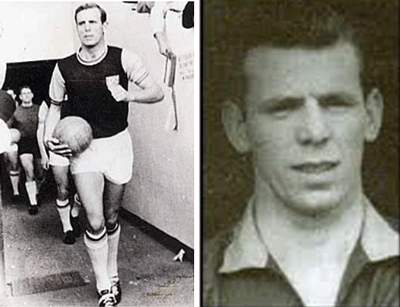
As a young teen in the late 1960’s it was not uncommon to arrive at the game two hours before kick-off on a Saturday afternoon in order to get the favoured view from the North Bank terrace. This allowed plenty of time to read the match programme from cover to cover to discover, not only what the current state of play was in the unofficial London championship, but also what was happening in the Football Combination (reserves) and South East Counties League (youth teams).

For several years running the name of Roger Cross repeatedly appeared in the back of the programme as he rattled in the goals for youths and reserves. He scored when he wanted to even before that idea was born.

Cross was part of the same youth intake as Trevor Brooking (they were born just a few weeks apart in October 1948) and Sir Trev mentions Cross as one of his pals at the club in his autobiography, My Life in Football. Strange to think that I had never heard of Trevor Brooking before his debut but was eagerly awaiting a first sighting of Roger Cross.

Cross made his debut as a substitute (for John Sissons) in August 1968 during a 5-0 home win against Burnley and later that season went out on loan just down the road at Leyton Orient. The start of the 1969/70 season saw Cross get a brief run of games in the first team, scoring his only goal in the 1-1 draw with Arsenal at Upton Park; but that run came to an end by October and he was transferred to Brentford.

His playing career then took him to Fulham, Brentford (again), Seatle Sounders and Millwall before going into coaching with QPR. Cross renewed his association with West Ham in 2001 and held a number of coaching and scouting roles before parting company in 2011 as a cost-cutting measure during the Avram Grant revolution.

West Ham Heroes –Number 1: John Dick

Remembering a legendary inside-forward and 3rd highest West Ham goalscorer.

John Dick PhotosWhen we are growing up most of us have heroes. As a young boy, once I had outgrown the nursery rhyme wallpaper, my walls were adorned with pictures of my first heroes. Photographs of West Ham footballers and pop stars filled my bedroom walls from the late 1950’s throughout the 1960’s. Pride of place was an action photograph of my first West Ham hero, John Dick, in a mid-air tussle for the ball in a game at Upton Park. It was taken by a press photographer who my uncle knew.
West Ham were promoted to the top flight at the end of the 1957-58 season. John Dick, who always wore the number 10 shirt (no names on them in those days), netted 26 times in that season, and scored 29 goals in Division One the following term. It was around this time that I began to take an interest in football and West Ham. I was only four at the time but I have memories, albeit hazy ones, of this period. 

I remember my first visit to Upton Park to see the Malcolm Allison testimonial game in November 1958, the delight when opening my Christmas present of a claret and blue short-sleeved V-neck West Ham shirt with a hand-sewn number 10 on the back on Christmas Day 1958, the excitement of seeing my first league game the same morning (yes Christmas Day 11am kick off!), and the first John Dick goal I recall when he netted a rebound off the Spurs keeper in front of the North Bank that day. We won the game 2-1 as well!

In a West Ham career that started before I was born and ended when I was eight, John Dick was leading scorer most seasons he was with us, scoring 177 goals at a rate of almost exactly one in every other game. His partnership with Vic Keeble for three years at the end of the 1950’s produced abundant goals (Keeble himself scored 51 goals in 84 games before injury curtailed his career).

Ted Fenton, our manager, spotted 22 year-old Dick when he was doing his National Service in Colchester, after watching him play for Crittall Athletic, now known as Braintree Town. He had a lethal left foot and was almost unplayable in the air. He was similar in a way to Andy Carroll, but with the added bonus of being more mobile, a prolific goal scorer, and a player who rarely missed a game through injury. In 1959, John, who was born in Glasgow, also won his first and only cap for Scotland against England.

My favourite game was in November 1959 when he scored a hat trick in a 3-2 win over champions Wolves. I remember the time well – we were top of the league and I went into hospital the following week for removal of my adenoids. The following weekend when I was still in hospital, despite leading Division One, we managed to lose 7-0 at Sheffield Wednesday! That’s West Ham for you.

I cried when we sold him to Brentford at the start of the 1962-63 season. I just couldn’t understand it. He was only 32 and had scored 23 goals the previous season. He was even more prolific at Brentford scoring 45 times in just 72 games.

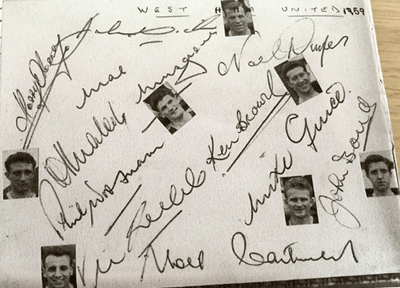
John Dick AutographHis autograph took pride of place at the top of my West Ham 1959 team signatures. So many West Ham legends signed that page for me and I added some miniature pictures cut out of programmes alongside some of them. In addition to John Dick my book was signed by Noel Dwyer, Harry Obeney, Malcolm Musgrove, Andy Malcolm, Phil Woosnam, Ken Brown, Mike Grice, Vic Keeble, John Bond, and Noel Cantwell.

John Dick died in 2000 aged 70. A seat in his memory stands in Hainault Forest near to where he lived and his ashes were scattered nearby. I will always remember my first footballing hero.

The Hammer’s Week in History 1

How has the week 5 – 11 September shaped up in Hammer’s history?

This Week Hammers HistoryThe doldrums of the International Break is the perfect time to look elsewhere for entertainment rather than seeking it from that collection of expensive labourers masquerading as craftsmen in the national team.

The mission that I chose to accept was to travel back in time and forage through the annals of this week in Hammer’s history; here is what I discovered for the period 5-11 September.

The first weeks of September over the years have been characterised by an abundance of goals; before early season exuberance on flat, grassy pitches in late summer sunshine gives way to a cold, muddy mid-winter’s slog with floodlights switched on before half-time.

This week in history has witnessed some heavy home defeats which includes 1-5 and 2-5 reverses to the ‘scallies’ of Liverpool in both 1965 and 1968; had there been Twitter in 1965 it would have been awash with abuse, as less than a week after the 1965 Liverpool game, came a further 2-5 defeat at home to Leicester. Not a great start to the season for a team that would provide 3 world cup winners the following summer.

There have been a fair share of big wins as well though including two which featured rare Bobby Moore goals; home to Wolves in 1964 (5-0) and away to Sunderland in 1967. Other big wins were 6-1 away at Manchester City (1962), a Dave Swindlehurst hat-trick in the 5-2 home hammering of Coventry (1983) and a Frankie Van Der Elst goal in a 5-0 mauling of Birmingham (1982).

Goals galore also in two 7 goal thrillers; one being Sam Allardyce’s first home win against Portsmouth in 2011; and the other the 1998 encounter with Wimbledon, which is this week’s featured match.

The fourth game of the season saw both teams undefeated going in to the midweek encounter at Upton Park. West Ham had beaten Wimbledon twice the previous season and a repeat performance was anticipated by the expectant home support.

The Hammers raced into a 3-0 lead midway through the first half, with goals from John Hartson (7 mins) and Ian Wright (14 and 27 mins) and all seemed to be going to plan despite Marcus Gayle pulling one back for Wimbledon in the 30th minute to make it 3-1 at half time.

The second period was a very different affair. After 64 minutes, a defensive miscue from home debutant Javier Margas (he of the claret and blue hair-do) allowed Jason Euell to reduce the arrears to 3-2 and then Gayle struck again in the 77th minute to bring the scores level. Rather than sit back and admire their handywork Wimbledon kept pushing forward for substitute Efan Ekoku to score the winner in one of the most remarkable come-backs seen in the Premier League.

Hislop, Pearce, Ruddock, Lampard, Margas, Moncur, Sinclair, Berkovic (Impey), Hartson, Wright, Lazaridis

Notable West Ham players born this week (a very defensive week) include:

5 September Malcolm Allison (d. 2010)
7 September John McDowell (65)
7 September Ray Stewart (57)
11 September Slaven Bilic (48)
11 September George Parris (52)

Minnows and Banana Skins

A look back as West Ham battle it out with non-league opposition.

FA CupNever mind the largely predictable World Cup qualifiers, today also sees the arrival of the First Qualification Round of The (Emirates) Football Association Challenge Cup. Still packed with romance for the clubs at the lower end of the football pyramid, dreams of Wembley, or at least a Third Round meeting with a Premier League team, will be at the back of many a non-league player’s mind as they rub in the pre-match White Horse Oil this afternoon. The big question up and down the country is can the ‘minnows’ from Ashby Ivanhoe, Brimscombe & Thrupp or Sporting Bengal United find their way into the bag along with the big boys next January?
Littered in West Ham’s FA Cup history have been numerous ‘potential banana skins’ with sadly far too many of them turning out to be real. The litany of tame surrender to lower league teams includes defeats by Tranmere, Torquay, Newport. Plymouth, Hereford, Wrexham, Grimsby and Mansfield (if you were to include League Cup defeats then you have a list longer than a James Collins clearance!).

To date, however, we have yet to suffer the embarrassment of defeat to a non-league side and here we look back at our unconvincing yet ultimately successful encounters with clubs from outside the top 4 divisions.

FA Cup 1971/ 72 4th Round (Southern League Premier Division v First Division)
9 February 1972 Hereford United 0 v 0 West Ham United
14 February 1972 West Ham United 3 v 1 Hereford United

Hereford were fresh from dispatching First Division Newcastle United in the Third Round. Following a creditable 2-2 draw at St. James Park they won the replay 2-1 in the Herefordshire mud with a spectacular Ronnie Radford goal that still gets shown on FA Cup specials now. I can’t tell you much about the first game at Hereford’s Edgar Street ground other than it ended goalless. Jeff Powell in the Daily Mail wrote: “‘Hereford blew a rich, ripe, agricultural raspberry at West Ham and all the football they represent. Colin Addison’s part-timers reduced West Ham to a rabble, scrambling to prevent Hereford’s historic FA Cup run escalating into the sensation of our time.”

Five days later the teams met again at Upton Park. Due to an industrial dispute involving power workers (or it may have miners) the game kicked off at 2:15 on a Monday afternoon – Hereford’s players having to take a day off work to play. I can remember bunking off school to watch and many others had a similar idea with over 42,000 crammed into the Boleyn Ground that day. The opening exchanges were evenly contested with both sides going close but a Geoff Hurst goal just before half time served to settle the nerves. After the break, Hurst notched two more before Hereford scored a late consolation goal through Billy Meadows. Hereford winger Dudley Tyler later joined West Ham for a then non-league transfer record of £25,000.

West Ham who had played the same eleven in both 1972 games against Hereford went on to lose 4-2 away to Huddersfield Town in the 5th round.

Ferguson, McDowell, Lampard, Bonds, Taylor, Moore, Redknapp, Best, Hurst, Brooking, Robson

Hereford exacted their revenge two seasons later beating us 2-1 at their ground after a 1-1 draw at Upton Park; but by then had been elected to the Football League.

FA Cup 1991/ 92 3rd Round (Football Conference v First Division)
4 January 1992 Farnborough Town 1 v 1 West Ham United
14 January 1992 West Ham United 1 v 0 Farnborough Town

Farnborough Town beat Torquay United in a 2nd Round replay to set up a home tie against West Ham. As Farnborough’s stadium had a capacity of less than 2,500 they agreed to switch the game to Upton Park. West Ham were struggling at the bottom of the First Division (and would ultimately be relegated in last place) and so this was as slippery as banana skin’s came. Farnborough were able to match West Ham in an evenly contested affair with few chances at either end. Just after the hour though Mike Small laid the ball back to Julian Dicks who rifled home right footed from just inside the area. Cue the customary defensive panic as Farnborough strived for an equaliser which eventually came when a goal bound shot was handled on the line by Dicks. Miklosko almost saved the resultant penalty from Dean Coney but the ball squirmed across the line to force a replay.

Miklosko, Breacker, Dicks, Gale, Potts (Morley), Thomas, Bishop, McAvennie, Small, Keen, Slater

With home advantage (!) for the replay and Kenny Brown drafted into the midfield West Ham were far more dominant in the second game. Apart from some early Farnborough chances it was mainly West Ham pressure with corner after corner but with few clear cut goalscoring opportunities. With the game looking to drift into extra time the Farnborough keeper flapped at yet another cross only for the ball to cannon of a defender and set up a simple chance for Trevor Morley to net the winner; to the palpable relief of the Upton Park crowd.

Miklosko, Breacker, Dicks, Gale, Foster, Thomas, Bishop, McAvennie, Brown, Morley, Slater

After seeing off 4th Division Wrexham, following a replay in the next round, the Hammers went out as 5th round losers to 2nd Division Sunderland – the eventual losing finalists.

Counting Sheep – 2 – The Letter C

Difficulty Sleeping These Warm Nights?

Counting SheepPreviously I advised ditching counting sheep theories if you can’t get to sleep, and selecting a West Ham team of players that you have seen whose surnames all start with the same letter.

My first team was the “B”s. Today I’ll pick my “C” team. To fit in all of the players I wanted to select I ended up with a 3-3- 4 formation, hence an attacking team with lots of goalscoring options.

So here is my all-time West Ham “C” Team:

Carroll (R)
Cantwell
Collins
Cresswell
Carrick
Cole (J)
Curbishley
Cole (C)
Carroll (A)
Cottee
Cross

And what other players did I consider but leave out? I couldn’t think of any other keepers, but in defence I omitted three different “Charles”, John, Clive, and Gary, Cushley and Coleman. Midfielders I left out included Cohen, Cullen, Courtois and Collison, and strikers were Roger Cross, Chadwick, Chapman, Carew, Connolly and Coker.

Have I overlooked someone I should have obviously included? Can you pick a team of “C”s to rival mine? Do you like my team or would you change it?

And who would manage the “C”s? We’ve only had one that I can recall – Curbishley (and he made my team, too).

The Names They Are a-Changin’

A look at the top 10 all-time most popular forenames for West Ham players.

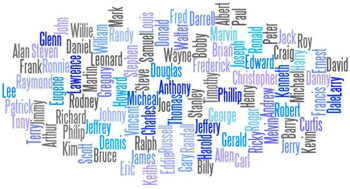
NamesWest Ham famously won the FA Cup in 1964, and again in 1975, with a team full of Englishmen. The 1975 team being the last all English winners of the cup. By 1980 the rot had set in with the inclusion of a single Scot in the form of Ray ‘Tonka’ Stewart.

The lineup back in those days would be full of what Al Murray (the Pub Landlord) would describe as beautiful British names. The team would be populated by players with old fashioned names such as Jim, John, Jack, Eddie, Bobby, Billy, Alan, Ken and Trevor. Scan down any West Ham team-sheet this season and you will find the likes of Adrian, Dimitri, Manuel, Cheikhou, Pedro, Gokhan, Enner, Diafra, Havard and Sofiane.

As an aside, I can remember Ron Greenwood trying to sign Israeli international Mordecai Spiegler after the 1970 World Cup (and I actually witnessed him in a West Ham shirt in a pre-season friendly against the Orient) but numerous obstacles surrounding international clearance and work permits prevented the deal going through. In different circumstances there could have been an Israeli in the 1975 cup winning team.

The foreign player is now a fixture of Premier League football and arguably the most skillful, entertaining and creative players are all from overseas. English players accounted for just 31% of Premier League starts during 2015/16 while West Ham were just above average with 36% (or 42% if you count British and Irish players). With James Tomkins having left the club, Aaron Cresswell injured and (as yet) no home grown recruits no the English contingent will no doubt show a downward trend this time around.

At least one of our new signings comes with a traditional name that would meet the Pub Landlord’s approval and that is Arthur Masuaku. It is perhaps surprising that only 12 Arthurs have ever played for West Ham (including Thames Ironworks) and that Masuaku is only the second ever post war Arthur. I know this piece of useful information because in an idle hour during the summer I crunched the data to discover what were the most common West Ham forenames.

The winner by some distance was William (including Bill and Billy) with 67 occurrences. There was stiffer competition for the runner-up spot where John (42) just pipped James (41) and George (40).

The complete Top 10 is:

  1. William (67)
  2. John (42)
  3. James (41)
  4. George (40)
  5. Tom (31)
  6. Robert (26)
  7. David (23)
  8. Harry (21)
  9. Frank (20)
  10. Fred (19)