Careful What You Wish For: Is This David Sullivan’s Self-Fulfilling Prophecy

Another desperate week sees West Ham pluck defeat from the jaws of victory at Brighton while the head coach goes berserk in his post-match press conference. It’s now seven games without a win for Potter!

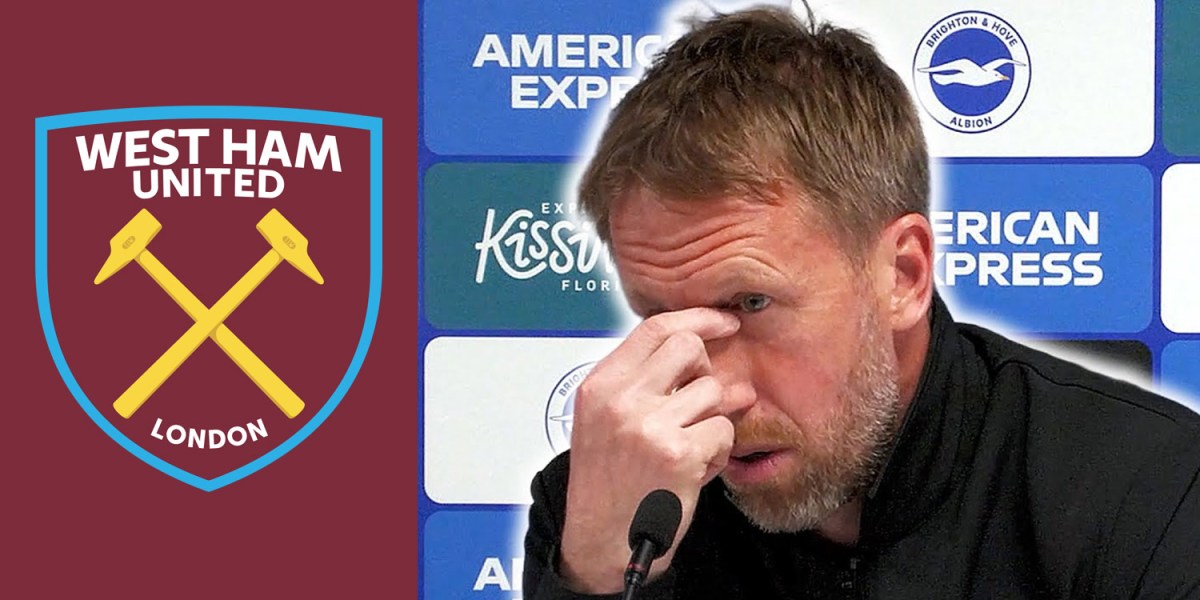
And so here we are again. Another game featuring questionable team selection, a shocking first half performance, improvement after the break, baffling substitutions and the sucker punch of a late goal. Topped off this week by our head coach – a student of psychology and emotional intelligence – melting as quickly as a slice of American cheese during his post-match press conference.

Pre-match expectations are increasingly managed these days by the announcement of the teams 75 minutes before kick-off. I had fully expected Graham Potter to fall back on a 3/ 5-man defence for this much anticipated return to Brighton. After all the 4-1 defeat he suffered as Chelsea manager must still have hurt and there was no way he was going to let that happen again.

Having complained that Niclas Fullkrug’s outburst after of the Southampton game had been unhelpful, and that such frank exchanges were best aired in private, Potter made a very public statement by relegating the German to the bench. No amount of denials or flannel about managing the striker’s fitness can disguise the obvious truth, Graham. Will he now drop himself for next week’s match following his own red-faced rant?

Fullkrug’s omission meant it was a switch back to a 3-5-2 formation of sorts, with Jarrod Bowen and Mohammed Kudus taking up narrow forward positions in front of a midfield three of Lucas Paqueta, Tomas Soucek and James Ward-Sideways. The bonus was the return of Aaron Wan-Bissaka to resume his one-man campaign for the Hammer of the Year award.

As ever, the fly in the ointment of the Potter machine are the struggles in midfield. Again constrained by a combination of individual limitations of the players involved and the role asked of them to maintain possession purely for the sake of it. The dilemma (or should that be dullema) is that having played out reluctantly and uncomfortably from the back to beat a high press, the midfield faffs around with the ball for so long that opponents have ample opportunity to retreat and set a second press. The result: no creativity, forward momentum and few scoring opportunities. Like Lopetegui before him, Potter has prioritised a system over the player’s ability to deliver it.

Does that mean we will see improvements once the coach has assembled a squad in his own image? Possibly yes, but how many windows and how many seasons is it going to take to assemble a team capable of competing at the right end of the table? It is a luxury and timescale that is rarely available to Premier League managers in an environment where revenues generated from league position and European competition are crucial to releasing the funds required for effective squad building. A case of forever chasing ones tail.

The high point of an otherwise drab first half at the Amex Stadium was a fine strike by Ayari for Brighton’s opener. As good a goal as it was, it owed much to the Hammer’s failure to put him under pressure. When he received the ball, there were eight West Ham outfield players inside the box but none withing 15 yards of the ball. A token Paqueta challenge was the best on offer.

 Half time saw Fullkrug replace JWP allowing Bowen and Kudus to take wider positions in a 3-4-3. Whether it was the formation and personnel changes or whether it’s just that the team are prepared to try harder after the break is anyone’s guess. The shape certainly looked better. While the performance never convinced consistently, West Ham did contrive to take the lead through goals from Kudus and Soucek. Both courtesy of Bowen assists underlining how more effective he is from wide positions.   

The euphoria was short lived however as two Brighton goals in the closing minutes not only denied the visitors a rare victory but left them empty handed once again. Was it a recurrence of the mentality problem? Were the players astonished – just like the week before – at the weirdness of the late substitution? The increasingly slow Vladimir Coufal brought on to play on his wrong side to fix a problem that didn’t exist. Was the real reason for Potter’s post-match meltdown a case of embarrassment for this managerial masterstroke?

There has been a Pavlovian response this season to blame Dinos Mavropanos for any goal conceded by West Ham – just as Thilo Kehrer was designated scapegoat in the past. I find the Greek not guilty on all charges this week and would go further to suggest that Max Kilman has increasingly developed into the greater worry. But due to negligence rather than obvious gaffes. He may be adept at winning aerial duels when they are directed straight at him, but he rarely attacks the ball or puts his body on the line – in the style of Craig Dawson or James Collins. It’s no surprise that such a casual approach is never a threat in the opposition box at set pieces. We should rightly expect more from a £40m defender who supposedly came with leadership qualities. Oh well, he’s only here for another six years.

The Brighton equaliser was the result of leaving a man completely unmarked at the far post and then allowing Mitoma to nip in unmarked to head home. Leaving Coufal and Kilman looking at each other in bemusement. The winner was another great strike by Baleba who again was given oceans of room to pick his spot as every West Ham player looked on admiringly from in and around their own box.

It’s 14 games now under Potter’s command. That’s no win in seven, and a grand total of 13 points earned and 14 goals scored. It’s long enough to have taken a good look behind the curtain; to get past the bluster, puff and hot air and discover this Potter is no wizard when it comes to coaching football. It’s a long way back from here. The question that has to be asked is whether the broken man seen in the post-match interview has what it takes to front up the challenge.

The consensus is that Potter will be (and should be) given the opportunity to preside over a summer pre-season and transfer window in an attempt to re-model the squad. Estimates vary on how much money is available to do this and who might need to be sacrificed to fill the coffers first. After that his future will be down to results. How ironic to find the club back in the self-same position as the previous summer. Needing to identify, negotiate, recruit and integrate a significant number of new faces – and all the problems that comes with this for a slow-burn manager needing a good start to the season.

If I was the type of person inclined towards conspiracy theories, I might suggest that all of the mayhem surrounding West Ham’s season was a dastardly act of vengeance by the West Ham chairman. In his eyes, his genius had saved the club from oblivion, provided a world class stadium, with a world class team that had delivered a European trophy. Yet the ungrateful supporters demanded entertainment in addition to the opportunity to buy merchandise, subscribe to membership schemes, and enjoy an open-top bus parade. What better way to teach them a lesson and get rid of the unwanted Technical Director (who had been foisted on him by that Czech geezer) than hiring a duff manager of two. That’ll learn them to be careful what they wish for. And show them the Chairman knows best.

I really don’t care about Sullivan’s private life, his choice of hats, or how he earned his (considerable) fortune. But I do care about how is holding back the club at a time of increasing change. Left alone, the club will fall further and further behind. As I have written before, its not that the board hasn’t invested in players – even if they will only ever consider recruiting out of work managers. The problem is that West Ham is run as the owners’ plaything. For prestige and to massage their egos. A glitzy, razmataz, exotic signing will get them moist while the hard work of data analysis, scouting and developing players leaves them cold. Does any other aspiring top club have an enthusiastic but amateur Chairman working in the role of Director of Football. No wonder its a shambles.

Modern day West Ham has abandoned its history and community roots except when it suits for PR purposes. It has no discernible identity and lacks even a half decent strategy for competing against the much richer clubs which dominate the football elite. While the owners will be desperate to preserve Premier League status – and hence the club’s asset value – there lies the limit of their ambitions. Unfortunately, current trajectory will see the Hammers among the favourites for the drop next season. We won’t always be able to rely on all three promoted clubs being rubbish. Sort it out. COYI!    

Graham Potter is currently facing challenges. Can he find the solutions to improve the situation?

Is he experiencing major difficulties, or are there minor issues that need addressing? Did he misjudge the size of the task? Is he up to it? The outcome remains uncertain.

Geoff reviewed our home draw against Southampton earlier this week, a game against a team that was relegated with seven games of the season remaining. I only saw the highlights. We became just the fourth team to fail to beat them on their travels this season after their win at Ipswich and draws at Fulham and Brighton, our opponents this Saturday.

Brighton sits in mid-table (10th) on 48 points and is one of five clubs who will finish between eighth and twelfth. Bournemouth (8th) has 49 points, Fulham and Brighton have 48, Brentford 46, and Palace 45.

The Premier League this season is separated into five distinct groups. The top pair comprises Liverpool and Arsenal. The next group of five (the “nearly teams”) are separated by just four points; Manchester City with 61, Forest 60, Newcastle 59, Chelsea, and Villa both 57.

Well behind the mid-table group are the “real disappointments,” consisting of Everton, Manchester United, Wolves all with 38 points, Tottenham with 37, and ourselves with 36. The three teams promoted last season have not performed well and are on their way back down.

A table I saw recently shows the points tally of each club in the Premier League compared to this stage last season. Everton has the same points as last time, while seven teams are worse off: Wolves (-5), Villa (-6), Arsenal (-8), West Ham (-12), Manchester United (-15), Manchester City (-18), and Tottenham (-23). We are 12 points below where we were at this stage last season, although we finished in the top half (9th). Forest is at the top of this particular table being 28 points better off.

I’ve just been reviewing Graham Potter’s media conference in advance of our trip to Brighton this Saturday. He began with the injury situation confirming Alvarez will still be sidelined with a back injury while Wan-Bissaka should be back. That’s good news.

He said he “understands the fans’ frustrations” at recent results: “We’re not playing how we want to play but to look at the bigger picture, it’s not so straightforward to change things. You have to accept things and be up for the challenge. I want to support the players, who have been brilliant, and we’ll fight together.” So the players have been brilliant eh?

He emphasised that in the games before he arrived (for the last two seasons he probably meant) the team conceded a lot of goals. His inference here was that they have now tightened up at the back and have been competitive. But not successful it seems.

When asked about our habit of conceding late goals, Potter said: “It’s a number of factors. It’s very complicated. When we came in, we were conceding early goals, and now it’s late goals, but it’s very tough for very different reasons.” What kind of answer was that!

Potter was also asked about Fullkrug’s comments afterlast weekend’s draw: “Sometimes you have to understand that after a game, everyone’s emotional. It should be that way, but when you’re a leader you have to accept the emotion and put things in perspective. Niclas wears his heart on his sleeve and he’s entitled to his opinion. For me, it’s better to have conversations in private. You have to be able to be honest and to think about the team as well.” I think he was saying (in a roundabout way) that he wasn’t too pleased!

These pre-match media conferences often feature responses that may seem bland.

I do wish Potter success and a productive transfer window. He has faced challenges since arriving at London Stadium, but it remains to be seen how his tenure will progress.

Saints Preserve Us: The West Ham Masterclass On Game Mismanagement

There’s no looking on the brighter side of life as West Ham struggle to a point against one of the Premier League’s worst ever teams. Is it the manager or players who are to blame?

Yet another dreary afternoon in West Ham’s dismal season received a belated brush of colour by the post-match comments from Niclas Fullkrug. His honesty and passion are to be admired; and the mentality of the players may well be contributing to the recent trend of conceding late goals and dropped points. However, it does not tell the whole story of why performances have been so poor, and why the club appears to be a downward spiral to disaster.

The context of Saturday’s game is that West Ham put in a dreadful first half performance against one of the statistically worst sides ever to take part in a Premier League campaign. Once again, the Hammers were fortunate – or thankful for poor finishing – not to be a goal or two down at the half time whistle.

For a brief period, Jarrod Bowen’s well taken goal early in the second period looked like it might spark further goals and a repeat of the collapse the Saints experienced a week earlier against Aston Villa. But the threatened deluge never materialised and allowed the visitors to deservedly claw their way back into the game and claim their sixth away point of the season.

The essence of Fullkrug’s anger was that the players (or at least some of them) had ignored Graham Potter’s instructions by dropping deep rather than continuing to push forward for more goals. If that was the coach’s intent, then his sequence of strange substitutions had the entirely opposite effect. He may not have planned for his team to defend with seven across the back, but it was the unintended consequence of removing each of his realistic goal threats from the pitch.

We could perhaps offer Potter a degree of understanding – given that he had inherited such a ramshackle squad – were it not for his prior admission that his priority was sorting out the defence; and the fact that possession for the sake of it, and a reluctance to shoot, were very much central to the teams he has previously managed. If he can prove he has learned from those experiences all well and good but simply repeating them at West Ham will never end well.

The starting lineup for the game looked reasonably promising and attack minded. The notable absences being Aaron Wan-Bissaka through injury and Edson Alvarez who was dropped from the matchday squad without explanation. No doubt having fallen out with the manager due to either lack of game time or being asked to play out of position to accommodate others.

Any hopes of an attacking masterclass against the league’s leakiest defence, however, did not materialise. With JWP and Carlos Soler competing for the crown of the most pointless passes in a single match, momentum was quickly lost whenever West Ham gained possession. It was a Green Cross Code style of midfield play – Think, Stop, Look, Listen, Wait. If the coast is clear, pass it sideways.

At this time of year, we are always encouraged to look on the brighter side of life. To this end, the coach will happily pat himself on the back with the boast that his team have been competitive in every match, and supporters can take comfort that there are only five more games to endure. Just 13 points and 13 goals in 13 games is a funny kind of competitive though. As Niclas might have said “we’re a piece of sh*t when you look at it.”  

Personally, I see at Potter’s style as part of the general malaise that is smothering entertainment in English football. Keeping possession and playing out from the back are just two useful tactics that have been developed into entire football philosophies where discipline and shape are preached at the expense of improvisation and flair. So many managers and coaches are fixated on the genius of their intricate systems for control and build up – like a game of 4-dimensional Mousetrap – while disenchanted supporters delight in fast, aggressive, forceful football.

Success may be able to paper over those cracks for a while – as we know from the Europa Conference victory- but will ultimately fail to satisfy the legacy fans who have a deep emotional connection to their club, as opposed to followers who look out for results and are happy to consume online content. Whoever said “football is a results business” is missing an enormous part of its true appeal. It’s not that results (or trophies) are unimportant – of course, they are – but they are not the be all and end all. It’s why so many had had enough of David Moyes.

With nothing of interest happening on the pitch, attention has inevitably turned to the summer transfer window. An endeavour which may or may not involve a massive overhaul of the squad. Reading from the more detailed analyses of West Ham’s finances – rather than the more hysterical headlines – the club does not have an immediate PSR problem. However, two seasons of poor performances in league and cups (and no European competition) will have stored up issues for future years reporting. The summer will likely see both comings and goings but that is true of all clubs in the current financial environment. The trick is in developing players and selling on at a profit – one of the many failings in West Ham recruitment policy over the years. Isn’t it the case that Declan Rice is the only player the club have sold for more than £25 million?

There are a good number in the squad I’d happily see depart and only a handful I’d be disappointed to lose. I doubt we have the capacity to shift all the deadwood in one go or can avoid sacrificing one or more of the better players.  We can only sit back and see what Potter and Kyle Macaulay have up their sleeves. I hope the plan is far more cunning than just going back to the clubs they used to work at or signing duds from relegated clubs. Based on current direction of travel, a big turnaround is necessary if the Hammers are to avoid a genuine relegation battle next season.

Ultimately, West Ham’s woes stem from a lack of leadership in the Boardroom. Since the Gold and Sullivan takeover the club has been treated as a vanity project by the owners. It’s not fair to say they haven’t invested but the overriding motivation has been glitz, glamour and self-promotion. The hard work required to establish a strategic football philosophy, based on continuity and succession planning has been repeatedly ignored. Happy to stumble along from year to year as long as the asset value is not threatened by the loss of Premier League status. The involvement of Daniel Kretinsky has had little effect on constraining David Sullivan’s erratic running of the club – I guess West Ham is little more than another minor investment for the Czech sphinx.

The apparent scrapping of the Director of Football role is another backward step which reinforces Sullivan’s continued meddling in football matters that he doesn’t understand. It may only be speculation, but my sense is that he did whatever he could to undermine Tim Stediten’s role. Both by appointing a manger against his wishes and then not giving him full control over transfers – I’m fairly confident that none of Max Kilman, Guido Rodriguez or Carlos Soler were the German’s choices. With Sullivan now restored to the position of de facto DoF he can confidently repeat all the mistakes and missteps of the past 15 years.

In hindsight, West Ham should have stuck with Julen Lopetegui for the remainder of the season. Uninspiring as his tenure was, performances haven’t improved since his departure while results and league position have become worse. It would have saved on compensation and allowed a thorough recruitment process for a new head coach to take place during the summer when more options than the Chief Executive’s husband’s mate would be available.

I do wish Potter the best of luck and a fruitful transfer window, but he has made a dreadful start to his London Stadium career. The breath of fresh air that heralded his arrival has now been replaced by a man who never looks convinced himself by what he is saying. He will do well to survive to the end of next season. COYI!

Remembering 50 years ago when West Ham won the FA Cup

(Prior to facing rock bottom Southampton this weekend we take a trip down memory lane with a nostalgic look back at the 1974-75 season)

After a 4-0 opening day defeat at Manchester City to begin the 1974-75 season West Ham only won one game in the first seven matches and were bottom of the league. This led to a managerial change and long-standing coach and former player John Lyall became the team manager under the guidance of Ron Greenwood.

A big change at Upton Park at a time when Britain was in the midst of a double-dip recession and change was present everywhere. At the time colour TVs had only been here for a few years enabling us to watch the three channels available, BBC1, BBC2, and ITV. A new 22-inch colour TV cost £259 (inflation adjusted to the present this is approaching £2000!), and we could watch a brand new comedy series (Fawlty Towers), but the internet, mobile phones, (even the Premier League!) and many other aspects of modern life as we know it now were still some years away. Petrol costs at the time had risen rapidly and had now reached around 17p per litre, although it was still sold in gallons at the time, and we could buy a brand new Ford Cortina for £1,765. A pint of beer set us back around 28p, a newspaper around 5p, and the average house price was around £12,000.

But, back to football, and we needed changes on the pitch if we were to progress after the dismal start. Billy Jennings and Keith Robson were bought and this had an immediate effect when they were teamed up with Bobby Gould in a front three which was immediately successful when all three scored (Jennings and Robson were on their debuts) when Leicester City were thrashed 6-2, Birmingham 3-0 and Burnley 5-3. Our new recruits had scored nine goals between them in their first three games together.

Five wins in September and October were followed with an unbeaten run of nine games from the beginning of November until Boxing Day as we rose to fifth in the First Division. That was the highest placing we managed in the season as we then began what was traditionally known as West Ham coming down with the Christmas lights as we gradually descended the table to finish thirteenth.

Looking back at the season we can see how things have changed in the last fifty years. The 22 team first division saw Derby County crowned as champions for the second time in four years (ironically they too only recorded one win in their first seven games), and teams such as Ipswich, Stoke, Sheffield United, Middlesbrough, Leeds, Burnley and QPR all finished in the top half. Newcastle, Arsenal and Tottenham (like ourselves) all finished in the bottom half and Chelsea were relegated alongside bottom club Carlisle. Just look at the league tables to see where Carlisle are now! (second from bottom of league 2 and likely to be relegated from the football league). Manchester United were a second division team, as were this weekend’s opponents Southampton who finished 13th.

We did face Southampton that season though in the third round of the FA Cup at the start of a memorable cup run. Gould and Lampard scored our goals in a 2-1 victory at the Dell. In Round 4 we were drawn against third division Swindon Town but we could only draw 1-1 at home (Jennings) before winning the replay away 2-1 (Brooking, Holland). And 2-1 was once again the score when we defeated QPR at Upton Park with goals from Holland and Robson to earn a quarter-final tie at Highbury.

There had been a surprise signing just before Christmas that season when a young Alan Taylor was signed for £45,000 from fourth division Rochdale. He had only four substitute appearances before he was chosen to start at Arsenal and he scored twice as we once again scored two goals to win the game 2-0.

We were now in the semi-final and having seen all the games up to this point I remember travelling with Geoff to Villa Park on April 5th to witness one of the most drab games of football we had ever witnessed as both ourselves and Ipswich played out a 0-0 bore draw. The replay was at Stamford Bridge the following Wednesday when in snowy conditions we were outplayed by high flying Ipswich but somehow once again won the game 2-1 with Alan Taylor scoring twice again. Ipswich were a top team at the time finishing third that season just two points behind champions Derby.

Fifty years ago this Saturday (19th April) I had to miss the home league game against Coventry City as I was getting married on the day. We lost the game 2-1, the eighth game in a run of nine league games where we had failed to win. A honeymoon in Majorca was kept to one week to enable me to be back for the final on May 3rd where for the sixth round of cup football in a row we once again scored two goals in a 2-0 win against second division Fulham who had Bobby Moore and Alan Mullery in their side. Alan Taylor made history scoring two goals that day to follow his two goals in the quarter- final and semi-final.

This Saturday we face already relegated Southampton who are rock bottom with 10 points and looking to pick up more to avoid the unenviable record of being the worst team in Premier League history. Our league position is not much better than theirs – following our late 2-1 defeat to Liverpool last weekend we have slipped to 17th, immediately above, and thankful for, the three teams who are so far below us. (See Geoff’s article reviewing the game). I agree with most of his excellent review but personally I wouldn’t want Alvarez replacing JWP. We are, however, just three points below Everton in thirteenth, so a successful run in our final six games of the season could possibly elevate us into 13th, the exact position we occupied 50 years ago.  

But this time around we don’t have a Cup Final to look forward to, and I suspect most of us as West Ham fans are just looking forward to the end of this poor season, the summer transfer window, a clearout, some new faces, and with renewed hope for a better campaign starting in August.

Anfield Retrospective: West Ham Reprise Role of Gallant Losers in Attempt to Derail Liverpool Title March

The two best known anthems in English football sing about the fragility of dreams. Once more it is the dreams that are tossed and blown that triumph over those which fade and die

Looking back at Sunday’s game Liverpool in isolation left the impression of a decent performance where West Ham were maybe unfortunate not to come away with a share of the spoils. Whether, as some suggest, it represented the green shoots of improvement for the Graham Potter era is far less certain. The reality remains that league position, points per game, and goals scored have all deteriorated since the new manager’s appointment. The Hammers are now statistically the worst side in the league outside of the woeful bottom three. Such a decline is a huge disappointment for any coach, no matter what position was inherited at outset.   

The match itself was less the game of two halves that has become the Hammer’s signature for much of the season, and more a game of four quarters. An opening quarter of total domination by the hosts, a period of relative stability where the visitors might easily have equalised and culminating with a final two quarters where, for long periods, the visitors looked much the better team. To bring the scores level only to quickly concede shortly afterwards was so West Ham. Adopting the role of gallant losers that is as much part of the club’s DNA as blowing bubbles.

If you watched the game on TV, you would have been exposed to a stream of nauseating Salah-vation during the match commentary in celebration of Mo’s contract extension. A situation that only got worse when his ‘goal-involvement’ cross was stroked home by Diaz after 18 minutes.

It was an afternoon to forget for Ollie Scarles who was given a torrid time by Salah. At times his defending was both naïve and weak, and his confidence shot to the point where it looked like he might burst out into tears. Hopefully, just a part of the learning curve although he has been unconvincing defensively in seeral of his recent games. A game or two out of the spotlight might help.

It did not come as a surprise to see Potter reverting to a back three when the teams were announced. It is a formation that is easier to justify away at Anfield than at home to Crystal Palace or Leicester. The drawback is that it doesn’t allow Jarrod Bowen, Mohammed Kudus, and Niclas Fullkrug to fit into the system or shape at the same time. Following the positive impacts made by Fullkrug’s introduction in previous games it was extremely disappointing not to see him feature on the pitch until the 78th minute.

Elsewhere, I would have preferred Edson Alvarez to have started in place of JWP but was relieved to see Tomas Soucek left on the bench. Until there is a rule change that allows players to come on just for set pieces, I don’t see what role the slumbering Czech can play in any side with an ambition to hold on to possession.  

The pairing of Lucas Paqueta and Carlos Soler in the attacking midfield areas provided more creative spark and interplay than we have been used to in recent times. Both may have contributed their best football of season, especially during the second half when they were instrumental in the Hammers running the show. I wonder how many Paqueta Islanders had put a wager on the Brazilian knocking over the referee.   

Paqueta did rather blot his copy book, however, with his role in the lead up to the Liverpool winner. There are certain areas of the pitch where looking to buy a foul is way too risky if there are no takers. His reputation for going down too easily and theatrically does him no favours at all. Of course, it is almost impossible these days to be certain what is and isn’t a foul. Without an insider understanding of the permitted force of a shove in the back; or how long you can rightfully hold on to an opponent’s shirt without being penalised we can only bow to the officials’ superior knowledge. Heads there was contact, he had a right to go down; tails, it was minimal contact, he went down too easily.

The dilemma was perfectly illustrated when Van Dyke headed the Liverpool winner. As the co-commentator euphemistically described it: “the nudge by Van Dyke moving Fullkrug out of the way”. Must be a little like pinball where a ‘nudge’ is allowed but a tilt is game over.

Whatever the likley outcome of the match, Liverpool will eventually be the 2024/25 Premier League champions. The home win simply brings forward the date on which it will be confirmed. It is difficult to argue that it is not deserved and a major achievement in Slot’s first season.

Thankfully, from a West Ham perspective there are only another six games to endure before the curtain comes down on one of the dullest campaigns in living memory. With a lowly league finish, no cup runs or European football, the Hammers have taken a massive step backwards compared to the clubs we mighty have imagined to be our financial equals outside the rich six – notably Newcastle and Aston Villa. It will be goodbye to a place in the list of the world’s top twenty richest football clubs when the results are announced next year.

All hopes must now be pinned on a successful summer of recruitment, apparently spearheaded by Potter and Kyle Macaulay but unlikely to be free of interference from the self-styled Director of Football in the boardroom, David Sullivan. Our best hope is that their decision making improves significantly from the one that lumbered the club with a loan deal for an unfit (and arguably unmotivated) Evan Ferguson. Even from a distance it looked like a really stupid move that was never going to benefit West Ham.

A lot of work is required to assemble a functioning squad from the spare parts that are currently in place. All the more difficult is a club that lacks any clear strategy on its recruitment aims. It is fanciful to believe the Potter/ Macaulay partnership were instrumental in Brighton’s successful and money-spinning transfer dealings, but perhaps they learned something from the experience. The worst of all worlds is that recruitment activity again focuses solely on existing short-term firefighting issues in the squad at the expense of building for the future. Past performance does not instil a great deal of confidence.

It got to the point on Sunday where I was relived to hear that Chelsea had equalised against Ipswich. And I am not overly confident that we will not allow Southampton to overhaul Derby’s lowest ever Premier League points total this weekend either. How on earth did we get here? COYI!

West Ham face a week of the two extremes. Liverpool away (the top) and Southampton home (the bottom).

And a few thoughts on the evolution of football since the 1960s.

In our next two games we go from one extreme to the other. On Sunday we visit champions elect Liverpool for what is traditionally our annual Premier League beating on Merseyside. I hate sounding defeatist, I’d love to believe otherwise but it is hard to think that we are going to go up there and surprise them. I know that they lost at Fulham last week but sadly the Cottagers were a much tougher proposition than facing West Ham at the moment, and you cannot believe that with our current form the three points, or even one, are there for the taking.

Then the following Saturday we go to the following extreme when entertaining (?) Southampton at the London Stadium. Surely, even in our current transitional mode three points is a certainty? Well I say that but 67 years of following the Hammers tells me otherwise. No guarantees of a win even against one of the poorest sides that the Premier League has seen.

Geoff’s article following the Bournemouth draw last Saturday says all I would want to say regarding the current state of affairs. I couldn’t add to that. Instead as I sat down to write this article my mind wandered and I got to thinking about the evolution of football in my time watching the game. I read an article about somebody from the 1960s coming back to life in the present day and the changes that they would encounter such as mobile phones, colour TV, internet and so much more, and thought about applying it to football.

When football fans reach a certain age, and I guess I have reached it, it is common to complain about how football has changed. “The beautiful game”, “a funny old game” or whatever you want to call it has undergone significant transformations over the decades since I first watched a game at Upton Park way back in 1958. As a youngster I thought it was a simple game, but it has evolved dramatically, especially in the 21st century. Football when I first knew it and football today are worlds apart in many ways, reflecting changes in tactics, technology, culture and the global nature of the game.

The football I remember from my youth was direct and more physical. The emphasis seemed to be on long balls and robust challenges. Teams at that time set up in a 2-3-5 formation, the players were numbered one to eleven, with each number relating to a specific position, 9 was centre forward, 11 outside left, 5 centre half etc. Players wore black boots, the kick-off had to travel forward, goal kicks had to clear the penalty area, almost all games kicked off at 3.00 on a Saturday or midweek games at 7.30 on a Wednesday. The referee didn’t draw any lines on the pitch to indicate ten yards, and players could back pass to a goalkeeper who could then pick it up.

Now boots are multi-coloured, the kick off always travels backwards, goal kicks can be small touches aimed at ball retention and building from the back. Referees now draw lines to indicate ten yards for free kicks in attacking areas but their accuracy at marking out the distance is sometimes questionable. Balls deliberately passed back to the keeper require modern keepers to demonstrate ball-playing skills that their predecessors didn’t have to. Some are better than others in this respect.

Years ago I don’t remember the term false nine at the time, or a number 41 playing as an eight or a 16 as a ten. I do remember Ron Greenwood studying continental football and introducing 4-2-4 to West Ham. Today, modern football is highly tactical, with variations in formation allowing for fluid transitions. There’s a greater focus on possession, pressing, and data-driven strategies.

In the 1960s training was less scientific, and fitness levels were varied. Some players had second jobs, Geoff Hurst for example played cricket for Essex in the summer alongside his main job as West Ham’s number 10. There was little focus on nutrition. Today footballers are generally elite athletes with access to advanced training methods, sports science and tailored diets.

Back in the day there was no VAR, no goal-line technology, no advanced analysis. Referees made decisions, often leading to controversy. Today technology plays a huge role from the tracking of player and team performance to VAR. And we still get controversy, VAR may have improved fairness (usually?) but at a cost where the natural flow of the game is disrupted. And we are also bombarded with statistics that may or may not be of interest too.

Back in the 1960s, time wasting was prevalent but less scrutinised than today. Goalkeepers could bounce the ball for some time before releasing it, players could pass back to them and they could pick it up and waste more time. In theory the modern game has introduced stricter enforcement against time wasting, with sometimes many minutes added to compensate for delays. However, despite these measures problems still persist. Substitutions in the final minutes or in added time remain tactics to disrupt the rhythm of the game.

And talking of substitutes they didn’t exist when I first watched the game. Players were known to return to the pitch with broken bones (even a broken neck in one famous instance) so that they had eleven on the field. Gradually that changed with one substitute allowed (for injury) and has gradually expanded so that now five are allowed with further additions for games with extra time or concussion injuries. How long before it becomes like rugby or American Football with “finishers” or “specialist teams”?

Social media did not exist in the 1960s whereas players today can be global influencers. Stadium safety has dramatically improved as a result of tragedies such as Hillsborough, Bradford etc which highlighted the need for stricter regulations. Modern stadiums are designed with advanced safety measures, including all seater stadiums and in theory better crowd control. However many still stand, especially behind the goals. But it is definitely safer.

Back in the sixties there was little football on TV – the cup final, England internationals and tournaments like the 1966 World Cup. Now of course, TV football is extensive. If you wish you can watch football almost non-stop day and night. The Champions League and other European competitions are a case in point. I remember the days when only the league champions gained entry into the European Cup, the cup winners entered the European Cup Winners Cup and perhaps a couple of others went into the Fairs Cup.

It has now changed to such an extent that we now have four English teams in the Champions League each season. Based on coefficient rankings that number will increase to five next season. And in the (unlikely perhaps) event of Aston Villa winning this season’s Champions League and finishing outside the top five in the Premier League then that will give English teams another spot taking it to six. Also, with Manchester United and Tottenham both languishing in the lower reaches of the league, but in the quarter finals of the Europa League, then if either of them win the competition that would be yet another team from England in next season’s Champions League bringing the total to seven!

The European competitions continue to expand. There has been a big rise in the number of games this season using the Swiss chess tournament method in the early stages. Never mind the quality feel the width is a phrase that is used to persuade us that quantity is more important than quality. Purely financial though isn’t it? Sometimes less is more. There’s a lot to be said for quality.

Football has evolved significantly since the 1960s, reflecting broader changes in society, technology and the global economy. The passion and essence of the game remain unchanged, its transformation has brought both opportunities and challenges. Football continues to evolve, sometimes for the better and sometimes not. I still believe that there is a lot that could be done to improve the game. Here are just some off the top of my head. You can probably think of others.

  • A solution is needed to the nonsense that takes place at corner kicks and free kicks involving pushing, pulling and holding.
  • The offside rule. Offside was designed over 100 years ago to eliminate goal hanging yet you can be offside anywhere in your opponents’ half. Why?
  • Timing of games – why can’t we adopt the rugby method of timekeepers independent of the referee via a stadium clock which could be stopped upon signal from the referee.
  • Unpunished time wasting.
  • Improvements are needed to VAR
  • Players surrounding the officials

I still enjoy watching good football, but I’m not sure that the enjoyment is what it was back in the 1960s / 1970s. In many ways modern football is perhaps better than old football. But my rose-tinted nostalgia for the game I watched back in my youth makes me lean towards those days. It’s probably just an age thing? Or is it?

West Ham Versus Bournemouth: A Bargain Bucket Of Matchday Takeaways

Despite little enthusiasm remaining for West Ham’s season of dismal decline into a bottom six club, here are the random takeaways from a mildly interesting draw with Bournemouth

My Kingdom For A Centre Forward

According to one report I read over the weekend, a cartoon style lightbulb flashed on in the London Stadium boardroom on Saturday when it was suddenly realised that all the Hammer’s current woes could be put down to not having a centre forward. Well, I never! Such valuable insight is outstanding and encoraging. It would otherwise never have occurred to the average supporter who has been bemoaning the shortage of striking options for the past ten years or more. We can now rest easy that having finally uncovered this hidden weakness it will be quickly resolved when Chairman David Sullivan returns to basics by taking back control of the summer transfer dealings. There must be 50 ways to sign a third-rate striker, and Sullivan has given each one of them a go. He will have learned his lesson though, won’t he?   

Hello Square Peg, Meet The Round Hole

It’s a shame that the striker revelation hadn’t been uncovered before the team sheets for Saturday’s home game against Bournemouth were handed in. Then highly paid and experienced Premier League manager, Graham Potter would surely have acted very differently when leaving the two centre forwards he did have available on the bench. If only he’d been aware that goals win games, the first half might have turned out very differently. I could almost sense the awful screech of metal sraping on metal as the starting eleven were forcibly squeezed into the semblance of a formation. There was some good news, however, in that whatever that formation was it wasn’t to be the 3/5 at the back that had bored us senseless in the previous run of games. None of the top teams elect to use such a formation as their default setting. It is one designed not to lose rather than win. I pray we see a good deal less of it as the season fizzles out into a disappointing finale and a worthless bottom six finish.   

It Was the Worst of Halves, It Was the Best of Halves

Has there been any game this season where West Ham have played well in both halves? Nothing springs to mind, although perhaps a case could be made for Ipswich at home and Newcastle and Arsenal away. Otherwise, the standard operating model has been the slow, unadventurous, low energy start that only perks up after a slew of half-time substitutions. Intriguingly, this has remained a consistent aspect of performances despite the transition of the coach’s baton from Lopetegui to Potter. Why would that be? Poor preparation, poor team selection, poor attitude by the players or a lack of leadership and belief on the pitch? Coming from a tradition where Moyes treated substitutes as a new-fangled development he didn’t really agree with, we now appear to lead the field in half-time changes. A total of 24 replacements made at the break in 14 different games.

A coach or manager calling for greater intensity is really just pointing the finger at himself. It can be excused in a one-off game but certainly not when it happens every week. As anyone with a pair of eyes could see, the whole performance and atmosphere changed on the introduction of Niclas Fullkrug. I hope Potter made a mental note that having a proper spearhead in attack made all the difference in the world. After all, he was probably the only person in the stadium who didn’t think he should have started with one at outset. And great to see West Ham score with two great throwback bullet headers evoking the spirit of Hurst and Peters.   

Do You Want Rice with That?

When Declan Rice was sold to Arsenal (and rescuing West Ham’s otherwise dodgy PSR position), the response was to sign a single defensive midfielder as replacement. But Rice offered far more than that. His ability to break/ surge/ carry the ball forward from deep at pace was an invaluable transition option. It was a capability that no member of the current squad possesses and the gap has never been filled – none of Alvarez, Soler, Soucek, JWP, Rodriguez, or Irvine come close, either technically or in speed of movement. So, while the club might give themselves a round of applause for recognising the need for a centre forward, this is an equally pressing deficiency. No amount of tippy tappy, backwards and sideways passing (no matter how high the pass completion rate) is going to bother a well drilled defence who have been given plenty of time to get back into shape. The alternative is to go long (high chance of failure) or move the ball through the lines quickly. A player capable of successful carries not only causes defences to panic but also creates space for others to exploit. Joao Gomes demonstrated this perfectly in our recent game at Wolves. It must be a top recruitment priority in the summer.

The Defence Rests

It is fair to say that the statistics back up Potter’s claim that he has been successful in tightening up the West Ham defence. Goals conceded have reduced from an average of 1.95 per game under Lopetegui to 1.18 under Potter. But it has been achieved by piling more numbers into defence and dropping deeper in the style of a David Moyes tribute act. It is not a tactical or coaching masterstroke. It may be no coincidence that we were back to conceding twice upon the reintroduction of a back four. Unfortunately, there are serious questions at the heart of the defence. Jean Clair Todibo (if he stays) does have the qualities to be a top-class defender but has struggled to string a run of games together due to one fitness issue or another. A warning sign or has he been handled badly? Max Kilman is a bigger worry for me. After a reasonably steady start to the season, his performances have gradually fallen away and looks well short of a player purchased at a cost of £40 million – and committed to a seven-year contract. He just seems to lack the necessary determination, aggression and assertiveness to perform as a Premier League centre back – in much the same way that Nayef Aguerd struggled with the physical aspects of the English game.

Who’s The Joker in the Orange

Years ago, there was a Two Ronnies Mastermind sketch where the specialist subject was ‘Answering the question before last.’ I can only think that referee Tim Robinson was applying a similar concept to his random acts of officiating. Little correlation was apparent between his decisions and the action that had jsut taken place.  Not that he favoured one team or the other, although his major contribution to the game’s outcome was penalising (and booking) JWP for being in the vicinity when an opposing player fell over – with Bournemouth equalising from the resulting free-kick. You have to wonder where PGMOL find these guys; and at a time where they believe what the game really needs is even more refereeing judegement. At least Robinson is from West Sussex and not another member of the north-west England cluster. A look at his record shows him as one of the Premier League’s least used refs who rarely gets a look in at any of the rich club games. I wonder why?

Paquetagate: Latest Odds

From the trickle of information leaking from the Paqueta spot-fixing enquiry, it sounds like the FA are failing to present a compelling case that any offence has actually been committed. Just a handful of samba dancing Paqueta islanders betting on the high chance of yet another yellow card for their favourite son. Hopefully this is more than wishful thinking and the Brazilian will be free to either continue his erratic contributions at West Ham, or be sold on at a decent PSR boosting fee. If the case does fall apart, it could have serious implications for the denial of the £85 million transfer that never was, as well as the lucrative contract that would have inevitably come with it. It would be a severe embarrassment for the FA. And for the various talking heads who looked at slow motion replays of the yellow card incidents and concluded he was guilty as hell.

Graham The Builder: Can He Fix It At West Ham?

It’s been a tough start at the London Stadium for Graham Potter whose record has dipped back below that of Julien Lopetegui. The honeymoon period is well and truly over. Where does he go from here?

It is frequently said that Graham Potter is a builder rather than an impact manager. Although a record of ten games played, just eleven points earned and a meagre nine goals scored could be classified as the level of impact expected in a car crash.

I get what people mean though. He was never going to be the guy strutting up and down the touchline waving his arms around in a maelstrom of passion. And, anyway, West Ham’s situation wasn’t that dire that immediate improvement was essential to avoid a relegation dogfight. The season’s silver lining was always the three teams already doomed for the drop, no matter how poorly the Hammer’s played.

Indeed, what the club badly needed was stability, consistency and someone able to implement a model that reflected the club’s financial position in the pecking order. That is, better than the average club in terms of revenues but way, way behind the richer six or seven opponents. Enter the manager touted by some on the Board to be West Ham gaffer for the next ten years.

To become competitive witin the prevailing financial regulations, an astute recruitment regime where profits on player sales contribute as a significant source of ongoing income. It is a model heavily focused on little nown emerging talent rather than chasing established internationals looking to see out their remaining days at the London Stadium on lucrative contracts. The approach that has failed for the past 15 years – underpinned by the Hammer’s miserable record on player sales (Declan Rice apart) – and has to change if progress is to be made.

While Potter’s ultimate assignment might reasonably be to establish a long-term footballing dynasty at West Ham, the inconvenient matter of today’s performances on the pitch cannot be ignored completely. On this score, Graham the Builder is looking more like Mr O’Reilly from Fawlty Towers than Barratt Homes.

When Potter was first appointed, I had hoped for signs that he had shaken off the ‘shot shy’ reputation that his style had earned at Brighton (and the short spell at Chelsea). As yet, the evidence suggests only a continuation of the norm. In his three full seasons on the south coast, the Seagulls goal tallies were 39, 40, and 42 – comfortably below the 49, 62, and 60 recorded by West Ham. Conversely, his side conceded fewer goals than the Hammers in each of the three seasons. On the face of it then, a defensive coach who uses possession for the sake of it to mask caution and an absence risk taking.

Three of the nine league goals scored during his West Ham reign came in the first game against Fulham – after just one training session where his methods had yet to be taken on board. Leaving just a further six in the subsequent nine games. Not the encouraging start we had imagined from a new manager bounce, or one which generates hope and excitement for the seasons to come. Circumstances change- but can he with better resources?

Tuesday night at Molineux was a typical 2024/25 West Ham performance. A abysmally poor first half that required emergency half-time substitutions in an attempt to salvage a game in which we were barely hanging on. It suggests either poor preparation or poor attitude on the part of the players; and has been seemlessly carried over from the Lopetegui era. Not for the first time it was good fortune rather than endeavour that had kept the score respectable at the break. A better shape in the second half led to an improved performance – which might have produced an equaliser – but it was far from convincing.

What Potter had hoped to achieve during the second half of the season is not obvious. Sitting on a worse points per game record and league position than his predecessor was probably not high on his list targets. It should have been an opportunity for experimentation – different styles and formations – and taking a detailed look across the squad. But while he has been hampered with injuries – and has made some attempt to blood youngsters – most of what we have seen is more of the same. Results weren’t a priority, so why not risk a little enterprise to get the fans onside. What is the incentive to watch West Ham in the final eight games of the season where there is nothing to play for and the level of entertainment is so low.

After appearing as a breath of fresh air after the Lopetegui debacle, Potter’s media appearances have gradually transformed into meaningless claptrap. The interview after defeat at Wolves could have been the HR guy giving a talk on mission statements in the after lunch session of the company offsite. All that was missing was a Powerpoint presentation.

Of course, it is a squad that Potter inherited rather than built, and we must allow him a transfer window (or two) to show what he can do and the direction in which he intends to travel. Hopefully, it will not involve the risk averse three at the back formation as the default setting.

All indications are that (yet again) a significant squad renewal and dead wood removal exercise is needed in the summer. It will be back to square one on all the issues this raises with the integration of new signings. There are talented players at the club but perhaps there is no way for them to compensate for the significant weaknesses that have been allowed to develop – most notably the lack of pace, movement, ball carrying and agility in midfield.  

The big question is whether the club can make a better fist of recruitment than it did last time around. There are plenty of gaps to fill and sacrifices may be needed to fill them all. Some are pinning their hopes on the association of Potter and Kyle Macaulay with the successful Brighton transfer model but that might be wishful thinking. I’m not convinced how deeply they were ever involved in that side of things. Equally, I’ve little knowledge on how extensive the West Ham scouting network is these days given that is was largely staffed by family members of previous employees. It’s a widespread undertaking in better run clubs and is no longer a case of taking your dog over the park at the weekend to find the next Bobby Moore.

My guess is that the scale of the changes will need to involve a mix of young talent and a handful of experienced older hands to keep things balanced. Only time will tell how successful the rebuild will turn out or how well the Chairman with his love of razzmatazz deals can be kept away from the recruitment process.

The honeymoon period is well and truly over for Potter. He has time to recover if he can conjur up a good summer and pre-season, but the football will have to be a lot easier on the eye to win over the fans. COYI!

Who will be the April Fools when West Ham travel to Molyneux?

I’ve often written about how I am disappointed by the flow of the domestic league season when it is broken up by international breaks. We’ve just endured break number four in this campaign and this was no different. If I’ve got something better to do I’m not averse to giving the international TV games a miss. But this time I watched both England games. What did I learn? Well in the first game apparently England set a record of the number of touches in the first half. Who cares? It was so tedious.

And in the game where Jarrod Bowen started it was so noticeable how it was only Declan Rice who wanted to move the ball in his direction (to the right). Everyone else in the team wanted to move it left to Rashford. And what a waste of time that was.

I couldn’t believe some of the squad choices either. Rashford after a couple of good games as a substitute for Villa? Burn, yes excellent in the air but will be shown up by pacy international forwards in good teams. And Henderson, apparently brilliant in the dressing room? That’s where he should stay. If they believe that then take him on as a coach don’t waste a squad place. Yes, he’s definitely one for the future!

Today’s game at Molyneux takes place on April Fools Day. How many games did we play in the 31 days of March? Incredibly, with the season approaching a climax – just two! Exactly what I mean by the disruption caused by international breaks. It took me a while to recall our last game, but that may just be an age thing! I eventually remembered – we were winning the Moyes derby then conceded an equaliser to Everton in stoppage time. Two more points escaped.

I’ve been supporting West Ham since 1958 and this has definitely been one of the most uninteresting seasons I can recall. For most of this time I’ve been a season ticket holder too. It’s good that we are now resuming after the break but there is not too much to look forward to other than to see what influence our new manager can bring to a squad which we can only assume he will want to overhaul in the summer. 

My main footballing interest as a spectator and fan of local games this season has been the Suffolk District League Division Three Under 15s and the Isthmian League North. One of my teams has just wrapped up their second title in three years and the other is battling for a place in the play offs or even perhaps the title to try to move from Step 4 to Step 3 in the non-league pyramid. The football has been good to watch and in both instances none of this interminable retaining possession passing the ball backwards and sideways across the back. The football equivalent of watching paint dry.

With just nine games of the Premier League season remaining this game is probably more important for Wolves than ourselves although I don’t believe there is really any danger of relegation for either. Sixteenth versus seventeenth as the season enters the final few weeks would normally be considered a six pointer and have a lot riding on it. Not this time though. We are 17 points clear of the drop zone and already have enough points. Wolves are 9 clear and won’t need much more to be safe.

The first meeting this season took place less than four months ago and one of the key factors in that game was the scrutiny on the two bosses Lopetegui and O’Neil, neither of whom still have their jobs. I don’t remember a lot about the game other than Soucek scoring with a header, Wolves equalising and then Bowen scoring the winner. They believed that they were hard done by with VAR not finding anything wrong with Bowen’s goal (they believed Mavropanos had committed a foul), and they also believed they deserved a penalty for a push by Emerson. Not exactly a memorable game but few have been this season.

Of course as always I’m hoping that we win, but more than that some good entertaining football where Graham Potter can begin to look to the future. It’s hard to get too excited though isn’t it?