Counting Sheep – 12 – The Letters (V,W, X, Y, Z)

Finishing off the last of the series of alphabetically themed West Ham teams.

Counting SheepIt had been a really good summer this year with hot days and warm nights. I began this series of articles by describing how, whenever I have trouble going off to sleep when the night temperatures are high, I think of teams of West Ham players. So I forget the idea of counting sheep and try to select a West Ham team that I have seen whose surnames all start with the same letter. It was harder, in fact impossible, for me to select players beginning with a single letter in many cases, so I’ve combined the letters in some cases to form a single team.

For the final article in my feature I now move on to the very end of the alphabet and have chosen a team whose surnames begin with V, W, X, Y or Z. Not surprisingly I couldn’t come up with any players beginning with X. But less surprisingly no Ys either! Can somebody help me out here? I honestly cannot remember ever seeing a West Ham player whose surname begins with Y.

So far I’ve picked eleven teams, “B”, “C”, “D”, “F”, “S”, a combined “G” and “H”, a combined “J”, “K” and “L”, a combined “M” and “N”, a combined “P” and “Q”, a combined “R” and “T”, and “Vowels”. So here is my V/W/X/Y/Z team (with no X or Y!) in a 3-3-4 attacking formation:

Walker
Walford,
Ward (E)
Winterburn
Woosnam
Ward (M)
Van der Elst
Wright (I)
Zamora
Zaza
Vaz Te

Players left out include Richard Wright, Williamson, Whitton, Whitbread, Valencia and Zarate

I’ve probably missed someone who I should have remembered. Would you have selected any of the players that I left out of my final XI?

And who would manage the V/W/X/Y/X team? It has to be Zola.

So I started at the beginning of the alphabet and worked my way through selecting twelve teams to help me drop off to sleep. I was disappointed to only manage five teams with single letters, but it was a fruitful exercise, albeit much harder than I thought it would be when I began. It helped me drop off to sleep, worked my brain, and brought back memories of the best players I’ve seen playing for West Ham. The summer is now behind us so going off to sleep is not a problem. But if I can’t drop off I can always revert to counting sheep.

Happy Birthday Geoff Hurst (75) and David Cross (66)

Many happy returns to two former West Ham goal scoring heroes.

Hurst & Cross

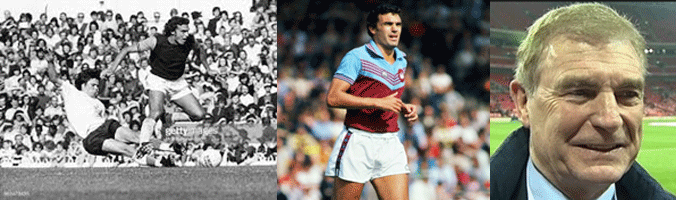
Geoff Hurst, 75 today, scored 249 goals in 502 appearances and was part of the victorious 1964 FA Cup and 1965 ECWC sides.  He remains the only player to score a World Cup final hat-trick.

David Cross, 66 today, scored 97 goals in 2003 and was an important member of the 1980 FA Cup winning side.

Counting Sheep – 11 – The Letters R & T

Do You Remember A Keeper With A Surname Beginning With T?

Counting SheepFor the eleventh article in my feature selecting West Ham footballers that I have seen whose surnames begin with the same letter or combined letters I now move on to R & T. I have to admit that trying to remember players whose surname begins with T has been harder than I thought and despite thinking for some time I have been unable to come up with a goalkeeper. It is for this reason that I have combined R & T for my penultimate team.

So far I’ve picked ten teams, “B”, “C”, “D”, “F”, “S”, a combined “G” and “H”, a combined “J”, “K” and “L”, a combined “M” and “N”, a combined “P” and “Q”, and “Vowels”. So here is the result of my “R” plus “T” team:

Randolph
Tompkins
Taylor (T)
Reid
Ruddock
Reo Coker
Redknapp
Robson (K)
Robson (B)
Taylor (A)
Tevez

Players left out include Rhodes, Reiper, Repka, Rat, Robson (M), Robson (S), Rowland, Rush, Radford, Rosenior, Raducioiu, Thomas (M), Tihinen, Taylor (M), Tyler, Tore, Todorov, Tristan

I’ve probably missed someone who I should have remembered. Would you have selected any of the players that I left out of my final XI?

And who would manage the R & T team? My only choices would be Redknapp or Roeder.

West Ham Heroes – Number 5 – Sir Trevor Brooking

The occasional series on Hammer’s heroes remembers the silky skills of Sir Trevor.

Sir Trevor Brooking

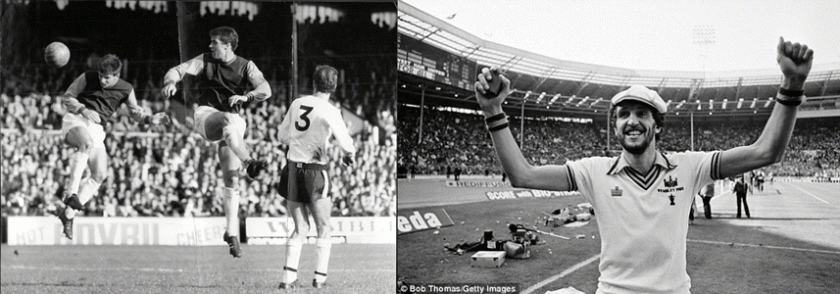
Perhaps the most skillful player I ever saw in a West Ham shirt was Sir Trevor Brooking. He made his debut for the club in 1967-68. I remember the season well. I was at Barking Abbey School and the early part of the season coincided with me and my friends starting in the third year, which was one of the age groups for one of the school football teams. We used to play games against other schools on Saturday mornings, and then in the afternoon we’d head off to Upton Park to watch our heroes play.

Trevor made his debut in the away game at Burnley at the end of August on a Tuesday evening, and then came on as a substitute for Billy Bonds to make his home debut the following Saturday against Manchester United. He had only played a handful of games before getting a run in the team as Christmas approached.

The first game I can really remember him playing for us, where he made quite an impact on me, was in the Boxing Day morning game against Leicester City. In those days the Boxing Day games used to kick off at 11 am, and I sat in the old West Stand to watch us fight back from conceding two goals in the first quarter of an hour, to win the game 4-2. Trevor scored one of the goals and a Brian Dear hat-trick sealed the win, but it was one of those games where we could have scored double figures.

The reason we didn’t was because of a superlative performance by the 18 year old, Leicester keeper, Peter Shilton. It was the first time I’d seen Shilton play and I wasn’t surprised when Leicester sold Gordon Banks, then the England keeper, to ensure Shilton was a regular in the Leicester goal.

On the day after we broke up from school for the Easter holidays, I remember Trevor scoring a great hat-trick in a 5-0 rout of Newcastle, one with his left foot, one with his right, and one with his head. It’s often said that Trevor didn’t score headed goals but that is not strictly true. I can specifically remember a diving header from about 18 yards to earn us a last minute 2-2 draw (I think against Wolves), and of course the important ones, the winning goal in the 1980 Cup Final against Arsenal, and a headed goal to break the deadlock in the European Semi-Final in 1976 against Eintracht Frankfurt. That was probably the best game I ever saw, and was possibly Trevor’s finest for West Ham. He made the second goal for Keith Robson, and then curled in the important third goal.

Only three players, Billy Bonds, Frank Lampard (the senior one), and Bobby Moore, turned out in more games for West Ham than Trevor. He played over 600 games and scored over 100 goals, a good return for a midfielder. He played 47 times for England, scoring five goals, but the peak of his career in the 1970’s was a lean time for the national side as we failed to qualify for the finals of the 1974 and 1978 World Cups.

He was comfortable with both feet, and had an uncanny knack of letting the ball run across him before playing it. So many defenders knew what he was going to do, but they couldn’t stop him. His ability to set up goals for others would have put him high up in the assists charts throughout his career, but those statistics were not kept in those days.

His last game for the club was the final game of 1983-84, a season which promised so much for the club. After winning the first five games we topped the league, and stayed in the top three throughout virtually the whole season until around mid-March, when a spectacular nose-dive saw us plummet to ninth, winning just one of our final dozen games. His final goal for us was scored on the last day of 1983 when we thrashed Tottenham 4-1 at Upton Park.

He never wanted to be a manager, but he stepped into the breach a couple of times in 2003, and although it was only on a caretaker basis, his record of nine wins in 14 games makes him the most successful manager we’ve ever had in terms of win percentage. After his playing career ended he was a long time pundit for the BBC on Match of the Day, and had a long career in senior administrative roles at the FA. He was knighted in 2004, and of course had stands named after him at Upton Park, and now the London Stadium.

He was Hammer of the Year an unprecedented five times and has always been regarded as a true gentleman. He was quite simply a West Ham legend. He was one of a rare breed; a player who played for just one club throughout his whole career. It was a pleasure to watch him play so many great games for us over such a long career.

West Ham Heroes – Number 4 – Billy Bonds

Six foot two, Eyes are blue, Billy Bonds is after you!

Billy Bonds

Throughout most of the 1950’s and the early 1960’s the number 2 shirt at West Ham was owned by John Bond. He was the right back in our FA Cup winning side in 1964 and was really the only number 2 I ever remember in my early years of watching West Ham. He played his last game for us in 1965, and was followed towards the end of the European Cup Winners Cup winning season by Joe Kirkup and Dennis Burnett. But we really needed to strengthen the team in this position so Ron Greenwood signed William Arthur Bonds, known to us all as Billy, in 1967.

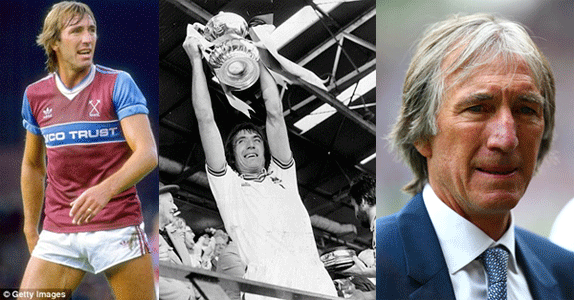
Those of us who were there on 19 August 1967 for the opening game of the season against Sheffield Wednesday witnessed the debut of the player who went on to play more games for the club than any other, 799, in a long career that spanned 21 seasons. He started at right back and without a doubt he was the best player I have ever seen in that position at West Ham.

Around three years later he was switched to play in midfield and formed an amazing partnership alongside Trevor Brooking. Throughout the first half of the 1970’s he continued in this role and once again, I have to say he was the best player I have ever seen at the club in the “box-to-box” midfield role.

He became captain when Bobby Moore left in 1974, and for the final ten years at West Ham he played at the back, initially alongside Tommy Taylor, and then formed an excellent partnership with the young Alvin Martin. He was one of the best centre backs I’ve ever seen at West Ham too, and in all three roles at the club he excelled.

He would be one of the first names in my all-time West Ham heroes team, and could fill any of the three positions, but perhaps he was at his playing peak in the early 1970’s when he single-handedly won so many games for the club from midfield.

To be honest I cannot recall a single game where I left the ground thinking that he hadn’t played well. He was fully committed throughout every game, and perhaps his skill was overshadowed by his commitment to win the ball when our opponents had it, but you shouldn’t be fooled, he was great with the ball too.

If I had to pick out one game that I remember above all others it was the day in March 1974 when we beat Chelsea 3-0 and Bill scored a hat-trick. He finished that season as leading scorer, which was most unusual from a midfield role, particularly in those times. Around the time of the Chelsea game I remember seeing him score a magnificent left-footed volley from outside the penalty area in a game against Coventry at Upton Park. I was standing on the North Bank directly in line with the shot.

He was always considered to be the fittest player at the club, and was almost 42 when he retired at the end of the 1987-88 season. I’ve watched the England team since the late 1950’s and when I think of some of the players who have pulled on the three lions shirt, then I am amazed that Bill never did. Without a shadow of a doubt he was the best English footballer I have ever seen (by a country mile) who never represented the full national team. He came very close a couple of times, but injury denied him in the end.

After being a youth team coach at the club, he became manager following the resignation of Lou Macari in 1990, and in his first full season at the helm led us to promotion. In the following ill-fated “Bond scheme” season that followed we were relegated, but the following year he led us back up into the top flight. He resigned in August 1994 when Harry Redknapp took over, and the two of them, who were very close friends, have never spoken since. The circumstances regarding the resignation have differing versions according to what you read.

Many consider that he was the best West Ham manager ever. Certainly those who trust statistics do. His win percentage of 44% is the highest of all full time West Ham bosses in history, his losing percentage of 30% is the lowest of all full time West Ham bosses in history, and the goals scored minus the goals conceded per game at 0.32 is also the best of all full time West Ham bosses in history.

He was Hammer of the Year four times, was awarded the MBE, won the PFA Merit award when he retired, and was the initial recipient of the West Ham lifetime achievement award in 2013. Quite simply he was an absolute West Ham legend. I’d personally like to see greater recognition for him at our new stadium.

West Ham Heroes – Number 3 – Sir Geoff Hurst

The West Ham and World Cup striking hero who had no trouble knowing where the goal was.

Sir Geoff Hurst

For a West Ham footballer of the 1960s Geoff Hurst was something of a rarity. Almost all of the team at the time were born within the sound of Bow Bells, whereas Geoff was born, as all the football programmes of the time will tell you, in Ashton-under-Lyne, Lancashire. His family moved to Chelmsford when he was a small boy, so he qualifies as another local player. His dad was a professional footballer in the lower leagues. Geoff joined the youth set-up at Upton Park around the same time as Bobby Moore.

In his early days he was a wing half, just like Bobby, but one day, in September 1963, Ron Greenwood made one of the most inspired footballing decisions of all time, when he decided that Geoff should swap his number 4 shirt for the number 10 shirt and play up front. Of course the rest is history.

In around 500 games for us he scored 249 goals, making him our second highest goalscorer of all time behind Vic Watson from an earlier era. As a centre-forward he had all the attributes needed, powerful, fast, strong in the air, two good feet, and an unshakeable temperament, where he refused to be intimidated by the tough-tackling defenders that were around at the time. He also knew how to put the ball in the net.

He played 49 games for England, scoring 24 goals. For West Ham and England he scored an average of a goal every other game. Of his type, and I know I am biased, I believe he was the best centre-forward I have ever seen. Only Alan Shearer runs him close; they had many similarities as footballers, with similar goalscoring records.

Of course he is most famous to the world at large for scoring a hat-trick for England in the 1966 World Cup Final. He remains the only footballer to have achieved the feat. He only won his first England cap in February 1966, and didn’t even start the tournament that year in the team. He came into the side for the quarter-final against Argentina when Jimmy Greaves was injured. He scored the only goal of a tough game, turning in a near post cross from Martin Peters, a goal straight from the West Ham training ground at Chadwell Heath.

He kept his place for the semi-final, setting up one of the goals in a victory over Portugal, and controversially (to some) also retained his place in the team for the final, despite Jimmy Greaves having recovered from injury. In so many ways, the hat-trick in the final was perfect. A near post header from a Bobby Moore free kick, a right footed shot that thundered down off the underside of the bar, and a left footed screamer in the last seconds of extra time (when some people were on the pitch thinking it was all over!).

But my main memories are of the goals and performances for West Ham throughout the 1960s. In many ways Geoff took over from my previous hero who wore the number 10 shirt, John Dick. Geoff was the leading scorer in seven seasons, and in the mid-sixties he twice scored forty goals in all competitions.

Perhaps the most impressive front-two partnership I have ever witnessed in almost sixty years of watching the game was the one Geoff forged alongside Johnny (Budgie) Byrne for a five year period from around 1962 until 1967. Their understanding, not to mention their prolific goal tally, was superb. He also played up front for a short time alongside both Jimmy Greaves and Pop Robson in a claret and blue shirt. Many will also recall the almost telepathic partnership with Martin Peters who played in midfield. On so many occasions they set up goals for one another, many of them coming from the near post cross that West Ham patented at the time.

I was listening to Dean Ashton (another in the Geoff Hurst mould) on the radio recently and he was bemoaning the current trend for one striker playing up front on his own. How I would love to see a change of tactic with a front pairing along the lines of Hurst and Byrne, or McAvennie and Cottee, in our attack at the moment.

Geoff was Hammer of the Year on three occasions in the 1960s at a time when we had so many great players. He is one of a handful of footballers to have been knighted, although quite why that honour was not bestowed upon the whole of the 1966 World Cup winning team is beyond me.

Of course we can’t leave a piece on Geoff Hurst without mentioning the controversial third goal (the first in extra time) in the 1966 World Cup Final. Apparently Geoff is asked the question almost every day. Did it cross the line? Well Roger Hunt says it did, as did the Azerbaijan linesman. That’s good enough for me!

West Ham Heroes – Number 2 – Bobby Moore

An occasional series on Hammer’s Heroes takes a look back at the finest defender of many a generation.

Bobby MooreWhen we are growing up most of us have heroes. As a young boy, my walls were adorned with pictures of my first heroes. Photographs of West Ham footballers and pop stars filled my bedroom from the late 1950’s throughout the 1960’s. Last time I wrote of my first hero, John Dick, whose replica shirt I got for Christmas 1958. The following Christmas my autograph book was signed by the West Ham team, who were all heroes to a five year old fan. Fast forward one year. I am now six, approaching seven, and Christmas is a week or so away.
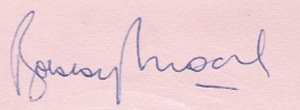
It’s a Friday night and my dad asks me if I want to go to Upton Park the following day. I’ve been to a few games by now, and of course the answer is yes. On Saturday morning he wakes me early. It’s still dark and very cold. He works on Saturday mornings and I go with him. At noon he finishes and we leave Chadwell Heath heading for Upton Park.

We arrive and go through the front gates as a number of the players are arriving. Young boys like myself surround the players holding out their autograph books for their signatures. My dad points out to me a tall blond teenager who has not been approached. I go up to him and ask him if he would please sign my book. Of course he replies, and asks me my name, where I live, where I go to school, who my favourite players are, and chats to me and my dad for a couple of minutes. The older players are more well-known and surrounded by young boys.

My dad asks him if he is confident of winning today. He replies that he expects a very difficult game. Our opponents, Wolves, have been one of the top teams in the country for the past few years. We thank him and he joins the others. He is the first real footballer I have ever spoken to. He became a hero to me that day and for years to come.

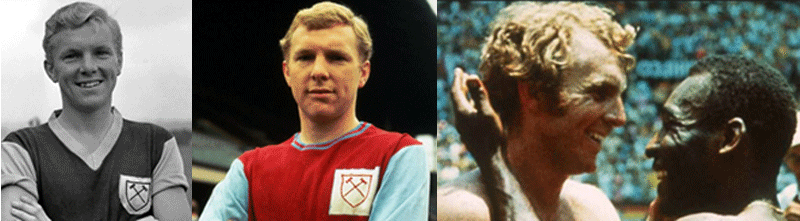
Bobby Moore Autograph 1Within a couple of years he was an England player, he played in the 1962 World Cup tournament in Chile, and he captained England at 22. He collected the FA Cup when we beat Preston in 1964, the European Cup Winners Cup the following year, and the World Cup a year later. Three times he climbed the 39 Wembley steps at the head of his team. He was still only 25 years old.
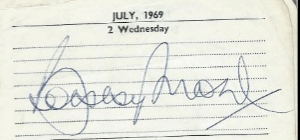
His footballing career is well documented. He was immaculate in every respect. He was, and still is, the best defender I ever saw. A view shared by so many leading figures in the game. His performances in the 1966 World Cup tournament stood out, and remember, he provided two assists in the final. I watched on TV, perhaps his best ever game when England lost 1-0 to Brazil in a group game at the 1970 tournament. If you’ve never seen it try to see a recording of the game. He was superb.

Bobby Moore Autograph 2I can recall so many games as I watched him hundreds of times. I have so many memories, including some unusual ones. I remember how he wiped his hands before shaking hands with the Queen when collecting the World Cup. I remember him accidentally knocking out a referee with the ball and picking up the whistle to stop the game. I remember him dancing a jig with Jimmy Greaves in a game against Tottenham. I remember him scoring a magnificent goal against QPR, running from inside our half and unleashing an unstoppable shot into the top corner, before turning on his heels and walking back barely celebrating. I remember his anticipation, the way he timed his tackles, his magnificent distribution. I remember watching a great defender. I haven’t seen anyone better since.
But most of all I remember how he took a couple of minutes to speak to an impressionable six year old boy, who never forgot those moments. I met him again a few years later and once again he gave me an autograph as we chatted. Oh, and the game in December 1960 against Wolves? We won 5-0 and unusually he scored one of the goals.

He died at too young an age, and never received the recognition that he deserved. He should have been Sir Bobby Moore for leading his country to World Cup victory and for services to football. His club and country should be ashamed for not using his talents when he stopped playing. Posthumously he now receives the recognition he should have had when he was still alive. He was simply the best defender that most people of my generation ever saw.

Where Have All The Strikers Gone?

Missing in Action: The 20 Goals Per Season Striker.

StrikersAfter the encouraging victory on Saturday the emotional swingometer has turned completely on its axis shifting from doom and despair to euphoric optimism. While the positivity is welcome after such a disappointing start to the season a sense of perspective needs to be maintained as we come to the end of our run of ‘easier’ games. The formation and attitude worked well at Palace and now we need to see if that can be followed through at home to Sunderland.

I cannot yet jump on the new found enthusiasm for Simone Zaza bandwagon. I don’t see that after one hard working performance we have a solution to our long running striker dilemma. He may have ‘put in a shift’ but was he really ‘different class’? Slaven Bilic said that we wouldn’t have won without him and I can only go along with that if he meant the alternative was playing with 10 men. Now Slav’s comments may have been designed to give Zaza a boost but I would like to see a greater end product (i.e. goals) rather than good stats on aerial duels won before I become a believer.

Now this is not meant to be a Zaza bashing article but rather to consider why it is that we have failed to secure an even half prolific goal scorer for such a long period of time. If the 20 goals a season striker is elusive at most clubs then he has completely disappeared during West Ham’s Premier League tenure. A regular goalscorer has been a problem for many years.  In our 20 Premier League seasons the best return that we have had was Di Canio’s 16 goals in 1999/2000. In only 7 of those 20 seasons has any West Ham player scored more than 10 league goals. In our last 10 Premier League seasons only Harewood (14 in 2005/6) and Zamora (11 in 2006/7) have exceeded the 10 goal mark. Quite a sorry return I would say.  Sure it is great to get goals from all around the pitch but every successful team tends to have at least one consistent scorer.

Paolo is also our all time Premier League scorer with 47 goals in 118 appearances (an average of 2 goals every 5 games) followed by Carlton Cole with 41 goals in 216 appearances (1 in 5). Only 10 players in total have scored more than 20 Premier League goals for West Ham and these include penalty takers Mark Noble and Julian Dicks. Tony Cottee is the only player to have scored a Premier League goal for West Ham to appear in the list of our Top 10 all-time goalscorers; 23 of his 115 goals coming in the Premier League era.

In the modern game a striker needs to contribute more than just goals but a striker who doesn’t score is not really doing his job. It seems strange that we have not been able to unearth and keep a decent goalscorer in recent history. There have been those that didn’t stick around for long for various reasons (Defoe, Tevez, Bellamy, even Ba) plus the unfortunate Dean Ashton but otherwise there has just been a procession of misfiring lumps; often the result of emergency January transfer window loan deals.

A top striker was stated as the priority in the most recent transfer window and the names of potential targets were appearing in the media almost daily. It is difficult to know how many of these were genuine or realistic but the many players mentioned didn’t fit a profile for a particular style or type of player. In the end it seemed that most were either not interested or not available and we ended up in a last minute panic taking whatever was convenient. It reminded me a little of going shoe shopping with a woman who has nothing to match the dress she will be wearing that evening.

I would be quite happy for Zaza to prove me wrong but neither his goal scoring record nor his performances have raised expectations that he will suddenly start firing them in from all angles . As things stand I don’t see any short term end to our striker famine unless we are able to pin all our hopes on Toni Martinez.

Counting Sheep – 9 – The Letters P and Q

Another combined team in the alphabeti spaghetti tangle of Hammer’s dream teams.

Counting SheepI’ve really enjoyed putting my thinking cap on and trying to come up with West Ham all-time football teams where the players surnames all begin with the same letter. When I began I thought that I would be able to make teams out of most of the letters of the alphabet, but it has proved to be a little more difficult than I envisaged. The original aim was to help me drop off to sleep instead of the more traditional method of counting sheep, but now it has turned into a brain training exercise (always useful when you reach my age!).

So far I’ve picked eight teams, “B”, “C”, “D”, “F”, a combined “G” and “H”, a combined “J”, “K” and “L”, a combined “M” and “N”, and “Vowels”. P is next and I was able to think of enough names to form a team. But thinking ahead to Q, that was one letter where I knew I would fail. I realised that I would have few options there, so once again I decided on a combined team, this time the P’s and Q’s. So I’ll mind my Ps and Qs, combine my Ps and Qs, and hope you don’t mind!

My all-time West Ham “P” plus “Q” Team in a 4-4-2 formation are:

Parkes
Parris
Pearce (I)
Potts
Pearce (S)
Paddon
Parker
Peters
Payet
Pearson
Quinn

I think you’ll agree I have picked a very strong midfield. Players left out include Pantsil, Pike, Powell, Poyet, Parks, Piquionne, Pogatetz, Porfirio and Quashie.

Have I forgotten someone really good who is a must for the P/Q team? And I can only remember one P/Q manager; Alan Pardew.

Counting Sheep – 8 – The Letters M and N

Another combined team in the search for alphabetically themed West Ham teams.

Counting SheepThis all began with me selecting teams of West Ham players whose surnames all started with the same letter. The aim was to help me drop off to sleep instead of the more traditional method of counting sheep.

So far I’ve picked seven teams, “B”, “C”, “D”, “F”, a combined “G” and “H”, a combined “J”, “K” and “L”, and “Vowels”. M comes next and it was easy to write down enough names to form a decent team. But thinking ahead to N I realised that I would have few options there, so once again I decided on a combined team. There are at least four stand-out captains in this side, although the one and only Sir Bobby would be the choice for this role.

My all-time West Ham “M” plus “N” Team in a 4-4-2 formation are:

Miklosko
McDowell
Martin
Moore
McCartney
Malcolm
Moncur
Noble
Nolan
McAvennie
Morley

So who have I left out this time? McKnight, McAllister and Mackleworth are three keepers who would have received very few votes when being compared to my selected custodian, Miklosko. Outfield players (M) were Mascherano, Morrison, Musgrove (perhaps the unluckiest to be omitted), Mullins, Moses, McAnuff, Maynard, MacDougall, Maiga, Margas, McGiven, McCarthy, McQueen, Mellor and Minto. The Ns included Neighbour, Neill, Nene, Newell and Nordtveit. Some very good players have not been included plus some who didn’t pull up any trees in a West Ham shirt.

Have I forgotten someone really good who is a must for the M/N team? And I can only remember one M/N manager. I’ll bet you don’t think of him as one of our most successful managers; Lou Macari.