A special supplement looking at events in September 1998.
 Geoff writes some excellent features that look back on specific weeks in West Ham history. I hope he doesn’t mind if I add to this week’s article which was posted on September 26, as I have personal memories of the long weekend (in football terms) that stretched from Thursday 24 September to Monday 28 September in 1998. That is eighteen years ago. So anybody born in that week is now able to do various things legally that they weren’t supposed to beforehand. And I personally know somebody who had their 45th birthday on September 27 that year, and who therefore celebrates their 63rd this week. Happy birthday Mr. H.
The weekend in question is what might be termed Premier League Matchday 7 nowadays, although I don’t think the phrase existed at the time. So every team had played 7 games at the end of the weekend, except for Manchester United and Chelsea who had only played six for reasons that I cannot recall.
Manchester United beat Liverpool 2-0 in the Thursday game in front of the weekend’s biggest attendance of just over 55,000. Aston Villa beat Derby 1-0 to open up a five point lead at the top of the table with five wins and two draws in their seven games. Incredibly (for a team well on top) they had only scored eight goals and conceded just one. This was the first defeat of the season for Derby, who were in second place, and they too had very few goals in their games, with just six scored and three conceded.
There were far fewer goals scored at the beginning of the 1998-99 season compared to today. 153 goals had been scored in 69 matches. This season there have been 176 goals in just 60 games. Only one of the ten games that weekend produced more than 2 goals (a 3-3 draw between Tottenham and Leeds). This year, last weekend had 7 matches where three or more goals were scored.
Aston Villa were top, Derby were second and Wimbledon third, (with West Ham fourth). Other Premier League teams included Newcastle, Leeds, Sheffield Wednesday, Charlton, Forest, Coventry and Blackburn. 50% of the teams in the league 18 years ago are no longer in the top flight. To further illustrate the changing nature of teams at the top, five of those teams who are not currently in the Premier League have been champions in the top flight of English football in the last forty-five years.
 I remember the weekend for two particular reasons. Firstly, I was at Upton Park for our game which featured as the Sky Monday night football. Just over 23,000 were there to witness us beating Southampton (who were rooted to the bottom with just one point at the time) by 1-0, with an Ian Wright goal in the second half. Compare that to the attendance for our game against Southampton on Sunday!
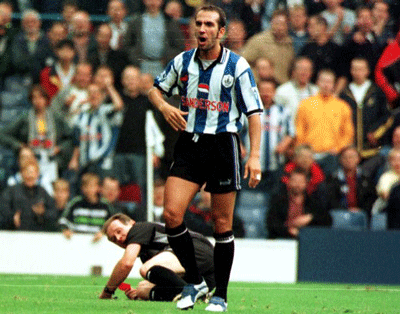
But the most remembered aspect of that weekend was in the game at Hillsborough where Sheffield Wednesday beat Arsenal 1-0 with a late goal. A certain Mr. Di Canio got in an angry exchange with both Patrick Vieira and Martin Keown. The referee, Paul Alcock, sent off Di Canio, who was so angry he pushed the official, who then fell theatrically to the ground. The red card (and of course the push) led to Di Canio receiving an eleven match ban. This was effectively the end of his time at Wednesday, and early in 1999 Harry Redknapp took what many considered to be a massive gamble, and brought Di Canio to Upton Park. In the four years he spent with us he became an Upton Park legend.
And how did the season end? Southampton, who were five points adrift of safety when we beat them, avoided relegation. Perhaps our situation is not as critical as the doom-mongers amongst our fans would have you believe after our poor start this season? Villa did not hang on to their big early season lead and finished in sixth place, 24 points adrift of Manchester United, the champions. Derby fell to eighth, and Wimbledon fell dramatically from third after seven games, to finish fifth from bottom.
We had what still remains as our best ever Premier League season finishing in fifth place. Not quite as impressive as our 1985-86 third place in the top flight, but our best ever finish since the inception of the Premier League which has been going for around 25 years now. As a result we qualified for the Intertoto cup, and our success in that meant we went on to the UEFA Cup where we were eliminated by Steaua Bucharest of Romania. What is it about Romanian teams?
Incredibly for a team finishing in fifth place, Ian Wright was our leading scorer for the season with just nine goals. Following the end of the season he never played another league game for us again, going out on loan to Forest and then finishing his career at Celtic and Burnley.
But it was the events at Sheffield Wednesday that weekend that were to have a significant impact on the history of West Ham, especially for the following four years.

 What began as a cure for insomnia on warm summer nights has begun to turn into a bit of an obsession. It all started with me trying to select teams of West Ham players whose surnames all started with the same letter.
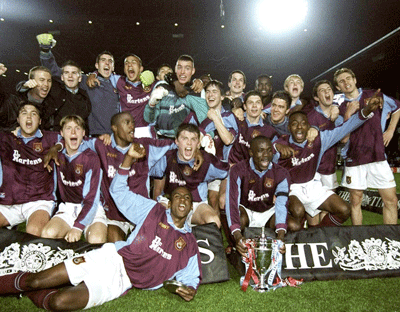
 The West Ham Under-19 side of 1998/99 swept all before them in claiming a spectacular league and cup double. The climax to the season was the two legged FA Youth Cup Final against Coventry City. The Hammer’s opened up a healthy 3-0 advantage in the first leg at Highfield Road and yet 21,000 supporters still turned out to watch the return at Upton Park a week later on Friday 14 May 1999. It took only a few minutes for West Ham to extend their lead and they eventually ran out 6-0 winners on the night (9-0 on aggregate).
 Newton had scored in both legs of the Coventry final. In the first a delightful chip over the head of the advancing Chris Kirkland and in the second an exciting run topped off with a ‘sumptuous’ strike past the stationary keeper. In many ways Newton was the star of the show even overshadowing the better known Cole and Carrick duo. There were even rumours of a million pound bid from Spurs shortly after the final.
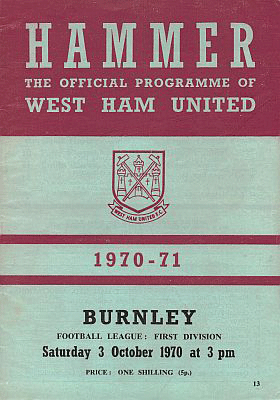 Wapping born Ayris was just 17 at the time and was seen as the next generation marauding winger to follow the fleeting footsteps of John Sissons and Harry Redknapp into the first team. His debut was a successful one providing the crosses (or assists in today’s terminology) for a Geoff Hurst hat-trick in a 3-1 victory. Ayris was used sparingly during the remainder of the 1970/71 season making a further 7 starts including in the infamous 4-0 FA Cup defeat at Blackpool where Moore, Greaves, Clyde Best and Brian Dear had been spotted partying into the early hours the night before the game.
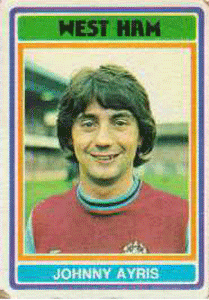 The Harris incident may not directly have ended his career but it had a large part to play. At just 5 feet 5 inches and a slender 9 stone he was utilised selectively in subsequent seasons by manager Ron Greenwood who felt the need to protect the young winger from the more agricultural players who inhabited top flight football at the time. Ayris made a further 33 starts over the next 5 seasons before being given a free transfer to non-league Wimbledon in 1977 and drifted out of the game at just 24 years of age.
 For every successful youth team product there are many more who simply fade away. Among these there are those who are hotly tipped for stardom but who ultimately do not deliver. We shall be taking a look at some of these ‘Boys Who Never Quite Made It‘.
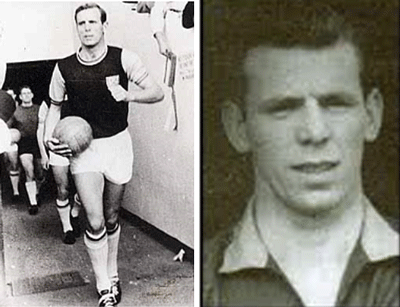 When we are growing up most of us have heroes. As a young boy, once I had outgrown the nursery rhyme wallpaper, my walls were adorned with pictures of my first heroes. Photographs of West Ham footballers and pop stars filled my bedroom walls from the late 1950’s throughout the 1960’s. Pride of place was an action photograph of my first West Ham hero, John Dick, in a mid-air tussle for the ball in a game at Upton Park. It was taken by a press photographer who my uncle knew.
 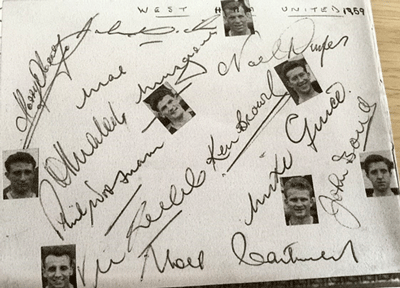 His autograph took pride of place at the top of my West Ham 1959 team signatures. So many West Ham legends signed that page for me and I added some miniature pictures cut out of programmes alongside some of them. In addition to John Dick my book was signed by Noel Dwyer, Harry Obeney, Malcolm Musgrove, Andy Malcolm, Phil Woosnam, Ken Brown, Mike Grice, Vic Keeble, John Bond, and Noel Cantwell.
 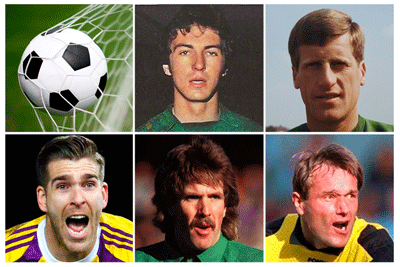 When West Ham play Accrington Stanley in the next round of the League Cup (or whatever it’s called these days) it will be the first encounter between the two clubs. Someone who did once play against Stanley though was legendary goalkeeper Willie ‘Fatty’ Foulke; at the time plying his trade with Bradford City. When Accrington visited Bradford for an FA Cup tie in February 1907 it was discovered that Foulke, who stood 6ft 3in and weighed in at circa 22 stone, was wearing a jersey that clashed with the red shirts of the visitors. After a fruitless search for a suitably large replacement Foulke was wrapped in a sheet borrowed from a neighbouring house. The game ended in a Bradford victory by the only goal and with Foulke barely called into action his makeshift attire was as pristine as it had been at the outset. Thus, the origin of “keeping a clean sheet”. [Incidentally, it is also claimed that the chant “Who ate all the pies?” was originally directed at Foulke.]
 Under The Hammers