My Favourite Games: Number 6 – West Ham 5:0 Burnley, August 26 1968

A series of occasional articles recalling my favourite West Ham games, and songs that topped the charts when these games were played. Today early season swagger against Burnley.

There have been so many great games in the last 58 years and I’ve covered many of them throughout my book, Goodbye Upton Park, Hello Stratford. Many are remembered because of the importance of the game, the goals scored, and the spine-tingling atmosphere generated by our fans. Hopefully my memories of these great games will evoke fond memories of fans, (especially older ones like me!), and the music in the charts at the time.

Favourite Games 6

In August 1968 I was fourteen and a half. It was, of course, the school summer holidays, and I was soon to move into the fourth form at school. I think that is year 10 in modern terminology. I was on a caravan holiday in Weeley when news broke of the Russian (strictly speaking Warsaw Pact) invasion of Czechoslovakia on 21 August. Younger readers will only know of two countries now, the Czech Republic and Slovakia, which were formed when the original country split (peacefully) in 1993. It was a major event in world history, and one that was discussed in current affairs lessons upon our return to school a couple of weeks later.

Another significant happening in history happened around the same time. England were playing Australia in the fifth test of the summer at the Oval. England were one down and needed to win the test to square the series. A famous test match ensued with England (or rather Derek Underwood) bowling out Australia on the final afternoon to win the match after a heavy rain storm had almost forced the abandonment of the game during the lunch interval. The large Oval crowd assisted in the mopping up process on this final day (Tuesday August 27).

Basil D’Oliveira, a mixed-race South African, had been playing cricket for England for a couple of years, and scored a magnificent 158 in the game and was one of the key reasons why England won the match. Despite this he was controversially omitted from the touring team to go to South Africa that winter, although later recalled to the party following an injury to Tom Graveney, and a public outcry. With the apartheid in South Africa at the time, the inclusion of a non-white South African was unacceptable to the hosts, and this led to the cancellation of the tour, and hastened South Africa’s isolation from world cricket soon afterwards. They didn’t return until 1991 after apartheid began to be dismantled. A further topic had been added to current affairs lessons on our return to school.

Meanwhile on the Monday evening of 26 August, West Ham had a home game against Burnley. It was a memorable game on a hot summer evening and we raced into a four goal lead by half time. We were playing some great stuff, and that first half was one of the best that I remember from that era. Martin Peters scored the opener, then Geoff Hurst added a couple before a teenage Trevor Brooking added a fourth. Shortly before Brooking’s goal, the referee had to go off the pitch injured. In those days we didn’t have a fourth official at games, so one of the linesmen took over the whistle, and a member of public (who was a qualified local referee) ran the line, dressed in his suit trousers, shirt and tie, as there was no spare kit for officials either! It wouldn’t happen today. To many observers Brooking’s goal was yards offside, but the deputy linesman dressed in his office attire, didn’t raise his flag, and maintained that the ball was last played by a Burnley player, with which the referee concurred, and the goal stood.

The Burnley players complained for ages, but I couldn’t see the point. They were already dead and buried in the game. Their chairman made quite a fuss the following day, and the whole thing was described, quite unnecessarily in my opinion, as a raging controversy. The referee had recovered by the start of the second half and resumed in charge. The deputy linesman had his ten minutes of fame, and made headlines being slated in the national newspapers the following day. Incidentally it wasn’t his first call up. He had been called upon in exactly the same circumstances just nine days earlier in our home game against Forest.

Brooking added our fifth goal with half an hour still to play, but we took our foot of the gas a little, and the game ended aa a convincing 5-0 win. It took us to the top of the Division One table (we eventually finished eighth), and was followed up with a 4-0 win over West Brom the following Saturday, and then a 7-2 victory over Bolton in the League Cup a few days later. But that wasn’t our highest score that season as we put eight past Sunderland in October. We scored 47 goals in our 21 home games in 1968-69, a figure only bettered by Manchester City, who finished in the bottom half! Burney finished 14th that year.

The West Ham team for the game was: Ferguson, Bonds, Charles, Peters, Stephenson, Moore, Redknapp, Boyce, Hurst, Brooking, Sissons. Roger Cross made his league debut coming on as a substitute for Sissons in the second half.

Number one in the charts in that memorable week in history was Mony Mony, by Tommy James and the Shondells, and other records close to the top were Fire, by the Crazy World of Arthur Brown, the Beach Boys with Do It Again, Tom Jones with Help Yourself, Dusty Springfield with I Close My Eyes and Count to Ten, the Bee Gees with I Gotta Get A Message to You. Simon and Garfunkel were in the top 20 with Mrs. Robinson, one of the songs from the soundtrack of the film The Graduate, which I greatly enjoyed watching (Dustin Hoffman had the leading role). Days by the Kinks was another great song I recall from that week’s chart.

By any stretch of the imagination, I don’t think that I could possibly include this season’s game at home to Burnley in any future favourite games feature!
My Favourite Games: Number 5 – West Ham 4:2 Manchester City, March 23 1996

A series of occasional articles recalling my favourite West Ham games, and songs that topped the charts when these games were played. Today beating Manchester City in 1996.

There have been so many great games in the last 58 years and I’ve covered many of them throughout my book, Goodbye Upton Park, Hello Stratford. So many of them are remembered because of the importance of the game, the goals scored, and the spine-tingling atmosphere generated by our fans. Hopefully my memories of these great games will evoke fond memories of fans, (especially older ones like me!), and the music in the charts at the time.

Favourite Games 5

Sometimes lady luck runs your way and sometimes it doesn’t. I’ve had more than my fair share of good fortune so I can’t complain. But there have been times when the luck hasn’t quite gone my way. On 23rd March 1996, we were playing at home to Manchester City who were struggling near the foot of the table at the time (and in fact they were relegated on goal difference at the end of the season). We visited Ladbrokes in Green Street on the way to the game as I fancied a bet on the correct score that day. Looking down their list I was looking for a value bet and thought that their odds on us winning 4-1 (80-1) were very generous. In those days they often put out some tempting, and realistic, correct score odds knowing how difficult it is to predict the score of a game. These days they are not usually so generous.

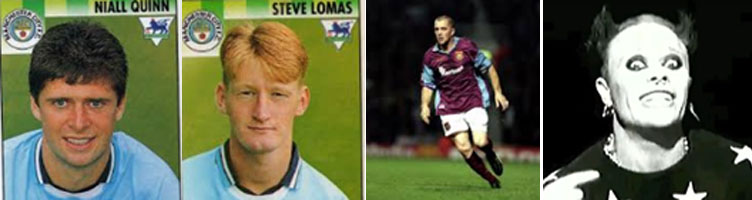
I put my five pounds on and we went in to see the game. I was with my dad and my son. Whenever I took my dad along we always had to buy seats at a low level as he didn’t like climbing the stairs to sit high up. So we had seats in the old West Stand lower just about level with the penalty area in the half where the Bobby Moore stand is. Slaven Bilic was playing for us and Steve Lomas, who came to us at a later date, was a City player at that time. Keith Cooper was the referee. City’s star player was Kinkladze and he was fouled early on for a penalty. I remember Ludo diving to his right to save it. About half way through the first half Iain Dowie scored with a header in front of the Bobby Moore stand, and 1-0 was the half time score. My bet wasn’t looking too hopeful with only one goal in the first half. I’d virtually forgotten about it.

In the second half Dowie headed his, and West Ham’s second goal from a Michael Hughes corner. Redknapp brought on Dani for Dumitrescu and Steve Lomas was sent off for two yellow cards. Ludo then blundered by dropping the ball allowing Niall Quinn to score an easy goal for 2-1.

There were about ten minutes left when Julian Dicks hit a trademark screamer from about 30 yards. From where we sat we were right behind the shot as it burst the net. 3-1. I remembered my bet and retrieved my betting slip from my pocket to look at it to make sure I had put it on correctly. Come on West Ham, just one more goal and £400 was on its way to me.

There were about five minutes left when Ian Bishop threaded a superb pass to Dani who ran on and tucked the ball past the keeper with his left foot. 4-1! This was unbelievable. OK West Ham you can ease up now! But they didn’t. They continued to attack sensing City were out on their feet. Hughes hit the post and Marc Reiper had an easy chance to score from the rebound but missed. I heaved a sigh of relief. I was looking forward to collecting my money!

The ninety minutes were up when the ball fell to Niall Quinn in our area. He swivelled and hit a superb left foot shot. Goal. Then Keith Cooper immediately blew his whistle for the end of the game. We didn’t even have time to kick off. To say I was gutted would be the understatement. It was a terrific game of football but you’ll forgive me for being a little disappointed.

The West Ham scorers that day were Dowie, Dicks and Dani. Have we ever had three “D” goalscorers in one game? Also in the team were Bilic, Bishop and Potts. Ludo had returned to play in goal after the late Les Sealey had made his one and only start between the sticks for us the previous week when we lost 3-0 at Newcastle. He did make one further appearance when he came on as a substitute for Ludo in the final game of the following season at Old Trafford. He had of course previously played for Manchester United, famously being picked for their FA Cup Final replay win in 1990, after their regular keeper Jim Leighton had a poor game in the first match against Crystal Palace.

Number one in the charts on that day was the Take That version of the old Bee Gees song, How Deep Is Your Love. Also in the top ten that week were Oasis with Don’t Look Back In Anger, Mark Morrison with Return of the Mack, and the Beatles with their second hit using the voice of John Lennon, many years after his death, with Real Love. The new chart always came out every Sunday then (I’m afraid I’m not up to date as to when it is changes these days), and the new number one on the day after the City game was Firestarter by Prodigy, which had gone straight in at the top after its release that week.

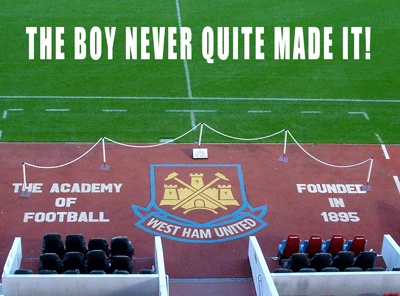
The Boy Never Quite Made It: Danny Williamson

Remembering Danny Williamson, a promising West Ham youngster destined never to hit the highest heights in career cut short by injury.

Boy Never Quite Made ItWest Ham is a club that likes to promote itself as the academy of football and there is nothing as rewarding for a supporter than seeing a young player break through from the youth system and establish a career in the claret and blue; especially when that youngster is a local lad.  In reality the record over the years in producing young talent has been rather patchy albeit there have been some spectacular successes and periods of plenty.  In this occasional series we look at those young players for whom there were high hopes but were unable to become local heroes at West Ham.
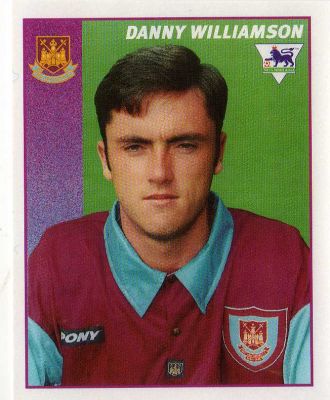
The academy was experiencing one of its barren spells during the late 80’s and early 90’s with the last notable graduates being Tony Cottee and Alan Dickens, who had both been key members of the boys of 86.  At the end of the 1993/ 94 season, 20 year old Danny Williamson was given his debut by manager Billy Bonds as a late substitute (for David Burrows) in a surprising 2-0 victory at Highbury, he then kept his place for the following two drawn games, away at QPR and at home with Southampton.  In the Southampton match Williamson got his Upton Park career off to a flying start by putting West Ham ahead after just 11 minutes.

Danny WilliamsonDanny Williamson was the perfect academy star, a keen West Ham supporter who was born in Plaistow and played locally for Newham and Essex boys before committing his future to the Hammers, despite the lure of interest from Arsenal.  After signing his first professional contract Danny enjoyed short loan spells at non-league Farnborough Town and third division Doncaster Rovers before getting his first team opportunity at West Ham.
Between his debut and the start of the 1994/95 season there was upheaval at West Ham with Harry Redknapp taking the manager’s seat and the resultant bitter departure of Billy Bonds from the club that he had served so magnificently during a 27 year association. Redknapp’s appointment preceded the arrival of new midfield signings John Moncur and Don Hutchison at West Ham which together with an unfortunate ankle injury limited Williamson to just 4 appearances for the season.  In the subsequent 1995/96 season, however, he took his chance to become a regular starter in the first team and made a total of 33 appearances, scoring 4 goals including a 70 yard run and finish away at Bolton.

His strong running, passing and ability to find space looked set to establish Williamson as a popular West Ham hero but his progress was to be interrupted once more by injury during the 1995/96 season.  Having recovered from one setback he was injured again in his comeback game at home to Chelsea resulting in the need for surgery on his foot.  It was while he was recovering from injury in August 1997 that he was sold to Everton in a deal, valued between £3 -4 million, which saw David Unsworth plus cash head to Upton Park.  He had made a total of 58 appearances for his boyhood club.

Williamson enjoyed a good start to his Everton career, commencing with a 2-1 home win over West Ham, but an injury to his foot sustained against the Wimbledon Crazy Gang in December 1997 ended up being his last ever game.  He remained at Goodison Park until his contract was cancelled at the end of the 1999/2000 season but he was never able to get far away from the treatment room.  A career that had started with such promise was never fulfilled.

Some supporters can get quite irate and critical about players that are continually injured but it is unlikely that many stay in the treatment room through choice.  With Danny there some accusations from Everton ‘scallies’ that Redknapp knew that he was crocked before the transfer but this is improbable given that Williamson had passed a medical before signing.

Danny Williamson retired completely from football at the end of his Everton contract, aged just 26, and later became involved in a property company operating in Portugal.

My Favourite Games: Number 4 – West Ham 4:2 Manchester United, May 16 1977

A series of occasional articles recalling my favourite West Ham games, and songs that topped the charts when these games were played

There have been so many great games in the last 58 years and I’ve covered many of them throughout my book, Goodbye Upton Park, Hello Stratford. So many of them are remembered because of the importance of the game, the goals scored, and the spine-tingling atmosphere generated by our fans. Hopefully my memories of these great games will evoke fond memories of fans, (especially older ones like me!), and the music in the charts at the time.

Man Utd 1977

One of the best games of football that I can remember, and certainly one of those with the most incredible atmosphere, came in the last game of the 1976-77 season. United were back again as a force in the top flight and we were facing relegation. It was a Monday night and United were playing in the FA Cup final the following Saturday. The equation was simple. If we won the game we would be safe. I met (lifelong friend and co-weblogger) Geoff Hopkins after work, and we stood on the West Stand Lower Terrace to watch the game. Considering the importance of the game, it was surprising that fewer than 30,000 were there to see it. I guess it was a sign of the times. We had only won two of our previous 13 games, leaving us in this precarious position, although in truth we had spent most of the season in the bottom three.

If we thought that United would be taking it easy with the cup final just a few days later we had another think coming. Firstly they fielded a virtually full strength team, and secondly within 30 seconds of the start their left winger Gordon Hill gave them a 1-0 lead. Frank Lampard (senior of course) scored the equaliser in the first half, yet another of his important goals, and then shortly before half time we were awarded a penalty. With Pop Robson in the team I’m not sure how a young Geoff Pike came to be the penalty taker, but he had scored twice from the spot in the previous month and he stepped up to take the kick. Unfortunately his fierce shot sailed high over the bar and we went into the break at 1-1. Fortunately he atoned for the miss early in the second half when he scored a tremendous goal to put us ahead. Pop Robson made it 3-1 to ease the nerves before Stuart Pearson (later to join us) pulled one back. Robson scored again to ensure a 4-2 victory that kept us in the First Division. Our stay in the top flight only lasted into the next season, as we were relegated after another dismal year when we barely got out of the bottom three for the whole time. Once again we could have saved ourselves from the drop in the final game but a 2-0 defeat at home to Liverpool sealed our fate and we went down for the first time in my life.

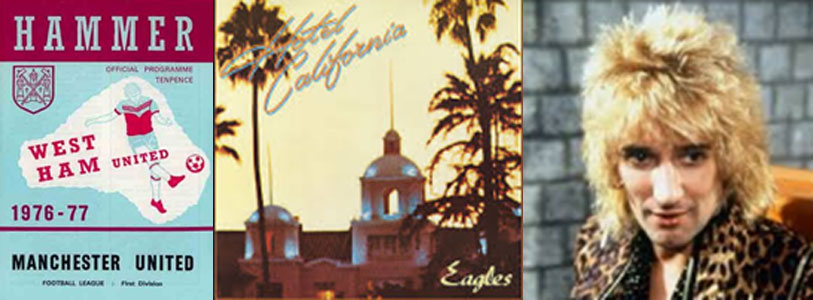
The number one in the charts that week was Free, by Deniece Williams. Other notable chart songs in May 1977 were Stevie Wonder with Sir Duke, Rod Stewart with I Don’t Want To Talk About It (which was the number one the following week), Abba with Knowing Me, Knowing You (not by A-ha!), Hotel California by the Eagles, Good Morning Judge by 10CC, and Lucille by Kenny Rogers, which took over at number one after Rod Stewart’s three weeks at the top. Even though it was almost 40 years ago, I can recall practically all the songs in that chart, unlike my non-existent memory of the May 2016 chart recalled in Number 3, the final game at Upton Park, also against Manchester United.

My Favourite Games: Number 3 – West Ham 3 Manchester United 2; 10 May 2016.

A series of occasional articles recalling my favourite West Ham games, and songs that topped the charts when these games were played . Today the last game at the Boleyn.

There have been so many great games in the last 58 years and I’ve covered many of them throughout my book, Goodbye Upton Park, Hello Stratford. So many of them are remembered because of the importance of the game, the goals scored, and the spine-tingling atmosphere generated by our fans. Hopefully my memories of these great games will evoke fond memories of fans, (especially older ones like me!), and the music in the charts at the time.

Favourite Game 3

No series on favourite matches could exclude this one. The final game at the Boleyn Ground, Upton Park was a memorable one for so many reasons. I’ll gloss over the shenanigans that delayed the kick off, and instead write about the marvellous entertainment served up by the players on this emotional night. We dominated the first half and came out of the blocks faster than in many games in the final season. Sakho’s well taken goal took a slight deflection in the tenth minute and another was disallowed for the ball going out of play. Both Carroll and Payet should have added first half goals when clean through but fluffed the chances. At the break we should have been three or four up and then the second half could have been a party. Would we come to rue those missed chances? This is West Ham. Of course we would.

Manchester United looked rattled throughout the first half and I couldn’t remember Randolph facing a shot. But half time seemed to have calmed them and two goals from Martial meant that we were behind with around 20 minutes left. How could this be? We had murdered them and yet here we were facing defeat in this final game. Surely they weren’t going to ruin the party? Hadn’t they read the script?

Within ten minutes we were back in front. A header from Antonio levelled the scores and Winston Reid, of all people headed the winner. Both goals were created by crosses from Payet, who else? Every one of us lucky to be there on that special night will remember the game for ever. We were so dominant that we had 20 shots on goal to the visitors 3. It would have been a travesty if we had not won the game. Fifty years before in 1966 we won our last home game at the end of the season, which happened to be against Manchester United, by three goals to two. An amazing co-incidence.

In the aftermath of the game, and much later than expected because of the delayed start, we were treated to additional entertainment in the form of a kind of closing ceremony, hosted by Ben Shephard and Bianca Westwood of Sky Sports who are both also supporters. Apart from the game itself the two additional highlights of the evening for me were the roll call of our players and managers who are no longer with us displayed on the screens as a backdrop to the band playing Abide With Me amid rapturous applause from the fans, and the ending with the lights being turned off on the big screen by the player in the number 6 West Ham shirt.

I have to admit that my musical tastes, despite being quite varied, are buried mainly in the 1960s and 1970s, and as time moves towards the present day, I know less and less about the charts, and my research for 10 May 2016 revealed that I knew none of the songs in the top ten that week. Number one was One Dance, by Drake featuring Wizkid & Kyla, which apparently held the top spot for 15 weeks, making it the second longest to hold the number one spot in chart history (which goes back to the 1950s). Other notable entries in that week’s chart, which younger readers will no doubt recall, include This Is What You Came For by Calvin Harris featuring Rihanna, Cheap Thrills by SIA, I Took A Pill In Ibiza by Mike Posner, and Work From Home by Fifth Harmony featuring Ty Dolla Sign. I’m none the wiser.

My Favourite Games: Number 2 – West Ham 3:3 Glasgow Celtic; 16 November 1970.

A series of occasional articles recalling my favourite West Ham games, and songs that topped the charts when these games were played. Today the Bobby Moore testimonial.

There have been so many great games in the last 58 years and I’ve covered many of them throughout my book, Goodbye Upton Park, Hello Stratford. So many of them are remembered because of the importance of the game, the goals scored, and the spine-tingling atmosphere generated by our fans. Hopefully my memories of these great games will evoke fond memories of fans, (especially older ones like me!), and the music in the charts at the time.

Bobby Moore Testimonial

West Ham 3 Glasgow Celtic 3, played on 16 November 1970 is an unusual choice perhaps as it was just a testimonial game, the one for Bobby Moore. Celtic were arguably the most attractive team in Europe at the time and they brought their first team to play in an exciting game. The football was full on attacking from both sides, and the noise was enhanced by the thousands of Scots who had travelled down to London for the game. It was a fitting tribute to a legend.

So on a freezing cold Monday night, I stood on the North Bank with school friends to watch an exhilarating game of football. Ticket prices were raised for the game from 6 shillings to 10 shillings – that’s 30p to 50p. I paid 3 shillings for my programme (15p). Celtic won the European Cup in 1967 with a superb display of attacking football beating a typically defensive and uncompromising Italian team, Inter Milan. I remember watching that game in black and white (very grainy pictures) in the early evening after coming home from school that day. They were a goal down and took the game to the Italians who were just content to hold onto their one goal lead. Eventually they managed to break through twice near the end of the game to deservedly become European Champions.

They remained a major force in Europe for a while, and in the season preceding the visit to play against us in Bobby Moore’s testimonial, they again reached the European Cup Final, losing 2-1 after extra time to Feyenoord of Holland. All credit to Jock Stein, their manager, who fielded the same team that had taken part in the European Cup final the previous May.

I remember the game going from end to end and it was a joy to watch. In truth Celtic were probably the better team, but in many ways we matched them which made for an exciting spectacle. It was one of those Upton Park nights where the atmosphere was electric, and the volume was increased by the multitude of Glaswegians who took their place on the South Bank. Their support was phenomenal.

Three times Celtic took the lead and three times we pegged them back. Celtic missed a number of good chances including one that I particularly remember from Jimmy Johnstone, who gave one of the greatest displays I have ever seen from an opposing player at Upton Park. His skill was phenomenal and many times he tore our defence to shreds. But with the game poised at 3-3 in the final minutes he contrived to put the ball over the crossbar when he was almost on the goal line. Perhaps it was a magnanimous gesture to ensure the game ended in a draw? Whatever. It was just a great game.

Our goals were scored by Geoff Hurst (from a cross by Moore), Johnny Ayris, a young tricky winger we had at the time who looked a great prospect as a youngster but only probably played a couple of dozen times for us in six or seven years, and the final equalizing header from Clyde Best.

The game was actually sponsored by Esso, and according to newspaper reports I read at the time and kept in a scrapbook, the 24,000 crowd meant that after deduction of all the expenses, Bobby Moore collected around £12,000. Gate and programme receipts came to around £21,000 but I suppose Esso took a cut and Celtic had to be paid expenses to appear. It doesn’t seem a lot now when you consider that he was a legend of the game, but I guess to put it into perspective the average wage at the time must have been (and I’m guessing here) somewhere around £30+ a week. The England players who won the World Cup in 1966 each picked up a bonus of £1000! It doesn’t really stand comparison with the vast sums of money earned by footballers today.

The number one song in the charts at the time was Woodstock, by Matthews Southern Comfort. Woodstock was a famous music festival held in the US in the summer of 1969. The festival, which attracted over 400,000 people, was widely regarded as a pivotal moment in popular music history. The event was captured in an award winning documentary in 1970, the movie Woodstock, a soundtrack album, and Joni Mitchell’s song which commemorated the event, and became a major hit for Crosby, Stills, Nash and Young, as well as the chart-topper for Matthews Southern Comfort. Other songs in the charts that week included Black Night, by Deep Purple; Band of Gold by Freda Payne, which had previously been a number one; War, by Edwin Starr (what is it good for, absolutely nothing); Paranoid, by Black Sabbath (with Ozzy Osbourne on vocals); Voodoo Chile, by Jimi Hendrix, about to become the number one in the following week; Whole Lotta Love, by CCS (the theme tune to a TV institution for so many years, Top of the Pops), Ride A White Swan, by T Rex; and Cracklin’ Rosie by Neil Diamond.

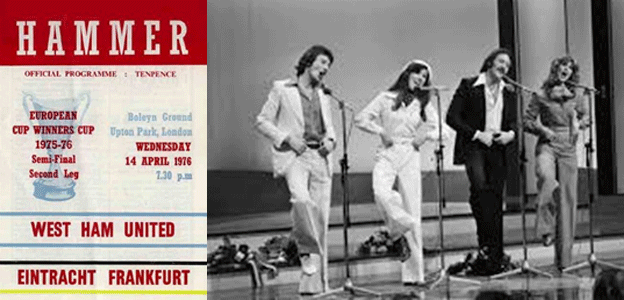
Favourite Games No.1 -West Ham 3:1 Eintracht Frankfurt, April 14 1976

A series of occasional articles recalling my favourite West Ham games, and songs that topped the charts when these games were played

There have been so many great games in the last 58 years and I’ve covered many of them throughout my book, Goodbye Upton Park, Hello Stratford. So many of them are remembered because of the importance of the game, the goals scored, and the spine-tingling atmosphere generated by our fans. Hopefully my memories of these great games will evoke fond memories of fans, (especially older ones like me!), and the music in the charts at the time.

Favourite Games 1

My favourite West Ham game of all time, West Ham 3 Eintracht Frankfurt 1, April 14 1976, was the second leg of the European Cup Winners Cup semi-final where we overcame the 2-1 deficit from the first leg with goals from Keith Robson and two from Sir Trevor Brooking. The Robson goal was a 30 yard screamer following an excellent long pass from Brooking. Most people thought that the chance had gone when at first he appeared to lose control of the ball. But he regained his balance and the South Bank net bulged from a wonderful left-footed strike. Brooking’s goals were a header (yes, he did score goals with his head, especially important ones, contrary to popular myth), and another which showed off his wonderful control and balance in such atrocious conditions.

There was an electric atmosphere in front of around 40,000 rain-sodden fans inside Upton Park. On that night over forty years ago it had rained all day and continued to pour down throughout the game. The pitch was a quagmire and barely a blade of grass was visible in the mud. As I stood on the North Bank terrace (now the Sir Trevor Brooking stand) with friends, the only stand visible that remained in 2016, when the final game was played at the ground, was to our left, the East Stand which had been in use for about eight years. The old West Stand was to our right and the South Bank faced us at the other end of the ground. At least when we were inside we were dry as a roof covered most of us.

Although we had won the FA Cup the previous season we had finished in the bottom half of the table, and at the time of our meeting we sat in sixteenth place in Division One having been at the top of the table in November. Our decline in the league that season was as steep as it gets and we had won only one league game in the whole of 1976 (1-0 at home to QPR in January). From Christmas Day that season we played 21 league games, winning one, drawing six, and losing 14, and eventually finished 18th. It was therefore even more remarkable, given our form and the conditions, that the game was such a magnificent spectacle. The Germans played their part and came close to scoring a second away goal which would have seen them in the final. But we held on, and overturned the deficit from the first away leg to win the tie 4-3 on aggregate, and progress to the final, where we lost 4-2 to Anderlecht in the infamous Heysel Stadium in Brussels.

The number one song in the charts at the time was Save Your Kisses For Me, by the Brotherhood of Man. The Eurovision Song Contest has been running for roughly the same amount of time that I have been following West Ham. The first UK entry was in 1957, the year before my first visit to Upton Park. For younger readers, and anyone who knows anything about the Eurovision Song Contest, the United Kingdom was once a leading player in this event. However in recent years, partly for political reasons, the changes in the make-up of Europe, and the fact that we don’t seem to bother about the contest to the same extent as other European nations, we have not been remotely a contender in the event.

This chart-topper won the 1976 contest, one of five UK winners ever. Can you name the others? Up until 1998, the UK had only finished outside the top ten on two occasions, and as well as the five wins (the last was in 1997), we were runners-up on 15 occasions. Other notable songs in the charts at the time of this famous game were: I Love To Love, by Tina Charles, which had previously been at number 1; Pinball Wizard, by Elton John, his rendition of the classic Who song; Yesterday, by the Beatles; and Fernando (sounds like a footballer!) by Abba.